With the best astrophotography app, you can take stunning night sky images with your phone. For the best results you still need a camera on a tripod, but the eight apps on this list make astrophotography a far simpler process. From finding constellations to checking the forecast for clear skies, these astrophotography apps have it covered.
PhotoPills is our favorite astrophotography app. While not a dedicated night photography app like some of the others, it is one of the best apps a photographer can use. It also has specialist features for nighttime shooting.
If that’s not the app for you, keep reading to see more of the best astrophotography apps for your iPhone or Android phone.



- Master camera settings for pro-quality astro shotos.
- Practical advice and tips to help you every step of the way.
- Learn to use your camera in whole new ways to conquer night sky photography.
© Reign Abarintos
Best Astrophotography Apps for iPhone and Android
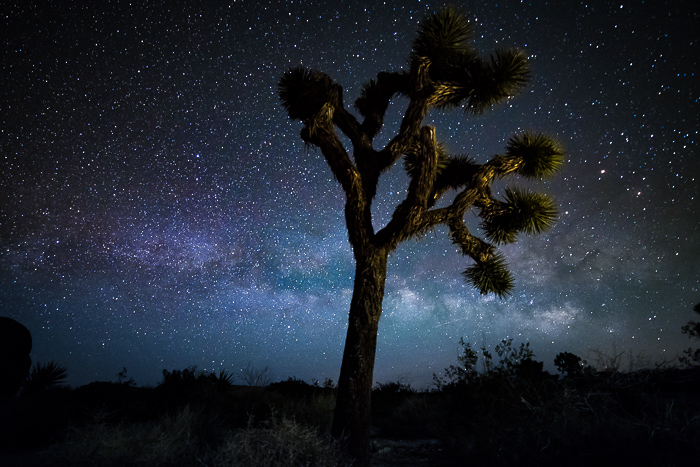
The best astrophotography apps make it easy to capture stunning images of the night sky. Whether you want a clear shot of the Milky Way, a dazzling moon image, or a star-trail long-exposure, these apps can help you achieve your goals.
We’ve included a wide range of different apps, and the list includes apps available for iPhones and Android smartphones. That means anyone can shoot astrophotography with their mobile device.
Astro apps do three separate jobs, and most photographers end up with one of each. Planners tell you where the Milky Way, the moon and the sun will be, and when. That is PhotoPills, The Photographer’s Ephemeris and Ephemeris: Sun and Moon Seeker. Star atlases name whatever you point the phone at, which is Sky Guide, Celestron SkyPortal and Stellarium Mobile. Then there is the camera app that actually takes the picture, and here that means NightCap Camera.
Astrospheric sits outside all three. It answers the question you should ask before you drive anywhere: will the sky actually be clear? If you are new to shooting after dark, our complete guide to astrophotography covers the camera side.
Here’s our list of the best astrophotography apps in 2026.
PhotoPills is one of the best apps for photographers, regardless of your favorite genre. But it’s especially useful if you’re interested in night sky photography. The handy features help you plan your shoots with better precision so you have a better success rate and improved results.
Moon photography enthusiasts will appreciate the lunar calendar, which tells you where you’ll find the moon at any given time on any date. It also tells you the shape, so you know in advance if you’re getting a full or crescent moon.
There’s a 2D map of the Milky Way. This tells you where you’ll find constellations and other cosmic artifacts. The app even has a dedicated Milky Way widget that helps you identify astral objects and plan your astro shots.
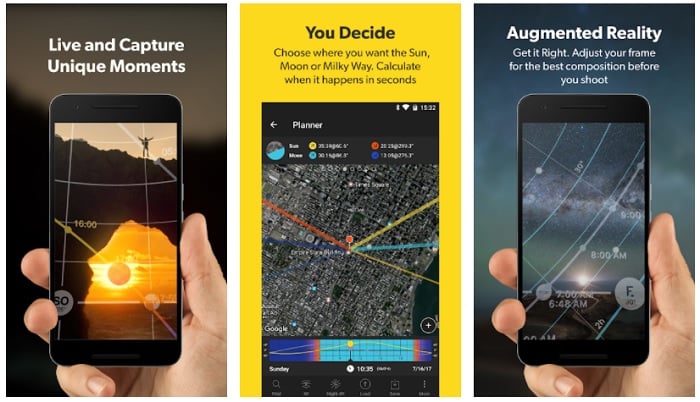
You can use the 3D augmented reality for a more detailed picture of the Milky Way. It also shows you Polaris and the Celestial Equator in vivid detail. This is incredibly useful when planning a night sky photoshoot.
The shot calculator works out exposure times for star trails and night sky long exposures. Its spot-stars calculation is a sharper tool than the old 500 rule, because it accounts for your sensor and focal length rather than assuming them.
But PhotoPills isn’t a dedicated astrophotography app. It has handy features for travel, landscape, and wildlife photography.
It provides key information on sunrise and sunset times, twilight hours, the golden hours, and the blue hour. There are helpful location-scouting tools. And it helps you with shot calculations, making time-lapse and long-exposure photography far easier.
Skip PhotoPills if all you want is to know which star you are looking at. It costs $10.99 as a one-time purchase, and a free star atlas like Stellarium Mobile names objects better than PhotoPills does. It is also a lot of app. Give yourself two or three nights before the planner feels quick.
2. The Photographer's Ephemeris
| Brand |
Brand
Crookneck Consulting LLC
|
| Operating System |
Operating System
iOS
|
| Free? |
Free?
No, one-time purchase
|
| Key Features |
Key Features
3D map of Milky Way, sun, moon stars directions and times, celestial events, lunar and solar eclipse info, line of sight analysis
|
The Photographer’s Ephemeris is the best map-based planner for iPhone users. It isn’t a camera app, but it does have everything you need to help plan a successful night sky photoshoot.
It gives you the location of the sun, moon, and other celestial objects on any date or time. You have azimuth and altitude calculations for the galactic center for any time of day or night.
The app charts all major celestial events, like phases of the moon, the solstices and the equinoxes. It also carries maps, times and a simulator for solar eclipses, with updated maps for the 2027 and 2028 eclipses. You’ll be notified about lunar and solar eclipses. And the app tells you the hours of civil, nautical, and astronomical twilight.
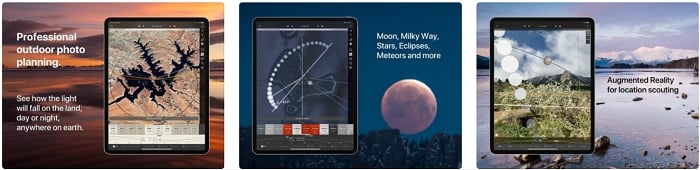
An augmented 3D map gives you a detailed view of the Milky Way, helping you find the objects and constellations you want to photograph. It also gives you topographic maps to guide you to the best shooting spots.
There’s a calculator that evaluates distance, bearing, and elevation angles between two given points. It has a compass with a magnetic north option. The map autorotates as you move, so you never lose your bearings.
A light pollution overlay gives you a better understanding of the amount of artificial light in your area. Even if you’re using a light pollution filter, it’s always best to find a shooting spot as secluded as possible.
It isn’t a camera app, so you’ll still need a camera and a good astrophotography lens. But it’s the perfect app to have on your iPhone if you’re a night sky enthusiast.
TPE is not for Android users at all, because there is no Android version. It costs $9.99, and the sunrise and sunset color forecasts are a separate Skyfire subscription on top of that, so the one-time price is not the whole story. Android shooters should go straight to the next app on this list.
Download: iOS
While not as advanced as The Photographer’s Ephemeris for iPhone, the Ephemeris app is a great alternative for Android users. It’s also free to download, helping you make a saving.
The true ephemeris tools help you track the paths of the sun and moon. They give you altitude and azimuth info of the Milky Way, as well as lunar illumination levels and phases. You can check this information for any time or date, past or future.
A 3D compass helps you find the celestial objects in the sky at any time from your exact location. You can switch between basic and advanced compass modes, depending on what you need.
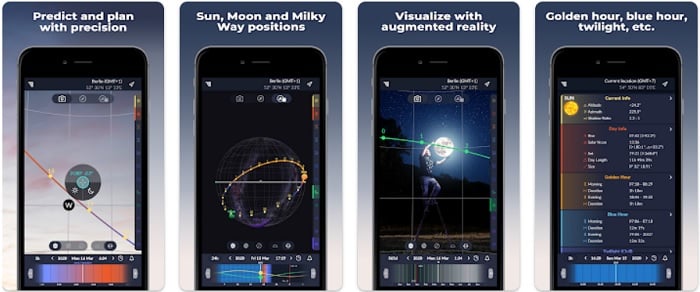
An augmented live view mode gives you a real-time visualization of any night sky scene, with all objects in their precise locations relative to your chosen point. You can do this for specific times in the future, allowing you to plan ahead and capture your desired astro shots.
The app also notifies you about twilight times and times for shooting in the golden or blue hours. It has precise sunrise and sunset times for practically any location around the globe.
While the app is free to download, there is a paid subscription option that unlocks more features. That means you can start off with the free version as you practice your astrophotography. But as you master the art, you can easily upgrade your app for even better results.
It is Android-only, so iPhone users can stop reading here and take The Photographer’s Ephemeris above instead. And it is a planner, not a star atlas. It will show you where the galactic core rises, but it won’t tell you the name of the bright object next to it.
Download: Android
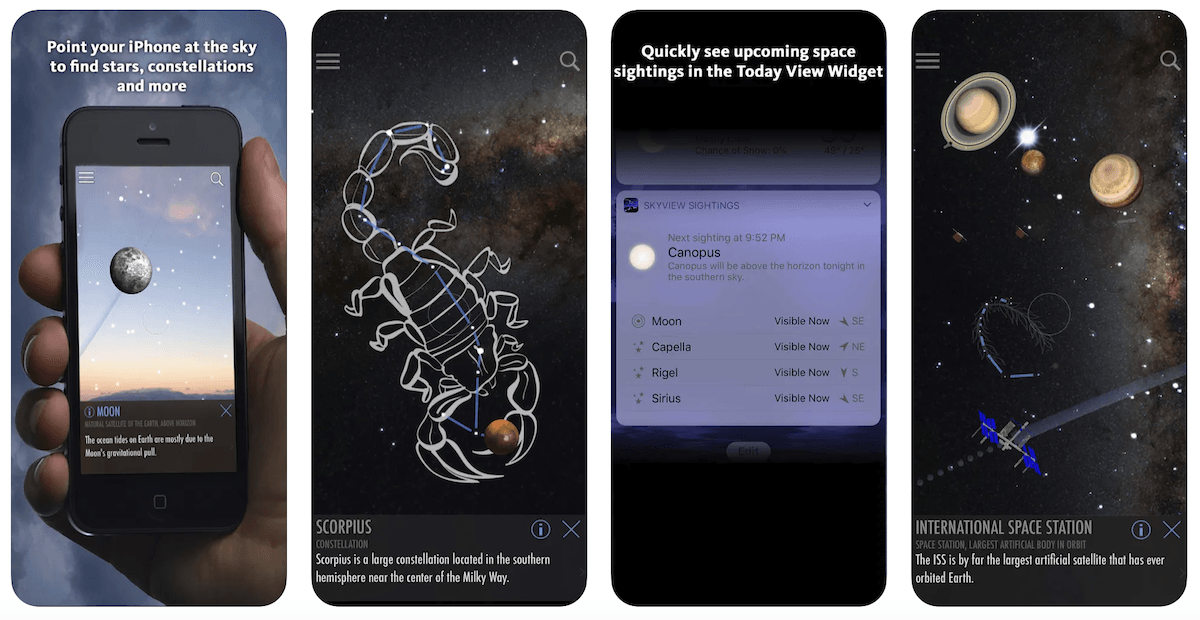
Unique to iPhones, the Sky Guide app is a stargazer’s dream come true. It isn’t a photography app per se, but it is a handy tool when shooting astrophotography.
Simply open the app and point your iPhone towards the stars. The app identifies whatever it’s looking at, whether that’s a planet, star, or constellation. It even identifies specific satellites and other man-made objects like the International Space Station.
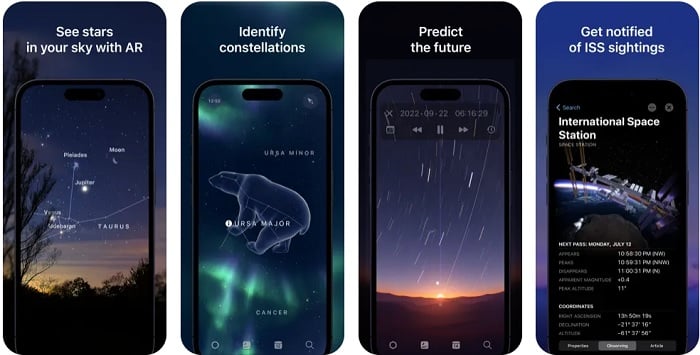
There’s an augmented reality mode that superimposes shapes over constellations, helping you understand how they got their names. It also draws connections between important points, giving you a better understanding of the sky above.
The app keeps you notified about upcoming events in your area, no matter where you are. These could be meteor showers or lunar and solar eclipses.
Sky Guide works without Wi-Fi, cell service or GPS, so you can use it in the remote, dark locations that suit astrophotography best.
The app itself is free now, with the deeper satellite tracking and image packs sold as in-app purchases. But it is iPhone and iPad only, and it tells you what is overhead right now rather than planning a shoot for next Thursday. Treat it as a companion to a planner, not a replacement for one.
Download: iOS
5. Celestron SkyPortal
| Brand |
Brand
Celestron
|
| Operating System |
Operating System
iOS and Android
|
| Free? |
Free?
Free with in-app purchases
|
| Key Features |
Key Features
Encyclopedia of cosmic information, past and future night sky simulator, library of images, compass mode, audio commentary
|
Being one of the leading telescope manufacturers, Celestron know a thing or two about the night sky. Their SkyPortal app, packed with features and information, is the perfect companion for anyone wanting to learn more about the sky above.
The app can identify 120,000 stars and over 200 star clusters, nebulae, and galaxies. You can also use it to identify asteroids and satellites.
In compass mode, the app gives you a real-time display of the sky above. Point your phone’s camera to the heavens and the app gives you all the relevant information.
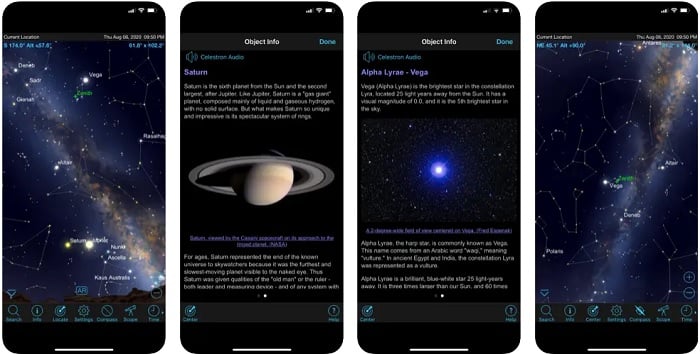
Compass mode still works in daylight, which is what makes it useful for prep. Stand in the spot you plan to shoot from in the afternoon, hold the phone up, and the app shows you where the Milky Way core will be that night. The simulator runs 100 years forwards or backwards, so you can check any date you like. A separate red night mode protects your dark adaptation once you are actually out there.
The app is packed full of fascinating information about the cosmos. It also has an astronomical image library and over four hours of audio commentary guiding you through the stars and planets.
You can hook your phone and the app up to a compatible Celestron WiFi telescope, making it easier to find specific astral objects.
That telescope tilt is also the catch. SkyPortal is built around Celestron’s own mounts, and without one it reads more like an astronomy encyclopedia than a photography tool. The app is free, but the SkySafari-grade upgrades are in-app purchases.
6. NightCap Camera
| Brand |
Brand
Realtime Dreams Limited
|
| Operating System |
Operating System
iOS
|
| Free? |
Free?
No, one-time purchase
|
| Key Features |
Key Features
Five astro modes including aurora, hand-held frame stacking, manual camera controls, ISO boost, noise reduction, 4K time-lapse
|
Unlike the other apps on this list, NightCap Camera is a camera app. It’s a specialist camera app for nighttime photography with helpful features for astrophotography.
NightCap has five dedicated astrophotography modes, and each one sets the camera up for you. Stars is for the Milky Way, Star Trails draws circles around the pole, Meteors fires automatically when something streaks, ISS catches the International Space Station going over, and Aurora is a time-lapse mode added in version 10 for the Northern and Southern Lights.
You can use the manual controls if you prefer, swiping to set exposure, ISO, focus and white balance. Phone lenses have a fixed aperture, so shutter speed and ISO are the two dials that actually change the shot.
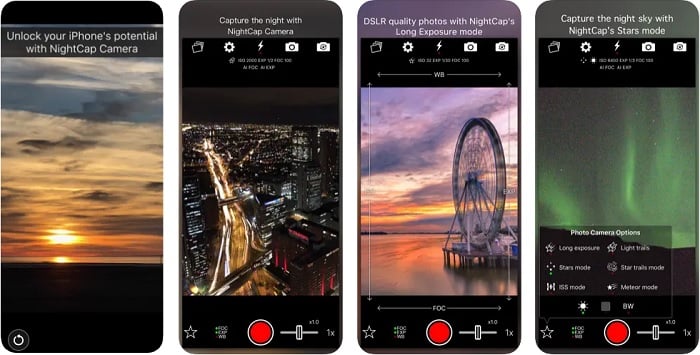
But taking pictures at night isn’t easy with a smartphone. Thankfully, NightCap has several features to improve your results. You can push the ISO 4x higher than other camera apps. The noise reduction mode gives you better clarity. There’s also a light boost to brighten overly dark images.
A 16x zoom helps with distant objects, including the face of the moon. Version 10 also aligns and stacks every frame as you shoot, so a hand-held long exposure is finally possible. It is no substitute for a tripod on a 30-minute star-trail sequence, but it means a usable Milky Way frame from a phone you are simply holding still.
You can expand your creativity with the app’s long-exposure and time-lapse features. With the latter, the results are 4K videos you can export directly to social media.
The catch is a big one. NightCap is iPhone only. It costs $2.99 as a one-time purchase with no subscription, which is fair, but Android shooters get nothing here and have to fall back on their phone’s built-in night mode.
Download: iOS
7. Stellarium Mobile
| Brand |
Brand
Noctua Software Limited
|
| Operating System |
Operating System
iOS and Android
|
| Free? |
Free?
Free with in-app purchases
|
| Key Features |
Key Features
Track natural and man-made celestial objects, accurate night sky simulation, 3D renderings of important objects
|
Another superb astrophotography app, Stellarium is a great companion for iPhone or Android users. Serving as a guide to the night sky, it’s a useful tool for anyone trying to capture the stars above.
The app helps you identify stars, constellations, planets, and comets. It also knows man-made objects like satellites and the international space station. All you need to do is point the phone camera upwards and it tells exactly what you’re looking at.
If anything up there tickles your interest, the app allows you to zoom in for a better view. It has real astronomical images to help you see and understand what’s up there.
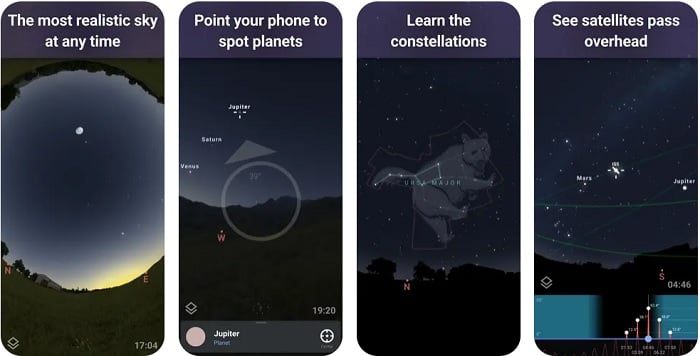
3D rendering allows you to see night sky views from other parts of the world. The app also has detailed live-view overlays to help illustrate the stars and constellations.
A special night mode helps you use your phone in the dark. It uses red light so your eyes don’t have to adjust so drastically when you switch between your phone screen and the darkest of night.
Stellarium Mobile is free on both iPhone and Android. Stellarium Plus adds a far deeper catalogue of deep-sky objects and smoother performance. On iPhone it is an in-app purchase inside the free app. On Google Play it is a separate paid download at $19.99, so check which one you are installing.
Stellarium is an atlas, not a planner and not a camera. It will not tell you when the galactic core clears your horizon or what exposure to use, so it earns its place next to PhotoPills or Ephemeris rather than instead of them.
Astrospheric is the app that decides whether the drive is worth it. It gives you reliable information about ground and sky conditions, so you know before you pack the car whether you have a real chance. It also keeps you abreast of the astronomical events worth staying up for.
Forecasting up to 84 hours ahead, the app gives you hour-by-hour weather updates, including detailed cloud cover at low, mid and high level.
It offers ground data readings on wind, temperature and humidity. The sky data covers cloud, transparency and seeing, which is the one that decides whether stars come out as points or mush. There is a Kp index reading for aurora too, and the transparency report folds in a wildfire smoke forecast.
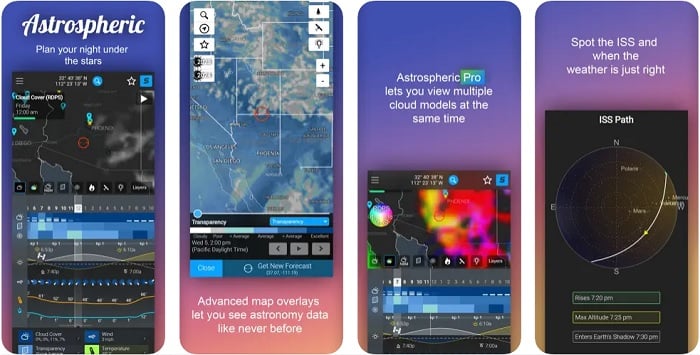
You get accurate sunrise and sunset times. It has all the details on the stages and patterns of the moon, including when and where it will appear on any given day. The app also keeps you notified on major events like solar and lunar eclipses.
The basic Astrospheric app is free for both iOS and Android. Astrospheric Pro adds the ensemble cloud forecast, aurora alerts and custom weather alerts.
It takes no pictures and identifies nothing in the sky, so it is never the only app you need. The free Android version also carries ads. Think of it as the app you check first and the others as the ones you use once you are out there.
© Jongsun Lee
Frequently Asked Questions
Do I Need to Pay for an Astrophotography App?
No. Stellarium Mobile, Sky Guide, Celestron SkyPortal and Astrospheric are all free to download, and between them they cover identifying objects and forecasting the sky. The money goes on planners and camera apps. PhotoPills is $10.99, The Photographer’s Ephemeris is $9.99 and NightCap Camera is $2.99, all one-time purchases rather than subscriptions.
Can an App Replace a Camera for Astrophotography?
Not yet, and only one app here even tries. NightCap Camera pushes an iPhone about as far as it goes, and version 10’s frame stacking makes a hand-held Milky Way shot realistic. For anything you want to print, you still need a camera on a tripod and a fast astrophotography lens. The other seven apps plan and identify. They never press the shutter.
Which Apps Work on Android?
PhotoPills, Celestron SkyPortal, Stellarium Mobile and Astrospheric are on both platforms. Ephemeris: Sun and Moon Seeker is Android-only. The Photographer’s Ephemeris, Sky Guide and NightCap Camera are iPhone-only, so Android users should build their kit around PhotoPills plus Stellarium plus Astrospheric.
Conclusion
Whether you’re tracking planets or searching for star clusters, every astrophotographer needs a good astrophotography app. They help you identify celestial objects. They offer important information on sky clarity, weather, and light pollution. Some apps even have specialist camera features to help you capture clear shots of the night sky.
PhotoPills is our top choice. It isn’t a dedicated astrophotography app, but it is a must-have for any outdoor photographer, and no other app here plans a night this well on both platforms.
If you want the shortest route to a working setup, install three apps tonight. Astrospheric tells you which night to go. PhotoPills tells you where to stand and when the core rises. Stellarium Mobile names what you find when you get there. Add NightCap Camera if you shoot on an iPhone and have no camera with you, and swap PhotoPills for The Photographer’s Ephemeris if you would rather plan from a map.
Then point the planner at the next new moon and go find the Milky Way.