Minimalist photographers use line, colour, shape and space to make a few elements carry a picture. A window on a plain wall or a lone figure against the sky can be enough.
These 21 photographers and visual artists offer different ways to approach that idea, from bright architectural details to quiet landscapes. Study the examples for their framing, use of colour and balance. The aim is to find ideas you can try in your own photos.

What Is Minimalist Photography?
Minimalist photography reduces a scene to a small number of visual elements. The concept of minimalism is often described as “less is more”: remove distractions so the subject, shape or relationship between elements can hold your attention.
Negative space is the quieter area around the main subject. It might be an open sky, a blank wall or a stretch of water. It does not have to be white, and it does not have to fill a fixed percentage of the frame.
Some minimalist photographers work in black and white to emphasise form and contrast. Others use a few strong colours. Repeated windows, a single shadow or a small figure in a large space can all provide a starting point.
Start by changing your viewpoint and checking the edges of the frame. With digital editing, you can refine the crop, straighten lines or adjust tones. Removing objects changes the scene, so keep that distinction in mind when studying work that blends photography and digital art.

21 Minimalist Photographers to Study
Look at what each composition includes and what it leaves out. Some examples turn buildings into arrangements of colour and shape. Others use open skies or mist to isolate a subject. The numbers help you browse the list; they are not a ranking.
1. Hans Macroe
Whether the focus is facades of buildings, urban details, or beach scenes, Hans’ minimalist compositions will make you feel relaxed. He is a master of using negative space in his silhouettes of people in flux.
His work is often coloured with the warmth of sunrises, sunsets, and golden hour.

2. Costas Spathis
Costas Spathis is a Greek artist and professional architect. His formal training is evident in his stylish use of line and space in his photography.
His minimal drone photography is often focused on geometric patterns in nature, cities, and everyday life.

3. Salvador Cappiello
Salvador Cappiello brings a surreal quality to minimalism, with clouds and blue skies featuring in his work.
The combination of familiar subjects and open space recalls Magritte’s paintings. It is an example of how a simple composition can still feel strange or dreamlike.

4. Tekla Evelina Severin
Tekla is a Stockholm-based colourist and multidisciplinary designer whose practice includes photography.
Her background in interior architecture connects with her interest in colour, geometry and spatial relationships. Blocks of colour give her work structure. Study how adjacent shades separate surfaces without adding more objects to the frame.

5. Minh T
Minh T builds minimalist compositions around architecture, light and geometry.
In his Adorama interview, he explains how a lone figure adds both scale and a story to a scene. Notice how the person can occupy little space while giving you a way to read the building around them.

6. Paloma Parrot
Paloma Parrot brings a minimalist approach to everyday interiors and home life.
Bright scenes and simple arrangements give her work a light, uncluttered feel. Look at how a familiar domestic subject can become the focus when its surroundings are kept quiet.

7. Ingo
Ingo’s photographs of building facades and architectural details can resemble abstract paintings.
Clean lines and pastel shades simplify the compositions. Study the boundaries between surfaces: a corner or a change in colour can become the main subject.

8. Olivier Morisse
Olivier Morisse combines simplicity with an interest in architectural form.
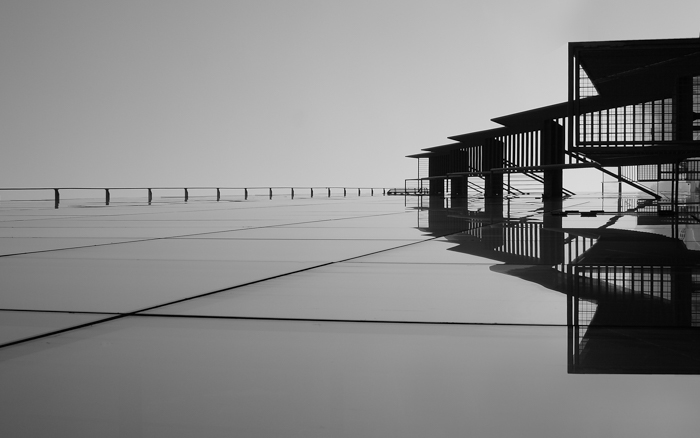
The example below draws attention to the relationship between the building and the sky. Looking up can turn a busy location into a composition of edges and open space.

9. Carolina Nusadua
Carolina Nusadua’s dreamy minimalist landscapes use gentle tones to create a calm mood.
Study the balance between the subject and its surroundings. A small point of interest can hold the frame when the rest of the scene has little competing detail.

10. Fameisficklefood
The Fameisficklefood work shown here brings a dreamlike quality to minimalist landscapes.
Clean lines and layers of soft colour give these scenes their structure. Look at how differences in tone separate one part of the landscape from another.

11. Mark Cushway
Mark Cushway created pared-back images built around horizon lines, silhouettes and open skies. He died in December 2024, as recorded in mivision’s tribute.
His use of sky as negative space gives small figures room within the frame. Study how the position of a silhouette changes the balance of the picture.

12. Karen Vikke
Karen Vikke explores the urban landscape through colour, repetition and negative space.
Her interview with iPhone Photography School describes her approach to photographing buildings and people with an iPhone. Her work offers ideas for finding compositions on an everyday walk, without making a particular camera the starting point.

13. Leda de Piart
Natural elements are prominent in Leda de Piart’s minimalist work, alongside white architectural curves and beach scenes.
The consistency of colour, shape and line gives these pictures a sense of balance. Look for the small changes within an otherwise simple scene.

14. Peter Chan
Peter Chan’s images of fresh outdoor scenes remind us of lazy summer days without a care in the world. The washed-out highlights add elements of nostalgia to his minimal compositions.
You can almost feel the gentle breeze running through his photos!

15. Téber
Venezuela-born artist Téber uses vibrant colour and surreal minimalism to create optimistic, dreamlike scenes.
His own site describes a practice that includes photography and AI, with AI use starting in 2026. Study the colour and space in the work while keeping the distinction between camera-made photographs and digitally created imagery in mind.

16. Johan Karlsson
Johan Karlsson uses a hazy style in minimalist outdoor scenes.
Fog and mist reduce background detail and leave room around the subject. These pictures show how soft tones can simplify a scene without relying on strong contrast.

17. Marina Collin
Marina Collin’s use of colour is bold and bright, even when the subject matter is simple.
Interiors and patterned facades become arrangements of coloured blocks. Study how repeating a colour or shape can hold a composition together.

18. Matías Celis Areco
Matías Celis Areco’s vibrantly coloured minimalist shots are sublime.
Scrolling through his Instagram account reveals a sumptuous selection of candy-coloured facades and skies.

19. Marcus Wallinder
Marcus works with photography and digital art under the name Meanwhile In Nowhere.
His minimalist architectural work invites you to study symmetry and negative space. His practice also extends to AI: in his statement for the 2025 project Metamorphosis, he describes combining it with digital manipulation.

20. Al Jackson
Al Jackson makes negative space a prominent part of his minimalist compositions.
Windows and the textures of building facades recur in the work. Look at how much of a wall remains in the frame around a small architectural detail.

21. Ömür Kahveci
Ömür Kahveci’s black and white landscapes are beautifully haunting.
His atmospheric use of fog and mist reduces each subject even more. These minimal photographs evoke the stillness and simplicity of nature.

How to Learn From These Minimalist Photographers
Choose one idea before your next walk. A window in a plain wall, a repeated shape or a person against the sky is enough to begin. Use the camera or phone you already have.
- Pick a visual rule. Try two dominant colours, repeated rectangles or one subject with open space around it. Use the rule to decide what belongs in the frame.
- Make three versions. Photograph the same subject from farther away, from closer up and from a different angle. Compare how much background each version needs.
- Check what competes for attention. Look for bright objects at the edges, lines that nearly meet and details that pull your eye away from the subject. Change your position or crop, then compare again.
Learn from the way an artist organises a picture, then apply that idea to a subject of your own. Keep the frame with the strongest relationship between its few elements.
Conclusion
Minimalist photography gives line, shape, colour and space more room to work. These examples show that simplicity can appear in a bright building facade, a domestic scene or a quiet landscape.
Try focusing on basic elements like line, shape, and colour without focusing on what the subject is. Choose one element for your next photo and compare a few compositions before you move on.