The DJI Osmo Action 6 is the best GoPro alternative for most people. Its 1/1.1-inch sensor is much larger than the 1/1.9-inch sensor in GoPro's HERO13 Black, and its variable f/2.0 to f/4.0 aperture helps most in the dim light where action cameras usually struggle. It also goes to 66 ft underwater with no case and has a screen on the front and back.
GoPro is not the only good choice anymore. DJI and Insta360 now make cameras that do things no GoPro does: a camera small enough to clip to your shirt, a flip-up screen for vlogging, or 360-degree video you frame after the ride. Akaso covers the low-cost end, and OM System makes a rugged compact for people who also want real photos. The picks below cover each of those needs.
The Best GoPro Alternatives for Every Kind of Shooter
Decide first what you want the camera to do that a GoPro does not. If you want the closest like-for-like swap, look at the first three picks. They are standard box-shaped action cameras that mount where a GoPro mounts. If you want hands-free angles, the DJI Osmo Nano and Insta360 GO Ultra are far smaller than any HERO camera. If you never want to miss the shot, the Insta360 X6 records in every direction. The table lists all eight with what each one is best for.




8 Best GoPro Alternatives
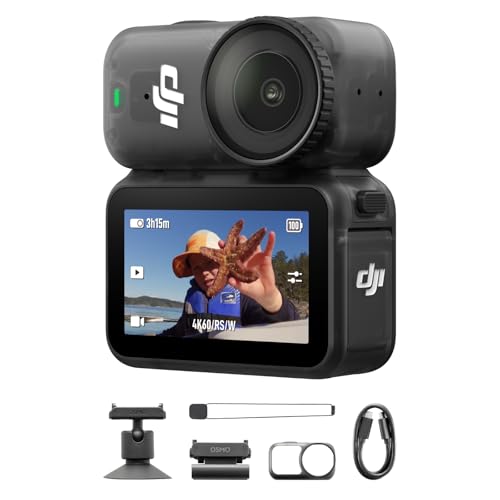
The DJI Osmo Action 6 is the strongest all-round alternative to a GoPro. It is DJI's current flagship action camera, and it is the first in the Osmo Action line with a variable aperture.
The low-light case is the main reason to choose it. The 1/1.1-inch square sensor is the largest in any standard action camera on this list. The aperture opens to f/2.0 for dusk, indoor and underwater shots, and closes to f/4.0 when you want more of the scene sharp in bright light. Compared with the 1/1.9-inch sensor in the GoPro HERO13 Black, that is a real step up in the conditions that most often ruin action footage.
It is waterproof to 66 ft (20 m) without a case. It has a 1.46-inch front touchscreen for framing yourself and a 2.5-inch rear touchscreen. The battery is rated for up to 240 minutes of 1080p recording, and 50 GB of built-in storage keeps you shooting if you forget a microSD card. Video goes up to 8K at 30 fps, and 4K runs at up to 120 fps for slow motion.
The aperture moves in preset steps, so do not expect the smooth manual control of a mirrorless lens. It weighs 149 g (5.3 oz), so it is no lighter on a helmet than a GoPro. If you mostly shoot in good daylight, the Osmo Action 5 Pro gives you the same screens and the same 66 ft rating for less money.
The Insta360 Ace Pro 2 is the best choice if you film yourself. Its 2.5-inch rear touchscreen flips up, so it faces you when the camera points at you. That gives you a full-size screen for vlogging, which a small front screen cannot match.
Image quality is close to the Osmo Action 6. It has a 1/1.3-inch sensor behind a Leica Summarit lens with a 157-degree view. It records 8K at 30 fps, 4K at 60 fps with Active HDR for high-contrast scenes, and 4K at 120 fps for slow motion. Insta360's FlowState stabilization and horizon lock keep footage level on bumpy rides. Its 50 MP photos are also a better source of stills than most action cameras give you.
The trade-offs are weight and water depth. At about 182 g (6.4 oz), it is the heaviest standard action camera here, and you feel that on a helmet. It is waterproof to only 39 ft (12 m) without a case, against 66 ft for the two DJI cameras. If you snorkel or dive often, the Osmo Action 6 is the better fit. If you talk to the camera more than you swim with it, choose the Ace Pro 2.
The DJI Osmo Action 5 Pro is the value pick. It gives you most of what makes the Osmo Action 6 good, and it is the previous generation, so it costs less.
You get the same body design as the Action 6. There is a 1.46-inch front touchscreen and a 2.5-inch rear touchscreen. It is waterproof to 66 ft (20 m) without a case. The battery has the same 240-minute rating for 1080p recording. It shoots 4K at up to 120 fps, and 47 GB of usable built-in storage backs up your microSD card. At 146 g (5.1 oz), it is a little lighter than the Action 6.
The difference is the sensor and lens. The Action 5 Pro has a 1/1.3-inch sensor and a fixed aperture, and it tops out at 4K. That is still larger than the sensor in a GoPro HERO13 Black. But the Action 6 is better after sunset and gives you 8K for cropping. If you ride in daylight and post to social media, the Action 5 Pro is all the camera you need. If you film at dawn, at dusk, or in forests, spend more on the Osmo Action 6.
The DJI Osmo Nano splits the action camera in two. The camera is a 52 g block with no screen. It clips magnetically to a helmet, a chest strap or a neck pendant. It docks into a separate Vision Dock that adds a touchscreen, more battery and a place to frame and review your shots.
That split is the reason to pick it over a GoPro. A normal action camera puts the screen, battery and lens in one lump, so the low and awkward angles go unfilmed. With the Nano you leave the heavy half in your pocket and put the camera where the action is. The camera runs for up to 90 minutes alone and up to 200 minutes with the dock.
The small body does not cost you image quality. It has the same 1/1.3-inch sensor size as the Osmo Action 5 Pro, 13.5 stops of dynamic range and 10-bit D-Log M for grading. It records 4K at up to 60 fps and 4K at 120 fps for slow motion. Built-in storage of 64 GB or 128 GB means there is no card to lose.
The limits come from the split design. The camera is waterproof to 33 ft (10 m), but the dock is only splash-resistant, so the half with the screen stays dry while the camera swims. The lens is a fixed ultra-wide with no optical zoom. If you want one camera with the screen always attached, buy the Osmo Action 6 instead.
The Insta360 GO Ultra is Insta360's answer to the same hands-free idea, and it is the newest model in its GO line. The camera weighs about 53 g (1.9 oz) and mounts with magnets. It lives inside an Action Pod that adds a 2.5-inch flip touchscreen and extra battery.
The flip screen is what sets it apart from the Osmo Nano. With the camera in the pod, the GO Ultra works like a tiny vlogging camera with a selfie screen. With the camera out, you can clip it to a cap or a pet harness and frame the shot remotely on the pod. Its 1/1.28-inch sensor records 4K at 60 fps, and the pair runs for up to 200 minutes. The camera alone lasts about 70 minutes.
It records to a microSD card rather than built-in storage. That is useful if you shoot a lot, but you have to remember the card. The camera is waterproof to 33 ft (10 m), and the Action Pod is only splash-resistant, so the screen cannot follow you underwater. Choose the GO Ultra for the flip screen and card storage. Choose the Osmo Nano if you want 4K slow motion and storage built in.
The Insta360 X6 is the alternative to GoPro's 360 camera, the GoPro MAX2. Its two lenses record the whole scene at once. You choose the angle in the app after the ride, so a bad framing decision is never final.
The X6 is Insta360's newest flagship 360 camera. Its two 1/1.1-inch sensors are the largest in the X series, which matters because 360 cameras spread their pixels over every direction. It records 8K 360 video at up to 50 fps. It can also shoot through one lens like a standard action camera at up to 5K and 60 fps. Hold it on a selfie stick and the stick disappears from the footage, which gives you a drone-like third-person view. It is waterproof to 66 ft (20 m) without a case, and the lenses are user-replaceable if you scratch one.
360 video costs you time. Every clip needs reframing in the app before you can share it, and the files are large. The battery is rated for about 140 minutes of 8K recording at 30 fps. At about 196 g (6.9 oz), it is also heavier than a standard action camera. If you want finished footage the moment you stop recording, the Osmo Action 6 is the simpler tool. For more 360 options, see our guide to the best 360 cameras.
7. Akaso EK7000
| Sensor Size |
Sensor Size
Not published by Akaso
|
| Top Video Mode |
Top Video Mode
4K at 30 fps
|
| Waterproof Without a Case |
Waterproof Without a Case
Not waterproof, housing rated to 132 ft (40 m)
|
| Screens |
Screens
Rear screen only
|
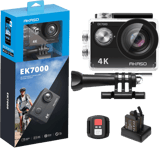
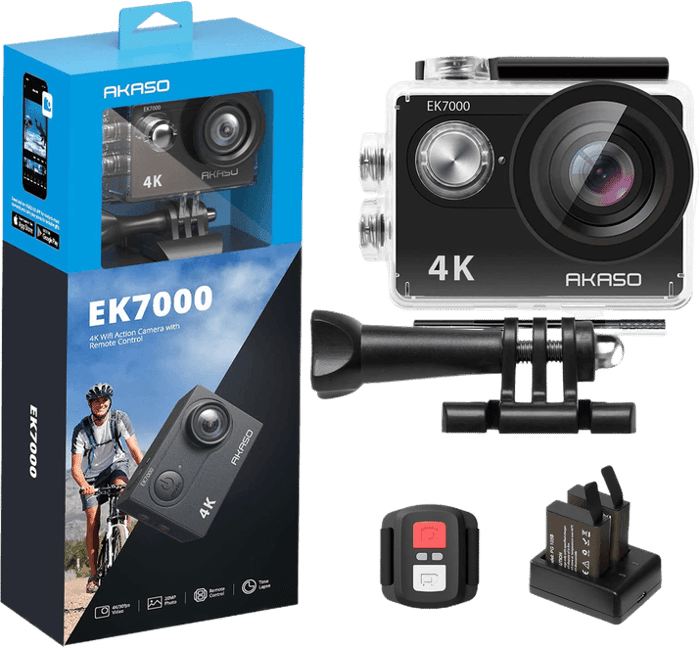
The Akaso EK7000 is the budget GoPro alternative. It costs a small fraction of any other camera here, so it suits a first action camera or a shoot where you might lose the camera.
It records 4K at 30 fps and 20 MP photos. It has electronic image stabilization, a 4x digital zoom and Wi-Fi for the phone app. It comes with a waterproof housing rated to 132 ft (40 m) and a wrist remote, so you can start recording without reaching for a helmet. The USB port also accepts an external microphone.
The camera itself is not waterproof, so it must go in the housing for any water use. It does not record sound in the housing. Slow motion tops out at 720p at 120 fps. Akaso does not publish the sensor size, and the camera is weak in low light. If you can stretch to a modern camera, the Osmo Action 5 Pro is waterproof on its own and far better after dark. If you just want to try action footage for very little money, the EK7000 does the job.
8. OM System Tough TG-7
| Sensor Size |
Sensor Size
1/2.33-inch
|
| Top Video Mode |
Top Video Mode
4K at 30 fps
|
| Waterproof Without a Case |
Waterproof Without a Case
49 ft (15 m)
|
| Screens |
Screens
Rear screen only
|
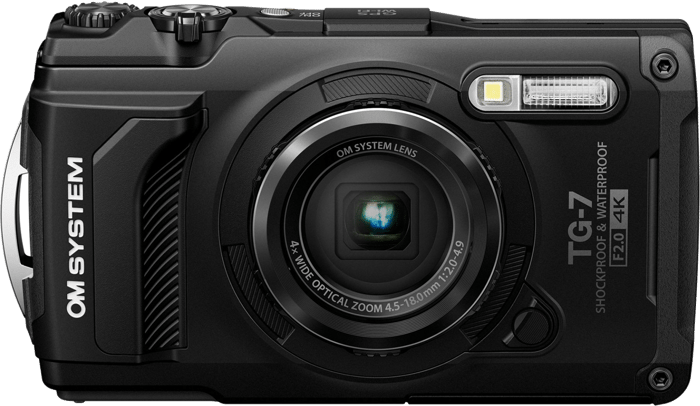
The OM System Tough TG-7 is a different kind of GoPro alternative. It is a rugged compact camera, not an action camera. Choose it if your trips are as much about photos as video.
It is waterproof to 49 ft (15 m) without a case, shockproof from 7 ft (2.1 m), crushproof to 220 lb (100 kg) and freezeproof to 14°F (-10°C). Unlike any action camera here, it has a 4x optical zoom, from 25mm to 100mm equivalent, with a bright f/2.0 aperture at the wide end. Its macro mode focuses as close as 0.4 in (1 cm), so it photographs small sea life and insects that a fisheye action camera cannot. It also has built-in GPS to record where you took each shot.
It is not a mounting camera. At 249 g (8.8 oz) with battery and card, it is heavy and awkward for a helmet or chest strap. Its 12 MP 1/2.33-inch sensor is small. 4K video tops out at 30 fps, and it lacks the horizon leveling of the DJI and Insta360 cameras. If you mainly film yourself moving, choose the Osmo Action 6. For more rugged compacts, see our guide to the best underwater cameras.
What to Look for in a GoPro Alternative
These checks help you match a camera to what you film.
Sensor Size Matters More Than Resolution
Almost every action camera now records 4K or more, so resolution rarely decides the choice. Sensor size does. A larger sensor gathers more light, which means cleaner footage at dusk, in forests and underwater. Read the sensor size on the spec sheet before the resolution. The 1/1.1-inch sensors in the Osmo Action 6 and Insta360 X6 are a real step up from the 1/1.9-inch sensor in the GoPro HERO13 Black. GoPro's new Mission 1 PRO has a 1-inch sensor, so compare like with like when you shop.
Check the Depth Rating of the Part You Take Underwater
Depth ratings vary more than the marketing suggests. The Osmo Action 6, Action 5 Pro and Insta360 X6 go to 66 ft (20 m) with no case. The Ace Pro 2 stops at 39 ft (12 m). The Osmo Nano and GO Ultra cameras go to 33 ft (10 m), but their screen docks are only splash-resistant. The Akaso EK7000 needs its housing for any water at all. The rating is for still water, so diving in or fast water sports put more strain on the seals.
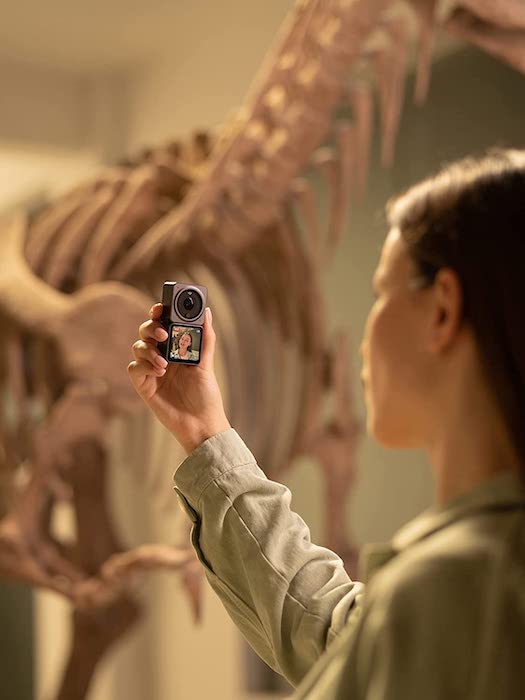
A DJI action camera with image stabilization switched on.
Your GoPro Mounts Will Still Work
You do not need to stay with GoPro to keep your mounts. The two-prong and three-prong finger mount GoPro uses is the common standard. Akaso cameras ship in frames that use it directly. DJI and Insta360 use magnetic quick-release mounts, and both sell adapters that convert them back to the GoPro finger pattern.
Plan for Sound
Poor sound ruins more videos than shaky footage. Built-in microphones pick up wind and handling noise, and a camera in a waterproof housing may record no sound at all. If you talk to the camera, check that it works with an external or wireless microphone. Our guide to the best camera microphones covers the options.
Time-lapse is another feature every camera here supports. Our Total Time-Lapse course shows you how to get great time-lapse videos from any of these action cameras.
Frequently Asked Questions
Is a GoPro Alternative as Good as a GoPro?
At the top of the market, yes. The Osmo Action 6 has a larger sensor than the GoPro HERO13 Black and a variable aperture that no HERO camera offers. The Ace Pro 2 adds a flip screen. Where GoPro still leads is its range of official accessories. Lower down the price scale, an Akaso trades low-light quality for a much smaller bill.
Is a 360 Camera Better Than an Action Camera?
It is better at one thing: never missing the shot. The Insta360 X6 records everything around it, so you choose the framing in the app after you film. The cost is time. Every clip needs reframing before you can share it. If you want the footage finished when you stop recording, a standard action camera like those in our best action camera guide is the better tool.
Conclusion: The Best GoPro Alternative
The DJI Osmo Action 6 is the best GoPro alternative for most people. Its large sensor and variable aperture give cleaner footage in poor light, and it goes to 66 ft underwater with no case. If you want angles a full-size camera cannot reach, the DJI Osmo Nano clips almost anywhere. On a tight budget, the Akaso EK7000 is the easiest way to start.