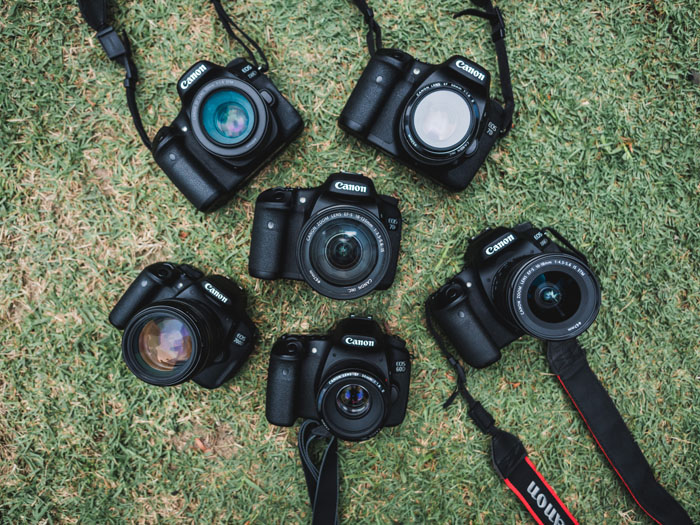
The simplest way to save time and speed up your workflow is using a fast SD card reader. Photography and videography are time-consuming activities. And one of the slowest parts of the process can be transferring the files from your digital camera to your computer.
Luckily, there are so many fantastic card reader options out there. And we’ll help you choose the best SD card reader for you. Our top choice is the Anker 2-in-1 USB 3.0 SD Card Reader. It’s small, affordable, and allows you to read and write from two cards at once. It’s a must-have for any photographer shooting standard SD cards. And if you shoot faster UHS-II SD or CFexpress cards, the ProGrade and Sony readers further down the list are built for you.
What is the Best SD Card Reader?
The best SD card reader is the Anker 2-in-1 USB 3.0 SD Card Reader. It is compact, affordable, and reads two cards at once with no external power needed. Here is a quick overview of the full lineup, followed by more in-depth reviews.
The Best SD Card Readers
Below are the best memory card readers compatible with several memory card formats (SD, microSD, CompactFlash, CFexpress, etc.). And they work with most of the popular operating systems (Windows, macOS, etc.) and digital devices (e.g., iPad). There’s something here for you, no matter what gear you use.
Let’s dive into the list and find out where each camera card reader excels and where they could improve. We’ll find the one that works best for you!
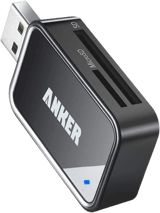
1. Anker 2-in-1 USB 3.0 SD Card Reader
| Size |
Size
1.2 x 3.3 x 6.5 cm
|
| Weight |
Weight
13 g
|
| Connection |
Connection
USB 3.0
|
| Supported Card Formats |
Supported Card Formats
UHS-I SD, SDXC, SDHC, microSDXC, microSDHC, microSD, MMC, RS-MMC, and SD
|
| USB Speed |
USB Speed
USB 3.0, 3.1 Gen 1 (5.0 Gbps)
|
| Operating System Compatibility |
Operating System Compatibility
Windows and macOS
|
| Best For |
Best For
Photographers looking for a small and affordable SD card reader
|
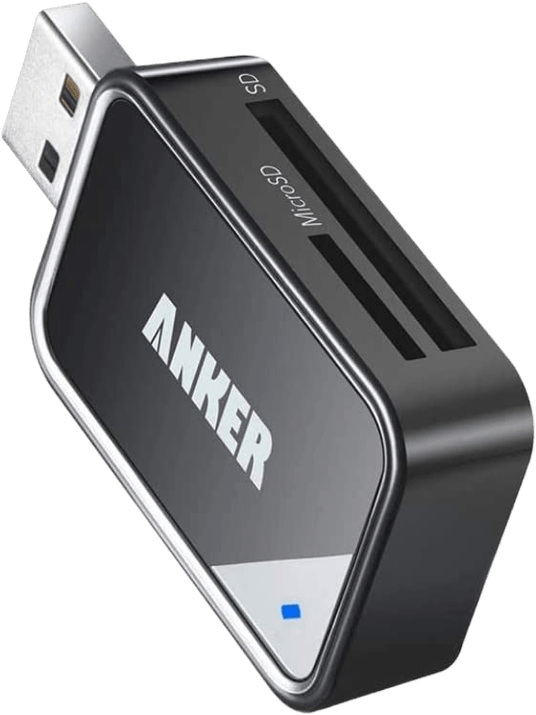
The Anker 2-in-1 USB 3.0 is the ultimate low-cost SD memory card reader. It’s for photographers and videographers who use SD and microSD cards.
As well as being affordable, the Anker SD card reader is also tiny. This makes it an excellent choice for both landscape and travel photographers, as it takes up zero space in your camera backpack.
Despite its low cost, it does not feel cheaply made and has a solid and durable design. The built-in USB 3.0 enables fast data transfer rates of up to 5 Gbps.
The two slots speed up your workflow by allowing you to read and write on two separate cards simultaneously.
And it is 100% powered by the attached device. So you never have to worry about finding a power source or running out of battery.
The limit is the card standard, not the cable. Both slots are UHS-I, which tops out at about 100 MB/s however fast your computer is. So if you have moved on to UHS-II SD cards or CFexpress, one of the faster readers below will save you far more time. For everyone still shooting standard SD cards, this is the one to buy.
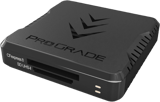
2. ProGrade Digital CFexpress Card Reader
| Size |
Size
7 x 7 x 1.8 cm
|
| Weight |
Weight
204 g
|
| Connection |
Connection
USB Type-C and USB Type-A
|
| Supported Card Formats |
Supported Card Formats
CFexpress Type B, UHS-I, UHS-II SD, SDHC, SDXC, and SD
|
| USB Speed |
USB Speed
USB 3.2 Gen 2 Type-C (10 Gbps)
|
| Operating System Compatibility |
Operating System Compatibility
Windows, macOS, and iOS (iPad Pro)
|
| Best For |
Best For
Professionals who need a reliable card reader
|
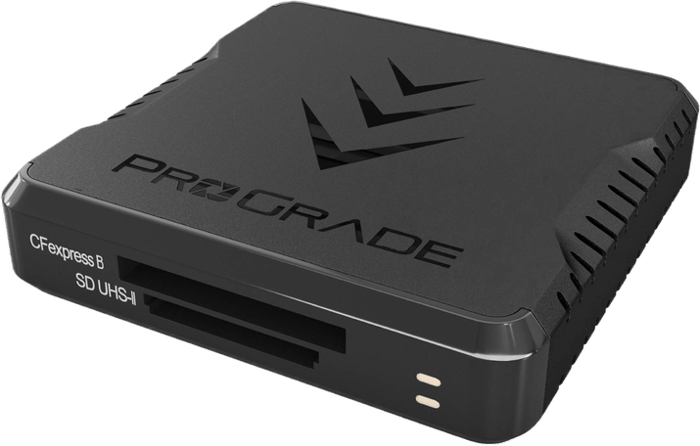
The ProGrade Digital CFexpress reader is the best all-rounder on this list. It boasts one CFexpress Type B slot and one UHS-II SDXC slot. These are the two most common camera card formats used by DSLR and mirrorless cameras.
On top of that, it uses a USB 3.2 Gen 2 Type-C interface. And it comes with both USB Type-C and USB Type-A connectors. They work together to deliver astonishing data transfer speeds of up to 1,250 MB/s (10 Gb/s).
The experts at ProGrade made this camera card reader portable and durable. Its rugged body is extra tough. And thanks to the metal mounting plate, it can be attached to a laptop or a cinema camera.
Everyone will free up valuable extra time by using this card reader. But it is particularly helpful for travel, event, sports, and outdoor photographers.
But you will be delighted by the results of this card reader, no matter what type of content creator you are. It’s for photographers, YouTubers, vloggers, filmmakers, or influencers. And if you need more convincing, it carries a two-year warranty, under which ProGrade will repair, replace, or refund it.
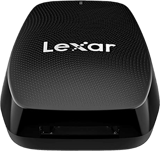
3. Lexar Professional USB 3.2 Reader
| Size |
Size
6.4 x 2.7 x 9.9 cm
|
| Weight |
Weight
136 g
|
| Connection |
Connection
USB Type-C
|
| Supported Card Formats |
Supported Card Formats
CFexpress Type B
|
| USB Speed |
USB Speed
USB 3.2 Gen 2 2x2 Type-C (20 Gbps)
|
| Operating System Compatibility |
Operating System Compatibility
Windows, Mac, and iOS (iPad Pro)
|
| Best For |
Best For
Only CFexpress Type B cards
|
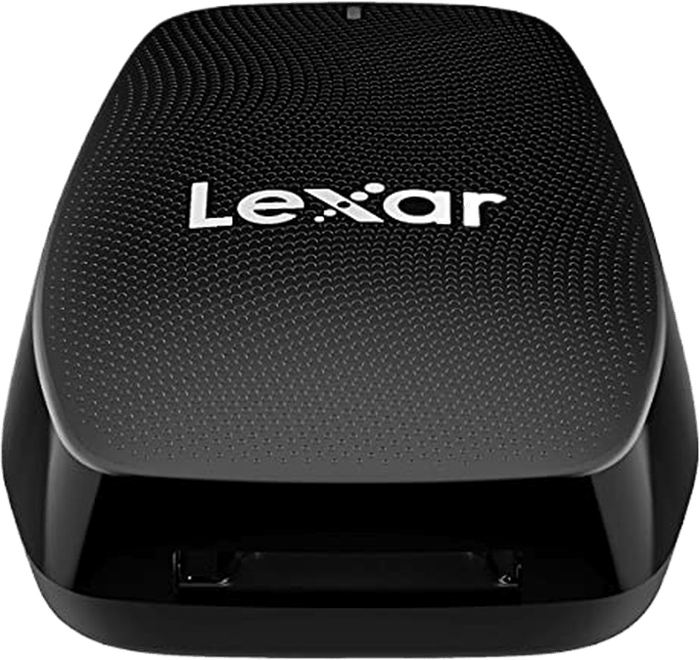
The Lexar Professional USB 3.2 is the fastest way to empty a CFexpress Type B card on this list. The only thing holding it back from the top spot is that it’s only compatible with CFexpress Type B cards. But if you primarily use that format, you will be blown away by the speed of this card reader.
Thanks to its advanced USB 3.2 Gen 2×2 technology, it can fully maximize the transfer speed of CFexpress Type B cards. And it moves files at a blazing 1,700 MB/s. But be aware that just because this card reader is extremely fast doesn’t mean your computer will be.
At the moment, only a select few PC desktop computers support this generation of USB ports. It still works with other devices, but the transfer speeds will be slightly slower. (But still very fast!)
4. UGREEN 4-in-1 USB 3.0 Card Reader
| Connection |
Connection
USB-A 3.0
|
| Supported Card Formats |
Supported Card Formats
SDXC, SDHC, SD, MMC, RS-MMC, microSDXC, microSDHC, microSD, CompactFlash, MS PRO, MS PRO-HG, and MS XC DUO
|
| USB Speed |
USB Speed
USB 3.0 (5 Gbps)
|
| Operating System Compatibility |
Operating System Compatibility
Windows, macOS, Linux, and Chrome OS
|
| Best For |
Best For
Reading multiple card formats simultaneously
|
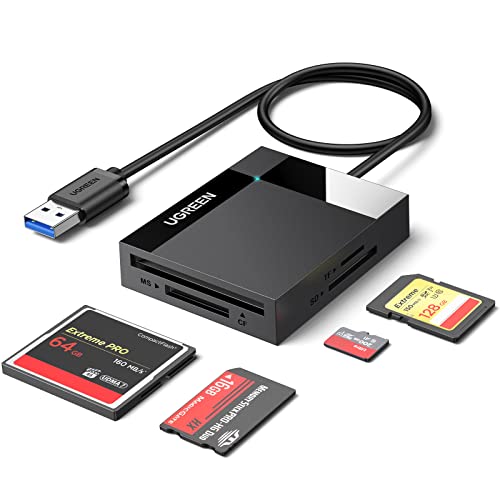
The UGREEN 4-in-1 USB 3.0 is a practical multi-format card reader. It has separate slots for SD, microSD, CompactFlash, and Memory Stick cards. And it can access all four cards simultaneously.
That flexibility makes it useful for photographers who work with both current SD cards and older camera formats. You can offload several types of media without carrying separate readers or constantly swapping cards.
Its USB-A 3.0 connection supports transfer speeds up to 5 Gbps. The reader is bus-powered and plug-and-play, with support for Windows, macOS, Linux, and Chrome OS.
But its card interface tops out at UHS-I, so it cannot deliver the full speed of a UHS-II SD card. The USB-A plug may also require an adapter on newer USB-C-only laptops. If your workflow centers on UHS-II or CFexpress cards, choose a faster dedicated reader instead.
5. ProGrade Digital SD UHS-II Dual-Slot Card Reader
| Size |
Size
7.1 x 7.1 x 1.8 cm
|
| Weight |
Weight
204 g
|
| Connection |
Connection
USB Type-C (USB-C and USB-A cables included)
|
| Supported Card Formats |
Supported Card Formats
SD UHS-II, UHS-I, SDXC, and SDHC
|
| USB Speed |
USB Speed
USB 3.2 Gen 2 (10 Gbps)
|
| Operating System Compatibility |
Operating System Compatibility
Windows and macOS
|
| Best For |
Best For
Photographers shooting UHS-II SD cards
|
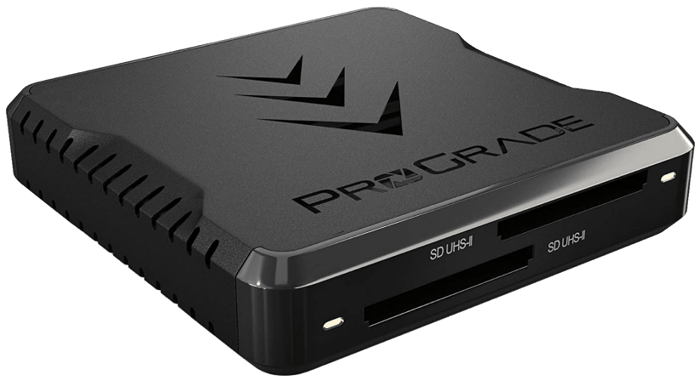
The ProGrade Digital SD UHS-II Dual-Slot is the reader to buy if SD cards are the only cards you own. It has two full-size SD slots and nothing else, which is exactly what most photographers need.
Both slots are UHS-II, and that is the whole point. A V60 or V90 SD card can only hit its rated speed in a UHS-II reader. Put the same card into a UHS-I reader like the Anker and it is pegged at about 100 MB/s, which is where the waiting comes from.
The USB 3.2 Gen 2 connection carries up to 10 Gb/s (1,250 MB/s), and both slots work at once. So a card from each camera body empties in one pass. ProGrade also puts a magnet in the base and includes an adhesive metal plate, so the reader clamps to the lid of your laptop and travels as part of the machine. An 18-inch USB-C to USB-C cable and a USB-C to USB-A cable are both in the box, and it carries the same two-year warranty as the CFexpress model above.
Its limits are the slots and the price. It reads SD and nothing else, so there is no microSD slot, no CompactFlash, and no CFexpress. If you offload drone or action camera microSD cards, you need the UGREEN above as well. And it costs many times what a pocket reader costs, which is money wasted if every card you own is UHS-I.
6. Sony MRW-G3 CFexpress Type A Card Reader
| Size |
Size
10.2 x 5.8 x 1.8 cm
|
| Connection |
Connection
USB Type-C
|
| Supported Card Formats |
Supported Card Formats
CFexpress Type A (4.0 and 2.0)
|
| USB Speed |
USB Speed
USB4 (40 Gbps)
|
| Maximum Read Speed |
Maximum Read Speed
1,800 MB/s
|
| Operating System Compatibility |
Operating System Compatibility
Windows, macOS, iOS, iPadOS, and Android
|
| Best For |
Best For
Sony shooters using CFexpress Type A cards
|
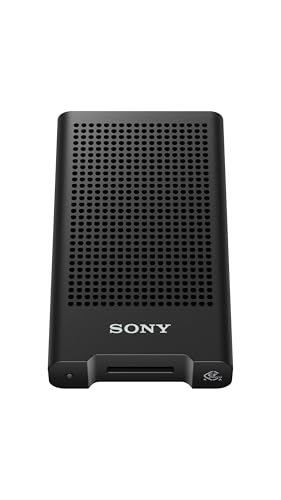
The Sony MRW-G3 is a single-slot reader built around one card format: CFexpress Type A. It handles the 4.0 generation of those cards and reads at up to 1,800 MB/s, the highest figure on this list.
It gets there over a USB4 connection carrying up to 40 Gb/s, so your computer needs a USB4 or Thunderbolt port to see that number in full. The metal shell doubles as a heat sink, which keeps the card cool while long video files copy across, and the reader also talks to iPhones, iPads, and Android phones for offloading in the field.
CFexpress Type A slots are still far from standard across the market. But Sony builds them into bodies like the Sony a7R V and the a7S III, and pulling a card through this reader beats copying it over the camera’s own USB port by a wide margin.
Be clear about what it does not do. There is no SD slot, so a Sony shooter who runs an SD card in the second slot still needs one of the SD readers above. It also costs several times what those SD readers cost, and that is money wasted unless you genuinely shoot CFexpress Type A.
Buyer’s Guide for the Best SD Card Reader
An SD card reader is often called a memory or camera card reader. It’s a device that reads, writes, and transfers files directly from your digital camera’s memory card to your laptop, tablet, or phone.
In the past, most computers had built-in SD card readers. But now, it’s increasingly common (especially in laptops) to omit them. Because of this, we have seen a rise in the popularity of portable card readers. And mobile memory card readers are usually much faster than built-in ones.

What is a good card reader?
Good card readers have a few crucial traits. The two most important are that they are fast and reliable. Every reader covered in this article is both, for the cards it takes. What separates them is which card formats they accept.
How do I choose an SD card reader?
The most critical step in selecting a reader is to ensure it’s compatible with your camera card format (or multiple card formats). After that, the choice is short. If you shoot standard SD cards, the Anker 2-in-1 is all you need. If you shoot UHS-II SD cards, the ProGrade Digital SD UHS-II Dual-Slot roughly triples your offload speed. If you shoot CFexpress Type B, the Lexar Professional USB 3.2 is the quickest, and the ProGrade Digital CFexpress reader takes SD cards in the same box. Sony shooters on CFexpress Type A want the Sony MRW-G3. And if you still have CompactFlash or Memory Stick cards in a drawer, the UGREEN 4-in-1 reads all of them at once. Size, portability, durability, and price separate what is left.
What is the best SD card reader app?
You don’t need a special app. On an iPhone or iPad, plug in the reader and the card shows up in Apple’s own Photos app, ready to import. Android users can browse and copy the files with SD Card Manager.
Conclusion
Every one of these card readers will speed up your workflow, reduce the time you spend transferring files, and give you more time to do the things you love. But some work better depending on what type of memory card you typically use. Let’s quickly recap the best SD card readers we covered.
The Anker 2-in-1 USB is our favorite SD card reader because it’s small, affordable, and reliable. It is the right buy for anyone shooting standard SD cards. The ProGrade Digital CFexpress reader is the professional pick, and it takes UHS-II SD cards in the same box. If SD is all you shoot but speed still matters, the ProGrade Digital SD UHS-II Dual-Slot empties two fast cards at once. And the Lexar Professional USB 3.2 remains the quickest option for CFexpress Type B. The UGREEN 4-in-1 reads CompactFlash and Memory Stick cards alongside SD and microSD, and the Sony MRW-G3 is the reader for CFexpress Type A.
Before you order, look at the card that lives in your camera. The label tells you whether it is a UHS-I SD, a UHS-II SD, or a CFexpress card, and that one answer picks your reader for you.