Off-brand camera batteries can make it easier to carry a spare. But the best choice starts with your camera’s exact battery code, not the brand on its front. A battery that fits may still have limits on charging, charge display, or camera functions.
Below are six battery kits to consider for Canon, Nikon, Sony, and Fujifilm. A separate historical section preserves the earlier Powerextra 2500 mAh kit account without a purchase route. Use the model checks to narrow your choice, then test a new pack before relying on it for a shoot. No battery brand or printed capacity alone guarantees safety or equal performance.
What Is the Best Off-Brand Camera Battery?
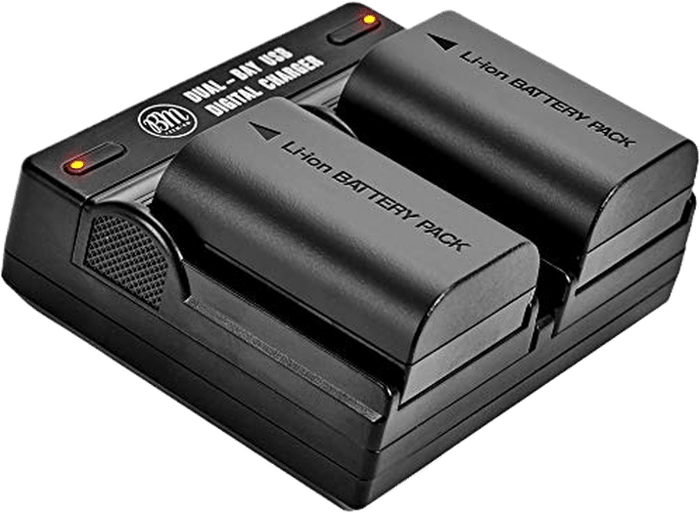
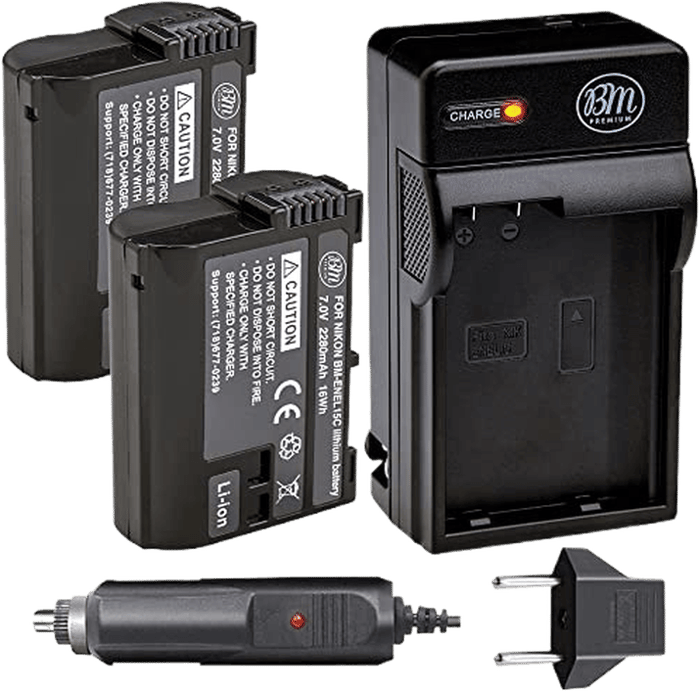
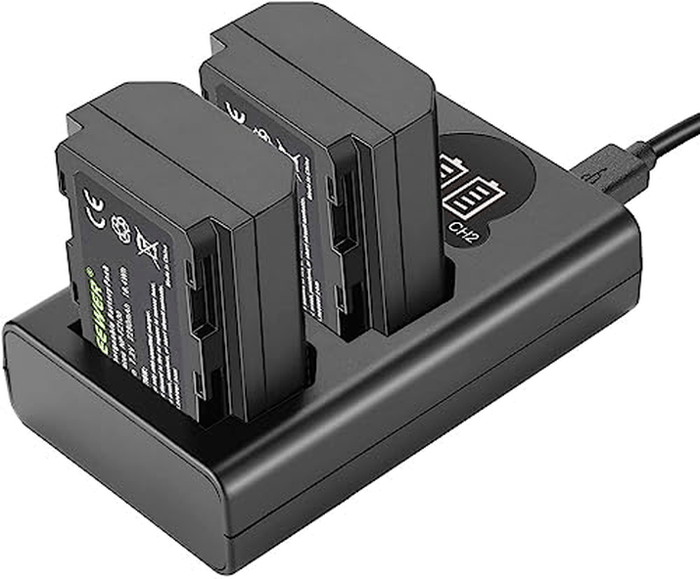
There isn’t one battery that suits every camera. The BM Premium LP-E6NH is the LP-E6NH option in this list. The BM Premium EN-EL15c is the Nikon EN-EL15c option. And the Neewer NP-FZ100 batteries are for cameras that take NP-FZ100 packs.
Start with the matching battery family. Then compare the kit contents, return terms, and support for your exact camera model. If you need every camera feature with the manufacturer’s stated support, choose the specified original battery.
What Are Third-Party Camera Batteries?
A third-party camera battery is made by a company other than the camera manufacturer. It may also be called an “off-brand” or “aftermarket” battery. OEM means Original Equipment Manufacturer: Canon’s own battery for a Canon camera is one example.
The letters and numbers identify the battery family. Keep the suffix too. LP-E6NH and LP-E6P, for example, are not interchangeable for every function. Canon’s EOS R6 Mark III power-accessory guide lists LP-E6NH as only partially functional and recommends LP-E6P for optimal performance.
Before buying, check three things:
- Battery code: Read the camera manual and the label on its supplied battery.
- Camera support: Look for your exact model and any firmware or feature limits.
- Charging method: Check whether the pack supports your external charger or in-camera charging. Do not assume both work.
The table gives an overview of the six buying recommendations. The separate Powerextra section below preserves the historical account and is not part of this list.
6 Best Third-Party Camera Batteries
These options cover four popular camera makers: Canon, Nikon, Sony, and Fujifilm. They are not a universal fit for those brands. Match the battery code before comparing a two-battery kit with a single OEM pack.
For the BM Premium kits and the other options below, check the warranty supplied by the seller for that exact item. A warranty describes support after a problem; it does not prove that a battery will match OEM runtime or work without errors.
Consider the BM Premium version of the LP-E6NH if your camera supports that battery type and you want the two-battery-and-charger kit shown here. Do not treat an LP-E6NH replacement as a substitute for every Canon battery.
The EOS R6 Mark III is a case where the suffix matters: Canon lists restrictions even with its own LP-E6NH pack. Check the power-accessory guide above before choosing a spare for that body. A third-party pack’s capacity rating does not remove the camera’s battery-type restrictions.
BM Premium’s EN-EL15 batteries are the EN-EL15c-family kit in this list. Compare the complete kit with the Nikon camera batteries you would otherwise buy, including the charger and the seller’s return terms.
Nikon battery generations need a closer check than “fits Nikon.” The Z 8 manual, for example, lists EN-EL15c, EN-EL15b, and EN-EL15a as supported packs. It also sets different charging limits. Those Nikon specifications do not certify a third-party replacement, so confirm the exact BM Premium pack’s support before purchase.
For a camera that uses the Sony NP-FZ100, this kit offers two Neewer NP-FZ100 batteries plus a charger. Neewer’s manual for its 2280 mAh NP-FZ100 kit lists a dual charger and notes that some cameras may lose the battery-level display after firmware updates.
NP-FZ100 does not fit every Sony Alpha camera. Sony’s a6400 manual specifies NP-FW50. Check the code first, then check whether your camera and firmware retain the charge display you need.
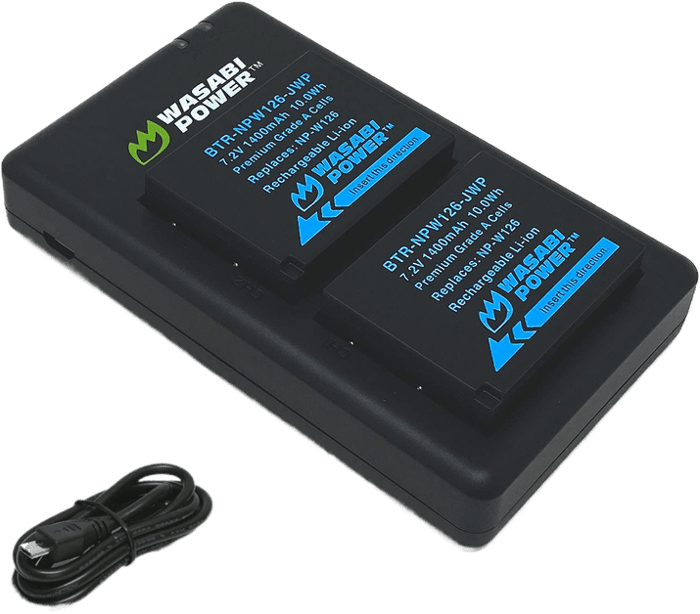
The NP-W126 Wasabi batteries (with charger) are one option for the NP-W126 family. Wasabi’s product page lists a 1400 mAh rating and a three-year manufacturer warranty. Treat the rating as a specification, not a measured shooting-time result.
Check the camera model rather than buying on “Fujifilm X Series” alone. Fujifilm’s X-T5 manual specifies NP-W235, a different battery family. An NP-W126 kit is not the right choice for that body.
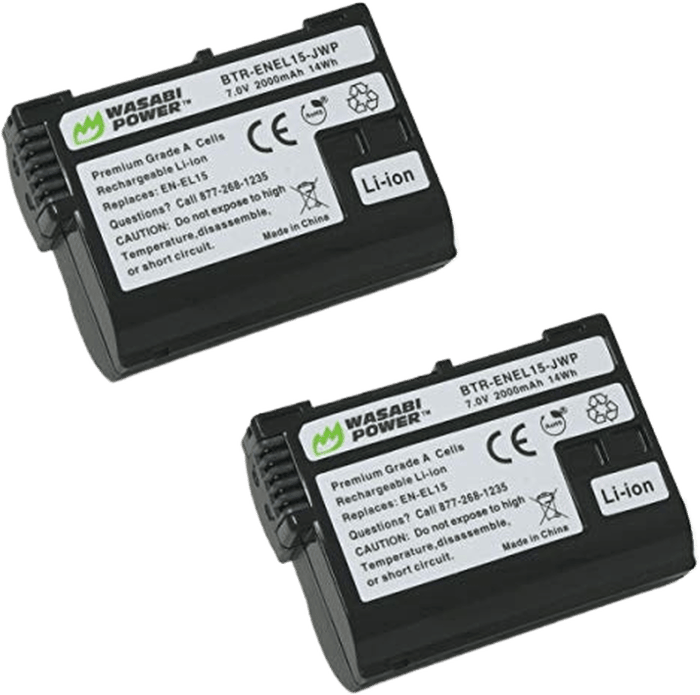
Compare Wasabi’s EN-EL15c batteries as another EN-EL15-family option. Wasabi lists its standard ENEL15 replacement at 2000 mAh with a three-year manufacturer warranty.
Check which version the seller will supply and whether it supports the charging method you use. Nikon’s compatibility rules for genuine EN-EL15 variants do not establish that every aftermarket pack behaves the same way. For a camera that you cannot afford to have stop during recording, test the pack in the intended mode before the job.
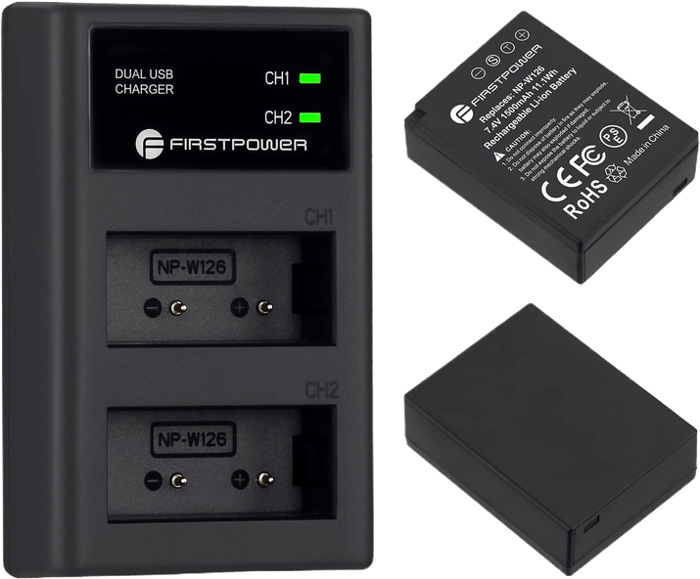
FirstPower’s NP-W126 two-pack with a charger is the second NP-W126 option here. Confirm the exact version before ordering: the current FirstPower NP-W126 kit page describes a 1600 mAh version, while the kit shown in this article is listed at 1500 mAh. That difference needs checking with the seller.
As with the Wasabi kit, the camera must use the NP-W126 family. Do not use a higher claimed capacity as evidence of better runtime or fewer compatibility problems. Choose a seller with return terms that let you deal with a pack that does not work as expected.
Historical Powerextra NP-FZ100 2500 mAh Kit
This section preserves the earlier Powerextra kit account. It is not one of the six buying recommendations above. The former purchase route has an unresolved brand and capacity mismatch, so no purchase link is provided here. The UK offer is unverified. Cost, ratings, and performance comments below are historical text, not current price, stock, or test results. No new battery test was performed for this update.
Original product photograph
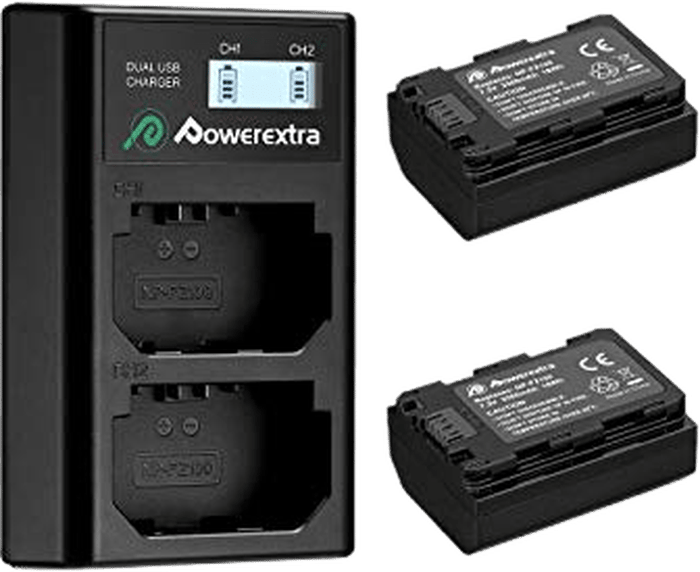
Retained kit specifications
| Brand | PowerExtra |
|---|---|
| Compatible With | Sony cameras that use NP-FZ100 (confirm exact model support) |
| Capacity | 2500 mAh |
Original article account (historical)
You can get two (or three) Powerextra batteries with a charger for two-thirds of the cost of a Sony battery. The capacity is higher than the original at 2500 mAh. Ratings are high for the battery. And lots of users give it a good rating.
But reviews are mixed. Some users report that they last as long as the brand name. Others find that it drains faster. But all in all, the battery seems to work fine with no camera errors.
Saved compatibility note (historical)
The Powerextra batteries with a charger are another NP-FZ100 option. Powerextra’s product specifications give its standard pack a 2500 mAh rating. That figure alone does not establish that it will outlast a Sony battery in your camera.
This option needs the same model and firmware checks as the Neewer kit. Do not assume a successful test in one Sony body proves support in another. Keep a known working spare available while you check battery warnings, the charge display, and recording behavior.
Original overview assessment (historical)
Second Best for Sony
- For Sony cameras that use NP-FZ100; confirm exact model support
- Very strong, reliable 2500-mAh power capacity
- Double battery pack with charger
- USB cable included for convenient charging
This retained account does not establish that a present listing is the same kit or that it is available.
Frequently Asked Questions
Over the years, I have bought third-party camera batteries. And I have had good experiences with them. That experience does not guarantee that every pack will work in every camera. Here are the checks that matter before you buy and use a replacement.
Is It Safe to Use Third-Party Batteries for Cameras?
Do not assume that any off-brand pack is safe simply because it fits. Nikon’s accessory notice warns that non-Nikon electronic accessories can cause damage and battery problems. Sony also recommends genuine packs in its battery-support guidance.
Follow the battery and charger instructions. Stop using a pack if it swells, leaks, changes shape, or shows other damage. Do not force a distorted battery into the camera. Nikon’s battery safety instructions say to stop use if a battery changes color or becomes deformed.
Are Third-Party Camera Batteries Good?
Judge the exact pack in the exact camera. A brand name or high star rating does not answer whether your camera will show the remaining charge or enable every function.
Sony’s battery-authenticity guidance explains that some cameras can show a warning or fail to display remaining charge with a third-party pack. A camera powering on is only the first check. Try the photo and video modes you plan to use, then check that the charge display behaves as expected.
Why Should I Buy Aftermarket Batteries?
The appeal is the cost of carrying extra charged packs. Compare the total for the exact kit you need, including its charger, with the original batteries you would buy. There is no fixed saving that applies to every brand or kit.
Compare the same battery family. Nikon’s EN-EL18d, for example, is a different pack type from EN-EL15c. Buying by camera brand alone can leave you with a spare that does not fit.

Do Third-Party Batteries Last Long and Have the Same Power?
A printed mAh rating does not tell you how many photographs or minutes of video you will get. Compare ratings only alongside the battery type and voltage, then assess runtime in the camera and settings you use.
For example, Nikon rates its EN-EL15c at 2280 mAh, while the standard Wasabi equivalent above is rated at 2000 mAh. Neither number is a side-by-side runtime test. Nor does capacity alone establish support for high-speed shooting, charging, or the remaining-charge display.
For a practical comparison, charge each pack with its specified charger. Use the same camera, lens, and shooting settings. Note warnings and unexpected shutdowns as well as runtime. Do this before a trip or an event where a failed battery would cost you photographs.
Are Aftermarket Batteries Worth It?
They can be worth considering for spare power if the exact pack works with your camera and the saving justifies the compromises. For budget digital cameras, compare the cost of the complete spare-battery kit with the cost of the camera, as well as your need for reliable power.
For paid work or a shoot you cannot repeat, a manufacturer-specified original pack is the more cautious choice. Keep a known working spare and avoid making a new battery’s first outing an important job. A lower purchase cost is less attractive if you miss photographs while dealing with an error or an empty pack.
Conclusion: Best Third-Party Camera Batteries
Start with the code on your battery and the requirements in your camera manual. Then compare the exact kit, charging support, warranty, and return terms. Choose on that basis before considering a capacity claim or discount. The six ranked entries form the buying list; the unranked Powerextra account is retained only as historical context.
The BM Premium LP-E6NH, BM Premium EN-EL15c, and Neewer NP-FZ100 batteries are the Canon, Nikon, and Sony options at the top of this list. They belong to different battery families. Check the match and test a new pack before relying on it. For full manufacturer support and the fewest compatibility questions, use the original battery specified for your camera.