We’ve rounded up eight of the best 360 cameras available on the market today. They range from the Insta360 X6 to the budget-priced Akaso 360. Read on to find out which one of these cameras is the best fit for your needs.
Our top pick has all the benefits of 360 shooting, an OLED touchscreen, and is waterproof to 66 feet (20 m) without a case.
What is the Best 360 Camera?
The best 360 camera overall is the Insta360 X6, Insta360's current flagship, thanks to its dual 1/1.1-inch Sony sensors, 8K 360-degree video at 50 fps, PureVideo low-light mode, and waterproofing to 66 feet (20 m) without a case.
Which one suits you comes down to three questions. If image quality decides it, the X6 and the X5 lead for video and the Ricoh Theta Z1 leads for stills. If the camera has to survive a bike trail or a ski slope, the GoPro MAX2 is the one tuned for that kind of motion. And if weight or price decides it, the X4 Air is the lightest at 165g and the Akaso 360 costs the least.
Before we look at the detail of the cameras we’ve chosen, here’s a summary of why we like them.


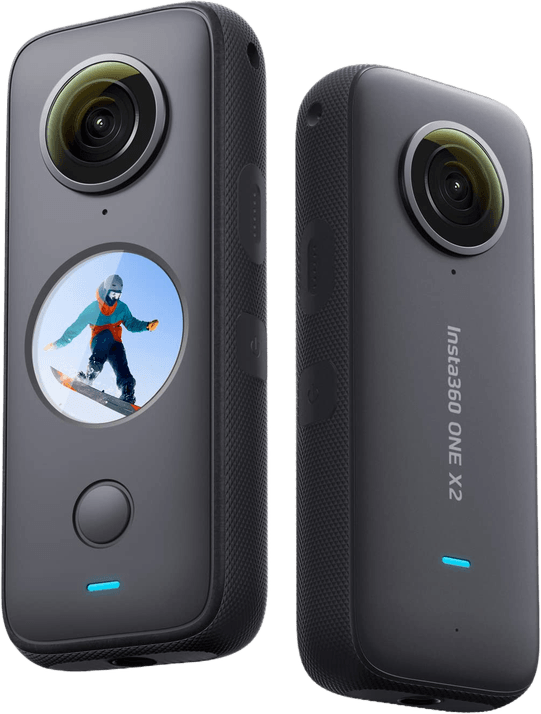
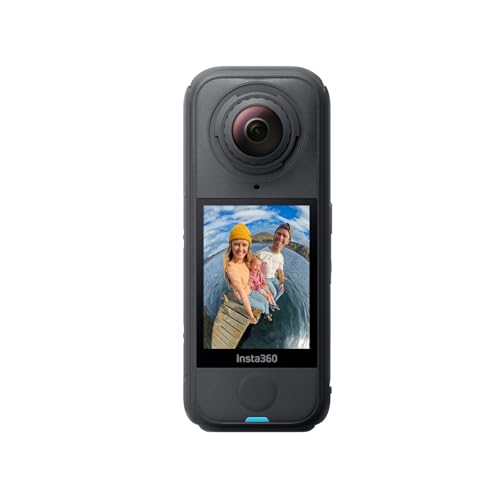
Now let’s look in more detail at our recommendations.
1. Insta360 X6
| Brand |
Brand
Insta360
|
| Maximum Resolution |
Maximum Resolution
8K
|
| Phone Support |
Phone Support
Android/iOS
|
| Memory |
Memory
47 GB internal + MicroSD
|
| Battery Life |
Battery Life
140 minutes (8K30)
|
| Water Resistance |
Water Resistance
66 feet (20 m)
|
| Key Features |
Key Features
Dual 1/1.1-inch Sony sensors and 8K50fps 360 video
|
| Best For |
Best For
The sharpest 360 image quality on the list
|
The Insta360 X6 is Insta360's current flagship 360 camera, built around dual custom Sony 1/1.1-inch square sensors. In 360 mode those sensors give it as much light-gathering area as a 1-inch sensor, matching the Ricoh Theta Z1 further down the list and beating every other camera here.
That is what earns it the top spot. The bigger sensors and a new triple-chip system take the X6 to 8K 360-degree video at 50 fps and 120 MP 360 stills, with 14.5 stops of dynamic range and a PureVideo low-light mode backed by two dedicated ambient light sensors. It is the first Insta360 camera to record Dolby Vision in-camera, and it shoots 10-bit color with an I-Log profile if you grade your own footage.
The hardware around the sensors keeps up. A 2.32-inch OLED screen at 1200 nits stays readable in daylight, the 2600 mAh battery is rated for 140 minutes of 8K30 recording and charges to 80% in 24 minutes, and 47 GB of usable built-in storage means you can still shoot if you left the memory card at home. It is waterproof to 66 feet (20 m) without a case, and the second-generation replaceable lenses mean a scratch costs a lens rather than a camera.
The catch is that several headline numbers come with conditions. PureVideo tops out at 8K30 rather than 8K50, ISO stops at 6400, and the 140-minute battery figure is a lab measurement at 8K30. At 196g it is heavier than the 165g X4 Air, and the 360 workflow has not changed: every clip needs a reframing pass before it is ready to share. If you want footage you can post straight off the camera, buy a flat action camera instead.
2. Insta360 X5
| Brand |
Brand
Insta360
|
| Maximum Resolution |
Maximum Resolution
8K
|
| Phone Support |
Phone Support
Android/iOS
|
| Memory |
Memory
MicroSD
|
| Battery Life |
Battery Life
208 minutes (Endurance Mode)
|
| Water Resistance |
Water Resistance
49 feet (15 m)
|
| Key Features |
Key Features
Replaceable lenses and PureVideo low-light mode
|
| Best For |
Best For
Sharp 360 footage with strong low-light performance
|
The Insta360 X5 is the best-value camera in Insta360's 360 range, and that is the company's own label for it now that the X6 sits above it. It is built around dual 1/1.28-inch sensors that capture 133% more light than the previous X4.
That larger sensor is the point: the X5 has a dedicated PureVideo low-light mode with AI noise reduction, so night and indoor 360 footage stays clean instead of grainy, a common weak spot for 360 cameras.
It shoots 8K 360-degree video at 30 fps, runs up to 208 minutes on a charge in Endurance Mode at 5.7K24 (nearer 88 minutes at 8K30), and is waterproof to 49 feet (15 m) without a case. The lenses are also user-replaceable, so a scratch costs a $30 part rather than a new camera.
It costs less than the X6 and keeps the features most people actually use (PureVideo, replaceable lenses, 8K capture) while giving up the X6's larger sensors, 8K50 frame rate and 10-bit color. The other trade-off is the one every 360 camera shares: footage needs a post-production reframing pass before it's ready to share, so it suits someone willing to edit, not someone who wants footage ready straight off the camera.
3. Insta360 X4
| Brand |
Brand
Insta360
|
| Maximum Resolution |
Maximum Resolution
8K
|
| Phone Support |
Phone Support
Android/iOS
|
| Memory |
Memory
MicroSD
|
| Battery Life |
Battery Life
135 minutes
|
| Water Resistance |
Water Resistance
33 feet (10 m)
|
| Key Features |
Key Features
Removable lens guards and Invisible Selfie Stick mode
|
| Best For |
Best For
Long-lasting battery life on extended 360 shoots
|
The Insta360 X4 shoots 8K 360-degree video using a 5nm AI chip, with 2.7K reframed output, a big jump over older 360 cameras that reframed at 1080p.
Battery life is the standout spec here: 135 minutes per charge, long enough to cover a full shoot without swapping batteries. It also has removable lens guards, so the fragile dual lenses survive a drop instead of the whole camera taking the hit.
You still get FlowState stabilization and 360° Horizon Lock, plus the Invisible Selfie Stick trick for drone-like third-person shots. A 4K single-lens mode is built in for when you just want normal footage without the reframing workflow.
The 8K mode does run into thermal limits. Expect it to throttle after around 27 minutes of continuous recording in warm conditions, so drop to 5.7K for longer takes. At 203g it's also heavier than Insta360's smaller Go-series cameras, which is worth knowing if you're mounting it on a helmet for a full day.
4. GoPro MAX 2
| Brand |
Brand
GoPro
|
| Maximum Resolution |
Maximum Resolution
8K
|
| Phone Support |
Phone Support
Android/iOS
|
| Memory |
Memory
MicroSD
|
| Battery Life |
Battery Life
80 minutes
|
| Water Resistance |
Water Resistance
16 feet (5 m)
|
| Key Features |
Key Features
Tool-free replaceable lenses and Max HyperSmooth stabilization
|
| Best For |
Best For
Rugged action 360 footage with easy lens swaps
|
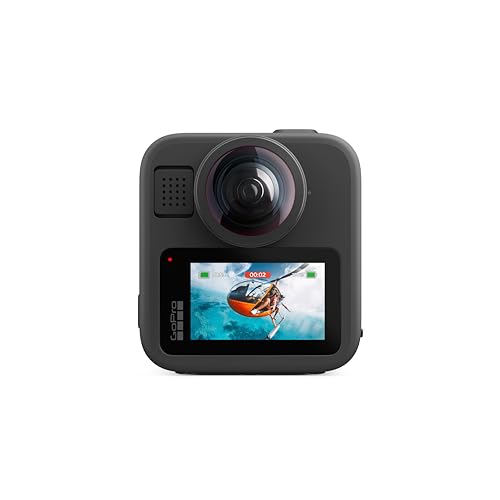
The GoPro MAX2 is GoPro's 360-degree flagship, built around dual 1/2.3-inch stacked sensors that shoot true 8K 360-degree video at 30 fps. It also captures single-lens HERO-style stills and video up to 4K60, so it works as a regular action camera on days you don't need the full sphere of image capture.
It's the strongest pick here for fast-moving action (skiing, mountain biking, skate parks) because GoPro's Max HyperSmooth stabilization with Horizon Lock is tuned for exactly that kind of motion, and the six built-in microphones give you directional 360 audio to match the footage.
The lenses are tool-free replaceable: twist off the rubber barrel with your fingers and swap in a new one for the cost of a lens rather than a whole camera. Battery life is 80 minutes at 5.6K30 360, it's waterproof to 16 feet (5 m) without a housing, and it charges over USB-C 3.0.
The trade-off is low light. GoPro's own materials flag weaker low-light performance next to rivals like the Insta360 X5, so if you're mostly shooting indoors or after dark, reach for the X6 or X5 instead. Some users also report the desktop editing workflow is fiddlier than Insta360's app, and moving the camera between hot and cold environments can cause condensation inside the housing, which is worth knowing before you take it snowboarding.
5. Ricoh Theta Z1
| Brand |
Brand
Ricoh
|
| Maximum Resolution |
Maximum Resolution
4K
|
| Phone Support |
Phone Support
Android/iOS
|
| Memory |
Memory
51 GB internal
|
| Battery Life |
Battery Life
1 Hour
|
| Water Resistance |
Water Resistance
None
|
| Key Features |
Key Features
RAW photo capability, 23 MP stills
|
| Best For |
Best For
Carry-anywhere capability
|
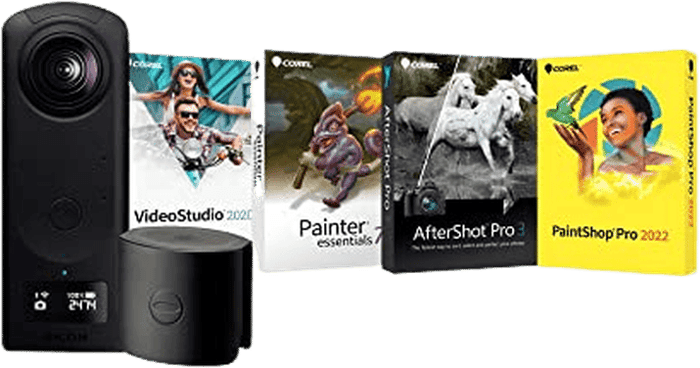
The Ricoh Theta Z1 is an excellent camera that specializes in 360-degree stills and video.
The Z1 has two 1-inch CMOS sensors that produce 360 photos with 23 MP resolution. That's getting close to DSLR quality. And it has a sensitivity of ISO 6400. That means you get great images in low-light situations.
The Ricoh Theta Z1 offers 4K resolution for 360-degree videos. It's not the highest on the market, but the quality is still excellent. The 3-axis rotational image stabilization maintains the quality, whether you're rolling or spinning!
You can capture images in RAW format for easy editing in post-production. And post-production is easy with the accompanying Ricoh Theta apps.
The battery life is very good for a camera with these specifications. It will take up to 300 stills or 60 minutes of footage. Ricoh now ships the Z1 with 51 GB of built-in storage, and that is all you get. There is no memory card slot.
Two things to weigh before you buy. The Z1 is not waterproof, so it stays indoors when the weather turns. And it is a stills specialist priced like one, which makes it the wrong choice if what you actually want is 8K video for social.
6. Insta360 ONE X2
| Brand |
Brand
Insta360
|
| Maximum Resolution |
Maximum Resolution
5.7K
|
| Phone Support |
Phone Support
Android/iOS
|
| Memory |
Memory
MicroSD
|
| Battery Life |
Battery Life
80 minutes
|
| Water Resistance |
Water Resistance
33 feet (10 m)
|
| Key Features |
Key Features
Image stabilization and touchscreen
|
| Best For |
Best For
Stunning 360 footage across a range of situations
|
The Insta360 One X2 is an upgrade of the One X, and it's now the budget option in Insta360's lineup. The X4, X5 and X6 all sit above it now, but the One X2's specs still hold up for the price.
The One X2 has a 360 image resolution of 5.7K. And it has a 6-axis "flow-state" image stabilization system.
The touch screen lets you see what you're shooting through the eye of the camera. So you can make sure it's the shot you want without having to consult your device.
You can charge the camera with a USB connection. And the battery life is solid for the price. It's also waterproof up to 10 meters straight out of the box.
One fun feature is the Invisible Selfie Stick mode. If your selfie stick is visible in the footage, the camera will automatically edit it out!
7. Insta360 X4 Air
| Brand |
Brand
Insta360
|
| Maximum Resolution |
Maximum Resolution
8K
|
| Phone Support |
Phone Support
Android/iOS
|
| Memory |
Memory
MicroSD
|
| Battery Life |
Battery Life
88 minutes
|
| Water Resistance |
Water Resistance
49 feet (15 m)
|
| Key Features |
Key Features
Ultralight 165g body with replaceable lenses
|
| Best For |
Best For
Lightweight travel-friendly 360 shooting
|
The Insta360 X4 Air is Insta360's lightest 8K 360 camera, weighing just 165g, built around dual 1/1.8-inch sensors that shoot a full 8K at 30 fps.
That weight makes it the pick for travel and everyday carry. It disappears into a jacket pocket in a way the bulkier flagships don't. The twin lenses are user-replaceable with improved drop resistance, so a knock on a curb doesn't mean a full camera replacement, and the companion camera app handles editing and upload on Android and iOS.
You still get 29MP 360 stills, FlowState Stabilization with 360° Horizon Lock, and native waterproofing to 49 feet (15 m), the same rating as the X5, plus a 2.5-inch touchscreen for framing shots without your phone.
The trade-off for the smaller body is battery: it's rated at 88 minutes, but real-world 8K recording runs closer to 74 minutes, so pack a spare for a full day of shooting. It also skips the X5's dedicated PureVideo low-light mode, so night and indoor footage is noticeably grainier. Buy the X5 instead if low light matters more to you than pocketability.
8. Akaso 360
| Brand |
Brand
Akaso
|
| Maximum Resolution |
Maximum Resolution
5.7K
|
| Phone Support |
Phone Support
Android/iOS
|
| Memory |
Memory
MicroSD
|
| Battery Life |
Battery Life
60 minutes
|
| Water Resistance |
Water Resistance
Splash-resistant
|
| Key Features |
Key Features
Dual 1/2-inch 48 MP sensors and 360 Horizon Steady
|
| Best For |
Best For
The lowest-cost way into 360 video
|
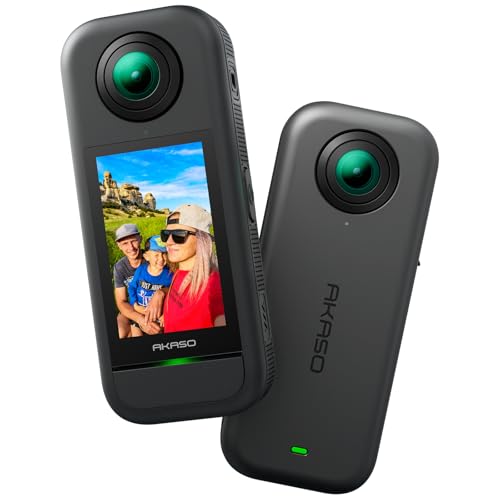
The Akaso 360 is the cheapest way onto this list. It is a true dual-lens 360 camera built around two 1/2-inch 48 MP sensors, and it records fully spherical 5.7K video at 30 fps.
That matters because the Akaso costs a fraction of what the flagships do, and the fun parts survive the cut. You get the Invisible Selfie Stick effect for drone-like third-person shots, 360 Horizon Steady stabilization that keeps the frame level, and AI subject tracking. Reframing runs on your phone or in Akaso 360 Studio on Windows and Mac, and neither app asks you to register an account.
The rest of the spec is sensible for the money. Stills come out at 72 MP in 360 mode and 18 MP flat, with DNG raw if you want to edit them properly. The body weighs 180g, the screen is 2.29 inches, and the removable 1350 mAh battery runs about 60 minutes, with a second battery in the standard kit.
The compromises are real and worth knowing. It is splash-resistant, not waterproof, so it has no business in a pool or the sea. Low-light footage loses shadow detail and there is no HDR mode to rescue it. The touchscreen is slow to register taps, which makes menu diving tedious. And there is no built-in storage at all, so budget for a UHS-I V30 memory card on top. If you shoot at night or anywhere near water, spend up to the X5.
Why Choose a 360 Camera?
360 cameras are all the rage with influencers and vloggers. Facebook and Instagram are ablaze with 360-degree photos and videos. The panoramic views you get from a 360 camera make them great for landscape photography. And now real estate photographers are getting excited about 360 cameras too.
They’re fun and easy to use. And they’re becoming an essential tool in many areas of photography.
How Does a 360 Camera work?
The basic elements aren’t so different from a traditional camera. You have a sensor and a lens that work together to create an image.
As with any DSLR, the 360-degree camera has a flat sensor. The difference is that it uses two back-to-back spherical lenses. Each lens provides a 180-degree view. And the processor puts these together to make the 360-degree image.
360 photos give you the freedom to navigate left or right. Or sometimes up and down. But to do this, you need a digital device. A computer is great, but a smartphone also works. Some cameras will link directly to your phone when you use their mobile app.
Conclusion: The Best 360 Camera
The Insta360 X6 is our top pick on this list. It has the strongest all-round feature set here: the biggest sensor area of any 360 video camera on this list, the sharpest low-light performance, and 8K 360-degree footage at 50 fps. Buy it if you want the best 360 image quality on sale right now.
If that is more camera than you need, the Insta360 X5 keeps PureVideo and the replaceable lenses for less, the GoPro MAX2 is the one to bolt to a helmet, and the Akaso 360 is the cheapest way to find out whether you enjoy shooting 360 at all.
Whichever you choose, order a fast memory card and an invisible selfie stick with it. The card keeps 8K recording from stuttering, and the selfie stick is what makes the drone-like third-person shots possible.