The NEEWER NL-116AI is the best LED light panel for most photographers. It is a 9-inch bi-color panel with a built-in battery, and it comes with a metal desk tripod and a cold shoe adapter. You can light a face, a desk or a small tabletop set on the day it arrives. Brightness and color temperature both move in 1% steps, so matching the room is easy.
The other picks cover needs that one small panel cannot. The Godox LDX50Bi is an AC-powered studio key light for portraits. There are two-panel kits with stands for product and interview work, RGB lights for colored scenes and a pocket light that sits on your camera. There are also USB kits for a fixed home setup and a clip-on light for phone selfies and video calls.
The Best LED Light Panels for Photography
Start with distance and power. A small battery panel is a key light for one face or one product at close range. A larger AC-powered panel or a two-light kit lights a person from across a room and can fill a whole tabletop set. Then decide on color. Bi-color panels move between warm and daylight white, RGB panels add any hue, and the simplest kits rely on clip-in color filters. Each review ends with the point where another pick becomes the better buy.
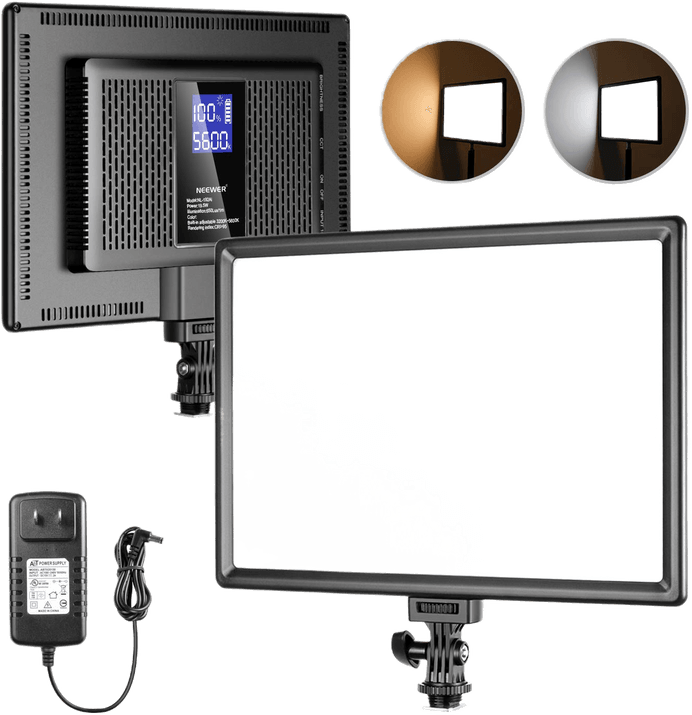
The NEEWER NL-116AI is our top pick because it does the most common job well and needs nothing else. It is a 9-inch panel with 116 LEDs, and the box holds a metal mini tripod, a cold shoe adapter and a USB-C cable. That is a complete key light for a desk, a portrait at arm's length or a small product shot.
Its controls are the main reason it beats the other small panels. Two knobs set brightness from 0 to 100% and color temperature from 3200K to 5600K, both in 1% steps. You can match warm room lamps or window light without gels. The 58 warm and 58 cool LEDs have a CRI of 95+, so skin tones and product colors stay natural.
The mount makes it easy to move between jobs. The cold shoe adapter tilts the panel 180 degrees front to back, so it can sit on a camera, a light stand or the desk tripod. The tripod extends to 8.6 inches (22 cm).
It is not a light for a big set. Output is 10W, or 600 lux at 1.6 ft (0.5 m). A carry bag is not included, so plan how you will protect it in a camera bag. The 4000mAh battery runs about 1.5 hours at full power and recharges in about two hours over USB-C. For two people or a wide product table, the GVM two-panel kit is the better buy. For a single portrait light with far more output, choose the Godox LDX50Bi.
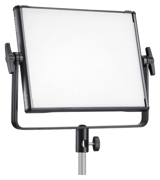
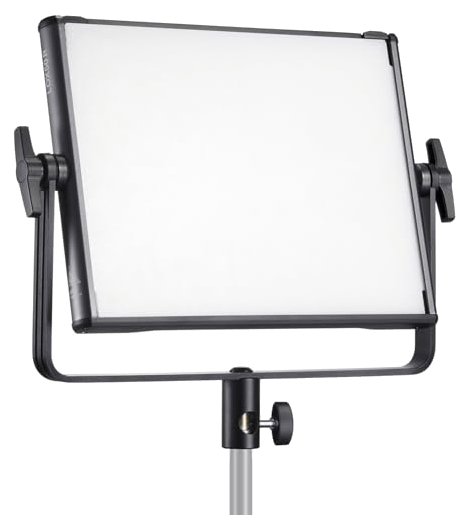
The Godox LDX50Bi is the panel to buy when one light has to carry a portrait or an interview. It is a 14 x 12-inch, 65W bi-color panel. Godox rates it at 2430 lux at 3.3 ft (1 m) in daylight mode. That is several times the output of the desk panels on this list, so you can put it behind a diffuser or further from your subject and still have light to spare.
The color range runs from 2800K to 6500K with dimming from 0 to 100%, and CRI and TLCI are both 96. A detachable diffuser comes in the box and softens the panel for faces. You can change settings on the light, in the Godox Light app over Bluetooth, or with an optional 2.4 GHz remote. The housing has no fan, so the light stays silent during video. A 360-degree U-shaped yoke lets you aim it at any angle on a stand. Godox also runs US service centers in New York, Ohio and California for its LED lights, which matters if a light fails mid-season.
Power is the decision to make before you buy. It runs from an AC adapter, and a built-in dual NP-F plate takes batteries when you work away from a socket. The batteries are not included, and neither is a stand. The panel weighs 4.1 lb (1.85 kg), so it needs a proper light stand rather than a desk tripod.
The NEEWER NL-116AI is the better choice for desk work and travel. Choose the Godox when you light people from more than a few feet away, or when you want one strong key light now and plan to add a second later.
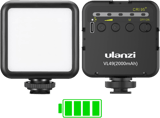
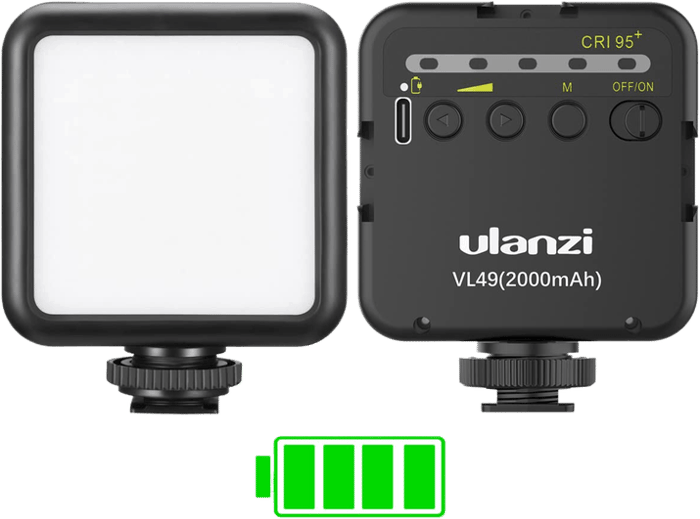
The ULANZI VL49 RGB is the best LED light for the top of your camera. It measures 2.6 x 3.1 x 1.2 inches (66 x 80 x 30 mm), so it fits in a pocket and adds almost no weight to a camera rig. It slides into the hot shoe of any camera through its cold shoe foot. The camera cannot control it, so you set it with the buttons on the body.
It does far more than white light. Color temperature runs from 2500K to 9000K, and the RGB mode turns through the full 0 to 359 degrees of hue. Brightness dims from 0 to 100%, and a small LCD shows each setting. Its 60 LEDs have a CRI of 95+ and reach 800 lux at 1.6 ft (0.5 m) across a 120-degree beam.
The mounting options make it useful off the camera too. There are three cold shoes and a quarter-inch thread on the body, and a magnet on the back holds it on steel surfaces. You can hide it in a set as a colored accent light, or put it close to a subject for macro photography. Several VL49s also lock together for more output.
The 2000mAh battery gives about two hours at full brightness and up to ten hours at the lowest setting. It charges over USB-C in about two hours, and it works while it charges. The size is the limit. It is a fill light for a face at arm's length, not a key light for a room. For that, choose the Godox LDX50Bi or one of the two-panel kits.
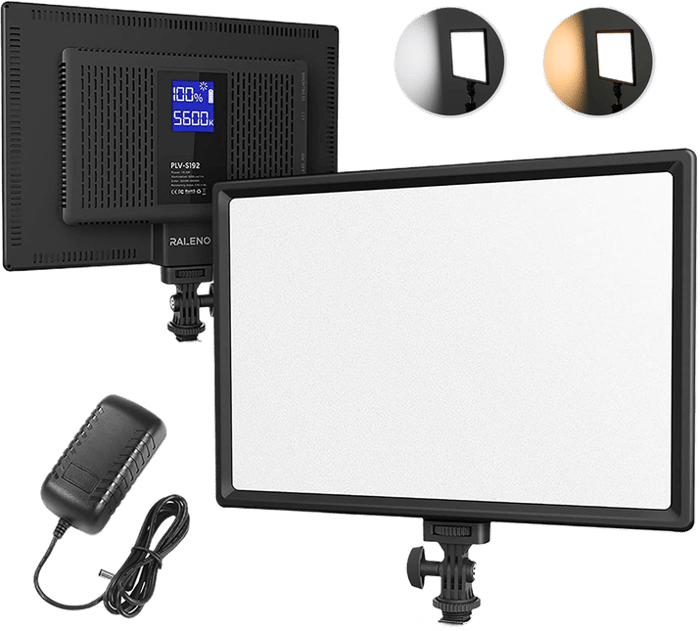
The RALENO PLV-S192 is the best panel for video podcasts and streaming at a desk. It is a 13-inch panel only 1 inch thick, so it can slide behind a monitor or lie flat in a bag. It comes with a desk stand that sets between 6.42 and 10.16 inches high.
The light is large and soft for its size. Its 192 LEDs put out 650 lux at 3.3 ft (1 m) from 19.5W, with a CRI above 95. Color temperature covers 2500K to 6500K, which reaches warmer than the NEEWER NL-116AI. An LCD on the back shows brightness and color temperature as you set them.
Power is flexible. A built-in 8000mAh battery gives about 80 minutes at full power, and the 5.9 ft (1.8 m) adapter takes over for longer sessions. A quarter-inch thread fits the desk stand, a light stand or a travel tripod. There is no cold shoe, so it does not mount on a camera.
Compared with the NEEWER NL-116AI, the RALENO is the larger and softer light. It suits a face on camera for an hour-long stream. The NL-116AI is smaller, adds a camera mount and a tripod, and suits travel and tabletop work better. Neither one lights a whole room. The RALENO also works for product shots on a small table, where its wide surface gives soft shadows.
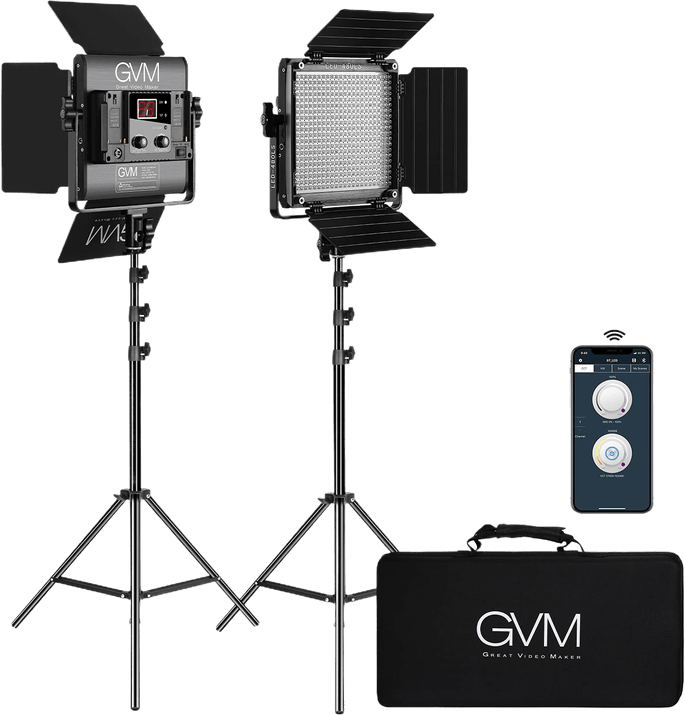
The GVM 2-Pack Bi-Color LED Video Light Kit is the best complete two-light kit for portrait, product and food photography. You get two panels, two light stands, two barn doors, two power adapters and a hard carry bag. With a key light and a fill light, you can control the shadows on a face or both sides of a product.
Each panel uses 480 LEDs rated CRI 97+ and TLCI 97+, so skin tones and product colors stay accurate on camera. The bi-color range is wide, from 2300K to 6800K. Brightness adjusts from 10 to 100% with a digital display on each panel, or you can set both lights from the GVM phone app.
The barn doors are useful for tabletop work. They keep light off the background or narrow it onto one side of a subject. Each panel runs from its AC adapter, or from an F970 or F750 battery when you shoot on location.
The batteries are sold separately, and two stands take real floor space. A solo streamer at a desk gets more from the RALENO PLV-S192 or the NEEWER NL-116AI. If you want colored light from a similar two-panel kit, choose the NEEWER 660 PRO II RGB.
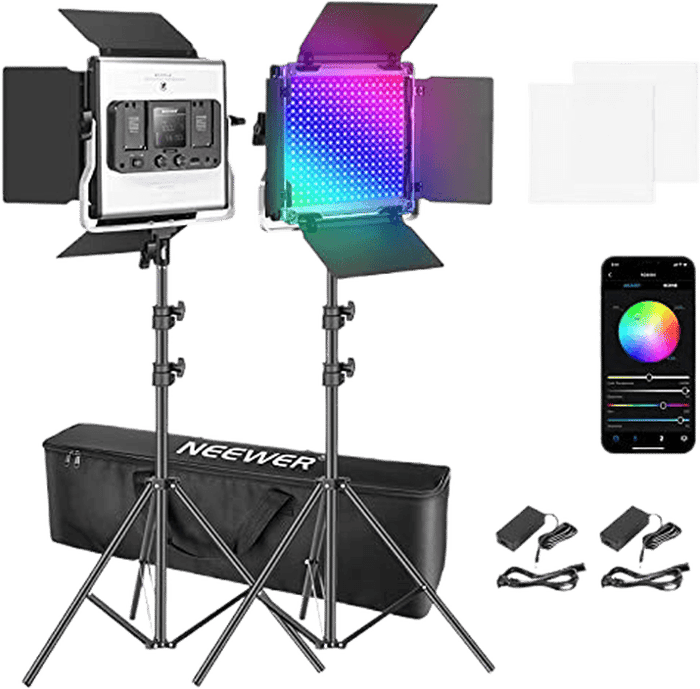
The NEEWER 660 PRO II RGB is the kit to buy for colored lighting on a set. It has two 50W panels with full 360-degree RGB color and a 3200K to 5600K white range. One kit can light a normal interview and then a stylized scene for a music video.
The white light is good enough for portraits and products. Each panel has a CRI of 97+ and reaches 7000 lux at 1.6 ft (0.5 m). Brightness dims down to a true 1%, which helps when you need only a small amount of fill. Output and color stay steady when you change the hue or color temperature, so you do not have to re-balance exposure after each change. Nine preset scene effects include police lights, fireworks, candlelight and lightning.
Control is easy across both lights. The NEEWER app connects over Bluetooth from up to 49 ft (15 m), sets one light or a group, and saves two favorite presets. The kit includes two stands that adjust from 3 ft to 6.6 ft, four-way barn doors, removable diffusers, AC adapters and a carry bag.
It is the largest kit here and needs room to set up. The NP-F550 or NP-F970 batteries for location work are an extra purchase. If you only need white light, the GVM bi-color kit covers the same jobs. For a pocket RGB light on a camera, choose the ULANZI VL49 RGB.
The NEEWER 192 LED ultra-thin panel gives you a bright, battery-powered panel that still fits on a camera. It is 0.4 inches (1 cm) thick and weighs 1.3 lb (580 g). It is the flattest panel on this list.
It is brighter than the other small battery panels. Its 192 LEDs (96 warm and 96 cool) reach 2400 lux at 1.6 ft (0.5 m) from 20W, with a CRI of 97+. Brightness runs from 0 to 100% and color temperature from 3200K to 5600K. Both settings show on an LCD on the back.
The cold shoe adapter puts the panel on a camera for head-on light, or on a tripod for more directional light. It tilts through 180 degrees. That makes it a good portrait or event fill light when you move around, and a capable key light in a small studio.
The 4000mAh battery runs about 1.5 hours at full power and recharges in two hours with the included adapter. You cannot use it while it charges, and no stand comes in the box. If you want a desk light with its own tripod, the NEEWER NL-116AI is the more complete package. For more output from an AC-powered panel, choose the Godox LDX50Bi.
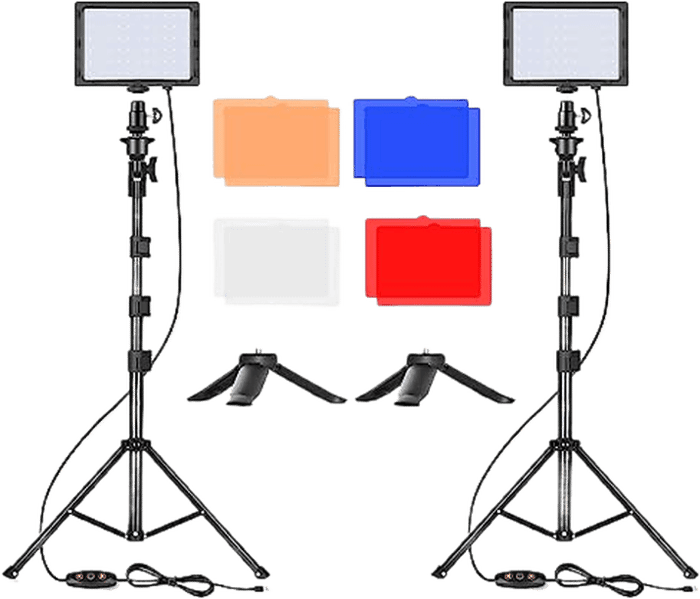
The EMART LED video light kit is a good low-cost start for product and food photography. You get two 12-inch panels, two stands, two magnetic barn doors and a phone holder. That is enough to light a tabletop subject from both sides with real control over product photography lighting. If food is your subject, our Edible Images guide shows how to use a setup like this.
Each panel has 352 LEDs with a CRI of 97+ behind a thick housing that spreads the light evenly. Output is 15W per panel. That is enough for a tabletop at close range, but not for a person across a room. The barn doors are what make the kit useful on a table. They keep light off the background or narrow it onto one face of a product. They also come off when you want a broad, soft light.
The stands rise to 73 inches and fold to 17 inches. Each one tilts the panel 180 degrees. There are four cold shoe ports and two quarter-inch threads on the panels for a phone or a microphone.
The controls are simple. You get three color temperature presets between 2800K and 7000K and ten brightness levels, not a smooth range. The panels run from USB with no battery, and the wall chargers are not included. You can power them from a USB charger or your photo editing laptop. If you want stepless control and app settings, the GVM bi-color kit is the step up.
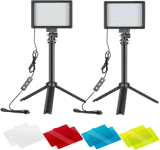
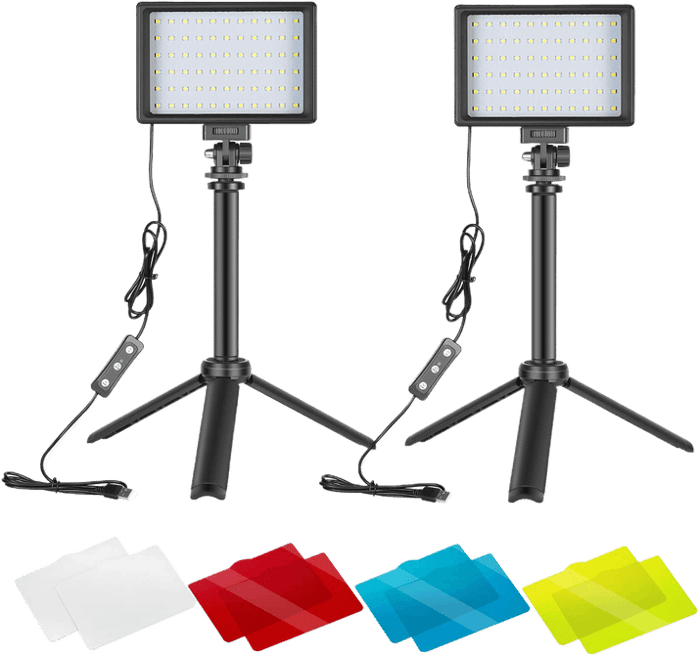
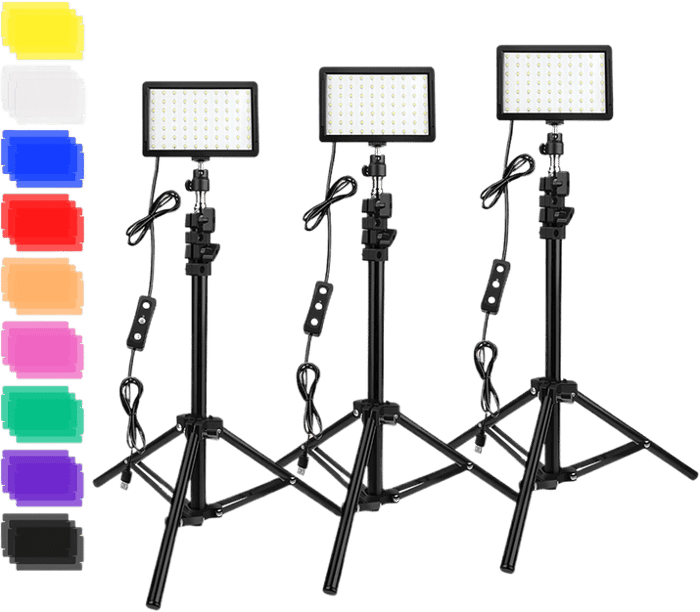
The Obeamiu LED light kit gives you three lights and three stands for a full three-point setup. With a key, a fill and a back light, you can control shadows on a face, a product or a miniature photography scene in a way one or two lights cannot.
Each panel has 70 LEDs with a CRI of 97+ and reaches 1100 lux at 1.6 ft (0.5 m). That is brighter at the same distance than the NEEWER NL-116AI, although the panels are much smaller. A button on the USB cable sets ten brightness levels from 10 to 100%. Color temperature only moves between 5400K and 5800K, so the light is always daylight white. Nine color filters come in the box for creative looks, but each one must sit over the white diffuser, which costs some output.
The tripods extend from 27.2 to 48.4 inches (69 to 123 cm) with quick-flip locks and a weighted base. Each has a gimbal head, so you can pan and tilt the panel.
None of the panels has a battery, and no wall adapter comes in the box. Each light needs its own 5V 2A USB supply and a socket nearby. The fixed daylight color is the main limit. If you work under warm room light, the GVM bi-color kit or the EMART kit lets you match it. This is a kit for a room you control, not a bag you carry.
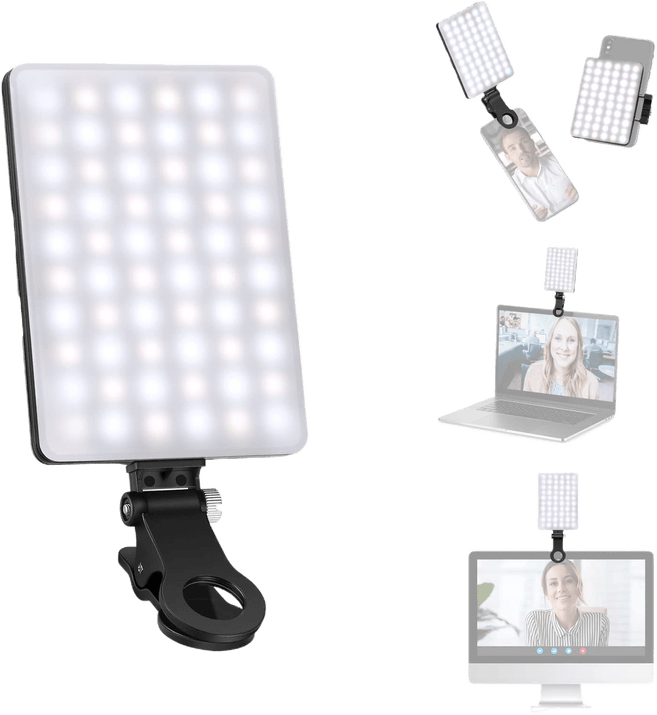
The NEEWER NL-60AI selfie light is the best light for a phone, a tablet or a laptop. It clips onto the device, keeps the front camera clear, and lights your face for selfies, video calls and TikTok videos.
It is small enough for a pocket, and it has 60 LEDs with a CRI of 95+. You choose warm, cool or mixed light, and brightness steps from 10% to 100% in 10% steps. There is no fine control of color temperature, so you pick the preset closest to your room.
The clip fits devices up to 1.2 inches (3 cm) thick. A second holder mounts the light behind a phone for fill light when you film with the rear camera. Two quarter-inch threads let it sit on a stand instead. The 2000mAh battery runs about two hours at full brightness and charges from any 5V 1A source over USB-C or micro-USB.
It does not light anything past arm's length. It is a face light for calls and phone content, not a panel for a set. If you also shoot with a camera, the ULANZI VL49 RGB is as portable and adds a cold shoe mount and full color control.
LED Light Panel Buying Guide
Choose One Light, Two or Three
One panel is enough for a face on a video call, a desk stream or a small product shot. Put it to one side of the camera and let the shadow side fall off. Add a second light when the shadows get too deep or you want to light the background. That is why the two-panel kits from GVM, NEEWER and EMART suit portraits, interviews and tabletop products. A third light behind the subject separates hair and shoulders from a dark background, which is what the Obeamiu set is for. You can also build up over time. Every bi-color panel here can match another by color temperature, so a single panel now and a second later still work together.
Compare Brightness at the Same Distance
Makers quote output in lux at different distances, and the figures are not comparable until you match them. Light falls off with distance, so moving from 1.6 ft (0.5 m) to 3.3 ft (1 m) leaves roughly a quarter of the lux. The NEEWER NL-116AI gives 600 lux at 0.5 m, which is close to 150 lux at 1 m. The RALENO PLV-S192 gives 650 lux at 1 m, and the Godox LDX50Bi gives 2430 lux at 1 m. Treat this as a rough guide, because panel size and diffusers change it. It still shows which lights can work from across a room and which need to stay close.
Decide Between Bi-Color, RGB and Filters
A bi-color panel mixes warm and cool LEDs, so you can match window light around 5600K or tungsten lamps around 3200K. Read our guide to color temperature if those numbers are new to you. Most photographers need only this. RGB panels such as the ULANZI VL49 RGB and the NEEWER 660 PRO II RGB add any hue for background washes and music video looks. Fixed-color kits like the Obeamiu use clip-in filters instead. You can add gels to any panel with a set like the Selens 20-piece gel kit.
Plan for Power Before You Buy
There are three power types on this list. Built-in batteries run the small panels for about 1.5 to 2 hours at full power, so carry the cable for longer shoots. The Godox, GVM and NEEWER 660 PRO II run from AC adapters and take NP-F or F970-type batteries that you buy separately. The USB kits from EMART and Obeamiu have no battery and no wall charger. Each Obeamiu light needs a 5V 2A supply to reach full brightness.
Check the Stand and Mount
A desk tripod is fine for the small panels, but a panel such as the 4.1 lb Godox LDX50Bi needs a full light stand. The kits from GVM, NEEWER, EMART and Obeamiu include stands. The Godox, the NEEWER 192 LED panel and the ULANZI do not. If you want a light on the camera, check for a cold shoe mount or adapter. The RALENO PLV-S192 has only a quarter-inch thread.
Best LED Light Panel FAQs
Are LED Panels Good for Photography as Well as Video?
Yes. An LED panel gives constant light, so you see the result before you press the shutter. That makes it easy to learn lighting for portraits, food and still life. Commercial photographers use them to put their Products in Focus, and they suit miniature photography and stop-motion work. A flash is still stronger for freezing movement or overpowering the sun outdoors. For a growing kit of photography equipment, a small LED panel is often the most useful first light. For a desk setup, an LED panel is also the natural partner for a streaming camera.
Is CRI Important?
Yes. CRI measures how accurately a light shows colors, on a scale to 100. Every pick on this list is rated 95 or higher, so skin tones and product colors look natural. A low-CRI light can make skin and products look dull or off-color, and that is hard to fix in editing.
Conclusion: The Best LED Light Panels
The NEEWER NL-116AI is the best LED light panel for most photographers. It gives you smooth bi-color control, a built-in battery and a desk tripod in one small kit. If you need one strong key light for portraits and interviews, buy the Godox LDX50Bi instead. For a light that lives on your camera, choose the ULANZI VL49 RGB.