A light box for photography gives small products a controlled background and softer light. The right one leaves room around your subject, lets you shoot from the angles you need, and fits the space where you work.
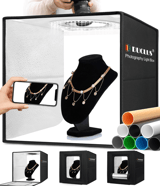
Our top pick is the DUCLUS 16 x 16-inch Portable Photo Studio Box. Its folding design and dimmable LEDs suit small tabletop products. If you already own lights, the Neewer fabric tent offers a different approach. For larger subjects, look at the Amazon Basics or Fasonic boxes below.
What Is the Best Light Box For Photography?
The DUCLUS is our first choice for a compact setup with built-in lighting. But box size comes first: a product that only just fits leaves little room for its backdrop, camera angle, or lighting adjustments.
These five options range from a mini studio for small accessories to a 32-inch box. The Neewer is the exception to the all-in-one kits: it needs a separate light source.

Here is what each option offers and where its size or lighting could limit you.
1. DUCLUS 16 x 16 inch Portable Photo Studio Box
| Brand |
Brand
DUCLUS
|
| Size |
Size
16 x 16 x 16 inch (40.6 x 40.6 x 40.6 cm)
|
| Power Supply |
Power Supply
Power outlet
|
| Dimmable? |
Dimmable?
Yes
|
| Key Features |
Key Features
LED lights can be dimmed and repositioned, box folds flat for storage and transport
|
| Best For |
Best For
Product photography when space is at a premium
|
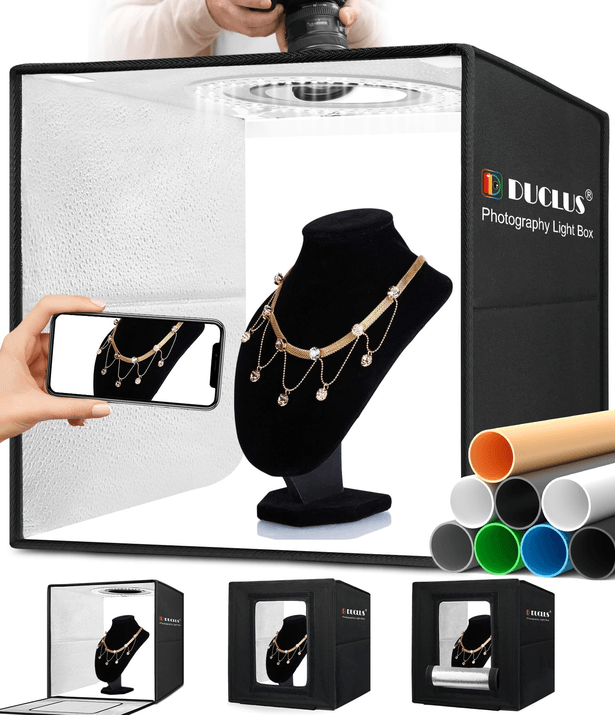
The DUCLUS 16 x 16 x 16-inch light box is a compact choice for small products such as cosmetics, crafts, and accessories. Measure your subject before choosing it; the stated box dimensions are not a promise that a product of the same size can be photographed comfortably.
Its 160 LEDs form a ring, with dimming to adjust brightness. The reflective interior spreads the light, and the supplied diffusion cloth helps soften it. You also get eight backgrounds: six PVC and two paper sheets.
The folding design suits a desk that must be cleared after a shoot. Front and overhead openings give you a choice of viewing angles without rebuilding the setup.
Choose it for small items and limited storage. If your products crowd a 16-inch cube, the larger boxes below give you more working room.
2. Neewer 24x24" Photo Studio Tent
| Brand |
Brand
Neewer
|
| Size |
Size
24 x 24 x 24 inches (61 x 61 x 61 cm)
|
| Power Supply |
Power Supply
n/a
|
| Dimmable? |
Dimmable?
n/a
|
| Key Features |
Key Features
Foldable, includes front cover and 4 color backdrops (black, white, blue, red)
|
| Best For |
Best For
Those who already have a suitable light source
|
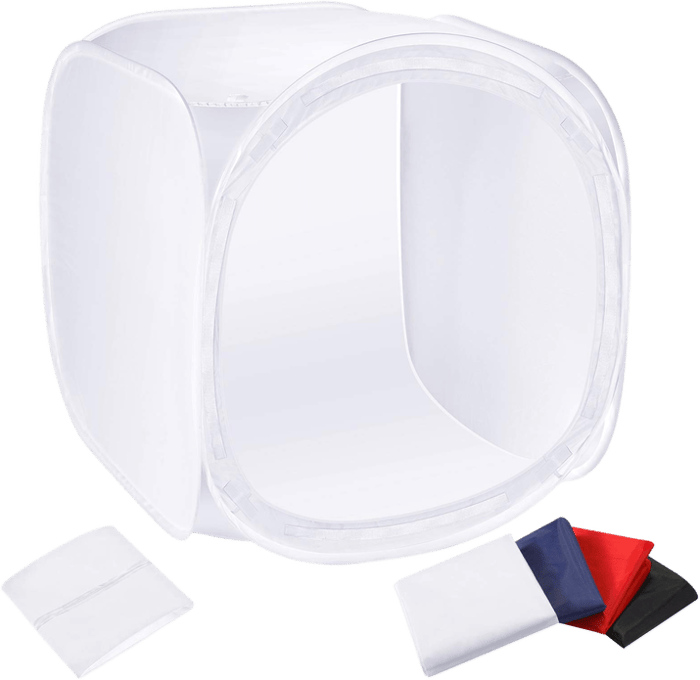
The Neewer 24 x 24″ version is a fabric shooting tent, with no built-in lights. Its translucent nylon walls diffuse light placed outside the tent. That makes it a sensible choice if you already have lighting you want to use.
The kit includes a removable front cover with a lens slit, a carrying bag, and four backgrounds in black, white, blue, and red. The front can be opened for arranging products, then covered for shooting.
Fabric backdrops can show creases after storage. Inspect the background before you set the product in place so you do not have to correct every crease later.
For separate continuous lighting, the EMART LED Continuous 5500K Light Lamps are an option. Allow desk space outside the tent for the lamps. If you want lighting contained inside the box, consider the DUCLUS or Amazon Basics instead.
3. Amazon Basics Portable Photo Studio Box
| Brand |
Brand
Amazon Basics
|
| Size |
Size
25 x 30 x 25 inches (63 x 76 x 63 cm)
|
| Power Supply |
Power Supply
Power outlet
|
| Dimmable? |
Dimmable?
No
|
| Key Features |
Key Features
Collapsible, 3 front doors for flexible shooting options, quick to set up
|
| Best For |
Best For
Taking product photos for the Amazon Seller app
|
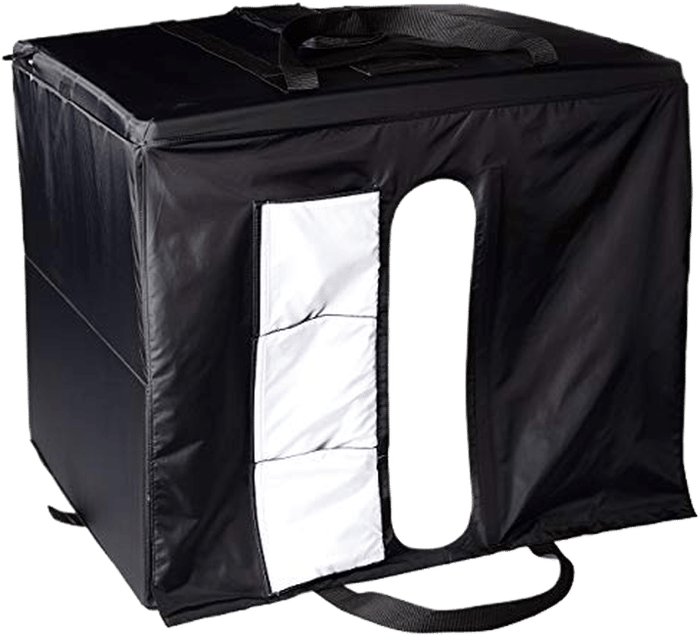
The Amazon Basics photo studio box offers a larger enclosure with built-in LEDs. Amazon lists its size as 25 x 30 x 25 inches and says it folds into a thin carrying case with no assembly required.
The kit includes a white backdrop and power supply. Its 5600K LEDs, three-part front opening, and top shooting hole suit both front-facing and overhead product views.
It can be used with a camera or a phone. A stable phone position and consistent lighting help you take great product images when you need several views of the same item.
The main buying question is whether you have room for it. Measure your table and leave space in front for the camera. A larger enclosure helps with bigger products, but it also occupies more of a small workspace.
4. Fasonic 32 x 32 x 32 inch Photo Studio Light Box
| Brand |
Brand
Fasonic
|
| Size |
Size
32 x 32 x 32 inches (81.3 x 81.3 x 81.3 cm)
|
| Power Supply |
Power Supply
Power outlet
|
| Dimmable? |
Dimmable?
Yes (10-100%)
|
| Key Features |
Key Features
210 LED beads across 3 rotating panels, CRI>95, 6 removable backdrops
|
| Best For |
Best For
Large product photography
|
The Fasonic 32 x 32 x 32-inch Light Box is the largest option here. Consider it for products or grouped arrangements that would crowd the smaller boxes, while still allowing space behind and beside the subject.
The listing specifies 210 LED beads across three light panels, with 360-degree panel movement and brightness adjustment from 10% to 100%. These controls let you change the direction and amount of light as well as the camera position.
It includes a diffuser and six PVC backdrops: white, black, orange, blue, green, and red. Multiple shooting openings provide different viewing angles.
Its drawback is the working space it needs. Check where you will assemble, use, and store a 32-inch box before buying it. Extra room only helps if the setup fits your workspace.
5. PULUZ 20 cm Portable Photo Studio Kit
| Brand |
Brand
PULUZ
|
| Size |
Size
8.66 x 9.45 x 9.06 inch (22 x 24 x 23 cm)
|
| Power Supply |
Power Supply
USB 5 V
|
| Dimmable? |
Dimmable?
No
|
| Key Features |
Key Features
Extremely portable with six different colored backdrops
|
| Best For |
Best For
Small product photography on a budget
|
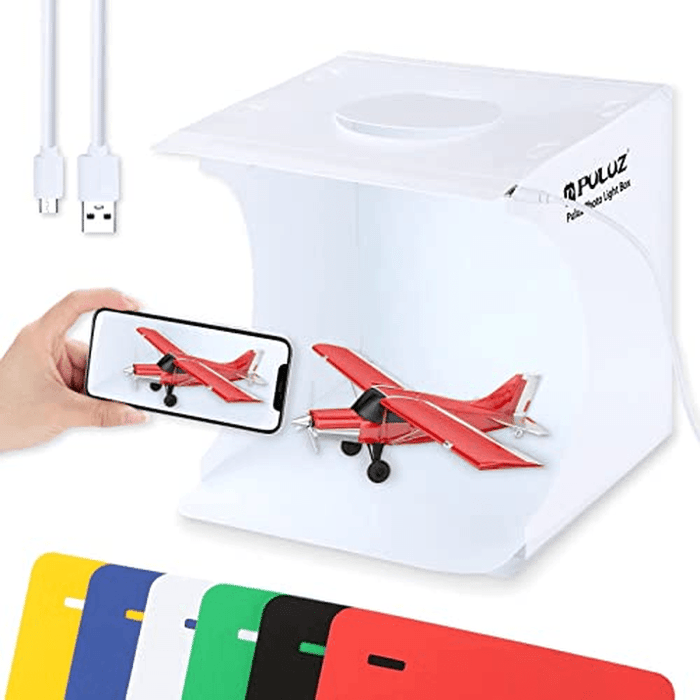
The PULUZ Photo Studio Box is the mini option for small accessories and individual pieces of jewelry. The listed dimensions are 8.66 x 9.45 x 9.06 inches, so leave room around the object instead of treating those measurements as the maximum subject size.
An integrated bar holds 20 LEDs. Front and top shooting windows let you change the viewing angle, and the box assembles with Velcro.
The listing specifies a 5V, 1A USB power supply. Check your power source before taking it to a client's shop or office.
Choose this size when carrying and storing the kit matter more than photographing larger objects. For jewelry sets, larger props, or several products together, measure the complete arrangement before deciding a mini box is enough.
How to Choose the Best Light Box for Photography
Start with the largest product you photograph regularly. Then check your lighting, camera access, and storage space. Those choices matter more than the number of LEDs alone.
Size, Ease of Use, and Portability
Measure the subject's width, height, and depth in the position you want to photograph it. Allow extra space for the backdrop to curve behind it and for the camera to see the whole product without including the edges of the box.
For example, a 16-inch-tall vase is a poor fit for a 16-inch cube, even if you can physically put it inside. You still need room above it and behind it. For grouped products, measure the arrangement rather than each item separately.
Check the camera position too. An overhead opening must give your lens or phone enough room to frame the shot. A front opening must let you work at a distance where your camera can focus.
If you travel to clients, check the folded size, carrying case, and power requirement. A portable box still needs a suitable place to set it up. Plan where you will place the box and how you will power it before the shoot.
Lighting
Decide whether you need a box with LEDs or a fabric tent for lights you already own. The Neewer has no built-in lighting; the other four picks include LEDs.
Dimming helps you adjust exposure without changing the aperture you chose for depth of field. Movable lights, where supplied, also let you change the direction of shadows and highlights. More LEDs alone do not tell you how the light will look on your product.
Keep the lighting consistent when photographing a series. Set white balance for the light you are using, and check a test shot before photographing the rest of the products. Stray room lighting can make that consistency harder to maintain.
Shooting Apertures and Backdrops
A top opening helps with flat lays. A front cover can reduce reflections of the room in a glossy subject, but a small lens slit is not the right solution for every object. You need enough camera access to find an angle that shows the product's shape.
A light box softens light; it does not guarantee a reflection-free photograph. With jewelry or polished surfaces, take a test shot and adjust the product, camera, or lighting angle. Even lighting can also reduce the contrast that makes a textured object look three-dimensional.
Check the backdrop material as well as its color. The ones that came with a cheap unbranded light box I bought are too shiny to be of any use. So it’s worth checking that. Choose a matte background when you do not want a reflected image beneath the product.
Keep backdrops clean and store them without sharp folds. Follow the material's care instructions for wrinkles; do not assume a plastic backdrop can be ironed like fabric.
Other Useful Tools to Have
A remote control for your camera can help a great deal. Especially if you want to hold a light or other accessory while you shoot.
A tripod or phone support helps keep the framing consistent while you adjust the product. Clean the item and backdrop before shooting, then check the first image for dust, glare, and missed focus.
A small stand can raise the product off the tent floor. I have used a cheap selection of plastic cereal bowls from Ikea as a lightweight stand.
Keep any support stable and outside the frame unless it is part of the picture. Set your camera angle first, arrange the product, and check the result before photographing a whole batch.
Conclusion
Choose a light box around your products and the space you have. A mini box suits individual accessories. A larger enclosure gives you more room for grouped or bulkier items. A fabric tent makes sense when you already own the lights.
Our top pick remains the DUCLUS 16 x 16-inch Portable Photo Studio Box for small tabletop products and a setup that folds away. Measure your subject first, leave space around it, and choose a larger box if the 16-inch size would restrict your shots.