Photo scanners come in many sizes with different resolutions, features, and prices. Freedom of choice is a luxury, but it can be hard to know which scanner is best for you. We’ve “scanned” through hundreds of photo scanners to find the very best, factoring in the different user requirements.
If you want to buy a scanner, we recommend this Epson FastFoto FF-680W photo scanner. It has excellent image resolution, so your photos don’t lose their magic. You can scan in batches for superfast photo scanning. And it can deal with photos of all sizes. It’s the best photo scanner for digitizing your photos.

What Is the Best Photo Scanner?
The best photo scanner is the Epson FastFoto FF-680W. It feeds 36 prints at once and digitizes a whole album in minutes. For film and negatives, the Plustek OpticFilm 8200i AI is the better buy.
Our list below covers batch scanning, budget-friendly flatbeds, and dedicated film and negative scanning. Before we discuss each scanner in detail, here is a quick roundup of our favorites and why we like them.
If you have a huge backlog of prints, start with the FF-680W or the Canon imageFORMULA RS40. Both have automatic feeders that work through dozens of photos unattended. For occasional, budget flatbed scanning, the Plustek ePhoto Z300, the Epson Perfection V19 II, and the Canon CanoScan LiDE400 all fit. The V19 II and the LiDE400 scan at 4800 dpi for a bit more money than the 600 dpi Z300. And if you shoot film, skip the flatbeds and go straight to the Plustek OpticFilm 8200i AI.
What to Look For in a Photo Scanner
Analog photography is in the midst of a revival. So many photographers are going back to film cameras.
As a result, more people are looking for the best photo scanner to digitize prints. And manufacturers have taken note and produced some excellent machines.
Many photographers will be happy with a single-purpose scanner. These are dedicated to scanning and have no other functions, like printing or copying. All but one on our list are “flatbed” or “tray-fed” scanners. The exception is a dedicated film scanner.
If you’re looking for a more versatile scanner, an all-in-one unit is what you need. A multifunction printer has printing abilities. But it’s also equipped with a flatbed scanner.
They duplicate photos well. But the scanning quality usually isn’t as good as single-function scanners.
Other models have more film-friendly features. They have hardware for scanning slides and film negatives. These home photo labs are for serious film photography buffs. And they often have printing capabilities too.
If you’re a film photography enthusiast wanting to save money on scanning costs, our list of the best film scanners is essential reading.
The price can vary a lot with scanners. Single-function scanners are often at the cheaper end of the spectrum. And as you add more features, the price tends to go up. But some specialist units can have high prices.
6 Best Photo Scanners
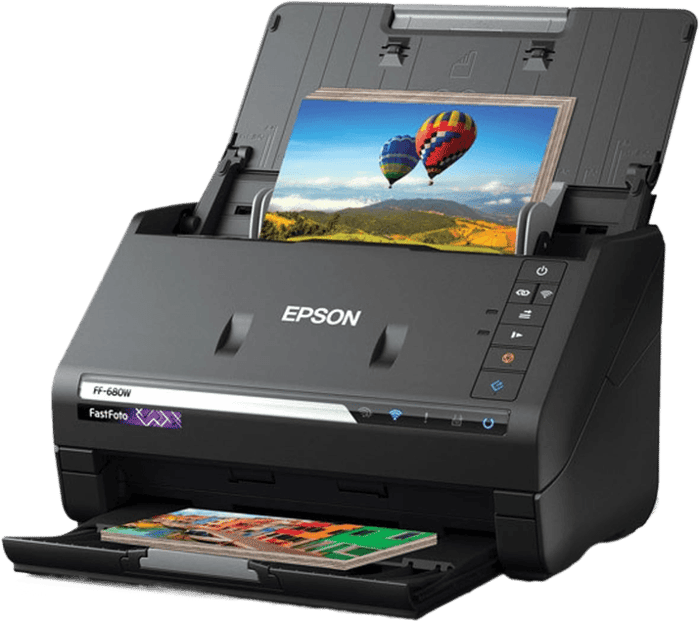
The Epson FastFoto FF-680W is a specialist photo scanner for home use. It’s one of the best batch scanners for digitizing your back catalog, and it’ll have your photo albums scanned and filed in no time.
It uses a document feeder system rather than a flatbed for scanning. So it’s aimed at photos, but you can also use it for A4 document scanning. And Polaroid pictures aren’t a problem either, thanks to the adjustable document feeder.
The automatic document feeder holds 36 photos at a time. It scans the whole set of 36 automatically, leaving you free to get on with other things.
You don’t have to insert a new print for each scan. It pulls the next photo through, scanning one photo after another. So it’s the fastest photo-scanning solution there is. It also handles different sized photos in the same batch, so you can scan images from different albums all at once.
A max dpi of 1200 is more than enough for most home scanning needs. There are scanners with higher dpi levels, but images scanned by the FF-680W still have excellent picture quality. Higher dpi’s also slow down the scanning process, and speed is one of this scanner’s secret weapons.
The Picture Perfect Imaging System improves old photos with color restoration and enhancement. The software also removes red-eye and dust spots for better-quality photos. This is a big help with old prints, revitalizing them so they look better than they did when originally printed.
It’s a wireless machine with Wi-Fi connectivity, so you can scan directly to computers and mobile devices without tethering. You can even have scans sent to a Dropbox or Google Drive account directly from the printer.
You can accompany the FF-680W scanner with the FastFoto app on your smartphone. It receives scanned photos, and you can add text and effects or create slideshows. This also makes it easy to share pictures directly on social media.
One thing to know before you buy: it's a document-feeder scanner, not a flatbed, so it can't handle film negatives, slides, or fragile and bound originals. If any of those are on your list, look at the OpticFilm 8200i AI or one of the flatbeds further down instead.
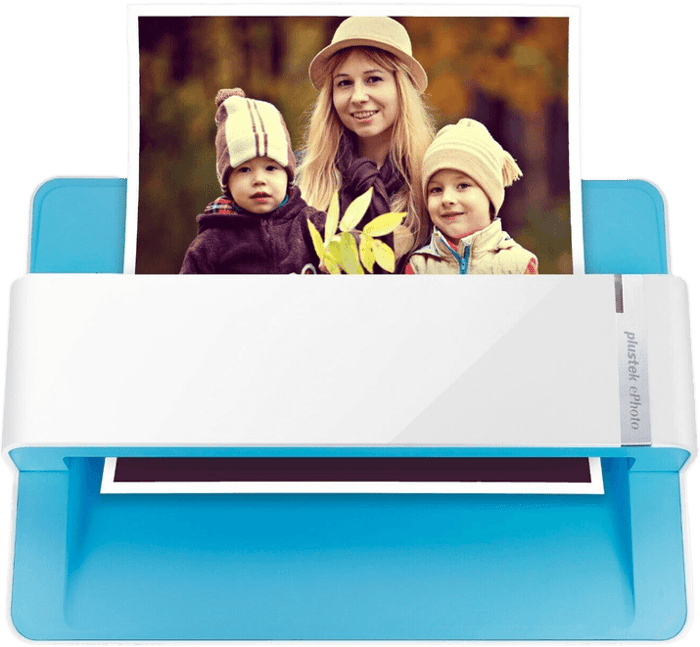
Photo scanners don’t get much more straightforward than the Plustek ePhoto Z300. It’s a basic scanner without complicated functions. This could be the right photo scanner for you if you want to digitize photos without investing in professional equipment.
There are no options for scanning film. But it supports several photo sizes (3 x 5, 4 x 6, 5 x 7, and 8 x 10 inches). You can also scan letters and A4 documents.
You need to feed each photo into the scanner one at a time. That might sound time-consuming, but it only takes two seconds to scan a 4 x 6-inch photo. So you’ll have full albums done in no time. And it has a scan resolution of 600 dpi.
The software includes image-enhancing functions. The simple interface lets you restore faded photos or enhance colors and details. And you also have options to do minor edits and organize your photos.
The ePhoto Z300 is a simple and affordable solution to your photo scanning needs. And it’s compatible with both Windows and macOS systems.
Keep in mind it feeds one photo at a time rather than in batches, and its 600 dpi ceiling is the lowest on this list. If you're digitizing a big backlog or want more resolution for enlargements, the FF-680W or the V19 II are the better fit.
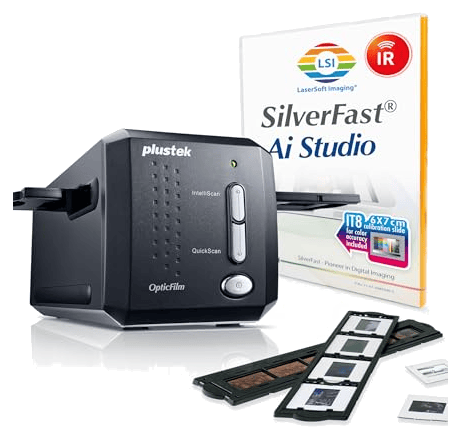
The Plustek OpticFilm 8200i AI is the best photo scanner for serious film enthusiasts. It is a single-function scanner without printing or copying features. But it is a fantastic scanner for people with a passion for film.
Epson now makes only one flatbed film scanner, the high-end V850 Pro, so a dedicated film scanner is now the affordable route to good home negative scans. This one is built for exactly that job and nothing else.
It scans 35mm negatives and mounted slides at 7200 dpi, far more real detail than any flatbed pulled off a 35mm frame, because the film sits millimetres from the sensor rather than on a glass bed.
It has an infrared channel for dust and scratch removal, the same idea as digital ICE. The scanner reads the defects on a separate pass and the software paints them out, which saves hours of retouching on negatives that have been in a shoebox for thirty years.
It ships with SilverFast, which handles the colour inversion and IT8 calibration properly, so you get finished photographs rather than raw inverted negatives.
Be clear about the limits before you buy. At around $499 it costs more than the flatbeds on this list, it only takes 35mm (no medium format, no prints), and it scans one frame at a time. If you mostly digitize photo prints, buy one of the flatbeds above instead.
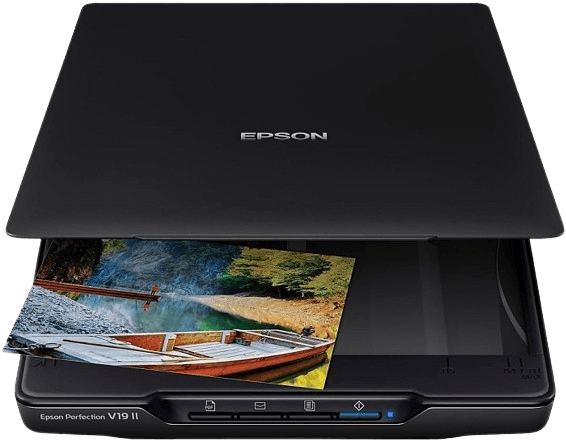
Slim, compact, and lightweight, the Epson Perfection V19 II is ideal for the home office. A sleek, professional design helps it blend in with your other devices without ruining your decor. It’s also one of the most affordable scanners on the list, allowing you to digitize your photo library without maxing out your budget.
The flatbed design allows you to scan everything from photos to books to documents. You can scan documents up to A4 size, so you’ll have no problem scanning photos. You can even scan more than one photo at a time to speed things up. The lid can also be raised or removed, allowing thicker objects to be scanned.
With a maximum scanning resolution of 4800 dpi, the V19 II enhances the quality of printed photos. They’ll look better on screen than they do in real life. The native scanning software also restores colors to old, faded photos, bringing vitality to ancient images with just a few clicks.
There’s no LCD screen, but the commands are so simple you don’t need one. One-touch scanning means you can get started straight away without navigating annoying, overly complicated menus. It’s also a plug-and-go system, so you don’t need to waste time updating drivers.
The V19 II automatically generates PDF files when scanning documents. It also gives them sensible names you can easily search for on your computer. That means you can scan a whole bunch of documents at once without making a mess of your filing system.
Measuring only 36.6 x 25 x 3.8 cm / 14.4 x 10 x 1.4 cm, it takes up very little space. And if you are lacking space, you can stand the scanner upright. You can squeeze it into tighter areas, and it still scans when standing up. It even has a built-in stand to keep it upright.
You don’t need to worry about the scanner becoming a drain on your electricity bills. It gets all the power it needs from the USB connection with your computer.
The Epson Perfection V19 II is the best value scanner on this list. It’s an affordable device that’s perfect for the home, allowing you to scan and enhance old photographs quickly and easily.
It doesn't have any film or negative holders, so it's built for photos and documents only. Film shooters should look at the OpticFilm 8200i AI instead.
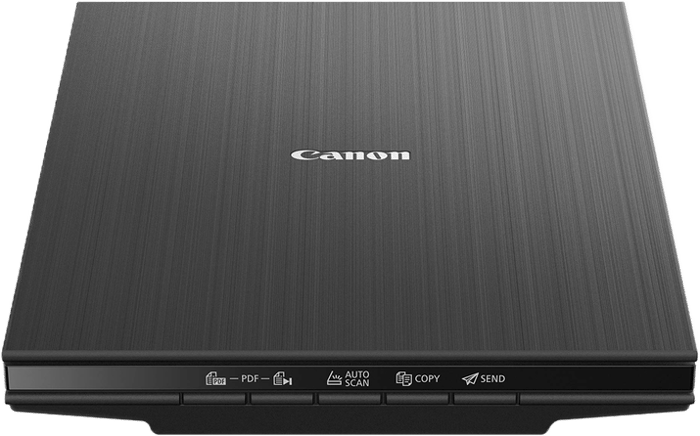
The Canon CanoScan LiDE400 is an excellent photo scanner for home use. It’s a slim-line scanner with a flatbed for scanning photos and documents. It’s simple and straightforward. And the scan quality won’t disappoint.
Photo scanners aren’t much more streamlined than this one. It takes up very little space in your home office. Plus, it’s versatile. It scans photos, documents, and thicker media like books. And documents can be saved as editable PDF files.
With a scan resolution of 4800 dpi, your digitized copies will look as good as the original prints. And it enhances colors and removes blemishes automatically.
The different scanning modes are intuitive. And they make storing and organizing your photos easy.
You have options for documents, photos, and customized scans. And you can direct the files to specific locations on your device. Or you can scan directly to OneDrive or Dropbox.
The LiDE400 is an energy-efficient machine. It connects to your computer with a USB. And that’s all the power it needs! Plus, the photo scanner wastes no time warming up.
Like the V19 II, it has no film-scanning hardware, so it's built for prints and documents rather than negatives. And as a single-sheet flatbed with no auto-feeder, it's a one-photo-at-a-time tool rather than a batch scanner.
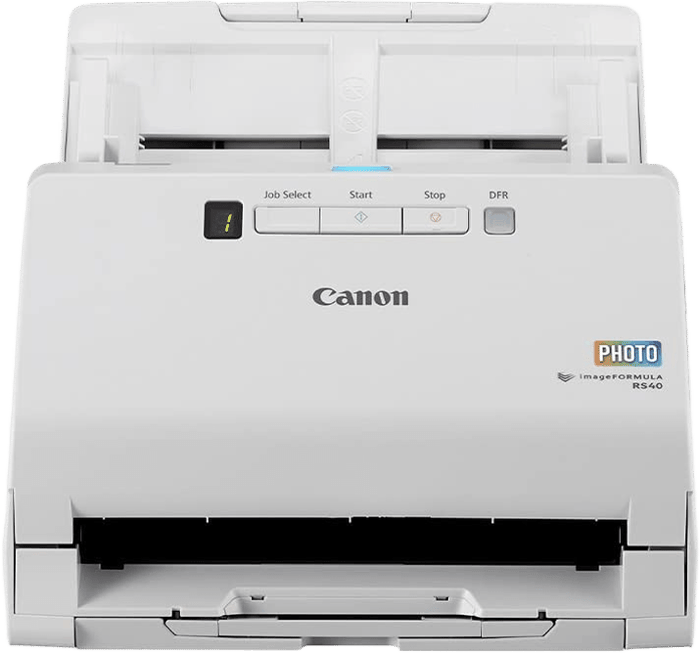
The Canon imageFORMULA RS40 is one of the best photo scanners if you're digitizing large amounts of photos. The batch scanning capabilities allow you to scan hundreds of images without much user input. It's also a versatile scanner you can use for document scanning.
Scanning with the imageFORMULA RS40 can actually enhance the image quality of your printed photos. You can choose the scan quality, with options from 150 to 1200 dpi. That means you can scan any type of photo from old holiday snaps to professional photos.
With a 40-photo capacity auto feeder, you can scan bundles of images without much effort. That means you can leave it to scan 40 photos while you work on something else. It's a huge time saver, especially if you have mountains of photos to archive.
It can also handle photos of different shapes and sizes. Standard photos measuring 4 x 6, 5 x 7, and 8 x 10 inches are no problem. But it can also scan Polaroid pictures, postcards, and panorama images.
When it comes to other types of documents, the RS40 is just as versatile. Your standard A4 document is a walk in the park. And it can scan letters, legal documents, invoices, and even ID cards.
You also get the CaptureOnTouch photo software. It's basic photo adjustment software, so it can't compete with Adobe Lightroom or other advanced programs. But it can help you reduce signs of fading and aging in the images. It can make subjects sharper and you can remove red-eye.
The Canon imageFORMULA RS40 is an excellent photo scanner for the home or office. It delivers professional-level digital renditions. And you can use it for all types of batch scanning.
It has no film or negative holders either, so slides and negatives are out of scope. For those, go to the OpticFilm 8200i AI instead.
FAQs on the Best Photo Scanners
This section answers some of the most frequently asked questions regarding photo scanners. We hope this information helps you find exactly what you need.
What is DPI?
Simply put, DPI is the scanner’s image resolution. It stands for Dots Per Inch, and the higher the number the better the resolution of a scanned image.
This is similar to the megapixel (MP) count on a camera’s sensor, only scanners use the word dot rather than pixels. Sensors with a higher MP have a better resolution, meaning images are more clear and have sharper detail. The same is true with scanners that use a higher dpi.
Dpi is one of the most important specifications when you’re looking for a photo scanner. It provides a good indication of the quality of the scanned images. However, bigger isn’t always better. It depends on the types of photo scanning you’re doing.
If you’re digitizing old photos, you won’t need the scanner with the highest dpi. You’ll be spending more money than you need to. Something with a max dpi of 4800 is more than good enough for this type of scanning.
You might need more if you’re a professional scanning images for work. A 6400 dpi will give you high-resolution images suitable for publication and enlargement.
You should also be aware that scanner listings usually only note the maximum dpi. The scanner will have lower dpi options for quicker scanning.
Which Scanner is Best for Batch Scanning?
The Epson FastFoto FF-680W is our top choice and its batch-scanning abilities are one of the main reasons for that.
You can load a full 36-photo deck into the feeder, and the scanner takes care of the rest. Press start and off it goes. You don’t need to press anything else until the all 36 prints have been scanned.
The time it takes to scan a 36-photo batch depends on the dpi setting you’ve chosen. The higher the dpi, the slower it will scan. But the automation means you’re free to do other things.
The Canon imageFORMULA RS40 is another top scanner for batch-scanning. It can hold up to 40 photos, which is more than one film’s worth of images. And like the FF-680W, once you start the process the scanner doesn’t stop until all 40 photos are scanned.
It’s also quick, scanning up to 40 items in just one minute. Of course, you have to scan with the lowest dpi setting to hit those speeds, but it’s still quick even at max resolution.
Which is the Best Film and Negative Scanner?
The Plustek OpticFilm 8200i AI is the best scanner for film and negatives. You can’t use any old flatbed scanner when scanning film negatives, and the only Epson flatbed that can is the high-end V850 Pro. A dedicated film scanner is the answer.
It takes 35mm negative strips and mounted slides at 7200 dpi, with an infrared pass for dust and scratch removal. The bundled SilverFast software renders the scans as proper photographs, not merely scanned negatives. They are fully formed, usable, high-resolution images.
If you shoot medium format, this one won’t help. It is 35mm only. Check the used market for a working Epson V600 or V850 Pro, or send the rolls to a lab.
If you’re looking for a dedicated negative scanner, check out our full article on the best film scanners for photographers. We look at all the best film scanners in detail, so it’s a must-see for film photographers.
Conclusion: The Best Photo Scanner
Having researched hundreds of scanners, we’re happy to recommend all of the scanners on this list. They are each uniquely good at what they’re built for.
The Epson FastFoto FF-680W is the best photo scanner on the market. With its batch-scanning features, you can scan whole libraries in no time. And its high-quality scanning means you will have glorious versions of your beautiful photos.
Still not sure which one? Match it to the job: the FF-680W or the RS40 if you have a big backlog to get through, the ePhoto Z300, V19 II, or LiDE400 for occasional flatbed scanning, and the OpticFilm 8200i AI if film negatives are involved. For most people clearing out a shoebox of prints, the FF-680W is still the fastest way to get it done.