The best thermal cameras let you see things invisible to the human eye. They reveal poor insulation, fire risks, and even dampness. And they come in many shapes and sizes. So we’ve selected the best thermal camera across styles and price ranges.
Our top pick is a great all-rounder. The TOPDON TC002C Duo has an impressive temperature range, an excellent refresh rate and sensitivity, and one USB-C plug that fits any current phone.
What Is the Best Thermal Camera?
The best thermal camera is the TOPDON TC002C Duo. It plugs into the USB-C port on any current iPhone, iPad, or Android phone, delivers a 256 x 192 sensor and a 25 Hz refresh rate, and works well for both home inspections and professional use.
If you want the cheapest way to see heat, the PerfectPrime IR202 clips onto an Android phone for well under half that. If you would rather not tie the job to your phone at all, the FLIR C3-X is a standalone camera with its own screen and battery. And if you are chasing damp rather than heat, the FLIR MR277 pairs the thermal image with a moisture meter.
Below, we look at our choices in detail, along with a buying guide to help you weigh up features.


8 Best Thermal Cameras
Now let’s look in more detail at our recommended thermal cameras. Jump to our buying guide at the end if you need some help sorting out features to consider. Or it may answer some questions you may have.
1. FLIR ONE Gen 3 Thermal Camera
| Brand |
Brand
FLIR
|
| Resolution |
Resolution
80 x 60 native (240 x 180 super resolution)
|
| Temperature Range |
Temperature Range
-4 to 248 F (-20 to 120 C)
|
| Thermal Sensitivity |
Thermal Sensitivity
150 mK
|
| Key Features |
Key Features
MSX image blending, 8.7 Hz frame rate, separate iPhone and Android USB-C models
|
| Best For |
Best For
Finding electric, insulation, or water problems around the house
|
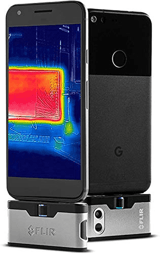
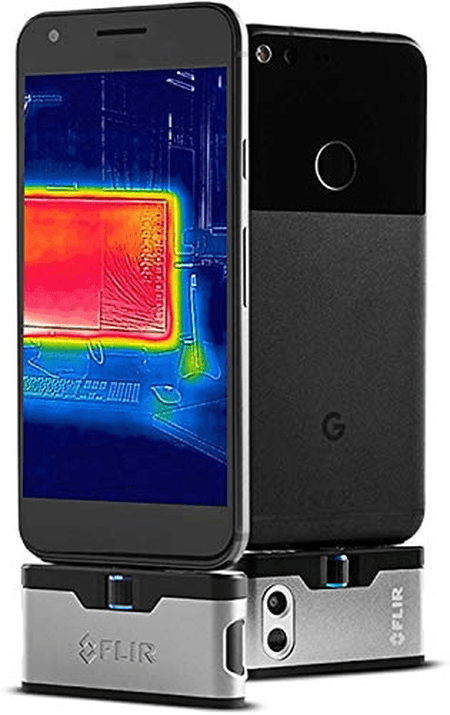
FLIR is a pretty dominant brand in the thermal imaging camera sector. There is a wide range of FLIR cameras that cater to many budgets. And this is one of their cheaper ones.
Like the PerfectPrime, the FLIR ONE Gen 3 attaches an IR camera to the bottom of your phone. But it has its own battery that needs to be charged. So this could limit long sessions.
FLIR dropped the “Gen 3” from the name in late 2025, so you will now see the same camera sold simply as the FLIR ONE. The hardware has not changed. The thermal sensor is 80 x 60, which FLIR upscales to a 240 x 180 image, and the refresh rate is 8.7 Hz.
That refresh rate is the number to check before you buy. It is fine for walking along a wall and watching a cold patch appear. But it smears if you pan quickly, so if you want to track anything that moves, buy one of the 25 Hz phone attachments below instead.
FLIR sells separate iPhone and Android models rather than one unit with an adapter, and the listing we link here is the Android USB-C version. The connector itself adjusts for height, so it copes with a wide range of cases and you don’t have to strip your phone before using the thermal camera.
FLIR is a popular manufacturer because of its MSX (Multi-Spectral Dynamic Imaging) technology. Many thermal imaging devices allow you to see either thermal or visible light images.
Often cameras blend them to show more precisely where the hotspots (or coldspots) are. Remember, the thermal image is a much lower resolution than the visible light image. So having the detail from the visible light camera is a bonus.
MSX technology is slightly different. It takes the visible light images and uses them to emboss the thermal imaging. This can be very useful if you’re looking for a heat signature in a tangle of wires or pipes.
What the Gen 3 doesn’t do is allow infrared or visual images to be shown on their own. But this is their entry-level device, so the features are limited.
The FLIR app allows you to record stills and videos and organize the files. If you’re one of several users in an organization, there is a cloud option to store and access everyone’s images.
2. TOPDON TC002C Duo Thermal Imaging Camera
| Brand |
Brand
TOPDON
|
| Resolution |
Resolution
256 x 192 native (512 x 384 TISR)
|
| Temperature Range |
Temperature Range
-4 to 1022 F (-20 to 550 C)
|
| Thermal Sensitivity |
Thermal Sensitivity
<40 mK
|
| Key Features |
Key Features
25 Hz frame rate, one USB-C plug fits iPhone, iPad, and Android
|
| Best For |
Best For
One camera that works on every current phone
|
The TOPDON TC002C Duo is an impressive thermal imaging camera. First of all, it’s neat and compact. It plugs straight into the USB-C port on the bottom of your phone. And it comes in a handy zippered pouch for safekeeping.
The “Duo” in the name is the point of it. One camera covers a USB-C iPhone, an iPad, and an Android handset, so you are not buying a connector-specific model that you have to replace the next time you change phone. It can be plugged in facing towards or away from you, which is handy.
The sensor is 256 x 192, which TOPDON’s TISR processing upscales to a 512 x 384 image. Thermal sensitivity is under 40 mK and the refresh rate is 25 Hz, which is the fastest here alongside the Seek Nano 300. When you connect it, the phone asks whether you want to launch the Topinfrared app. The app is easy to use. You can take a photo or a video of the live view, and you can monitor a single spot, a line, or a whole plane.
I’ve carried TOPDON’s previous TC002 in my camera backpack for a while now, and take it with me when I’m traveling. What I love about it is that a complete beginner can point it at a wall and read the answer, while an advanced user still gets the measurement tools they need. The TC002C Duo is that same camera with the connector problem solved. What it will not do is work on its own. If you need a self-contained camera with its own screen and battery for a full day on site, buy the FLIR C3-X below instead.
3. FLIR C3-X Compact Thermal Camera
| Brand |
Brand
FLIR
|
| Resolution |
Resolution
128 x 96 pixels
|
| Temperature Range |
Temperature Range
-4 to 572 F (-20 to 300 C)
|
| Thermal Sensitivity |
Thermal Sensitivity
70 mK
|
| Key Features |
Key Features
MSX technology, LED light, and robust case
|
| Best For |
Best For
Demanding everyday use
|
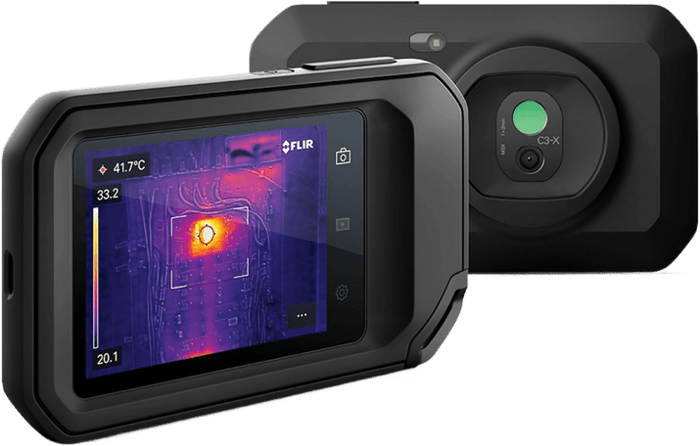
The FLIR C3-X comes in a robust case designed to survive two-meter drops. The touchscreen display is 640 x 480 pixels. It’s low by phone and camera standards but adequate for the task. And there is an LED light to help the f/1.1 aperture on the visible-light camera in poor light.
This thermal camera offers good flexibility for viewing images. You can view what the IR sensors see or what the normal camera sees. Also, you can see the MSX or a picture-in-picture IR image on top of the visual image. The refresh rate is 9 Hz.
The FLIR C3-X uses a rechargeable battery. FLIR rates it at four hours. And as with all FLIR IR cameras, the software is key to making the most of the thermal images. It also allows easy sharing.
This rugged, no-nonsense thermal imaging device meets most needs very well. I haven’t included a separate entry for the FLIR C5. It is very similar to look at but has an upgraded sensor.
It also has a higher top limit of temperature detection of 752 F (400 C) and a better resolution of 160 x 120 pixels, which is about 55% more pixels. Both have IP54 weather ratings.
The C3-X is the wrong buy if you only need a thermal camera once or twice a year. It costs roughly three times the cheapest phone attachment on this list, and that premium only pays for itself if you are using it regularly enough to want a tool that doesn’t tie up your phone.
4. PerfectPrime IR202 Infrared Thermal Camera
| Brand |
Brand
PerfectPrime
|
| Resolution |
Resolution
80 x 60 pixels
|
| Temperature Range |
Temperature Range
-40 to 752 F (-40 to 400 C)
|
| Thermal Sensitivity |
Thermal Sensitivity
150 mK
|
| Key Features |
Key Features
15 Hz frame rate, available for USB-C Android and iPhone
|
| Best For |
Best For
Keeping in the toolbox for occasional use
|
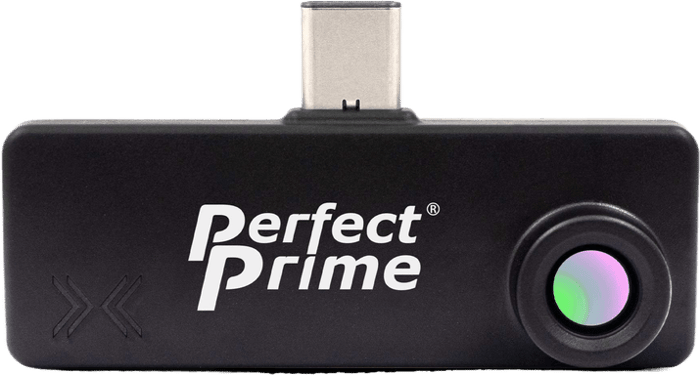
The PerfectPrime IR202 is our best budget thermal imaging camera. And it makes you feel like James Bond. It attaches to the bottom of your Android smartphone via the USB-C socket. PerfectPrime sells an iPhone model separately.
And it uses your phone’s battery and screen. So you don’t have to worry about the screen resolution. The idea is quite simple. Plug the infrared (IR) camera into the phone. Then use the phone’s processing power, battery, and screen to do the rest.
This is a very small unit. It adds a shade over an inch (2.5 cm) to the length of your phone. You can easily carry it in a bag or even in your pocket. And it comes with a pouch to protect it.
The refresh rate of the image is 15 Hz or 15 frames per second (fps). This is adequate if you’re looking for heat leaking from your house. If you want to identify prey on a hunt, then look elsewhere. A moving image with this low frame rate is tiring on the eyes.
It’s unlikely a daily building inspector would buy this. Not all industry people believe the product’s temperature range and sensitivity claims.
But it’s worth considering this thermal imaging camera if you have an occasional need. Or maybe you just fancy having a nifty thermal gadget to add to your collection.
There is another version available. The PerfectPrime IR501 has a higher-resolution sensor and actually costs less than the IR202. The catch is that it is Android USB-C only, and its temperature range tops out at 626 F rather than 752 F.
5. Seek Thermal Nano 300 Thermal Imaging Camera
| Brand |
Brand
Seek Thermal
|
| Resolution |
Resolution
320 x 240 pixels
|
| Temperature Range |
Temperature Range
-4 to 626 F (-20 to 330 C)
|
| Thermal Sensitivity |
Thermal Sensitivity
<35 mK
|
| Key Features |
Key Features
25 Hz frame rate, SV1 Image Optimization, USB-C connector for iPhone 15 and 16
|
| Best For |
Best For
The highest native thermal resolution of the phone attachments here
|
Another thermal imaging phone attachment is the Seek Thermal Nano 300. It’s a clip-on sensor that plugs into your phone’s port and uses the phone’s own screen, battery, and processing.
The Nano 300 has a 320 x 240 sensor, the highest native thermal resolution of any phone attachment here, and a 25 Hz frame rate. That refresh rate matters if you’re panning across a wall or a roofline looking for a heat leak. The image keeps up with your hand movement instead of smearing, which is a common complaint with slower phone-attachment thermal cameras.
There’s no visual image blending or overlay here. You get the 320 x 240 thermal image resolution and nothing else layered on top. If you want a visible-light overlay on the thermal image, look at the FLIR options above instead.
High-frame-rate, high-resolution thermal cameras like this one can fall under IR export restrictions in some countries, since the same specs are regulated for military use. If you need to travel internationally with a thermal camera, check the current export rules for your destination before you buy.
The Nano 300 connects via USB-C and is built for iPhone 15 and 16. Seek also sells Nano models with a Lightning connector for older iPhones and a USB-C version for Android, so check which connector matches your phone before ordering.
6. Hti-Xintai HTI-19 Infrared Thermal Camera
| Brand |
Brand
Hti-Xintai
|
| Resolution |
Resolution
320 x 240 pixels
|
| Temperature Range |
Temperature Range
-4 to 932 F (-20 to 500 C)
|
| Thermal Sensitivity |
Thermal Sensitivity
50 mK
|
| Key Features |
Key Features
High maximum temperature and 3 GB memory
|
| Best For |
Best For
Users needing a higher temperature range
|
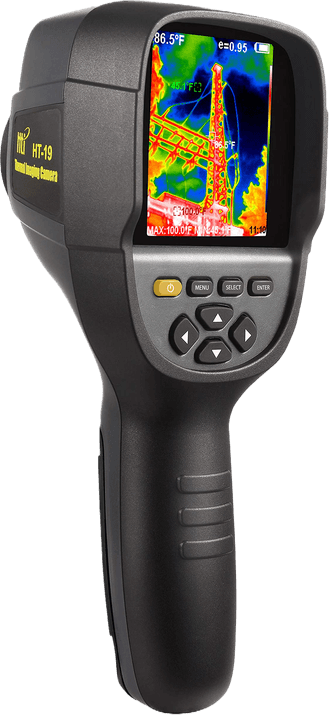
The Hti-Xintai HTI-19 is another pistol-grip camera for thermal imaging. It has 3 GB of onboard memory and a rechargeable battery. It should give you about three hours of recording thermal images.
The conventional camera records as usual. The refresh rate is 9 fps.
The menus allow you to adjust the position of the images. This is because, like any similar camera, there is some parallax error. This varies according to the distance from the subject.
The 50 mK sensitivity is impressive. So is the high maximum temperature of 932 F (500 C). This might be a major selling point for you at this price point.
In other ways, there are some shortcomings. There’s no tripod mount. There is no wireless option, so you must transfer images via USB. And there’s no target laser for easy target pointing.
The 320 x 240 resolution is a plus. And combined with the high maximum temperature range, it’s worth a look.
7. Bosch GTC400C 12V Thermal Camera
| Brand |
Brand
BOSCH
|
| Resolution |
Resolution
160 x 120 pixels
|
| Temperature Range |
Temperature Range
14 to 752 F (-10 to 400 C)
|
| Thermal Sensitivity |
Thermal Sensitivity
50 mK
|
| Key Features |
Key Features
Runs on Bosch 12V Max battery platform, Bluetooth and Wi-Fi image sync, IP53 rated
|
| Best For |
Best For
Bosch tool owners who want thermal imaging on their existing battery platform
|
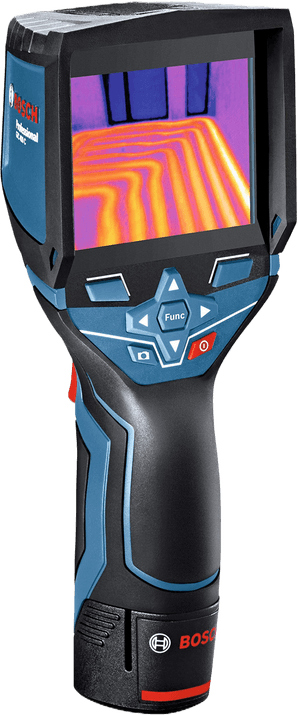
The Bosch GTC400C is a professional-grade thermal camera built to slot onto Bosch’s own 12V Max battery platform. That is a genuine advantage if you already own Bosch cordless tools, since you can skip carrying a separate charger.
For tradespeople who need to document a job rather than just eyeball it, the GTC400C’s 160 x 120 sensor and picture-in-picture blending of the thermal and visual cameras make it easy to show a client exactly where an insulation gap or air leak is. Bluetooth and Wi-Fi sync gets images onto a laptop for a report without a cable.
Its temperature range runs from 14 F to 752 F (-10 to 400 C) with under 50 mK thermal sensitivity, and the IP53 rating means it can handle dust and light splashes on a jobsite. It stores up to 500 images internally.
At around $1,400, it costs about three times the FLIR C3-X above, and its 160 x 120 sensor is only a step up from that camera’s 128 x 96. Most of that money buys Bosch battery compatibility rather than image quality. If you don’t already run Bosch 12V tools, the Hti-Xintai HTI-19 above gives you a 320 x 240 sensor for well under half the price.
8. FLIR MR277 Moisture Meter & Thermal Camera
| Brand |
Brand
FLIR
|
| Resolution |
Resolution
160 x 120 pixels
|
| Temperature Range |
Temperature Range
32 to 212 F (0 to 100 C)
|
| Thermal Sensitivity |
Thermal Sensitivity
70 mK
|
| Key Features |
Key Features
Built-in pin and pinless moisture meter, hygrometer, MSX imaging, 8 GB storage
|
| Best For |
Best For
Water-damage and dampness inspections
|
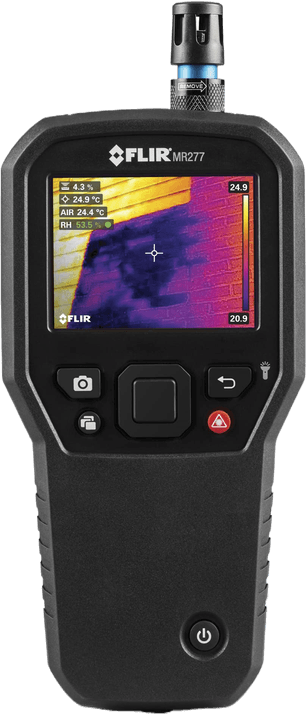
The FLIR MR277 is a hybrid tool. It is a moisture meter and hygrometer built around a 160 x 120 MSX thermal camera, aimed at building and water-damage inspectors rather than general heat-hunters.
This roundup’s buying guide flags dampness as one of the main reasons people buy a thermal camera in the first place, and the MR277 is the one camera here built specifically for that job. Point it at a wall, and the thermal image highlights the cold, damp patch before you confirm it with the built-in pin or pinless moisture probe.
It has an 8-hour battery, 8 GB of onboard storage, a pinless probe reading 0-100 on its own scale, and a pin probe reading 7-30% moisture content in wood. Thermal sensitivity is under 70 mK.
At around $1,849, it’s the most expensive camera on this list, and its 32 F to 212 F (0 to 100 C) temperature range is far narrower than the FLIR C3-X’s 572 F ceiling above. Buy this one because you need the built-in moisture meter and hygrometer, not because you need extreme heat range or a bargain price.
Buying Guide for Thermal Cameras
Here are some answers to a few FAQs. We hope they help you in your buying decision.
How Do I Choose a Thermal Imaging Camera?
Thermal cameras are used to detect and visualize thermal radiation. This is emitted by all objects based on their temperature. Thermal cameras are often used in industrial and engineering applications. But they have become more popular for personal use in recent years.
Thermal cameras come in a variety of shapes and sizes. There are small handheld cameras to large-format ones you can mount on drones.
There are many factors you should consider when purchasing a thermal camera. These include the resolution, spectral range, and image processing capabilities.

How Does a Thermal Imaging Camera Work?
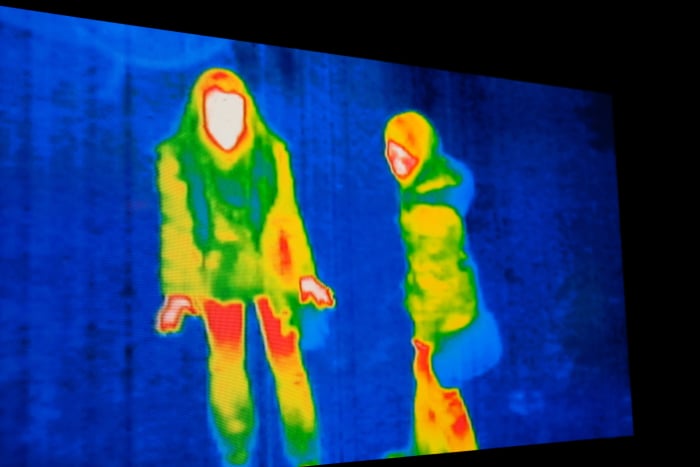
Light is one tiny segment of the electromagnetic spectrum. Imagine visible light as one octave on a piano. And the whole electromagnetic spectrum would stretch from Earth to the Sun. Thermal imaging cameras work by “seeing” the infrared (IR) section of that spectrum.
Heat produces IR. And a thermal imaging camera uses this infrared radiation to tell you how hot something is. Like a normal camera, a thermal imaging camera has a lens and a sensor. In this case, those sensors detect IR radiation.
Like a conventional camera, they present that information on a screen and save it to a memory device. You can then see the various temperatures of everything displayed in the image.
What Are the Important Features of a Thermal Camera?
These are the key features to look out for when buying thermal imaging cameras:
- Resolution: Like a normal digital camera, this is how many pixels there are. Pixel count isn’t nearly as crucial as it is in digital photography. You don’t need to see the pattern on your brickwork. You just want to know how warm it is. So the best thermal cameras have better resolution than cheaper ones. It just might not be as crucial as we are used to.
- Temperature Range: This is the scope of max and minimum temperatures the thermal cameras can “see.” Our review’s cheapest camera has a wide range. The PerfectPrime IR202 range is -40 F to 752 F (-40 to 400 C). The extreme ranges are cold enough for most and hotter than your pizza oven. But it’s not quite hot enough for the fire brigade!
- Thermal Sensitivity: This is the smallest detectable temperature difference between two measurement points. Thermal sensitivity is measured with the cutest measurement unit in science. It is the milli-Kelvin (mK). Again, using our list’s cheapest camera as an example, it has 150 mK sensitivity. That means every pixel can tell the temperature difference between areas of as little as 0.15 C! The lower the number, the more sensitive the sensor. But 150 mK is way more than sufficient to find where heat is escaping.
- A Visible Light Camera: This helps us see conventional and infrared images. After cataract surgery, Claude Monet may have been able to see some ultraviolet light. But none of us can see infrared. So overlaying the IR images on a normal photo helps us see where the hotspots are.
- Style: You either have it, or you don’t! But here, I’m referring to the body that houses the thermal imaging camera. Some camera bodies are like barcode scanners. And others are like small, chunky mobile phones. And speaking of mobile phones, some attach via the USB or Lightning port on the base of your phone.
- Screen Resolution: Does the thermal imaging camera use your phone? Then the screen resolution will be good. Otherwise, check the camera itself so it won’t disappoint.
Conclusion: Best Thermal Cameras
The best thermal camera is the TOPDON TC002C Duo. This is due to its impressive temperature range, excellent refresh rate and sensitivity, and simple, compact design. It offers a reliable and accurate way to detect temperature differences and is perfect for both professional and amateur use.
Its single USB-C connector means one camera works with a current iPhone, an iPad, and an Android phone. And its compact, pouch-ready design makes it easy to carry around. It’s the best choice for a reliable and accurate thermal camera.
If your problem is damp rather than heat, buy the FLIR MR277 instead and use the moisture meter to confirm what the thermal image shows you. And if you want a camera that works without a phone at all, start with the FLIR C3-X.