The Peak Design Slide is the best camera strap for most photographers. It works as a sling, a shoulder strap or a neck strap, and you change between them with one hand. Its Anchor Links unclip the camera in seconds when you move it to a tripod. It suits most bodies, from a mid-size mirrorless camera to a DSLR with a standard zoom.
The other straps cover different loads and ways of carrying. Some keep a heavy camera at your hip for a full day. Some are thin enough for a small camera and a pocket. Others are padded neck straps, harnesses for hiking or for two bodies, and a hand grip for fast street work.
The Best Camera Straps for Every Camera and Carry Style
Choose by where you want the camera to sit. A neck strap keeps it on your chest, where it is quickest to raise. A sling moves the weight to your shoulder and parks the camera at your hip. A harness holds it against your body so it cannot swing, and a hand strap keeps it in your grip. After that, match the padding to the weight of your kit. A light mirrorless camera is fine on thin webbing. A full-frame body with a 70-200mm lens needs a wide pad. The table gives each strap's best use, and the reviews explain the trade-offs.
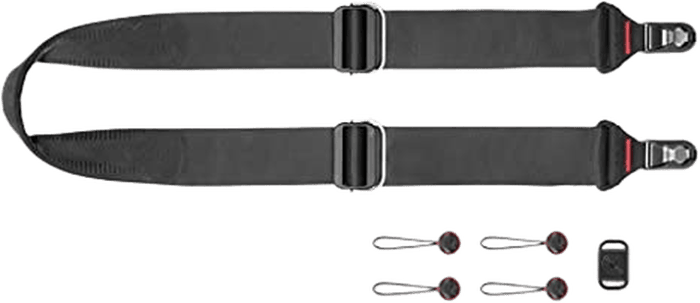
The Peak Design Slide is our first choice because one strap covers most ways of carrying a camera. You can wear it as a cross-body sling on a long walk, shorten it to a shoulder strap in town or hang it round your neck when you shoot often. Two quick-adjusters change the length from 39 to 57 inches. You can do it with one finger while the strap is on.
The webbing has padding inside it, so it stays slim instead of wearing a thick pad. One side is smooth and slides over a jacket when you pull the camera up. The other side is grippy, so the strap stays put in shoulder carry.
The Anchor Link system is the other reason it wins. Small anchors stay on the camera's strap lugs, and the strap clips on and off in seconds. That matters if you move between a tripod and handheld shooting, because the strap never hangs in front of the tripod head. Peak Design rates each anchor for more than 200 lb. The same anchors also fit the Peak Design Leash, so you can keep both straps for different days.
The Slide is a wide strap, and on a small camera it can feel like more strap than camera. Choose the Leash for a compact body. Choose the BlackRapid Blackline I if you want a dedicated sling with a thicker pad for a heavy lens.
2. BlackRapid Blackline I
| Carry Style |
Carry Style
Cross-body sling
|
| Camera Connection |
Camera Connection
Locking carabiner on a tripod-socket screw
|
| Padding |
Padding
Breathable mesh and foam pad
|
| Standout Feature |
Standout Feature
Underarm stabilizer stops the strap slipping
|
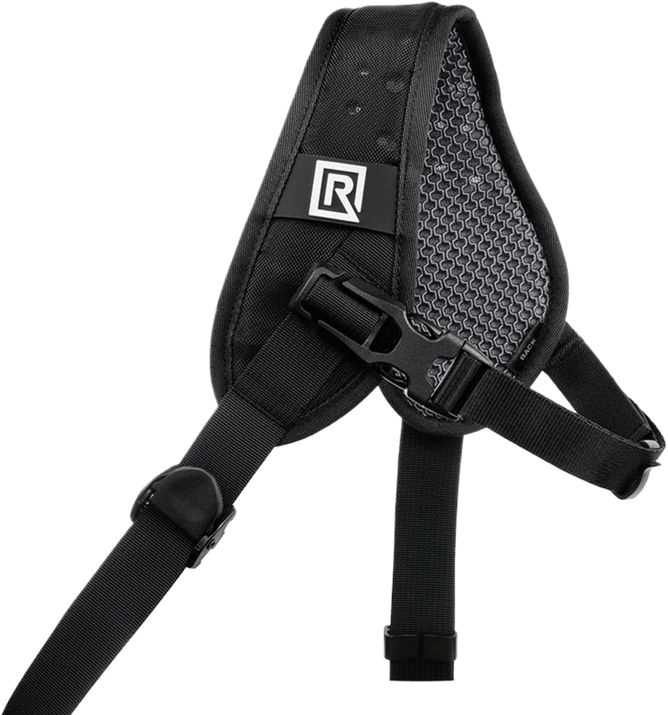
The BlackRapid Blackline I is the strap for a heavy camera on a long day. It is a cross-body sling, so the weight sits on your shoulder and the camera hangs at your hip, not on your neck. When you need it, you slide the camera up the strap to your eye.
The shoulder pad is the main difference from the Peak Design Slide. It combines polyester mesh, foam and air mesh, so it spreads the weight and stays breathable in hot weather. The webbing is nylon and adjusts to a maximum length of 66 inches. An underarm stabilizer locks the strap in place and stops it sliding off your shoulder. Spring-loaded cam locks on the webbing hold the camera at your hip while you walk.
The camera connects through a screw in the tripod socket, called the FastenR, and a locking swivel carabiner. BlackRapid includes a safety tether as a backup. On most cameras the screw has to come out before you can fit a tripod plate, which slows you down if you often switch to a tripod.
Order the right version. The Blackline I Right is worn on the left shoulder with the camera at the right hip. The Blackline I Left is the mirror image. For two cameras, BlackRapid sells the Blackline II as a double harness. The HoldFast Money Maker below does the same job in leather.
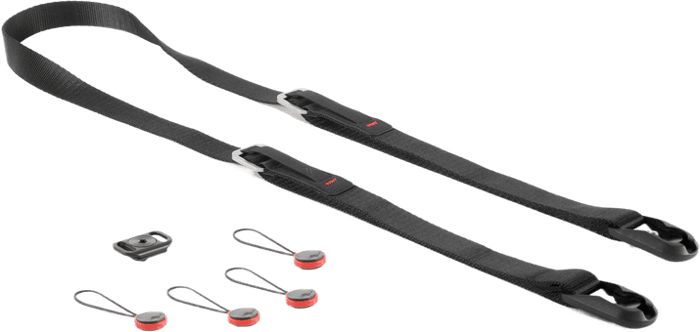
The Peak Design Leash is the best strap for a small mirrorless or compact camera. It uses the same Anchor Link connection as the Slide, but the webbing is thin and unpadded. It rolls up small enough for a jacket pocket, so you can take it off the camera and pack it in seconds.
It works as a sling, a shoulder strap, a neck strap or a short safety tether. The length adjusts from 33 to 57 inches with aluminum and Hypalon adjusters, which gives it a shorter minimum than the Slide. That shorter setting holds a small camera close on your chest without a long loop.
The smooth nylon glides over clothing when you lift the camera. That is good for speed, but it gives the Leash less grip on your shoulder than the Slide's textured side.
The missing padding is the limit. With a light body and a small prime lens you will not notice it. With a full-frame camera and a big zoom, the narrow strap presses into your neck or shoulder within an hour or two. Choose the Slide if you carry a heavier kit, or the OP/TECH Pro Loop if you want a padded neck strap.
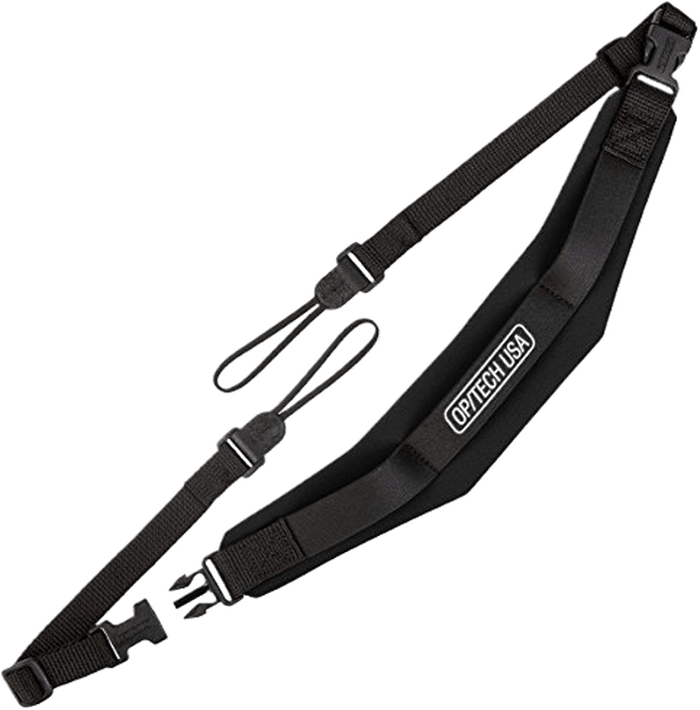
The OP/TECH USA Pro Loop Strap is the padded neck strap to buy if comfort matters more than versatility. Its curved neoprene pad is 2.5 inches wide and 15 inches long. The neoprene stretches with each step, so the camera bounces less on a long walk. OP/TECH rates the strap for cameras and lenses up to 15 lb.
A non-slip backing keeps the pad on your shoulder when you wear it that way. You can also wear it around your neck or across your body.
The Pro Loop version uses two thin 1/4-inch cord loops with leather tabs. They fit cameras with small or slim strap holes, where a wide strap end will not go through. Buckles join the loops to the strap, so you can unclip the strap and leave the small loops on the camera.
The length range is short. It adjusts only from 37 to 43 inches. That is fine for neck or shoulder carry, but it is tight as a cross-body sling if you are tall or wear a thick coat. The Peak Design Slide has a much wider range, and the USA Gear TrueSHOT adds pockets to a padded neck strap.
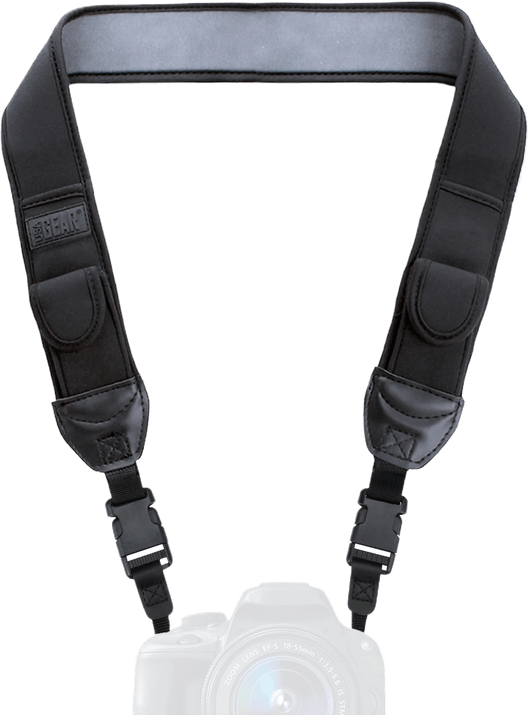
The USA Gear TrueSHOT is a padded neck strap with storage built in. Small pockets hold memory cards, and side pouches take a spare battery, a lens cap or a cleaning cloth. On a short walk or a family day out, that can save you carrying a separate bag.
The pad is stretch neoprene with a non-slip surface, so it holds its place around your neck or on your shoulder. Dual quick-release buckles on adjustable loop straps let you take the strap off the camera quickly. USA Gear backs the strap with a three-year warranty.
The TrueSHOT comes in a range of printed patterns as well as plain black.
It is a neck strap first. Everything you put in the pockets hangs from your neck with the camera, so a full load adds weight where you feel it most. If you want the camera at your hip instead, choose the BlackRapid Blackline I. If you want the most comfortable plain neck strap, the OP/TECH Pro Loop has the more substantial pad.
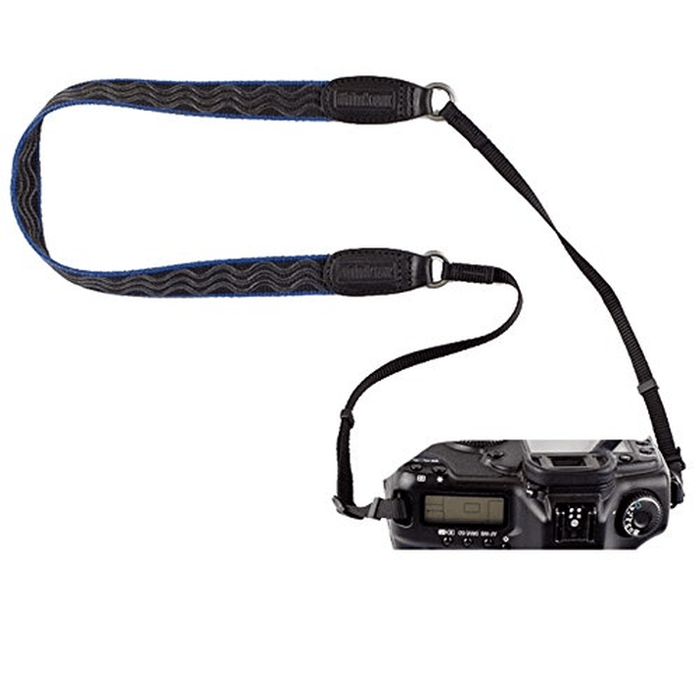
The Think Tank Camera Strap V2.0 is a simple, light neck strap for photographers who carry two similar cameras. It comes in a gray version and a blue version, so you can tell two identical bodies apart at a glance. Wedding and event photographers who shoot with two of the same camera will find that useful.
The strap is 1-inch webbing with non-slip material on both sides, so it stays on your shoulder whichever way it lands. It weighs about 2 oz and folds flat, which makes it easy to pack. The full strap extends to about 55 inches, long enough for neck or shoulder carry.
There is no quick release. The ends thread through the camera's strap lugs, which is slow to fit and remove. There is also no padding. The soft webbing is comfortable with a light camera, but a heavy body will press the narrow strap into your neck.
If you take the strap off often, the Peak Design Slide is the better buy. For a heavy camera, the OP/TECH Pro Loop has the padding this strap lacks.
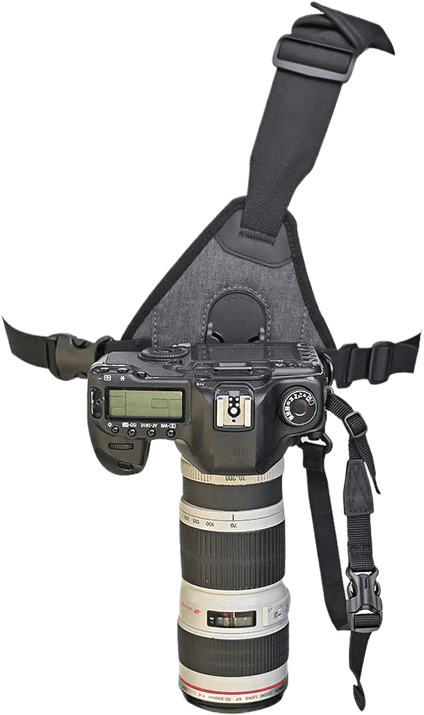
The Cotton Carrier Skout G2 is the best choice for hiking. It is a sling-style chest harness. You put it over one shoulder and clip it around your torso, and the camera locks to your chest. It cannot swing or bounce as you climb, and your hands stay free.
A small hub screws into the camera's tripod socket. You twist the hub into the harness to lock it, and twist it out to shoot. That holds the camera more firmly than any strap on this list. The padded shoulder and ventilated back let you wear it under a backpack's shoulder straps, which is awkward with a sling.
The harness is made of Kodra synthetic canvas with a water-repellent coating. A clip-on weather cover comes in the box, with a safety tether as a backup. It adjusts to fit waists from 26 to 57 inches.
The Skout G2 is for small to medium cameras. Cotton Carrier recommends its larger G3 harness for a gripped DSLR or a telephoto lens. Off the trail it is a lot of strapping for a city walk, where the Peak Design Slide is the better fit.
8. HoldFast Money Maker Two-Camera Harness
| Carry Style |
Carry Style
Two-camera harness
|
| Camera Connection |
Camera Connection
Clips screw into the tripod sockets
|
| Padding |
Padding
None, 1.5 in leather straps
|
| Standout Feature |
Standout Feature
Sized by height in small, medium and large
|
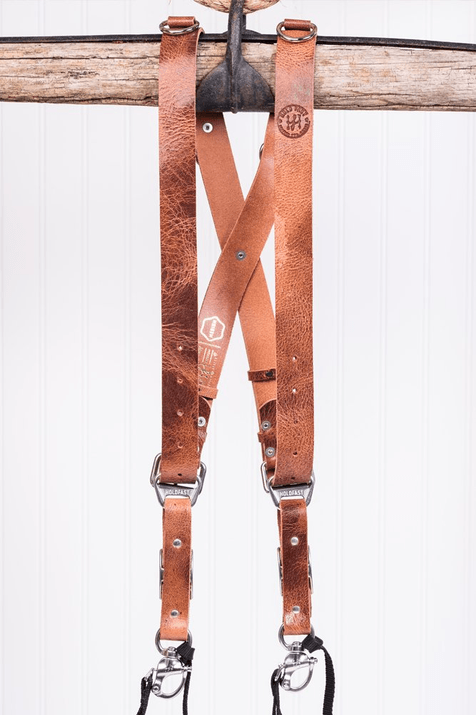
The HoldFast Money Maker is the harness to buy if you shoot with two cameras at once. It crosses over your back and shoulders and holds a camera at each hip. You can keep a wide zoom on one body and a telephoto on the other, then switch cameras instead of changing lenses. That suits weddings and events, where there is no time to change lenses.
Each camera hangs from a small clip that screws into its tripod socket. The straps are 1.5-inch leather, with English bridle, water buffalo and vegan versions. D-rings let you clip on extra accessories.
Sizing is the first thing to get right. HoldFast sells small, medium and large sizes matched to your height, and the wrong size leaves the cameras sitting too high or too low.
The Money Maker only earns its place if you really carry two bodies. With one camera it is a heavy, expensive sling. There is also no padding, so two heavy bodies put their full weight on the leather straps. With one camera, the BlackRapid Blackline I is the better sling.
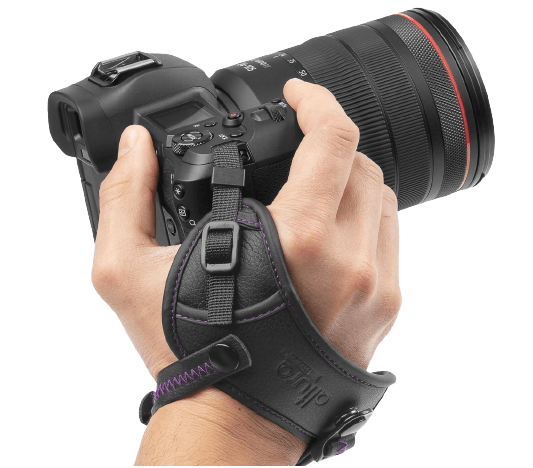
The Altura Photo Rapid Fire Grip is for photographers who find a strap gets in the way. It is a hand and wrist strap that holds the camera against your palm. You can shoot street, event or wedding photos without a strap swinging into the frame or catching on things.
A metal plate screws into the camera's 1/4-inch tripod socket and gives the strap a firm connection with no wobble. The dual grip wraps both your hand and your wrist, and a padded wrist holder cushions it. It adjusts to fit any hand size. A safety tether catches the camera if the grip slips, so you can loosen your hold and use your other hand to change a lens or a card.
The plate is the catch. It uses the tripod socket, so it has to come off before you mount the camera on a tripod. A hand strap also only helps while you hold the camera. When you want to rest your arm, you need somewhere to put the camera.
Pair it with a light neck strap such as the Peak Design Leash, or choose the Peak Design Slide if you want one strap that does everything.
How to Choose a Camera Strap
Match the Carry Style to How Long You Shoot
Neck straps put the camera on your chest, where it is fastest to raise. For an hour or two with a small camera, that is the simplest choice. Over a full day, a neck strap loads your neck with the whole weight. A sling or shoulder strap moves the load to your shoulder and keeps the camera at your hip. Harnesses spread the weight further and stop the camera swinging, which matters on a trail or with two bodies. A hand strap carries nothing for you. It keeps the camera secure only while it is in your hand.
Check How the Strap Connects to Your Camera
Straps connect in two ways, and each affects how you work. Lug straps and anchor systems attach to the strap lugs on the sides of the body. They leave the tripod socket free, so you can mount a tripod plate at the same time. Slings, harnesses and hand grips such as the BlackRapid, Cotton Carrier, HoldFast and Altura screw into the tripod socket instead. If you use a tripod often, check whether that screw has to come out first, or whether it accepts a tripod plate.
Also check the size of your camera's strap lugs. Some small mirrorless and compact cameras have narrow slots or round eyelets. A wide strap end will not thread through them. Straps with thin cord loops, such as the OP/TECH Pro Loop and Peak Design's Anchor Links, fit most of these cameras.
Pick Padding for the Weight You Carry
The padding should match your heaviest regular setup, not the camera alone. A mirrorless body with a small prime lens is comfortable on thin webbing such as the Peak Design Leash or Think Tank V2.0. A full-frame body with a large zoom needs a wide pad. The OP/TECH neoprene pad and the BlackRapid foam pad spread that weight. Check any maximum load the maker lists, too. The OP/TECH Pro Loop is rated for 15 lb.
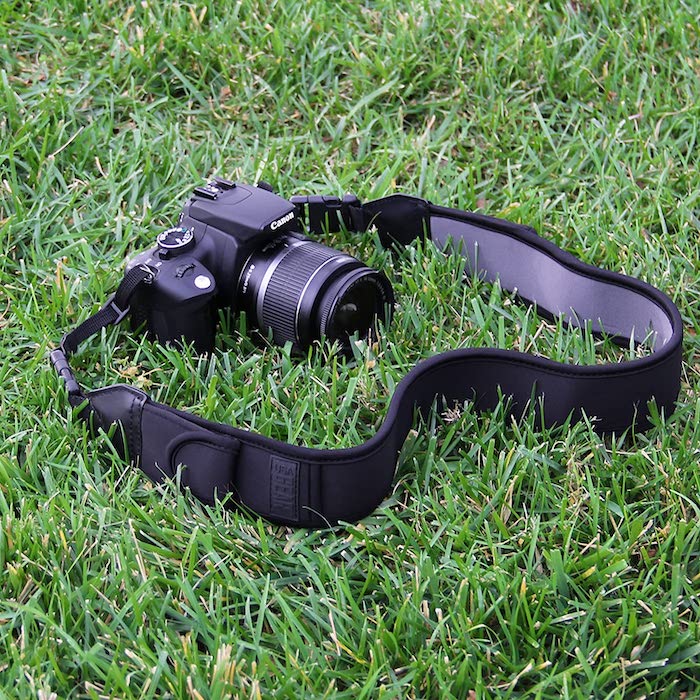
A padded neck strap with pockets. USA Gear TrueSHOT
Frequently Asked Questions
Is a Neck Strap or a Shoulder Strap Better?
It depends on how long you carry the camera. A neck strap keeps it on your chest, which is the fastest place to shoot from. A shoulder strap or sling parks it at your hip and out of the way, and your shoulder takes the weight instead of your neck. For a couple of hours either is fine. For a full day with a heavy body, the sling wins.
Can I Use a Camera Strap With a Heavy Lens?
Yes, but choose a padded one, and consider where the weight hangs. A sling such as the BlackRapid Blackline I puts the load on a wide foam pad on your shoulder. For a very long lens, a strap that connects to the lens's tripod foot is better than one on the camera body, because it balances the weight and takes strain off the lens mount.
Conclusion
The Peak Design Slide is the best camera strap for most photographers. It changes between sling, shoulder and neck carry, and its Anchor Links let you take it off the camera in seconds. If you carry a heavy camera all day, the BlackRapid Blackline I moves the weight to a padded shoulder sling. For a small mirrorless or compact camera, the Peak Design Leash gives you the same quick release in a strap that fits in a pocket.