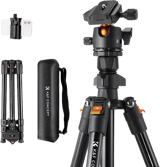
The best travel tripod for most photographers is the K&F Concept Lightweight Travel Tripod. It weighs 2.5 lb and folds to 15.5 inches, yet it stands 64.1 inches tall and holds 17.6 lb. No other tripod here gives you that much height and load capacity for so little weight and money.
Every travel tripod trades stability against size. So the other picks each favor one need. Some pack smaller for a carry-on. Others survive rain and surf, carry heavier lenses, reach higher, or suit video. There is also a tabletop option for days when a full tripod will not fit in the bag.
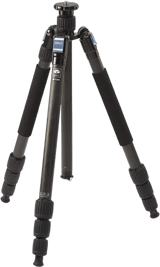
The Best Travel Tripods for Every Kind of Trip
Start with the constraint that matters most on your trips. If the tripod has to fit in a carry-on, compare folded length first. If you hike with it, look at weight. If you shoot long lenses or in wind, compare load capacity, because a higher rating usually means stiffer legs at full height. The table lists each tripod's role, and the reviews below explain the trade-offs.
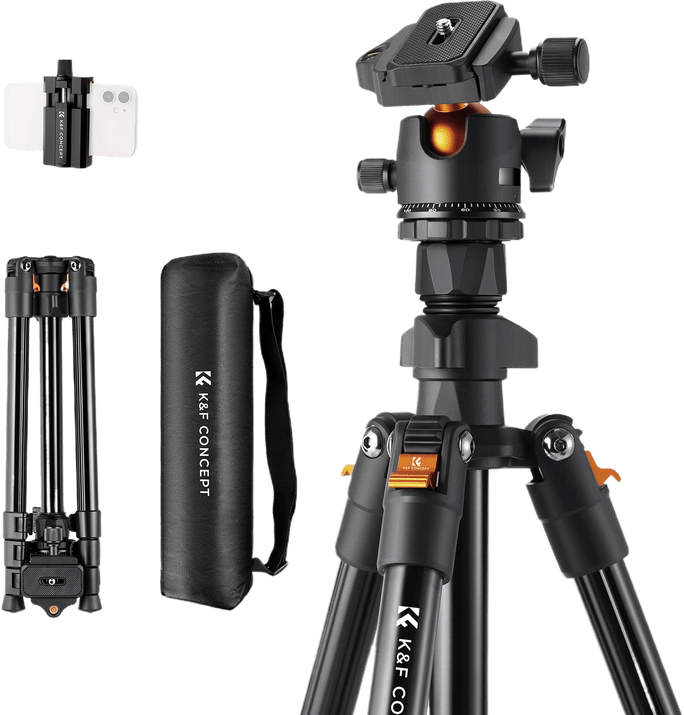
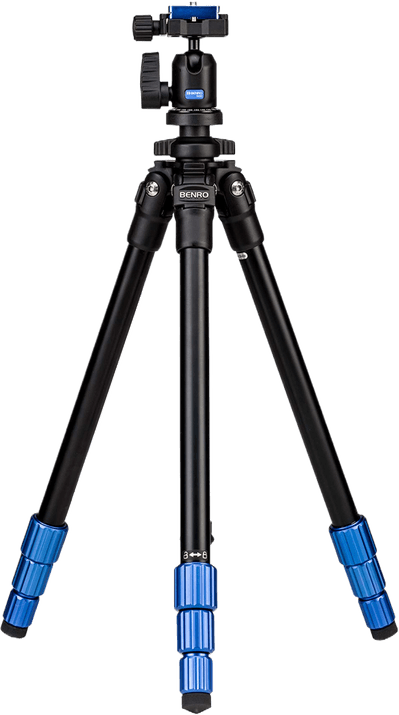
The K&F Concept Lightweight Travel Tripod is our top pick because it does the basic job of a travel tripod better than its price suggests. It is light enough to carry all day and tall enough to use without stooping.
At 2.5 lb it adds little to a daypack. The 17.6 lb load rating covers a full frame body with a fast zoom, with room to spare. That is double the rating of the Benro Slim and the Manfrotto Befree Live further down this list.
The working range runs from 20.4 inches to 64.1 inches, and it folds to 15.5 inches for packing. Flip locks make height changes quick. The kit includes a ball head with a separate panning base, a bubble level, a quick-release plate and a carry case.
The compromise is the material. Aluminum legs damp vibration less well than carbon fiber, so in strong wind a carbon tripod such as the Peak Design Travel Tripod or the Sirui W-1204 settles faster. Four leg sections also take a moment longer to deploy than three. If you rarely shoot long exposures in wind, neither matters much, and the K&F is the best value here.
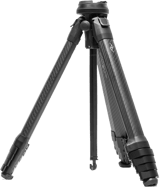
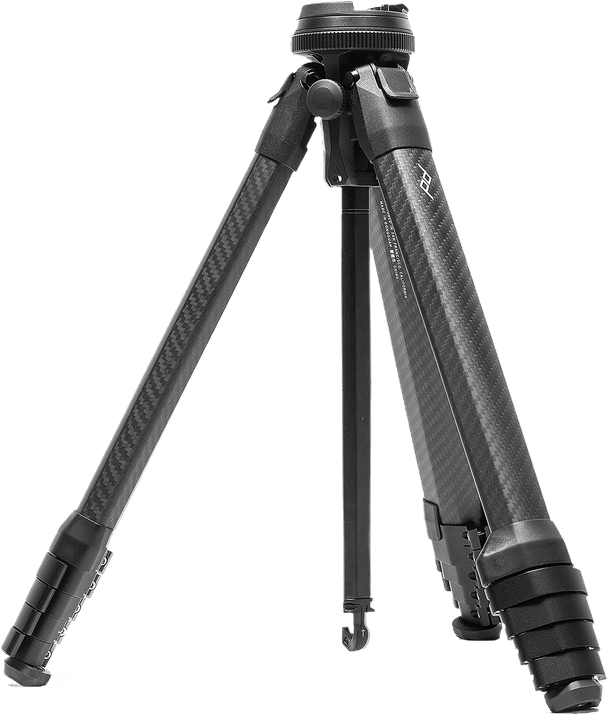
The Peak Design Travel Tripod is the most thoroughly re-engineered travel tripod you can buy. We know Peak Design from its camera bags and straps, and the same focus on packed volume went into this tripod.
The legs close around the center column with almost no gap, and the low-profile ball head sits inside the leg cluster rather than on top of it. The result packs to 15.5 inches long and about the diameter of a water bottle. That shape slides into a backpack side pocket where a conventional tripod of the same length will not. It stands 60 inches tall with the column raised, which is enough for most travel photography.
The carbon fiber version weighs 2.81 lb. An aluminum version weighs 3.44 lb and costs noticeably less. Both carry 20 lb. The head is Arca-Swiss compatible, and a single ring locks the ball. A hidden phone mount lives in the center column.
The catch is cost. This is the most expensive tripod on the list. If you mostly shoot near the car rather than hours up a trail, buy the aluminum version and spend the difference on a lens. And if you want a full-size head with a separate panning lock, the K&F gives you one for far less.
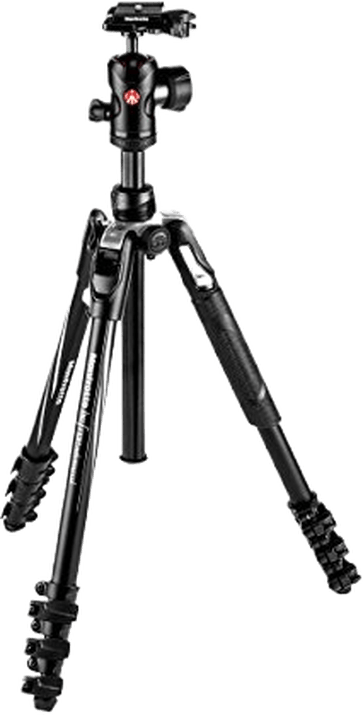
The Manfrotto Befree Advanced is the dependable middle choice. It suits photographers who want a well-supported brand, lever locks and a proper ball head in a tripod that still fits in a carry-on.
Its lever locks are the main reason to choose it. You can see at a glance whether each section is locked, and they do not loosen the way a half-turned twist collar can. The legs fold back around the head to 15.7 inches and extend to 59.4 inches. Manfrotto rates it for 19.8 lb, which is more than enough for a full frame kit with a 70-200mm lens.
It comes with Manfrotto's compact 494 ball head and a quick-release plate. Manfrotto also sells an Arca-Swiss version of the Befree Advanced if your other gear already uses that plate standard.
At 3.5 lb it is a full pound heavier than the K&F, and it does not reach as high. Choose the Befree Advanced for its locks and head. Choose the K&F if weight and height per dollar matter more.
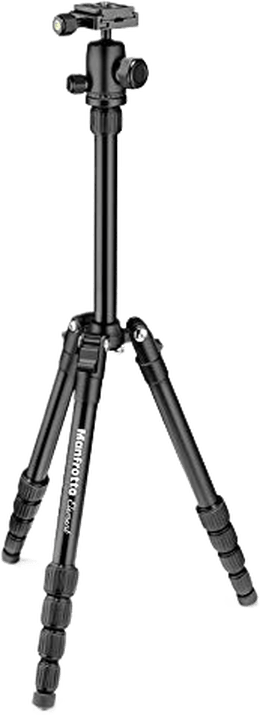
The Manfrotto Element Traveller Small is the tripod to pick when packing space is the hard limit. It folds to 12.6 inches, the shortest of any full-size tripod on this list. That is short enough to fit across the bottom of most carry-on bags.
It weighs 2.54 lb and reaches 56.3 inches. You get 50.2 inches with the center column still down, which is the steadier way to work. Three leg angles take it down to 14.2 inches. Manfrotto designed it for mirrorless cameras and rates it for payloads up to 13.2 lb. A spring-loaded hook under the column takes your bag when the wind gets up. The ball head has an independent 360-degree pan lock, which helps when you shoot panoramas.
That short fold comes from five thin leg sections. The thinnest is just 0.39 inches across. At full height it is less rigid than the K&F or the Befree Advanced, so it suits a mirrorless body with a standard zoom better than a long lens. If you can spare three more inches of bag space, the K&F stands taller and steadier.
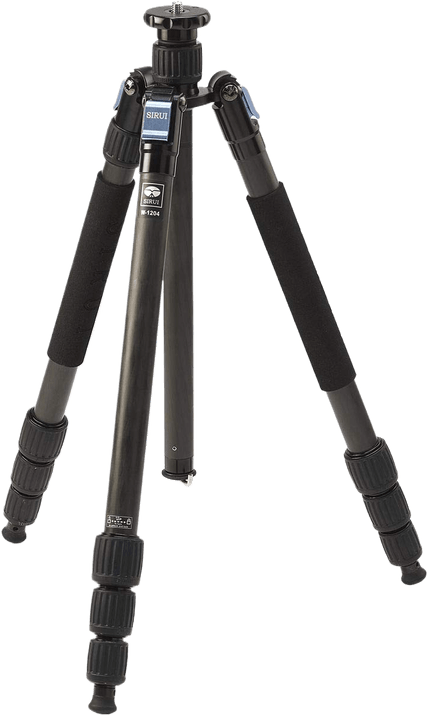
The Sirui W-1204 is one of very few genuinely waterproof travel tripods. It is the one to take if your trips involve rain, beaches or river crossings, or if you carry a heavy lens.
Sealed twist locks keep water, sand and grit out of the leg tubes. You can stand the legs in shallow surf and the locks still work afterward. The feet unscrew to switch between rubber and spikes, and a counterweight hook adds stability in wind.
It is also the strongest tripod here. The carbon fiber legs carry 33.1 lb while the tripod weighs about 3.1 lb, so a telephoto with a gimbal head is within reach. It reaches 65 inches and drops to 5.7 inches for low angles. One leg unscrews and becomes a monopod with the parts in the box.
The trade-off is packed length. At 19.3 inches folded, it takes more of a carry-on than the Peak Design or the Manfrotto Element Traveller. It is also sold as legs only, so budget for a head. Buy it because your shoots involve wet or heavy work, not because you want the smallest tripod in the bag.
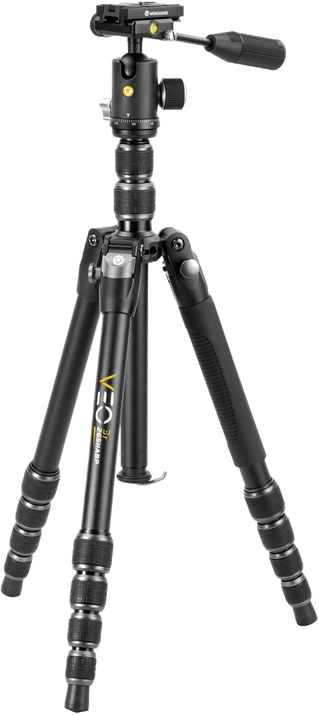
The Vanguard VEO 3T 265HABP has the tallest reach on this list. Its multi-angle center column takes it to 65.4 inches, and the low-angle adapter in the box brings it down to 5.8 inches for macro work. The twist-lock legs set to three angles: 20, 50 and 80 degrees.
It also carries 26.5 lb on five-section aluminum legs, which is second only to the Sirui. The Arca-compatible ball head is included, and its pan handle pulls off when you do not want it. The quick-release plate converts into a smartphone holder with a cold shoe, and a Bluetooth remote comes in the box. Vanguard designed the twist locks to come apart for cleaning, which helps after beach shoots. The tripod also converts into a monopod, and spiked feet come with the rubber ones.
The downside is weight. At 4.7 lb it is the heaviest tripod here, and it packs to 17.3 inches. It earns its place if you want height, load capacity and a full accessory kit in one box. When your bag is the constraint, the Manfrotto Element Traveller and the Peak Design both pack smaller.
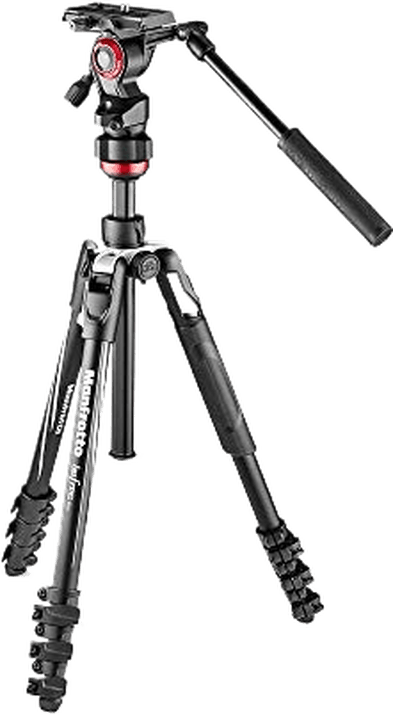
The Manfrotto Befree Live is the video pick. It pairs Befree lever-lock legs with a fluid video head, so pans and tilts stay smooth instead of jerking the way a ball head does.
The head is the reason to buy it. It has fluid drag on pan and tilt, separate locks for each, a sliding plate to balance the camera and a pan bar. The legs fold to 15.7 inches and give you a range of 15.7 to 59.5 inches across three leg angles. It weighs 3.9 lb.
The minimum height is the main limit. At 15.7 inches it cannot get low, so ground-level shots need the Manfrotto PIXI Evo or the Vanguard's low-angle adapter. The 8.8 lb load rating also rules out large cinema rigs and long lenses with accessories bolted on.
If you shoot mostly stills and only occasional clips, the Manfrotto Befree Advanced uses the same style of legs with a ball head and a higher load rating. If video is a big part of your travel work, the Befree Live is one of the best tripods for it at this size.
The Benro Slim is a simple, well-built kit from an established tripod maker. It suits photographers who want to unpack and shoot quickly. It arrives with an N00 ball head, an Arca-Swiss plate and a carry case.
Its legs do not fold back over the head. That costs packed length, but setup is faster because you only spread the legs and extend the twist-lock sections. Each leg sets to one of three angles. The working range runs from 15.7 inches to 57.6 inches, and the center column reverses for low shots. At 2.6 lb it is one of the lighter full-size tripods here.
The cost is size and strength. At 20.1 inches folded it is the longest tripod on this list, and the one most likely to stick out of a small carry-on. Its 8.8 lb rating also suits a mirrorless kit better than a heavy telephoto. If you travel by car or keep the tripod strapped outside a backpack, the length matters less. Otherwise, the K&F packs shorter and carries twice the load.
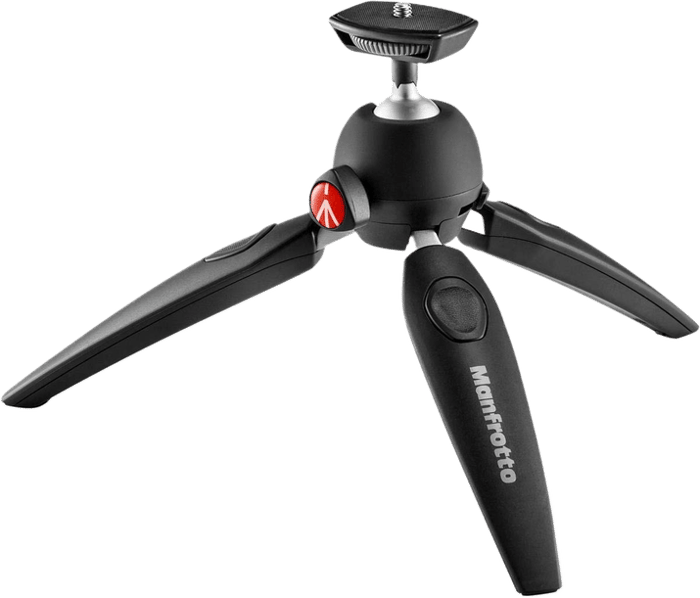
The Manfrotto PIXI Evo is the tripod for days when nothing else fits. It weighs 0.57 lb and packs to 8.1 inches, so it goes in a coat pocket or a small accessory pouch.
It is a tabletop and ground-level tool, not a tripod you stand behind. It tops out at 7.9 inches. The two-section legs and two leg angles let you level it on a wall, a café table or a rock. The ball head handles 5.5 lb, which covers a full frame mirrorless body with a standard zoom. On a tripod this small, keep the setup balanced over the legs, because a long lens will tip it before it reaches that weight limit.
It is also useful for vlogging and selfies. Fold the legs together and it works as a handgrip. The obvious limit is height. It cannot replace a full tripod for eye-level landscapes. Treat it as a companion to one of the picks above, or as the only support you take when weight matters more than framing.
How to Choose a Travel Tripod
These checks help you compare specifications on any travel tripod, including ones not on this list.
Compare Folded Length With the Head Attached
The folded length that matters is the tripod with its head fitted. Most travel tripods fold their legs back around the head to save space, so the quoted length usually includes it. Legs-only tripods such as the Sirui W-1204 grow by the height of the head you add. If you plan to carry the tripod inside a cabin bag, compare that full length with your bag's inside length.
Check Maximum Height With the Column Down
A tripod is most stable with the center column down. Raising a thin column on a light tripod adds vibration, especially in wind. Look for the column-down height as well as the maximum. The Manfrotto Element Traveller lists 50.2 inches with the column down against 56.3 inches fully extended. Many makers publish only the maximum, so treat a tall headline figure on a light tripod with care.
Choose Your Leg Locks
You can adjust tripod legs through either twist locks or lever locks.
Twist locks are slimmer and pack smaller. But if you don't twist them tight enough, they can slip. Lever locks add a little bulk, but you can see at a glance that each one is closed.
After using a monopod with twist locks that kept sliding mid shoot, flip locks are my preference.
Leave Headroom on Load Capacity
Add up your heaviest body, your heaviest lens and anything bolted to the hot shoe, then leave plenty of headroom. A tripod rated well above your kit's weight is usually stiffer at full height. Ratings are not measured the same way by every maker, and some are quoted at the narrowest leg angle. Use them to compare tripods rather than as an exact limit.
Plan for Wind, Water and Sand
A counterweight hook under the column lets you hang your bag for extra stability in wind. Spiked feet grip grass and dirt better than rubber. If you shoot in the rain or in the surf, a sealed tripod like the Sirui W-1204 saves you from stripping and cleaning the legs after every trip. If you want a support that doubles as a monopod, see our monopod vs tripod guide. The Sirui and the Vanguard both convert.
Frequently Asked Questions
How Heavy Should a Travel Tripod Be?
Anything around 3 lb or less is easy to carry all day in a daypack. Our top pick weighs 2.5 lb, and the Manfrotto Element Traveller weighs 2.54 lb. The tallest option here, the Vanguard VEO 3T 265HABP, weighs 4.7 lb. Extra weight usually buys height and load capacity, so decide which of the three you are least willing to give up before you shop. If you hike for hours, a pound saved matters more than a few inches of height.
Is a Carbon Fiber Travel Tripod Worth the Extra Money?
Carbon fiber damps vibration better than aluminum and saves weight. The Peak Design Travel Tripod shows the size of the gap, because its two versions are otherwise identical: 2.81 lb in carbon against 3.44 lb in aluminum. If you shoot long exposures in wind or carry the tripod for hours, carbon is worth paying for. In still air near the car, an aluminum tripod does the same job for much less.
Can I Take a Travel Tripod on a Plane?
Usually, yes. Tripods normally travel in cabin bags, but airlines set their own size limits, so a long tripod is the one to check before you fly. Packed length decides whether it fits inside the bag. The shortest full-size option here is the Manfrotto Element Traveller at 12.6 inches. The Benro Slim at 20.1 inches is the one most likely to stick out of a small carry-on.
Conclusion
The K&F Concept Lightweight Travel Tripod is our choice for the best travel tripod. It is light, tall and strong for its size, and it comes with everything you need to start shooting.
If you want the most packable tripod and can pay for it, choose the Peak Design Travel Tripod. For rain, surf or heavy lenses, choose the sealed Sirui W-1204. When bag space is the hard limit, the Manfrotto Element Traveller folds to 12.6 inches. For video, choose the Manfrotto Befree Live.