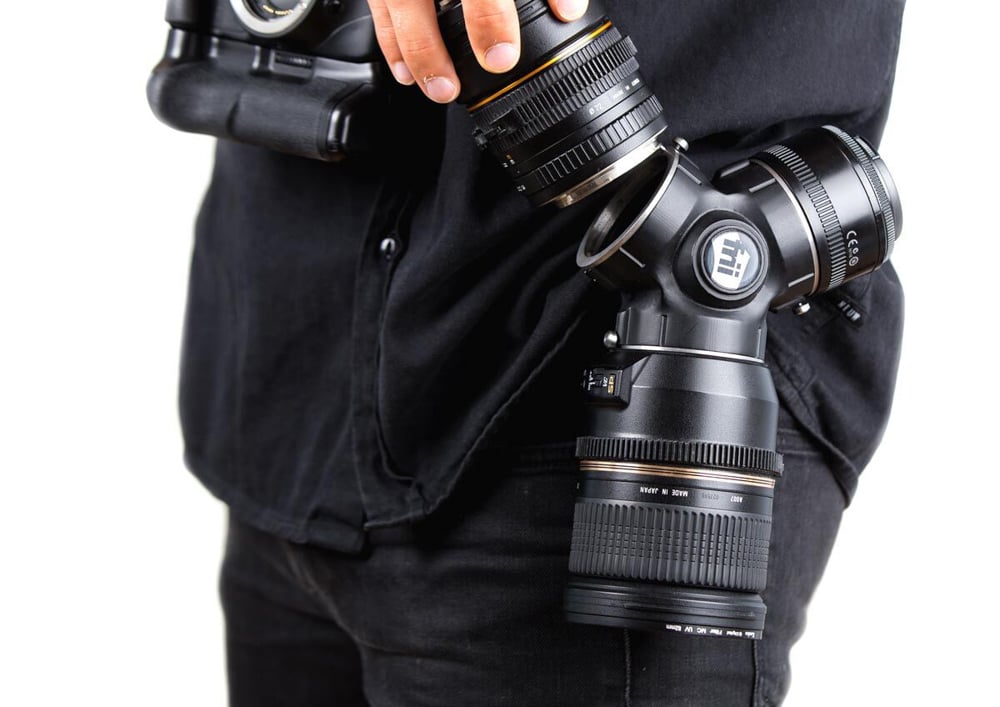
The TriLens lens holder belt keeps up to three spare lenses on your hip, ready for a lens change without opening a bag. In my original test, it felt lighter than I expected and worked well at a local picnic event. The trade-off was exposure: the lenses could still catch on people or take a knock.
About this review: The hands-on account and photographs below come from the original TriLens review first published in 2019. Frii Designs now sells TriLens v2, with revised mounts and a different belt clip. The handling findings here apply to the original model; the v2 details are a separate check of Frii’s current listing.
What Is a Lens Holder Belt Holster?
A lens holster carries spare lenses outside your camera bag. The TriLens attaches to your belt and holds each lens by its mount, so you can reach it at your side.
That can help in event photography, where a moment may pass while you search through a bag. A belt holder gives you access to a different lens while keeping your bag out of the way. It does not remove the need to detach one lens from your camera and attach another.
Who Are Frii?
Frii Designs was founded by photographer and mechanical engineer Jonas Lundin, who works with his brother Hampus. The company’s own account describes their engineering backgrounds and shared interest in building photography equipment.
The original TriLens was crowdfunded on Kickstarter and Indiegogo. If you are comparing a belt holder with a bag, our Peak Design backpack review covers another way to carry your kit.
What Is the TriLens Lens Holster?
Event photographers may carry two camera bodies so they can switch between a wide-angle and a telephoto lens without changing lenses during a key moment. A TriLens offers a different approach: carry spare lenses on your belt and change them on one body.
It is not a replacement for a backup camera. Nor is a lens change the same as picking up a second body that is already ready to shoot. Its benefit is having the next lens within reach.
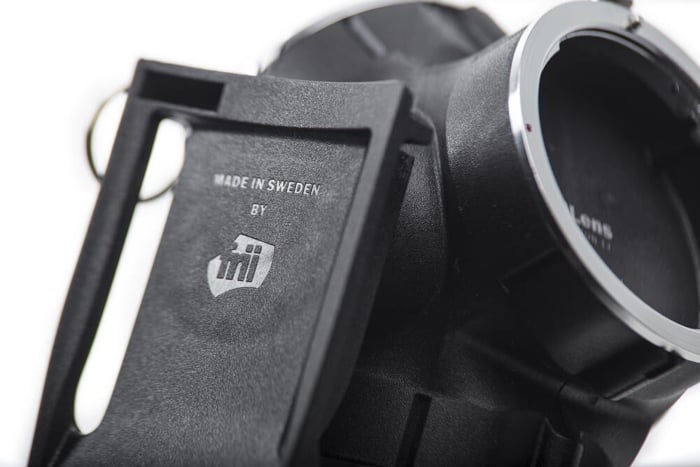
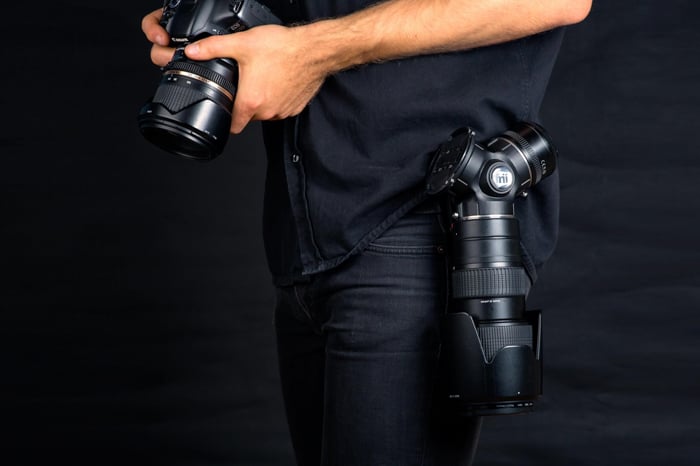
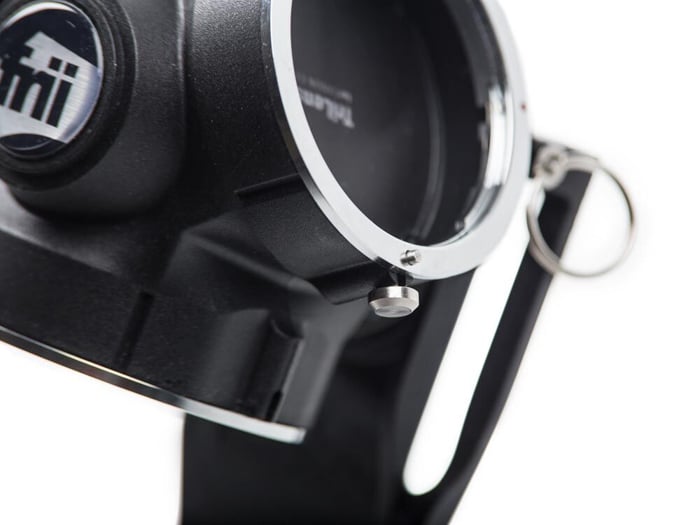
The original TriLens has three lens mounts on a rotating housing. The lenses attach with a bayonet fitting, as they do on a camera, and each mount has a release catch. Frii’s original campaign describes an auto-friction mechanism that adjusts resistance as the load changes.
Unlike hand straps, which secure a camera at your hand, this holder puts the spare-lens load on your belt. Whether that feels comfortable depends on your belt, lens combination and how you move. My experience with the test lenses is below.
What Was Included With the Original TriLens?
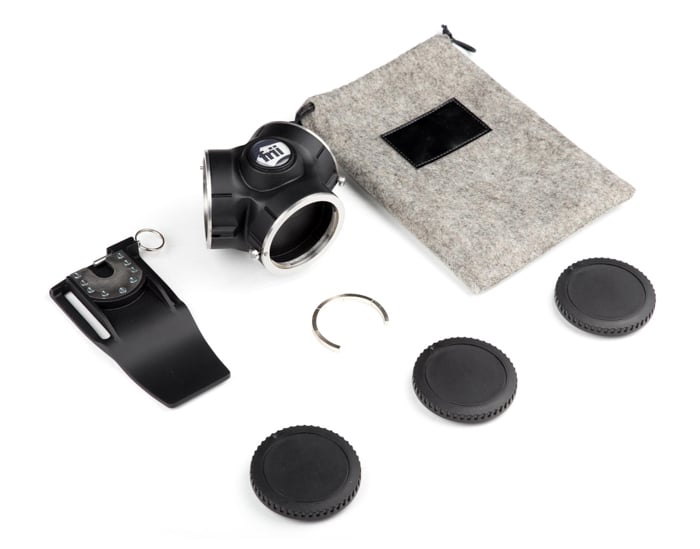
The package I reviewed contained:
- 1 TriLens belt clip
- 1 TriLens housing
- 1 felt bag
- 5 sets of cap magnets
- 3 protection caps
This is the original package, not a list of what comes with the current v2 set.
TriLens Lens Holster: Review
First Thoughts
The box was substantial and well designed. The back even had the names of the people who funded the original crowdfunding campaigns. A magnetic closure and photographs of the holster in use made a good first impression.
Inside were the lens holder, detachable belt clip, cap magnets, protection caps and drawstring pouch. There were also two double-sided cards: a thank-you note with a QR code for the quick-start guide, and instructions for using the holder and fitting the magnetic strips.
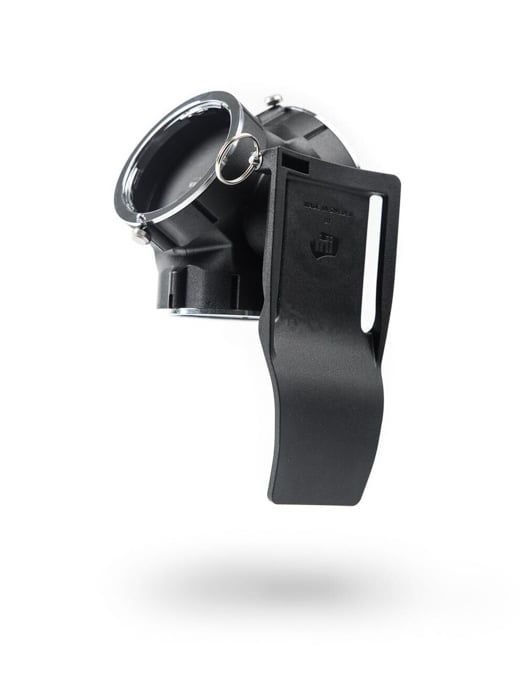
The holder felt sturdy in my hands. The connection between the housing and belt clip looked secure, although appearance alone could not tell me how it would feel when loaded with lenses.
Holster Build and Construction
Frii’s original campaign specifies high-strength steel and fiber-reinforced nylon. In use, the detachable housing made it straightforward to fit the belt clip first and then attach the lens holder.
The belt clip gripped my belt tightly. Once it was in place, I could connect the housing and check that its locking pin was engaged. Before loading lenses, follow the instructions for your exact model: the current v2 clip differs from this one.
Attaching a lens felt familiar. Line up the mount marks, engage the bayonet fitting and check that the lens has locked before letting go. Do not force a lens that does not fit; the holder must match the lens mount.
The supplied magnetic strips were optional. They gave me a place to keep lens caps close by while changing lenses. They did not turn the holder into an enclosed lens bag.
Usability
When I first saw the TriLens advertised, I thought it looked a little silly. As a professional photographer, I could see the benefit, but having three of my favorite lenses on one exposed holder felt like tempting fate.
There were two concerns: accidental bumps and the weight pulling at my belt. My Manfrotto bag and Peak Design Capture Clip V3 were my usual carrying systems, and both could feel heavy when loaded with a DSLR and wide-angle lens.
For the TriLens test, I used the Canon EF 100mm Macro, Canon 135mm and Canon 24-70mm. The combined weight recorded in the original review was 5.83 lb / 2.64 kg.
The load did not pull down my belt as I had feared. I also did not get the waist discomfort I had experienced with the Peak Design Capture Clip V3. That is a finding from this test, not a promise that every belt and lens combination will feel the same.
At a local picnic event, I liked having everything with me and being free of a bag. The lenses stuck out a little, but I could keep an eye on them. I found the holder comfortable to use.
The exposure concern remained. I could not lie down without worrying about damaging a lens, and a secure mount did not protect the equipment from knocks or scrapes. I would be cautious in a dense concert crowd.
I would not choose it for everyday street or travel photography, either. Even if someone could not easily detach a lens, the equipment was still visible. The holder could also draw attention from the people I was photographing.
Weddings and events made more sense to me, as did a studio setup where I wanted spare lenses beside me. The test supports that use case, but it was not a long-term durability test or a test of every shooting situation.
Final Thoughts
What I Like About the Original TriLens
- Spare lenses within reach without opening a bag
- Less weight at my waist than I expected in this test
- Rotating housing and release catches for the individual lenses
- Detachable housing and magnetic cap storage
What I Don’t Like
- Exposed lenses can take accidental knocks
- The setup draws attention to the equipment I am carrying
- Sitting low or lying down needs extra care around the lenses
The main choice is access versus protection. I liked the access at the picnic event, but I would still use a bag when I wanted the lenses enclosed or out of sight.
Buying a TriLens Now: Check the Version and Mount
The Frii Designs website now lists TriLens v2. Its complete-set listing specifies a v2 housing, Belt Clip v2, three Magcaps and a velvet pouch. Those are different package contents from the original kit shown above.
With Canon, Nikon, and Sony, the brand name is only the starting point. The original campaign listed Canon EF, Nikon F and Sony E/FE versions. The current v2 listing separates Canon EF, EF-S and RF, and Nikon F and Z. It also lists Sony E/FE, Fuji X, Micro Four Thirds, Pentax K and L-Mount options.
Match the holder to your lenses’ exact mount before ordering. A review of the original Canon EF setup does not establish how a different mount or the v2 hardware handles. Check current delivery information with the seller; the original review’s express-delivery promises are not a reliable guide to an order today.
The screenshot below belongs to the original review and shows the website as it appeared then.

Conclusion
The original TriLens won me over as a way to keep spare lenses beside me at an event. It felt more comfortable than I expected with the three Canon lenses I used, and I did not have to return to a bag for each lens change.
I would choose that access for an event or studio session where I had room to move. For crowded spaces or discreet travel, the exposed lenses would put me off. If you are buying today, check the v2 mount and instructions separately: this review records the original model’s field test, not a hands-on verdict on its successor.