The best inspection camera for a job is one that fits the opening, reaches the problem and lets you see it from the right angle. A steerable tip helps inside an engine or awkward cavity. A longer cable matters more when the area you need to inspect is farther away.
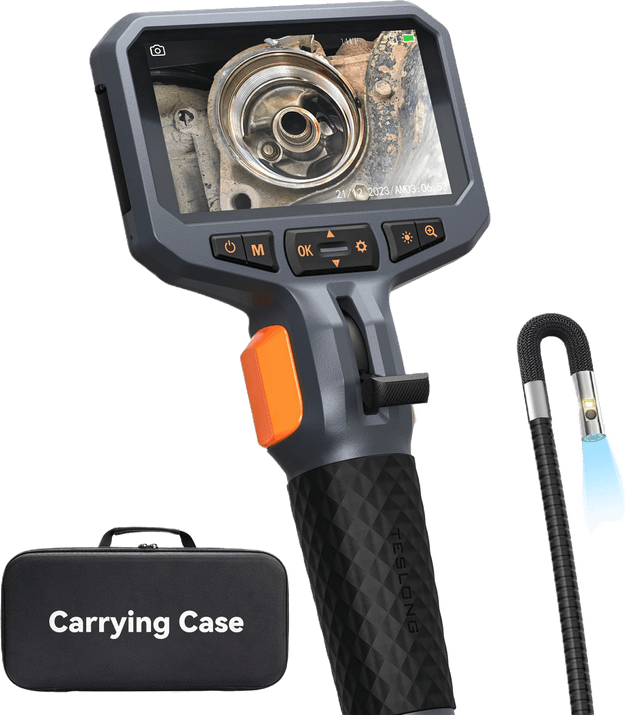
Our top pick is the Teslong TD450S Dual Lens Inspection Camera. Its two-way articulating tip and separate screen make it a strong option for close inspection. But its 1.55 m probe will not suit every job. Below, we compare eight options for DIY work, trade use and specialist barrel inspection.

What Is the Best Inspection Camera?
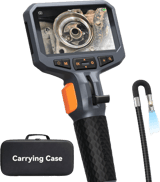
The Teslong TD450S Dual Lens Inspection Camera is our overall pick for close inspection where you need to control the viewing angle. It combines forward and side cameras with a tip you can steer from the handle.
Choose by the space you need to see, rather than by megapixels alone. The Teslong NTS300 and DEPSTECH DS300 have longer-cable options. The Bosch GIC 12V-5-27 C suits buyers who already use Bosch Professional batteries. The rigid Teslong at the end of the list serves a different purpose: straight access into a rifle barrel.
The table below introduces the eight picks. The sections that follow explain their main trade-offs.




Choosing the Best Inspection Camera
Start with the size of the opening and the distance to the object. Then decide whether you want a screen in the handle or a camera that uses your phone. A side-facing lens and a moving tip solve different problems, as the buying guide below explains.
1. Teslong TD450S Articulating Dual Lens Inspection Camera
| Brand |
Brand
Teslong
|
| Number of Lenses |
Number of Lenses
2
|
| Works With |
Works With
32 GB microSD card (included)
|
| Power |
Power
Built-in battery (approx. 4 hours)
|
| Waterproofing |
Waterproofing
IP67
|
| Maximum Length |
Maximum Length
5.1 feet (1.55 m)
|
| Key Features |
Key Features
Two-way 210-degree articulating tip, 4.5-inch IPS screen, 8 forward LEDs plus 1 side LED
|
| Best For |
Best For
Anyone who needs a reliable, good-quality inspection camera for regular use
|
The Teslong TD450S Dual Lens Inspection Camera earns our top spot for combining two viewing directions with a tip you can move from the handle. Its forward and side cameras let you look along a cavity and across its wall without swapping a mirror attachment.
Teslong’s TD450S specifications list a 4.5-inch screen, an 8.5 mm probe and two-way articulation through 210 degrees. Adjustable lighting helps you illuminate the area in front of the probe. The included 32 GB microSD card stores photos and recordings.
The main limit is reach. At 1.55 m, the probe is a close-inspection tool. It will not cover a long pipe run. Check the access route before buying, including whether there is room to bend the tip once it is inside.
Choose the TD450S when controlling the viewing angle matters more than cable length. If you mainly need to look farther into an accessible duct or cavity, compare the longer-cable models below.
2. Bosch Professional GIC 12V-5-27 C Inspection Camera
| Brand |
Brand
Bosch
|
| Max Resolution |
Max Resolution
1280 x 720 pixels
|
| Number of Lenses |
Number of Lenses
1
|
| Works With |
Works With
32 GB microSD card (included), USB-C
|
| Power |
Power
Bosch 12V Professional battery or 4 x AA
|
| Waterproofing |
Waterproofing
IP67 camera head, IP54 body
|
| Maximum Length |
Maximum Length
59 inches (150 cm)
|
| Key Features |
Key Features
AutoUp automatic image rotation, 5-inch HD screen, 75-degree field of view
|
| Best For |
Best For
Professionals who already have Bosch 12V tools
|
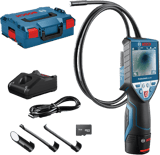
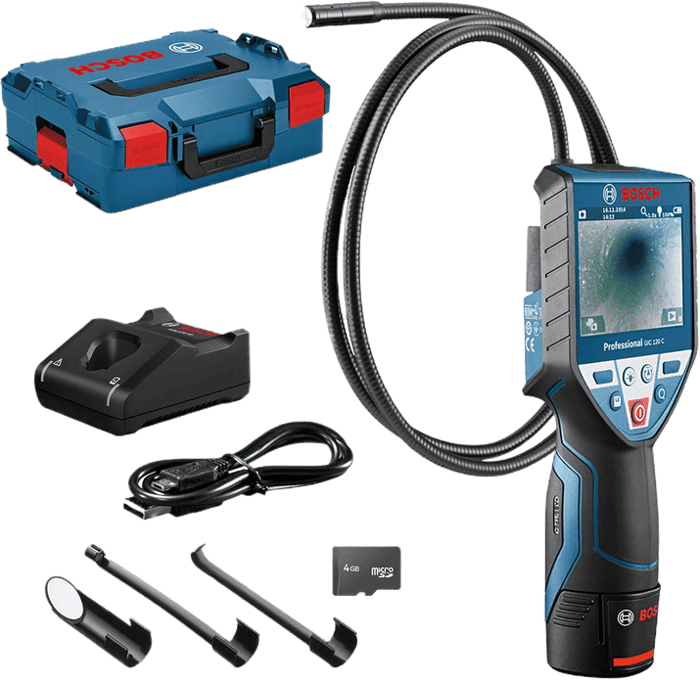
The Bosch Professional GIC 12V-5-27 C is precisely that: an inspection camera for professionals. Especially if they already own a number of Bosch professional tools. Rather helpfully, a great many of them run off the same 12V battery system. That includes the BOSCH GTC400C Thermal Image Camera I reviewed in our roundup of thermal imaging cameras. Cutting down the number of battery types and chargers in the van is a real bonus for a busy contractor.
Bosch’s GIC 12V-5-27 C page lists a 5-inch, 1280 x 720 display. AutoUp turns the image upright as the camera head changes orientation. That helps you keep track of what you are seeing when the cable twists inside a cavity.
Its cable is 1.5 m long and the head is 8.3 mm across. The focus range is 30–80 mm, so this is a camera for looking at nearby surfaces. The camera cable has an IP67 rating; the tool body has IP54 protection. Those ratings do not mean you can immerse the handset.
A 32 GB microSD card and USB-C cable are included. It runs on a compatible Bosch Professional 12V battery, such as the Bosch GBA 12V 2.0Ah, or AA batteries with the battery adapter. Check which power accessories come with your chosen kit.
The reason to choose this Bosch is its battery system and upright-image function. If you need a steerable camera tip or much more cable, those requirements should decide your choice first.
3. Teslong NTS300 Dual Lens Inspection Camera
| Brand |
Brand
Teslong
|
| Max Resolution |
Max Resolution
1080p stills, 720p video
|
| Number of Lenses |
Number of Lenses
2
|
| Works With |
Works With
Self-contained screen, no phone or app needed
|
| Power |
Power
Built-in 5,000mAh battery (approx. 4.5 hours)
|
| Waterproofing |
Waterproofing
IP67
|
| Maximum Length |
Maximum Length
16.5 feet (5 m)
|
| Key Features |
Key Features
7 adjustable LEDs (6 front, 1 side), 5-inch self-contained IPS screen, hard carrying case
|
| Best For |
Best For
Anyone who wants a no-phone-required dual-lens inspection camera
|
The Teslong NTS300 Dual Lens Inspection Camera has its own 5-inch screen, so you do not need to pair it with a phone. It is the option to compare with the TD450S when reach matters more than a steerable tip.
Teslong lists several NTS300 probe configurations. For the longer-reach version covered here, check that you select the 8 mm dual-lens probe with a 5 m cable. The product name alone does not guarantee that length.
The forward and side cameras have separate lighting. The monitor saves 1920 x 1080 stills and 1280 x 720 video to a 32 GB microSD card. Teslong rates the 5,000 mAh battery for four to five hours; actual runtime will depend on use.
Choose it for a separate screen and longer reach. The extra cable is something you also have to manage and store, so there is little reason to buy five metres for a job that needs only one.
4. Ralcam Two-Way Articulating Borescope
| Brand |
Brand
Ralcam
|
| Max Resolution |
Max Resolution
HD video
|
| Number of Lenses |
Number of Lenses
1
|
| Works With |
Works With
Built-in 5-inch screen, 32 GB card included
|
| Power |
Power
Built-in battery
|
| Waterproofing |
Waterproofing
IP67
|
| Maximum Length |
Maximum Length
5 feet (1.5 m)
|
| Key Features |
Key Features
Two-way articulating tip, 5.5 mm slim probe, digital zoom, built-in microphone
|
| Best For |
Best For
Anyone who needs a steerable tip on a slim probe
|
The Ralcam Two-Way Articulating Borescope is the one to reach for when the thing you need to see is around a corner rather than at the end of the hole. A control on the handle bends the last section of the probe two ways, so instead of poking blindly and hoping, you steer the lens onto the fitting, the weld or the dropped key.
It does that on a slim probe. At 5.5 mm across, the Ralcam goes into holes that the 8.5 mm cameras here simply will not enter, which matters for engine bores, door skins and conduit. Digital zoom enlarges part of the image; it does not recover detail that the camera failed to capture.
Everything else is self-contained. There is a 5-inch HD screen in the pistol-grip handle, a 32 GB card in the box, and an IP67 rating on the probe, which needs to be read with the maker’s limits on immersion. There is a microphone in the handle too, which is more useful than it sounds. You can narrate what you are looking at as you record instead of writing notes afterwards.
Reach is where it falls down. The cable is 5 feet (1.5 m), less than a third of what the DEPSTECH DS300 gives you, and there is a single lens rather than the dual-lens setup on our top pick. Its main appeal here is a steerable tip on a slim probe. If your jobs are straight runs down a drain, buy on cable length instead.
5. DEPSTECH DS300 Dual Lens Industrial Endoscope
| Brand |
Brand
DEPSTECH
|
| Max Resolution |
Max Resolution
1080p video, 2 MP stills
|
| Number of Lenses |
Number of Lenses
2
|
| Works With |
Works With
TF/microSD recording card (check kit contents)
|
| Power |
Power
Built-in battery (approx. 4 hours)
|
| Waterproofing |
Waterproofing
IP67
|
| Maximum Length |
Maximum Length
16.5 feet (5 m)
|
| Key Features |
Key Features
One-button dual-lens switch, 4.3-inch color IPS screen, 7.9 mm probe, 7 LEDs on 3 brightness levels
|
| Best For |
Best For
Anyone wanting dual-lens visibility without paying premium prices
|
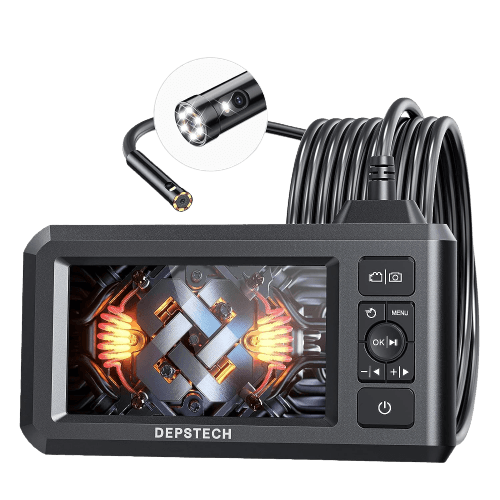
The DEPSTECH DS300 Dual Lens Industrial Endoscope combines a separate 4.3-inch screen with forward and side cameras. It is the option to compare with the NTS300 if you want a longer cable without a moving camera head.
DEPSTECH’s dual-lens DS300 listing specifies a 16.5-foot semi-rigid cable. A button switches between the two views. Seven LEDs and three brightness settings let you change the lighting rather than accepting the brightest setting for every surface.
The maker lists 1080p video, 2 MP photos and about four hours of battery use. Its stated close-focus ranges are 3–8 cm for the front camera and 2–6 cm for the side camera. Positioning the lens at the right distance matters as much as the resolution printed on the box.
The tip does not steer from the handle. You aim it by shaping and turning the cable, then use the side camera to inspect a different direction. Before ordering, confirm the recording-card requirements and package contents for the exact kit.
6. DXZtoz Industrial Endoscope
| Brand |
Brand
DXZtoz
|
| Max Resolution |
Max Resolution
2 MP
|
| Number of Lenses |
Number of Lenses
1
|
| Works With |
Works With
MicroSD card
|
| Power |
Power
Built-in battery
|
| Waterproofing |
Waterproofing
IP67
|
| Maximum Length |
Maximum Length
5.5 feet (1.7 m)
|
| Key Features |
Key Features
Articulating head, up to 8x digital zoom
|
| Best For |
Best For
Anyone looking for a self-contained, articulating borescope
|
The DXZtoz Industrial Endoscope offers all the convenience of an articulating lens head in a self-contained unit. The adjustable pistol-grip control unit offers full control of image features and the adjustable head.
That head can turn 180 degrees back on itself. And in an S shape, it can get past obstacles that might thwart a rigid probe. There are LED lights to illuminate the way, and they are adjustable to four different levels.
The control unit is nicely designed and offers easy, logical access to the controls. It means everything can be controlled with one hand. The lens control, zoom, LED control, and shutter button fall under your thumb for convenience. This leaves the other hand free to insert the probe.
The whole kit comes in a decent carrying case with the cables, lens brush, and three useful attachments. These are a hook, a magnet, and a 90-degree mirror. So even if the bendy end doesn’t show what you need, the mirror might help.
7. NIDAGE Wireless Endoscope
| Brand |
Brand
NIDAGE
|
| Max Resolution |
Max Resolution
2 MP
|
| Number of Lenses |
Number of Lenses
1
|
| Works With |
Works With
iOS and Android
|
| Power |
Power
Built-in battery
|
| Waterproofing |
Waterproofing
IP67
|
| Maximum Length |
Maximum Length
5 feet (1.5 m)
|
| Key Features |
Key Features
Wi-Fi connection to your phone, 5.5 mm semi-rigid probe, 6 adjustable LEDs
|
| Best For |
Best For
Anyone looking for a low-cost and easy-to-use inspection camera
|
The NIDAGE Wireless Endoscope uses a phone as its display. That separates the screen from the probe control box, which can make positioning the screen easier. It also makes the phone and camera app part of the inspection setup.
The original AW655 manual describes a 5.5 mm camera head, adjustable lights and a Wi-Fi connection to the phone. Its listed focus distance is 3–10 cm. The camera still needs to be close to what you want to see; a larger phone screen cannot make an out-of-focus image sharp.
Before choosing this older phone-based model, check that the app named in the supplied manual is available for your phone and current operating system. Test the connection and recording before starting a job. If you want a camera you can turn on without phone setup, compare the DS300 or NTS300 instead.

8. Teslong Rigid Borescope
| Brand |
Brand
Teslong
|
| Max Resolution |
Max Resolution
720p
|
| Number of Lenses |
Number of Lenses
1
|
| Works With |
Works With
Android, PC, Mac
|
| Power |
Power
via USB
|
| Waterproofing |
Waterproofing
N/A
|
| Maximum Length |
Maximum Length
26 inches (66 cm)
|
| Key Features |
Key Features
Rigid scope for inspecting rifle barrels
|
| Best For |
Best For
Anyone looking for a rigid borescope for their rifles
|
The Teslong Rigid Borescope serves a different job from the flexible cameras above. Its straight probe is intended for barrel inspection, rather than following bends in a pipe.
Teslong’s NTG100H is the 26-inch rigid USB model. The maker lists Android, Windows PC and Apple OS X support. Do not confuse it with the NTG100H-C or Wi-Fi variants: the cable, device support and mirror kits differ.
A side-view mirror lets you inspect the barrel wall, and markings on the rod help you locate the area you are looking at. Check the minimum bore size for the exact probe and mirror combination rather than assuming that every model with a similar name fits.
Choose this type for straight, specialist access. For a cavity that requires a bend, one of the flexible inspection cameras is a better match.
Buyer’s Guide: The Best Inspection Camera
What Is the Difference Between an Endoscope and an Inspection Camera?
In tool listings, “endoscope” often means the same small camera-on-a-cable device as “borescope” or “inspection camera.” A medical endoscope is a different device. None of the tools in this list is for examining people or animals.
What Are the Main Features to Look Out For?
Start with fit and focus. The camera head must pass through the smallest opening along the route. Allow room for a mirror or other attachment too. A probe that fits through the entrance can still get stuck at a bend farther in.
Next, check the focus range. For example, Bosch specifies 30–80 mm for the GIC 12V-5-27 C. Moving closer than the stated range can make the image blurrier, even when the camera has a high recording resolution.
Adjustable lighting matters on reflective surfaces. Use enough light to see the subject without washing out the part you need to inspect. Treat screen resolution, photo resolution and video resolution as separate specifications.
How Much Reach Do You Need?
Measure the route from the access point to the area you want to see. Leave enough cable outside to hold and control the probe. Nominal cable length is not the same as a promise that you can push the camera that far around bends.
The TD450S has a 1.55 m probe. The NTS300 configuration discussed above and the DS300 offer about 5 m. Longer cable helps only if you can guide it to the target and retrieve it. A small general-purpose borescope is not automatically suitable for a long sewer survey.
Moving Head or Fixed?
An articulating camera lets you bend the tip using a control at the handle. A fixed-tip camera relies on the cable’s shape and rotation to aim the lens. Image rotation on the screen does not physically steer the camera.
Choose articulation when you need to look back at a surface or change direction inside a cavity. There must still be space for the tip to turn. Do not force it through an obstruction; straighten the bending section with its control before withdrawing it.
Twin Lens or Single?
A dual-lens probe adds a second viewing direction, usually to the side. It lets you inspect a wall without turning the whole head toward it. An articulating tip changes the direction the head points. A camera can have either feature or both.
A single-lens camera may use a side-view mirror attachment instead. Check the space the attachment needs and its focus limits. These affect where it works, regardless of how many pixels the camera records.
Built-In Screen or Phone Connection?
A camera with its own display keeps the phone out of the setup. Check how you will save and transfer recordings, including whether the kit includes a memory card. Battery runtime and charging arrangements matter if you use it throughout a working day.
A phone-based camera saves you carrying another screen, but you need the correct connector or Wi-Fi connection and a supported app. Confirm compatibility with your exact phone before buying. A Wi-Fi camera’s own connection is different from a requirement for home internet access.
What Does an IP67 Rating Cover?
Check whether the rating applies to the probe, the cable or the whole tool. For example, Bosch rates this camera’s cable IP67 and its body IP54. Teslong’s safety instructions also distinguish water-resistant probes from monitors that must not be submerged.
Follow the specific model’s limits for depth, time, temperature and liquids. A waterproof probe is not permission to use a camera near live wiring, moving machinery or flammable substances. Read its safety instructions before putting it into equipment.
Conclusion: The Best Inspection Camera
The Teslong TD450S remains our pick when you need to steer the camera and switch viewing direction during a close inspection. Choose the NTS300 or DS300 when the route calls for more cable. The Bosch is worth considering if its battery system and upright-image function suit your work.
Before ordering, check three things: the smallest opening, the route length and the distance at which the lens needs to focus. Those decide whether a camera can show you the problem. A higher pixel count alone cannot fix a probe that does not fit or reach.