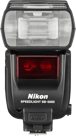
The Nikon SB-5000 is the best flash for most Nikon shooters. It is Nikon's own flagship speedlight, so i-TTL exposure works without surprises. It also has built-in radio control for off-camera work and a cooling system that keeps it firing through long events.
You don't have to pay for Nikon's name to get good light, though. Godox makes speedlights with rechargeable lithium batteries that recycle faster than the AA-powered flashes here. There are also cheaper TTL units that still give you a strong guide number, a pocket-size flash for small Z cameras, and a ring flash for macro work.
The Best Flashes for Nikon DSLR and Mirrorless Cameras
The first choice is between Nikon's own flashes and a third-party system. A Nikon speedlight works with Nikon's wireless system, so it can trigger or follow other Nikon flashes. A Godox flash joins the Godox X radio system instead. That system is cheaper to grow and works across camera brands, but it only talks to Godox lights. After that, decide between AA batteries and a lithium pack. Then pick the head shape and size that suit how you shoot.
Our Nikon Flash Reviews
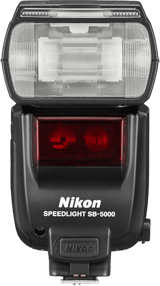
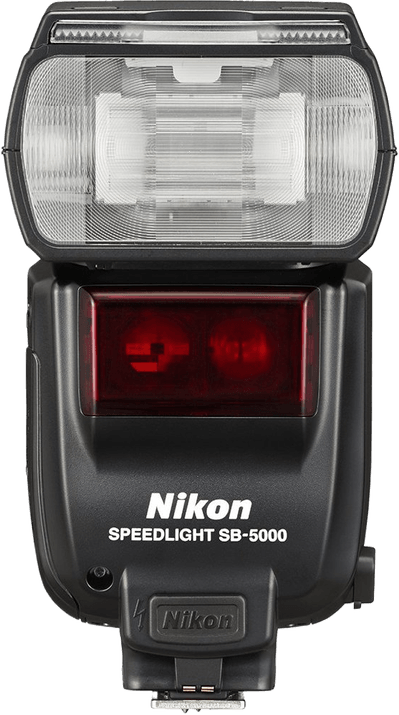
The Nikon SB-5000 is the flash to buy if you want one Nikon speedlight that can do everything. It is the first Nikon speedlight with built-in radio control. Radio does not need line of sight, so the flash still fires when it sits behind your subject or out of the camera's view.
Radio control works with recent Nikon bodies such as the D850, D500, D7500, the Z7 and other Z cameras. You need a Nikon wireless remote controller from the WR-R10 family on the camera. Without one, the SB-5000 still works off-camera through Nikon's optical Creative Lighting System (CLS), as a master or a remote.
Power is strong for a speedlight. The guide number is 113 ft (34.5 m) at 35mm and 180 ft (55 m) at 200mm, at ISO 100. Recycling takes about 1.8 seconds with Ni-MH AA batteries and about 2.6 seconds with alkaline cells. A built-in cooling system lets it fire about 100 flashes in a row without overheating. That matters at weddings and events, where an overheated flash pauses itself. It also supports high-speed sync, slow sync and rear-curtain sync.
The SB-5000 is the most expensive flash on this list, and you pay extra for the radio remote. It runs on four AA batteries, so it recycles more slowly than the lithium-powered Godox V860III-N. It has no LED modeling lamp. Choose the Godox if you want faster recycling for less money and don't need Nikon's own wireless system.
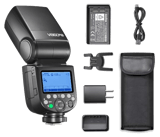
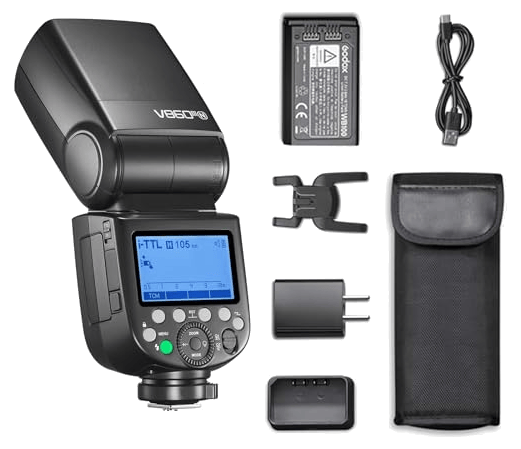
The Godox V860III-N is the best third-party speedlight for Nikon. It gives you full i-TTL, high-speed sync and a built-in radio transceiver for a lot less than the SB-5000.
Its biggest advantage is the 2600 mAh lithium battery pack. It recycles in about 1.5 seconds at full power and gives roughly 480 full-power flashes per charge. That beats any flash here that runs on AA batteries. One pack replaces a pocket full of AAs on a long shoot, and the recycle speed stays steady as the charge drops.
The guide number is 197 ft (60 m) at ISO 100 with the head zoomed to 200mm. The zoom covers 20-200mm. A front LED modeling lamp has 10 brightness levels, so you can preview the light direction and help autofocus in dim rooms. The built-in 2.4 GHz Godox X radio works up to about 330 ft as a master or a slave, and it can also be triggered from a Godox X-series transmitter on the camera.
There are trade-offs. The V860III-N has no weather sealing, and you can't swap in AA batteries when the pack runs flat. If you shoot long days, a second VB26-series pack is a sensible extra. The Godox X system also only works with Godox lights. Pick the Nikon SB-5000 if you already own Nikon flashes or need Nikon's own wireless control.
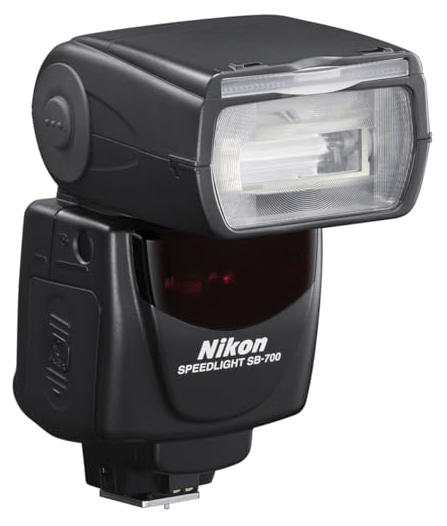
The Nikon SB-700 is the lower-cost way to stay inside Nikon's own flash system. It is still part of Nikon's current speedlight line, and it gives you the same i-TTL metering in a smaller, lighter body.
It is a step down in power. The guide number is 92 ft (28 m) at 35mm and ISO 100, and the zoom stops at 120mm. Recycling takes about 2.5 seconds with Ni-MH or alkaline AA batteries. That is fine for portraits and family events, where you have time between shots.
Off-camera, the SB-700 uses Nikon's optical CLS. It can act as a master to fire other Nikon flashes or as a remote. On a DSLR with a pop-up flash and Commander mode, the camera's own flash can trigger it with no extra hardware. Z cameras have no built-in flash, so they need another master on the hot shoe. The optical signal also needs a clear line of sight, which is harder outdoors or when the flash is behind your subject.
Manual power goes from full to 1/128, which is useful for soft fill light and catchlights in portraits. If you want radio control and more reach, the SB-5000 is the upgrade. If brand loyalty does not matter, the Godox V860III-N recycles faster and adds radio for less.
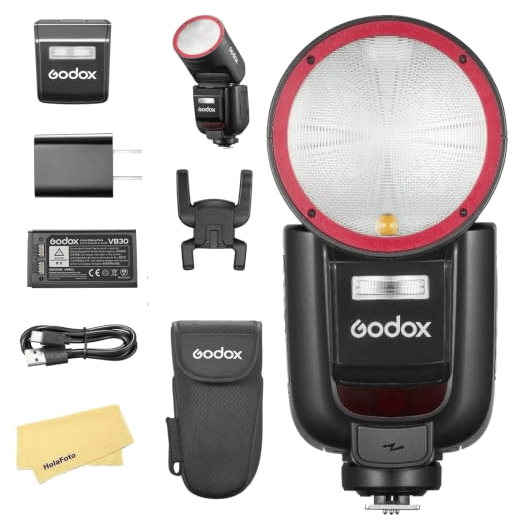
The Godox V1 Pro N is the pick for portrait and event photographers who want softer, more natural-looking flash. Its round head spreads light in a smooth circle with a gradual edge. A standard rectangular head gives a harder-edged spread. That makes direct and bounced flash look more like a small studio light.
It is also the fastest flash on this list. The 76Ws head recycles in about 1.3 seconds, and the 2980 mAh lithium pack gives about 500 full-power flashes per charge. You can charge the pack over USB-C as well as with the Godox charger, which helps when you travel.
The head tilts from -7 to 120 degrees and swivels through 330 degrees, so bouncing off a wall or ceiling is easy. It has a 2W LED modeling lamp with 10 levels and the same Godox X radio as the V860III-N. Godox also makes a detachable SU-1 sub flash for it, which adds a small fill light when you bounce the main head.
The zoom range is only 28-105mm, so it can't throw a tight beam as far as a 200mm zoom head. Round heads also use round-head modifiers, so speedlight accessories you already own may not fit. If you mostly need reach, the V860III-N is the better Godox choice.
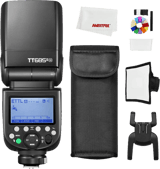
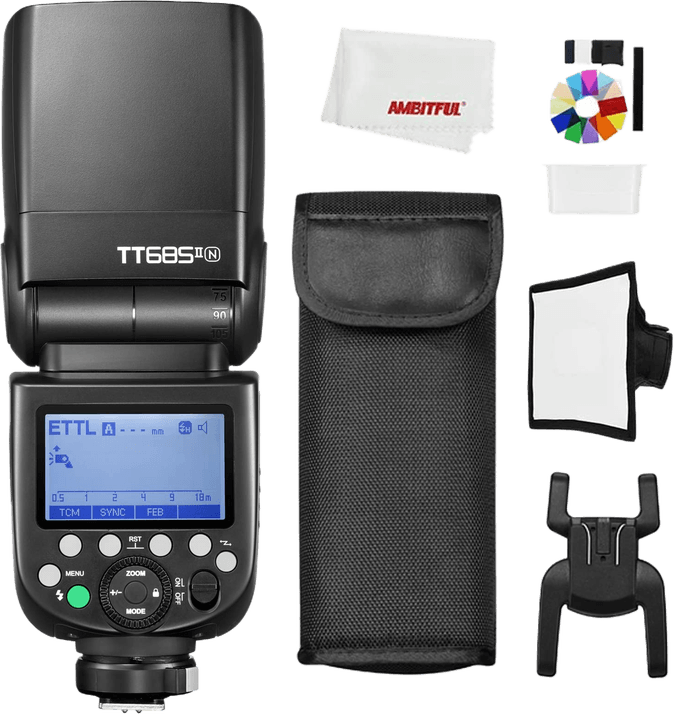
The Godox TT685II-N is the budget flash that still gives you most of what a pro speedlight does. It supports Nikon i-TTL and high-speed sync. It has a guide number of 197 ft (60 m) at 200mm, the same as the V860III-N.
The difference is power. The TT685II-N runs on four AA batteries. That gives about 330 full-power flashes and recycling of up to about 2.6 seconds. If you already own rechargeable AAs, there is nothing new to buy, and spare batteries are easy to find anywhere. A port for an external battery pack helps if you need faster recycling at events.
It also has a built-in Godox X radio that works as a master or a slave, so it can grow into an off-camera setup with other Godox lights. The TCM button converts a TTL exposure to the same manual setting. This lets you get a good exposure quickly and then lock it for a series of shots. A quick-release lock makes it faster to mount on the hot shoe.
There is no LED modeling lamp, and AA batteries recycle more slowly as they drain. If you shoot long events, the lithium-powered V860III-N is worth the extra cost. If you want something smaller for a light camera, look at the TT350II N.
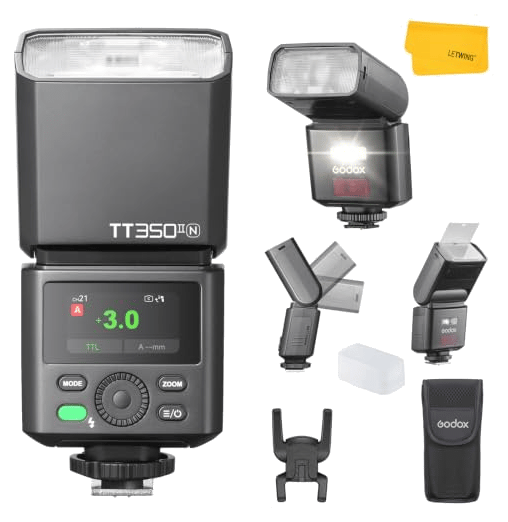
The Godox TT350II N is the flash for small Nikon bodies such as the Z50 II, Zf and Z fc. It weighs about 7.6 oz (216 g) without batteries and runs on two AA cells. A full-size speedlight can make these cameras top-heavy, but this one keeps the kit balanced and easy to carry.
This new version of the TT350 adds a color screen, an LED modeling lamp and a redesigned hot shoe. It keeps i-TTL, high-speed sync and the Godox X radio, so it can also act as a master to trigger bigger Godox flashes off-camera. The head tilts from -7 to 120 degrees and swivels through 270 degrees for bounce.
The cost of the small size is power. The guide number is 36 m (118 ft) at ISO 100, against 60 m for the TT685II-N. That is only about a third of the light. Recycling takes about 2.5 seconds with Ni-MH batteries, and you get about 210 full-power flashes. That is enough for bounced flash in a normal room or fill light outdoors. It is not enough for a big hall with a high ceiling. Choose the TT685II-N if size matters less than reach.
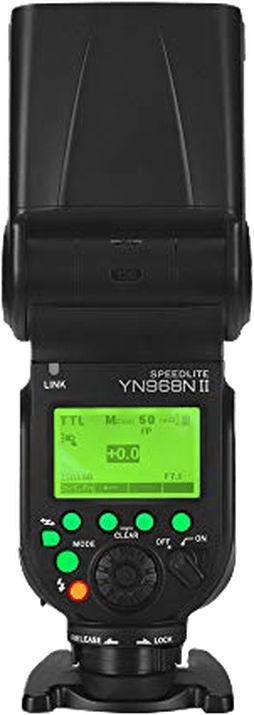
The Yongnuo YN968N II is a full-power AA speedlight with a built-in LED video light. That makes it useful if you shoot both stills and short video clips with the same camera. The LED panel gives about 300 lux at 3.3 ft, which is enough for a close interview or a product clip. It also comes with a color conversion filter.
As a flash, it has a guide number of 196 ft (60 m) at 200mm, a 20-200mm zoom, i-TTL and high-speed sync. The head tilts up to 150 degrees for bounce. Manual power goes from full to 1/128. The built-in 2.4 GHz radio works as a master or a slave with Yongnuo's wireless system, including the YN622N transceivers.
Its weakness is speed. Recycling takes about 3 seconds with alkaline AA batteries, the slowest of the standard speedlights here. Yongnuo's radio system also does not work with Godox lights. If you don't need the LED panel, the Godox TT685II-N is the better budget flash and gives you access to the larger Godox system.
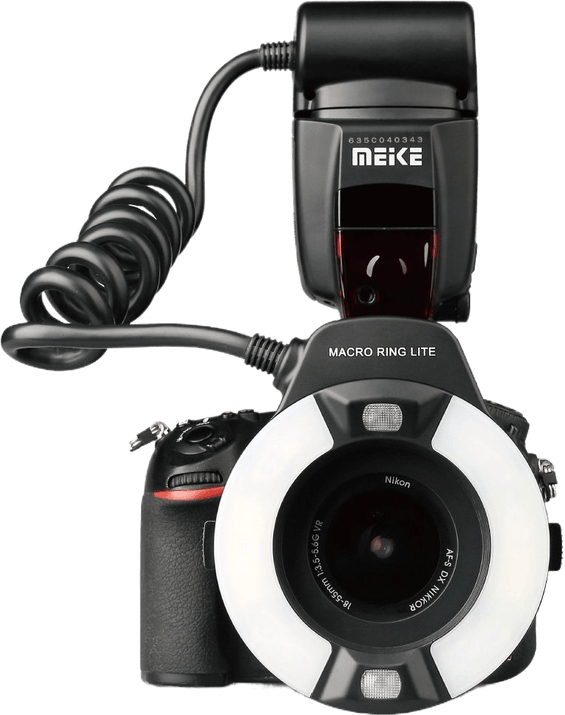
The Meike MK-14EXT-N is a ring flash for macro and close-up work. It is a different tool from the hot shoe flashes above. Its flash head mounts on the front of the lens, and two xenon tubes light the subject from around the lens barrel.
That matters at macro distances. When the subject is only a few inches from the lens, a hot shoe flash fires over the top of the lens and leaves a hard shadow below it. The ring places the light right at the lens, so it lights the subject evenly. You can fire either tube alone to give the light some direction and modeling, or both tubes together for flat, even light. An LED lamp helps you focus in dim light. Adapter rings fit lenses with 52mm to 77mm filter threads.
The guide number is only about 46 ft (14 m) at ISO 100. That is plenty a few inches from the subject, but it can't light a room. Meike's compatibility list covers Nikon DSLRs only. If you shoot a Z camera, expect to set the flash power manually. For everyday flash, choose a hot shoe speedlight such as the TT685II-N and keep the Meike for close-up subjects.
If you're buying this flash to improve your macro shots, improve them even more with our Macro Magic course.
Choosing the Best Flash for a Nikon DSLR or Mirrorless Camera
Guide Numbers Are Not Always Comparable
Guide number (GN) tells you how far the flash can light a subject at a given ISO. Makers quote it at different zoom settings, though. Nikon quotes the SB-5000 at 113 ft at 35mm, while Godox quotes 197 ft for the TT685II-N at 200mm. At 200mm, the SB-5000 reaches 180 ft. So the real gap is much smaller than the headline numbers suggest. Compare guide numbers at the same zoom position and ISO. Also remember that GN does not scale in a straight line. A flash with half the guide number gives about a quarter of the light.
Pick One Wireless System
If you plan to shoot off-camera, the wireless system matters more than the flash itself. Nikon flashes talk to each other through Nikon's optical CLS. The SB-5000 also uses Nikon radio. Godox flashes use the Godox X radio system, and Yongnuo flashes use Yongnuo's own radio. These systems do not mix. A Godox X transmitter on your camera can fire Godox speedlights and Godox studio and pocket flashes, but not a Nikon SB-700. Choose the system you want to grow into before you buy the second flash.
TTL or Manual
TTL vs. manual decides who sets the flash power. TTL reads the scene through the lens and sets the output for you, which is faster when your subject or distance keeps changing. Manual mode gives a fixed, repeatable output that suits a studio setup or a series of product shots. Every flash here supports both on a Nikon DSLR. The Meike ring flash is the exception on Z cameras, as noted above.
Conclusion: Best Flash for Nikon
The Nikon SB-5000 is the best flash for Nikon if you want Nikon's own radio control, a cooling system for long events and no compatibility questions. The Godox V860III-N is the main alternative. It recycles faster on its lithium pack and costs much less, but you join the Godox system instead of Nikon's. On a tight budget, the Godox TT685II-N gives you TTL, high-speed sync and Godox radio on ordinary AA batteries.