The Nikon Z 24-70mm f/2.8 S II is the best Nikon S lens for most Z camera owners. It covers wide scenes to head-and-shoulders portraits at a constant f/2.8. Its internal zoom keeps the lens the same length at every focal length, and it weighs 130 g less than the original version. If you want one high-grade lens for events, travel and everyday work, start here.
The other nine lenses cover the jobs a standard zoom cannot do well. There is a longer zoom for travel, a 70-200mm for sports and events, and f/1.2 primes for low light and portraits. The list also has a light 35mm prime, two wide-angle lenses for landscapes and night skies, a true macro lens and a 100-400mm for wildlife.
The Best Nikon S-Line Lenses for Z Cameras
Every lens here is a full-frame Nikon S-Line lens for the Z mount, so the choice comes down to the job. Zooms give you framing flexibility. The f/1.2 and f/1.8 primes give you more light and more background blur at one focal length. Weight matters more than it seems: the 50mm and 85mm f/1.2 primes each weigh more than the 24-70mm f/2.8 S II. Use the table to find the lens for the kind of pictures you take most, then read its review for the trade-offs.
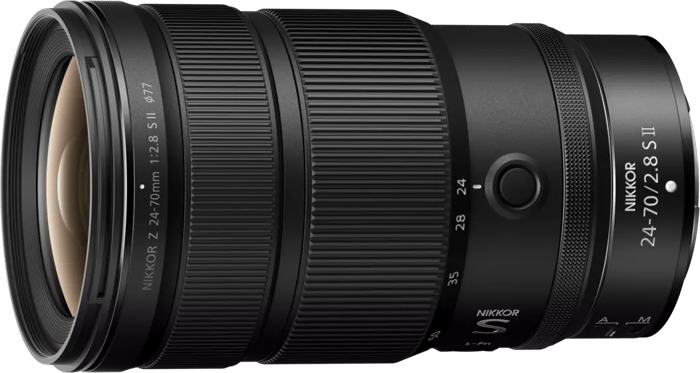
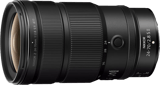
The Nikon Z 24-70mm f/2.8 S II is the lens most S-Line buyers should get first. Its range runs from a room-wide 24mm to a tight 70mm portrait, and f/2.8 stays available at every focal length. That covers weddings, parties, travel days and family pictures without a lens change.
The main improvement over the original lens is the internal zoom. The lens stays the same length when you zoom, so the balance does not shift on a gimbal. It is also lighter than the first version at 675 g, and its 11-blade aperture gives rounder out-of-focus highlights. It focuses as close as 0.79 ft at 24mm, which is useful for food and detail shots.
It has no optical stabilization. On a Z5, Z6 III, Z8, Z9 or Zf, the camera's in-body stabilization does that job. On a Z50 II or Zfc, it gets no help against camera shake. The original Z 24-70mm f/2.8 S is still sold new, but the II is the one we recommend. If you shoot mostly outdoors and want more reach, the Nikon Z 24-120mm f/4 S is the better choice. For more standard zooms across other systems, see our list of the best 24-70mm lenses.
2. Nikon Z 24-120mm f/4 S
| Weight |
Weight
1 lb 6.3 oz (630 g)
|
| In-Lens VR |
In-Lens VR
No
|
| Max Magnification |
Max Magnification
0.39x
|
| Filter Size |
Filter Size
77mm
|
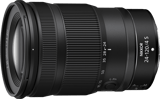
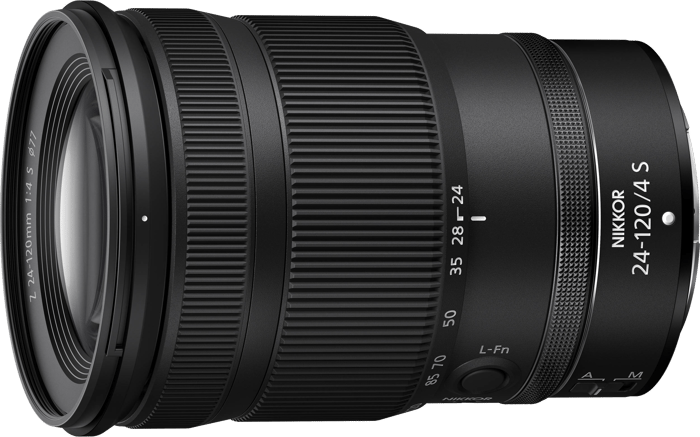
The Nikon Z 24-120mm f/4 S is the best one-lens kit in the S-Line. It reaches from 24mm to 120mm, so you can photograph a street scene and then a distant detail without changing lenses. It weighs 630 g, about the same as the f/2.8 S II, but gives you 50mm more reach.
The trade is light. At f/4 it gathers half the light of an f/2.8 zoom. Indoors or at dusk, you will need a higher ISO or a slower shutter speed. It also blurs backgrounds less. For travel, landscapes and daylight events, that rarely matters, and the extra reach often matters more.
It also magnifies close subjects more than the other zooms. It reaches 0.39x magnification at 1.15 ft, the highest on this list after the macro lens. That makes it good for flowers, food and product details. Its zoom extends as you turn the ring, unlike the internal-zoom f/2.8 S II. There is no optical stabilization, so it works best on a Z body with in-body stabilization.
Choose the Nikon Z 24-70mm f/2.8 S II instead if you shoot indoor events or want more background blur. Choose the 24-120mm if you travel light and shoot mostly in good light.
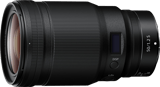
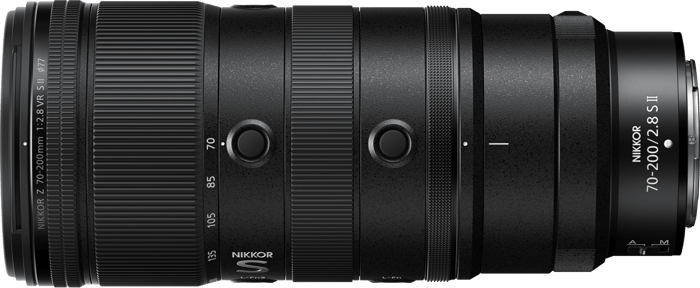
The Nikon Z 70-200mm f/2.8 VR S II is the telephoto zoom to buy for sports, events and outdoor portraits. The 70-200mm range lets you stay back from the action, and f/2.8 keeps shutter speeds fast in poor light. It also compresses backgrounds and blurs them more than the f/4 and f/5.6 zooms here.
This second version is much easier to carry than the first. It weighs 998 g without the tripod collar, which Nikon says is about 26% lighter than the original. Like the 24-70mm S II, it uses an internal zoom, so its 8.2 in length never changes. Nikon also rates its autofocus as about 3.5 times faster than the first version.
It is the only f/2.8 zoom on this list with optical VR. Nikon rates it at 5.5 stops, and 6.0 stops with a Synchro VR camera. It also works with the Z TC-1.4x and TC-2.0x teleconverters if you need more reach later. It is still a long lens, so it does not suit a small travel bag. If wildlife at a distance matters more than low light, the Nikon Z 100-400mm f/4.5-5.6 VR S gives you twice the reach. For more sports options, see our Nikon sports lenses list.
4. Nikon Z 50mm f/1.2 S
| Weight |
Weight
2 lb 6.5 oz (1,090 g)
|
| In-Lens VR |
In-Lens VR
No
|
| Max Magnification |
Max Magnification
0.15x
|
| Filter Size |
Filter Size
82mm
|
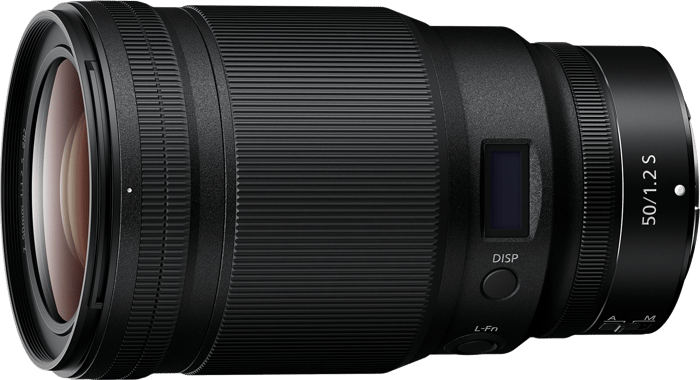
The Nikon Z 50mm f/1.2 S is the best S lens for low light. Its f/1.2 aperture gathers more than twice the light of an f/1.8 lens. That lets you keep a low ISO in dim rooms and blur backgrounds strongly at a natural 50mm view. It suits evening events, environmental portraits and street photography after dark.
Its two STM focus motors keep focusing quick and quiet for stills and video. The 9-blade aperture gives smooth out-of-focus highlights. It focuses as close as 1.48 ft.
The drawback is size. It weighs 1,090 g, more than the 24-70mm f/2.8 S II, and it takes 82mm filters. That is a lot of lens for one focal length. If you want a fast prime to carry all day, the Nikon Z 35mm f/1.8 S weighs about a third as much. If you mainly shoot portraits, the Nikon Z 85mm f/1.2 S frames faces more tightly. Choose the 50mm f/1.2 when low light and a natural field of view matter more than weight.
5. Nikon Z 85mm f/1.2 S
| Weight |
Weight
2 lb 9 oz (1,160 g)
|
| In-Lens VR |
In-Lens VR
No
|
| Max Magnification |
Max Magnification
0.11x
|
| Filter Size |
Filter Size
82mm
|
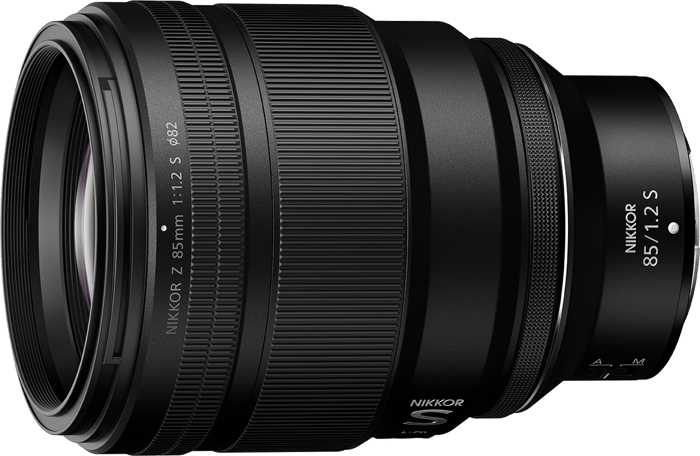
The Nikon Z 85mm f/1.2 S is the S lens built for portraits. At 85mm you can frame a head-and-shoulders portrait from a comfortable distance, with a flattering perspective. At f/1.2, the background blurs strongly even in a busy setting.
Its 11-blade aperture keeps highlights round, and its f/1.2 aperture lets you shoot indoors or at dusk without a flash. It is the lens to choose for weddings, headshots and evening sessions where the subject is the whole picture.
It asks a lot in return. It weighs 1,160 g, the heaviest prime here, and it cannot focus closer than 2.79 ft. That rules it out for tight detail shots of rings or flowers. There is no optical stabilization, so slow shutter speeds rely on the camera's IBIS. If you want more working distance for portraits, Nikon also makes the Z 135mm f/1.8 S Plena. If you want one lens for portraits and events, the Nikon Z 70-200mm f/2.8 VR S II covers 85mm and much more at f/2.8.
6. Nikon Z 35mm f/1.8 S
| Weight |
Weight
13.1 oz (370 g)
|
| In-Lens VR |
In-Lens VR
No
|
| Max Magnification |
Max Magnification
0.19x
|
| Filter Size |
Filter Size
62mm
|
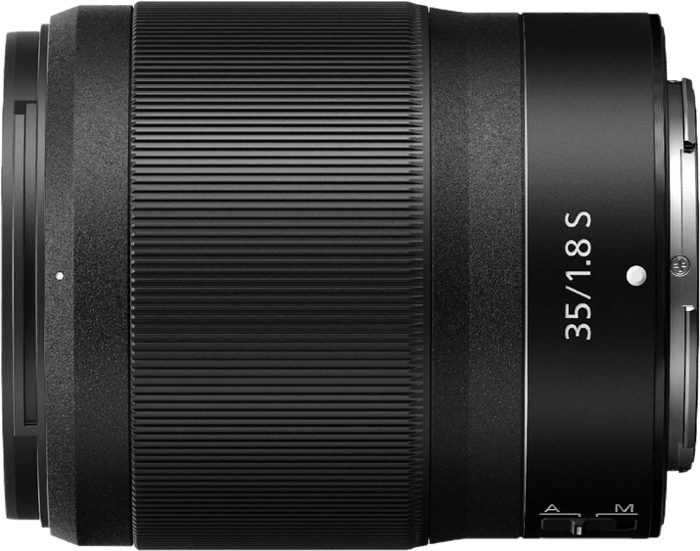
The Nikon Z 35mm f/1.8 S is the lightest lens on this list and the easiest S lens to carry every day. At 370 g it balances well on any Z body. Its 35mm view suits street photography, travel and environmental portraits that show the place as well as the person.
Its f/1.8 aperture is bright enough for indoor shooting without a flash, and it gathers more than twice the light of the f/2.8 zooms. It focuses as close as 0.82 ft, so you can also shoot table-top details. It takes small 62mm filters, the same size as the MC 105mm macro.
The trade-off is that it is not as bright as the f/1.2 primes. The Nikon Z 50mm f/1.2 S gathers over a stop more light, but weighs about three times as much. If you want a wider view, the Nikon Z 20mm f/1.8 S gives you more of the scene. If you want one small prime that goes everywhere, this is it.
7. Nikon Z 14-24mm f/2.8 S
| Weight |
Weight
1 lb 7 oz (650 g)
|
| In-Lens VR |
In-Lens VR
No
|
| Max Magnification |
Max Magnification
0.13x
|
| Filter Size |
Filter Size
112mm (with HB-97 hood)
|
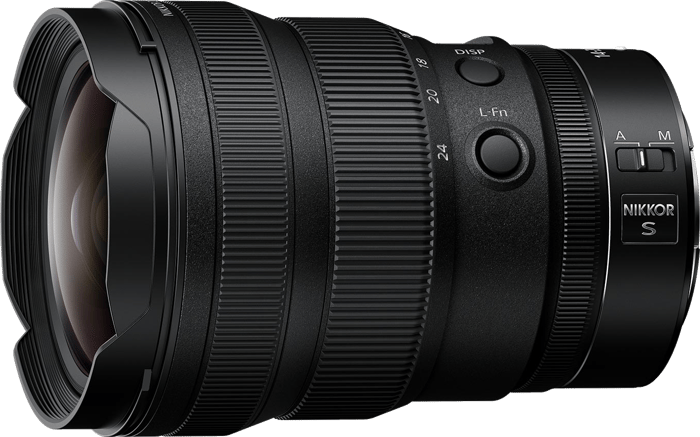
The Nikon Z 14-24mm f/2.8 S is the best ultra-wide zoom in the S-Line. At 14mm it takes in a whole room or a large landscape from a close position. The constant f/2.8 aperture helps with dim interiors and night scenes.
It is light for a 14-24mm f/2.8 lens at 650 g. It also solves a common ultra-wide problem with filters. Many lenses this wide have a bulging front element that takes no screw-in filter. With the supplied HB-97 hood fitted, this one takes 112mm screw-in filters, and a rear slot accepts gel filter sheets.
That filter solution has a cost. 112mm filters are large and cost more than common sizes, and you need the larger hood to use them. At 0.13x magnification it is also not a close-up lens. If you mainly photograph the night sky, the Nikon Z 20mm f/1.8 S gives you more light for less weight. For architecture, interiors and dramatic landscapes, nothing else on this list goes as wide.
8. Nikon Z 20mm f/1.8 S
| Weight |
Weight
1 lb 1.9 oz (505 g)
|
| In-Lens VR |
In-Lens VR
No
|
| Max Magnification |
Max Magnification
0.19x
|
| Filter Size |
Filter Size
77mm
|
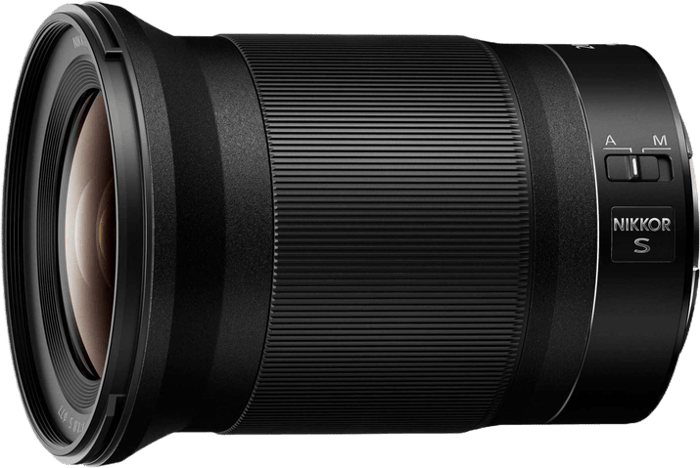
The Nikon Z 20mm f/1.8 S is the best S lens for astrophotography. Its f/1.8 aperture gathers more than twice the light of an f/2.8 zoom. That means shorter exposures before stars start to trail. Nikon designed it to render small points of light cleanly, so stars keep their shape near the frame edges.
It is also a strong landscape lens. The 20mm view is wide without the extreme stretch of 14mm, and it takes standard 77mm filters with no special hood. At 505 g it is light enough for long hikes to dark-sky sites. It focuses as close as 0.66 ft, so you can put a foreground subject close to the lens.
The limit is the fixed focal length. You change framing by moving, not zooming. For interiors or tight spaces where you need wider than 20mm, choose the Nikon Z 14-24mm f/2.8 S. For night sky work, the 20mm f/1.8 S is the better tool.
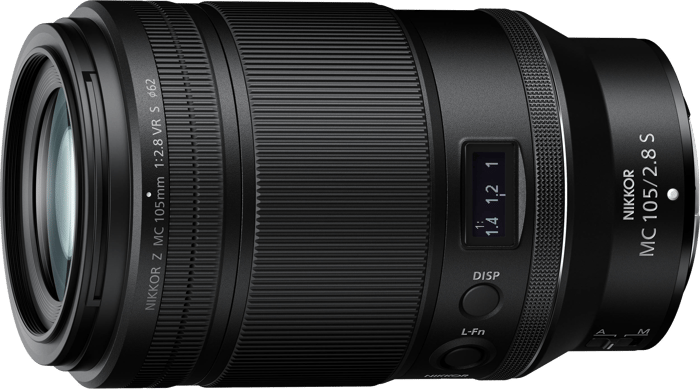
9. Nikon Z MC 105mm f/2.8 VR S
| Weight |
Weight
1 lb 6.3 oz (630 g)
|
| In-Lens VR |
In-Lens VR
Yes, 4.5 stops
|
| Max Magnification |
Max Magnification
1x
|
| Filter Size |
Filter Size
62mm
|
The Nikon Z MC 105mm f/2.8 VR S is the S-Line macro lens. It reaches 1x magnification, so a subject the size of your camera's sensor fills the whole frame. That is the level you need for insects, jewelry and fine product details. None of the other lenses here go past 0.39x.
The 105mm focal length gives you more working distance than a 50mm macro. That helps you avoid shading the subject or scaring an insect. Its 4.5-stop optical VR helps with handheld close-ups, and a focus limiter keeps the autofocus from searching through the whole range. It also works well as a sharp short-telephoto portrait lens.
Its f/2.8 aperture is fine for macro, where you usually stop down for depth of field. For portraits in dim light, it gives less background blur than the Nikon Z 85mm f/1.2 S. For more choices across systems, see our guide to the best macro lenses.
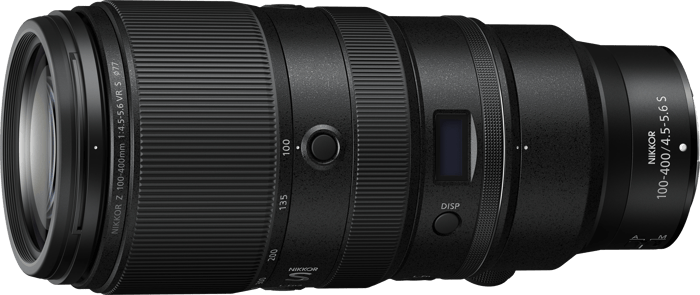
10. Nikon Z 100-400mm f/4.5-5.6 VR S
| Weight |
Weight
2 lb 15.8 oz (1,355 g)
|
| In-Lens VR |
In-Lens VR
Yes, 5.5 stops
|
| Max Magnification |
Max Magnification
0.38x
|
| Filter Size |
Filter Size
77mm
|
The Nikon Z 100-400mm f/4.5-5.6 VR S is the S lens for wildlife and distant outdoor subjects. It reaches twice as far as the 70-200mm, which makes birds, deer and field sports fill much more of the frame. Its 5.5-stop VR makes handheld shooting practical at 400mm.
It is also surprisingly useful up close. It reaches 0.38x magnification, so it can photograph flowers, butterflies and dragonflies from a distance. It takes the same 77mm filters as the two S II zooms and the 24-120mm.
The compromise is light. At 400mm the aperture closes to f/5.6, two stops darker than the Nikon Z 70-200mm f/2.8 VR S II. In a dark forest or an indoor arena, that means high ISO settings. It weighs 1,355 g without the tripod collar, and the zoom extends as you turn the ring. Choose it for daylight wildlife and outdoor sports. Choose the 70-200mm for indoor events and low light.
How to Choose a Nikon S Lens
What the S Means
The S marks Nikon's S-Line, its higher-grade Z lenses. They are built to a higher optical standard than the standard Nikkor Z lenses, with dust and drip resistance. Every lens on this list is sealed this way. Nikon also makes standard Nikkor Z lenses without the S. They cost less and suit many photographers, but this list covers the S-Line only. Our guide to Nikon lens abbreviations explains the other letters, such as VR and MC.
Using S Lenses on DX Cameras
All ten lenses are full-frame lenses, but they also fit DX cameras such as the Z50 II and Zfc. On a DX body, each lens gives a 1.5x tighter view, so the 50mm f/1.2 frames like a 75mm lens and the 100-400mm like a 150-600mm. These bodies have no in-body stabilization, so the MC 105mm, 70-200mm and 100-400mm are the only picks here with stabilization on them. The heavy f/1.2 primes also feel large on a small DX body.
Plan Your Filter Sizes
Filters add up across a kit, so it helps to know which lenses share a size. The 24-70mm f/2.8 S II, 70-200mm S II, 24-120mm, 20mm and 100-400mm all take 77mm filters. The 50mm and 85mm f/1.2 take 82mm. The 35mm f/1.8 and MC 105mm take 62mm. The 14-24mm needs 112mm filters with its HB-97 hood. If you already own 77mm filters, five of these lenses can use them with no step-up ring.
Frequently Asked Questions
Should I Buy the Original Z 24-70mm f/2.8 S or the S II?
Buy the S II if you can. It is 130 g lighter, its internal zoom keeps the length fixed, and its 11-blade aperture keeps out-of-focus highlights rounder. The original is still a sharp, sealed f/2.8 zoom, so it remains a sensible choice if you find it new at a large discount. It extends as you zoom, which matters most on a gimbal.
Conclusion: The Best Nikon S Lenses
The Nikon Z 24-70mm f/2.8 S II is the best Nikon S lens for most photographers. Its constant f/2.8 and internal zoom make it a strong first lens for events, travel and portraits. If you want more reach and travel light, choose the Nikon Z 24-120mm f/4 S. If low light and background blur matter most, the Nikon Z 50mm f/1.2 S is the best prime here.