

One of the most important pieces of equipment for any photographer is the camera flash. Those photographers who practice portrait, event or product photography will find it vital.
Below are the ten flashes we would buy today. If you want one answer and no reading, buy the Godox V860III. It gives you TTL, high-speed sync and a lithium-ion battery, it is sold in a version for every major camera system, and it costs a fraction of what the camera makers ask for their own flagships.
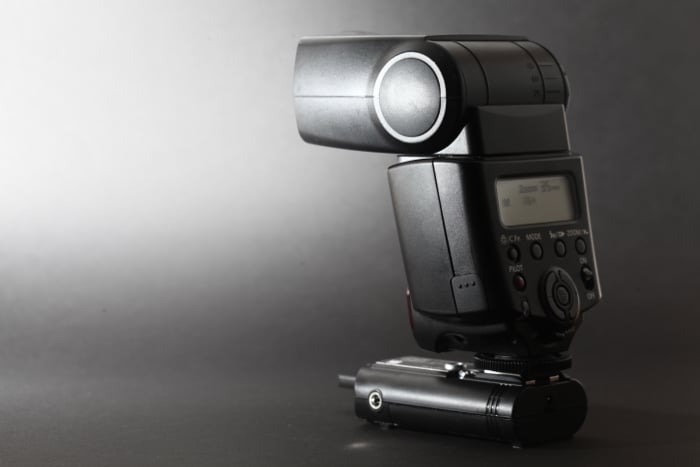
Here an old Canon 430EX II fires a flash at a black background.
What is a Camera Flash Gun?
A camera flash is an external unit which attaches to your camera via the hot shoe. It’s a lot more powerful than a built-in flash. And it will allow you to take better quality photos.
The following are just some of the advantages a flash gun has over a built-in flash.
- Off-camera flash: A camera flash can be used off-camera by using either infra-red, radio or a change in light as its trigger. The ability to do this will give you much more creative potential.
- More power: While not as powerful as studio lights, a flash unit still packs a serious punch. If you use multiple units you’ll be able to build a mobile studio.
- Direction of light: Built-in camera flash aims in one direction. A flash unit can be manipulated to aim the light in different directions. This will allow you to bounce the light off the wall or a ceiling when indoors.
- Light modifiers: There are lots of light modifiers you can use with a flash. Soft boxes, snoots, or shoot thru umbrellas are some examples of these.
- Stroboscopic effect: Use the strobe as your shutter in a darkened room. Keep your camera shutter open, and use a burst of flashes to create a multi-exposure look with a moving object.
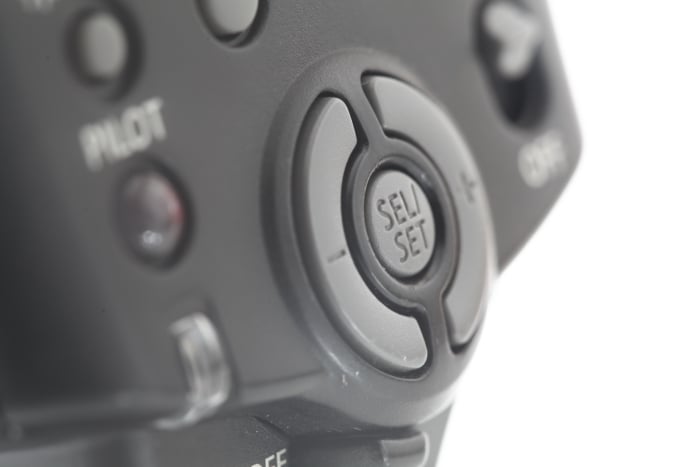
The better more expensive flash units will have a greater number of settings you can use.
How to Choose a Camera Flash
Four questions settle almost every flash purchase. Answer them in this order and the list below narrows to one or two units.
- Which system do you shoot? A flash talks to the camera through the shoe, so the version matters. Canon’s current Speedlites need the multi-function shoe on recent EOS R bodies. Godox, Yongnuo and Neewer sell a separate version of the same flash for Canon, Nikon, Sony, Fujifilm and Micro Four Thirds. Buy the one that names your brand.
- Do you need TTL? TTL meters the scene and sets the power for you, which matters at a wedding or an event where the distance to your subject keeps changing. The Godox V860III, the Godox TT685II and every own-brand unit here have it. The Yongnuo YN560 IV and the Neewer TT560 do not, and they are cheaper because of it.
- How much power, and how often? Guide number is the shorthand. The Canon EL-5, the Nikon SB-5000, the Godox V860III and the Godox TT685II all sit around 60 metres at ISO 100. The Sony HVL-F28RMA is 28, which is fine for fill but not for lighting a room.
- AA cells or lithium-ion? AA units are cheap to keep going and easy to replace on the road. A lithium-ion pack recycles faster and lasts far longer: the Godox V860III gives about 480 full-power flashes on one charge, where four AAs in the TT685II give about 330 and recycle more slowly as they drain.
Canon Flash Guns
Canon makes a series of flash guns, often referred to as strobes. These units are exclusively for Canon cameras and could damage other camera bodies.
The current line-up is built around the multi-function shoe on the EOS R bodies, and it runs to three units: the EL-1 at the top, the EL-5 in the middle and the EL-10 as the affordable one. Canon has ended production of the 600EX II-RT, the 470EX-AI and the 430EX III-RT, so a listing under any of those names is old stock, a grey import or a used unit at a new-unit price. Check before you click.
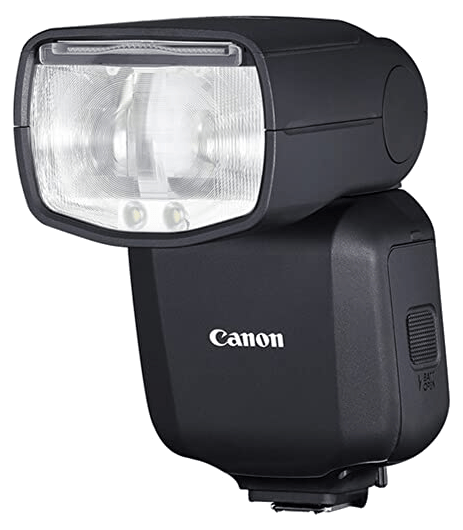
Canon Speedlite EL-5
The EL-5 is the flash most Canon mirrorless owners should buy. It is the unit Canon designed around the multi-function shoe, and it is the one that keeps up with a fast wedding or event day without cooking itself.
Power is the headline. Its guide number is 60 metres at ISO 100 with the head zoomed to 200mm, which is as strong as anything in this article, and it recycles in 0.1 to 1.2 seconds. Canon rates it at roughly 95 continuous full-power pops before it needs a rest.
The other reason to choose it over the EL-10 is the battery. The LP-EL lithium-ion pack is good for somewhere between 350 and 2,450 flashes depending on how hard you push it, so a long day needs one spare rather than four sets of AAs. Radio control is built in, with five groups and up to 16 units on the 2.4 GHz band.
The drawbacks are real. Manual power runs from 1/1 down to 1/1024, which is more control than the older Speedlites gave you, but you pay for all of this: the EL-5 is one of the two most expensive flashes here. It also assumes a recent EOS R body with the multi-function shoe, and some models want a firmware update first. If you shoot an older Canon DSLR, this is not your flash.
- Rotating head: Bounces off a ceiling or a wall in any direction.
- Focal length: Covers 24 to 200mm, and down to 14mm with the pull-out wide panel.
- Manual power: 1/1 to 1/1024, in the same menus as the camera body.
- Wireless: 2.4 GHz radio as sender or receiver, five groups, 16 units.
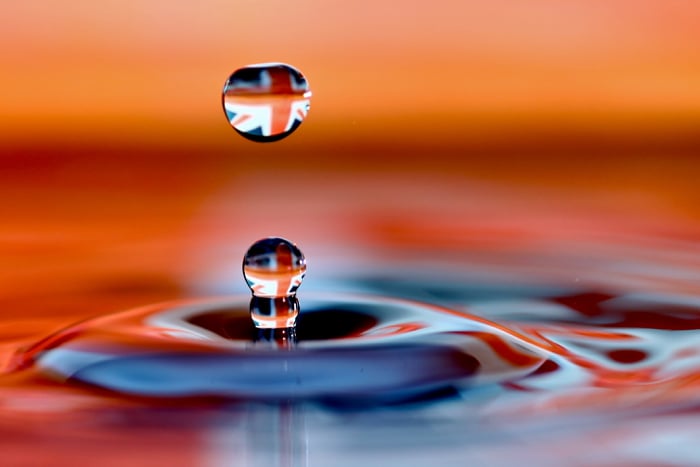
You’ll need a flash to be able to take photos like this one. The water droplet is caught mid-air by camera flash at high-speed sync.
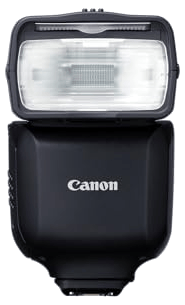
Canon Speedlite EL-10
The EL-10 is the sensible Canon flash. It is the one to buy if you want Canon’s own metering and menus without paying flagship money, and it is the cheapest current Speedlite that will still run a small multi-flash setup on its own.
It runs on four AA batteries, which is the practical argument for it. You can buy replacements at a petrol station at midnight, and a set gives somewhere between 210 and 1,700 flashes depending on power. Recycling takes 0.1 to 2.5 seconds.
It also has proper 2.4 GHz radio in both directions, which the mid-range Speedlites took a long time to gain. It works as a sender or a receiver over roughly 30 metres, and it can drive up to 15 other EL or EX Speedlites, so it can be the only trigger in a small kit.
The compromises are power and reach. The guide number is 40.5 metres at ISO 100 at 105mm, against 60 for the EL-5, and the head only zooms to 105mm rather than 200mm. It tilts from 0 to 90 degrees and swivels up to 150 degrees, but it cannot bounce downward for close-up work. If you light rooms rather than people at arm’s length, spend the extra on the EL-5.
- Rotating head: 0 to 90 degrees up, 150 degrees left and right. No downward tilt.
- Focal length: 24 to 105mm, with a 14mm wide panel.
- Manual power: 1/1 to 1/1024.
- Wireless: 2.4 GHz radio, sender or receiver, up to 15 units.
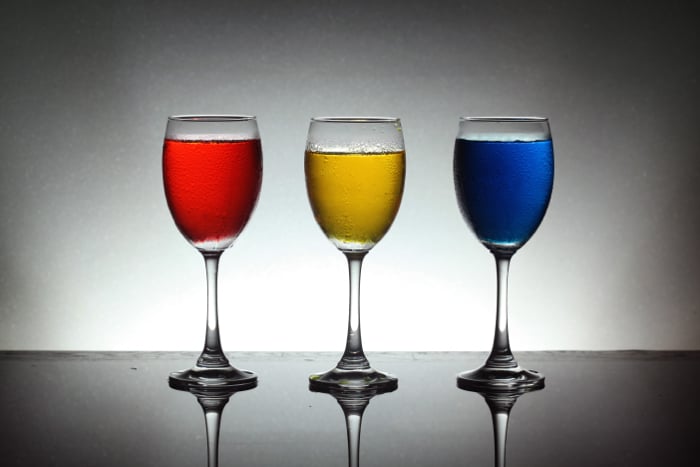
Product photography often needs strobes for good lighting.
Nikon Flash Guns
Nikon has its own range of strobes as well, and like with Canon these are brand specific. Don’t try mounting these on non-Nikon cameras, unless you feel the urge for a new camera.
Nikon has been quieter than Canon here, and that is good news for buyers: both of the flashes below are still current, and they cover the top and the middle of the range between them. They mount on Z bodies and on Nikon DSLRs alike.
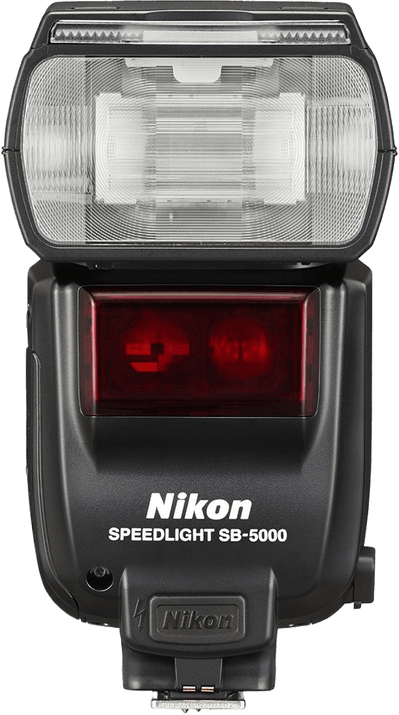
Nikon Speedlight SB-5000
This is still Nikon’s best strobe, and it is still a great piece of equipment. It has great performance when set to TTL. It also runs cooler than other flashes, thanks to an internal cooling system that lets you fire 100 shots back to back at full power.
The number that matters is a guide number of 55 metres at ISO 100 with the head at 200mm, or 34.5 metres at 35mm. Flash duration runs from 1/980 second at full power down to 1/30,820 second at the lowest setting, which is where it earns its keep freezing water and other fast subjects.
This unit will work as your master flash in conjunction with other flash units, and to do this you can use either radio or optical control. Radio reaches about 30 metres across six groups, and the older optical system covers three. Where it diverges from the Canon is that the radio side needs Nikon’s WR-R10 or WR-R11 controller on the camera, so budget for that as well.
The drawback is the price. This is the most expensive flash in this article by some distance, and if you are not shooting events or fast action you will never see the difference between it and the SB-700 below. It also runs on four AA batteries rather than a lithium-ion pack, so a long day still means carrying spares.
- Rotating head: Angles from -7 to 90 degrees to bounce the flash, and 180/180 left to right.
- Focal length: A range of 24 to 200mm and a 14mm wide panel.
- Manual power: This goes from 1/1 down to 1/256th.
- Wireless: Works as a master and slave with optical and radio control.

This portrait used a flash to the left of the camera. It’s created a low key portrait.
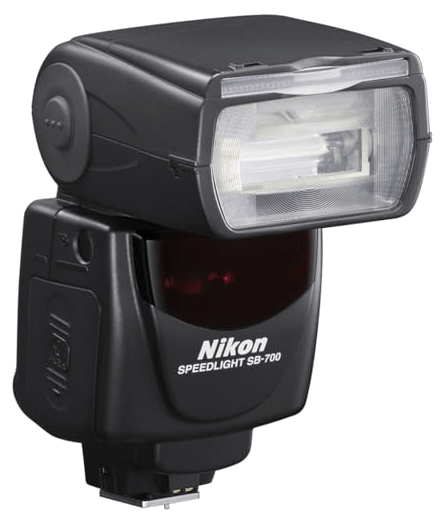
Nikon Speedlight SB-700
The Nikon SB-700 is the Nikon flash most people should actually buy. It has been in the line-up for years, and it has survived because it does the ordinary jobs well: a bounced portrait, a fill flash outdoors, a second light in a small home studio alongside a reflector.
Its guide number is 28 metres at ISO 100 with the head at 35mm, so it is roughly half as strong as the SB-5000. In practice that costs you a stop of reach, not a working method. Zoom coverage runs 24 to 120mm on full frame, or 14 to 120mm on a DX body.
The key feature is that this strobe will act as a master, making the need to shell out on the more expensive SB-5000 less pressing. You also get greater manoeuvrability of the flash head itself, and a set of gels and a diffusion dome in the box.
The real limit is triggering. The SB-700 is optical only, so it needs line of sight to its slaves and it struggles outdoors in daylight. Adding radio means buying separate flash triggers, at which point a Godox unit with radio built in is the cheaper answer. Buy the SB-700 if you want Nikon’s own metering; buy Godox if you want to work wirelessly across a room.
- Rotating head: Aim up and down at -7 to 90 degrees. Swivel right and left at 180/180.
- Focal length: 24 to 120mm on full frame, 14 to 120mm on DX.
- Manual power: 1/1 down to 1/128th.
- Wireless: Works as a master and slave, but only with optical control.

Food photography always looks better with strobes, and the light coming from just behind.
Sony Flash Guns
Sony also produces flashes which are specific to their cameras. These are built for the multi-interface shoe on the Alpha mirrorless bodies, and they are designed to make the most of Sony’s metering and menus.
Sony refreshed the range in April 2025: the HVL-F46RM and the HVL-F28RM both gained A-suffix versions with faster sync speeds for bodies like the a9 III. The older HVL-F32M has been out of production for years, so treat any listing for it as a used unit.
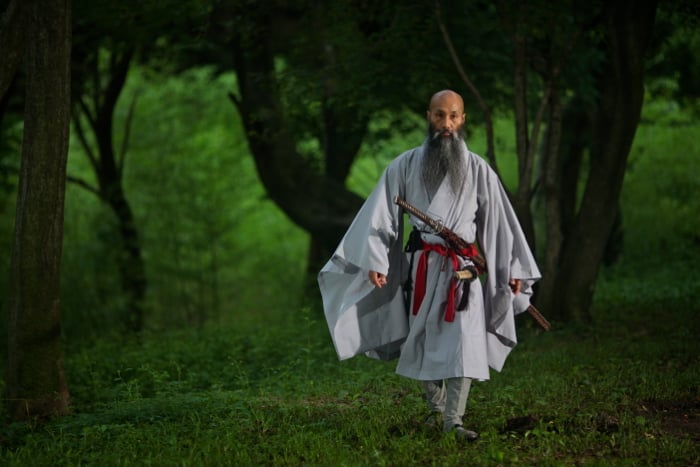
In this photo the monk is lit by strobes in the dimly lit forest.
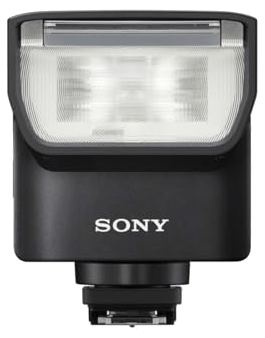
Sony HVL-F28RMA
The HVL-F28RMA is Sony’s small radio flash, and it is the one that makes sense for most Alpha owners. It is the flash you leave on the camera because it is not heavy enough to notice, and it is the cheapest way into Sony’s own radio system, whether you shoot one of Sony’s budget-friendly bodies or an a7.
Its strength is the wireless. For a unit this size you get a full 2.4 GHz radio transceiver, 14 channels, three groups and up to 15 units, over about 35 metres. It works as the commander as well as a receiver, so one of these can trigger a set of larger flashes on stands.
It runs on two AA batteries rather than four, which is what keeps it pocket-sized. Recycling is 0.1 to 4.1 seconds on rechargeable Ni-MH cells, and you get roughly 130 flashes from a set. The head tilts through click stops at 0, 20, 40, 60, 80 and 120 degrees.
The catch is the number 28. That is the guide number at ISO 100 and 50mm, which makes this a fill and bounce flash, not a room light. Coverage is 50mm as standard, or 24mm with the built-in wide panel, so a wider lens will vignette without it. If you need real power on Sony, look at the HVL-F46RMA or the Godox V860III-S instead, both of which cost more but light a room properly.
- Rotating head: Tilts through 0, 20, 40, 60, 80 and 120 degrees.
- Focal length: 50mm coverage, 24mm with the wide panel.
- Wireless: 2.4 GHz radio, commander or receiver, 14 channels, three groups.
- Power: Two AA batteries, roughly 130 flashes per set.
Other Flash Guns
There are plenty of other flashes on the market as well, and this is where the category has changed most. Godox now covers every camera system with one radio protocol, which is why three of the five units below carry that name. You will still need to buy the version built for your camera body.
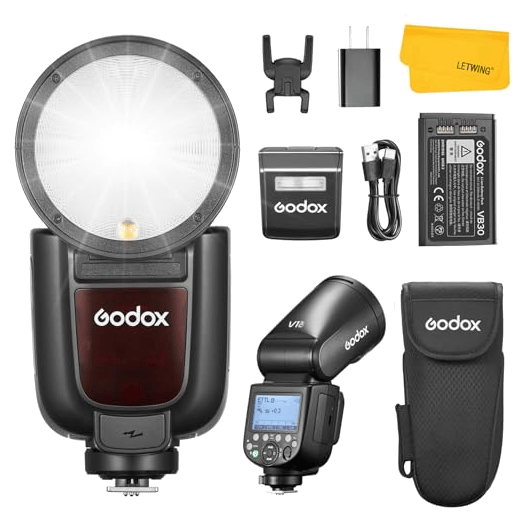
Godox V1 Pro
The V1 Pro is the flash to buy if you care about the quality of the light rather than the size of the number on the box. Its head is round rather than rectangular, so the falloff at the edge of the beam is gentler and bare-flash portraits look less harsh.
That round head is also a mounting system. Godox’s AK-R1 modifiers, the snoots, grids, gels and bounce cards, clip on magnetically, so changing the light takes a second rather than a handful of elastic bands. There is a magnetic SU-1 sub-flash for a catchlight or a touch of fill as well.
The rest is standard current Godox: TTL, high-speed sync to 1/8000 second, the 2.4 GHz X radio system, and a 2,980 mAh lithium-ion pack good for about 500 full-power flashes. A ten-level LED modelling light lets you see roughly where the light will fall before you fire it.
It is not the obvious first flash. It costs more than the V860III for the same power, the round head does not take the rectangular softboxes you may already own, and if you shoot events rather than portraits you are paying for a lighting quality you will rarely notice. Buy it for people; buy the V860III for everything.
- Head: Round, with a magnetic mount for the AK-R1 modifier set.
- Manual power: TTL and manual, high-speed sync to 1/8000 second.
- Battery: 2,980 mAh lithium-ion, about 500 full-power flashes.
- Wireless: Godox 2.4 GHz X system, master and slave.
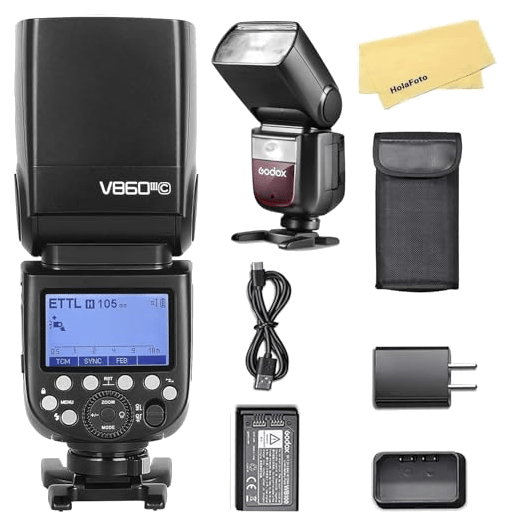
Godox V860III
If you buy one flash from this article, buy this one. The V860III does everything the own-brand flagships do, on every camera system, for a fraction of the money, and it is the unit we would put in a working bag first.
The power matches the Canon and Nikon flagships: a guide number of 60 metres at ISO 100 with the head at 200mm, with zoom coverage from 20 to 200mm. Recycling is 0.01 to 1.5 seconds, and the VB26 lithium-ion pack gives around 480 full-power flashes, so an event day runs on one battery and a spare.
TTL and high-speed sync to 1/8000 second are both there, allowing creative lighting at fast shutter speeds, along with the Godox 2.4 GHz X radio system that also talks to the company’s studio strobes and triggers. A ten-level LED modelling lamp helps you place the light, which is unusual at this price. Sony users should buy the V860III-S version.
The honest drawbacks are build and support. The plastics do not feel like Canon’s, the menus take a session to learn, and a warranty claim means dealing with a Chinese manufacturer rather than a local service centre. It is also mount-specific, so check you are buying the version for your brand. If you are already deep in Canon or Nikon’s own wireless system, staying there may be worth the premium.
- Rotating head: Bounces and swivels for ceiling and wall work.
- Focal length: 20 to 200mm zoom coverage.
- Manual power: TTL and manual, high-speed sync to 1/8000 second.
- Battery: VB26 lithium-ion, about 480 full-power flashes, 1.5 second recycle.
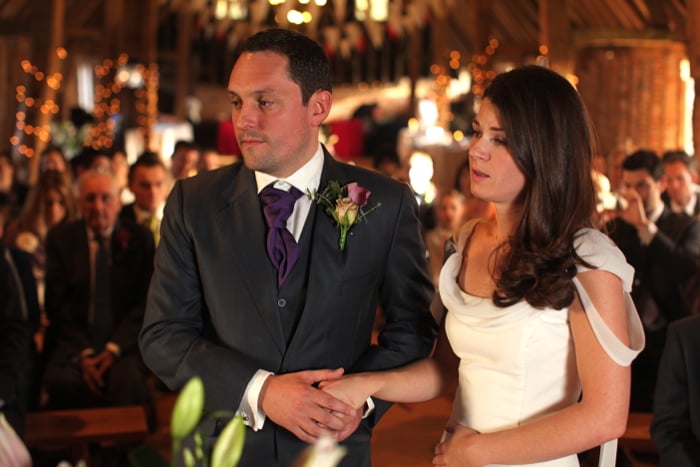
Wedding photography always needs a good camera flash, and the knowledge of how to use it.
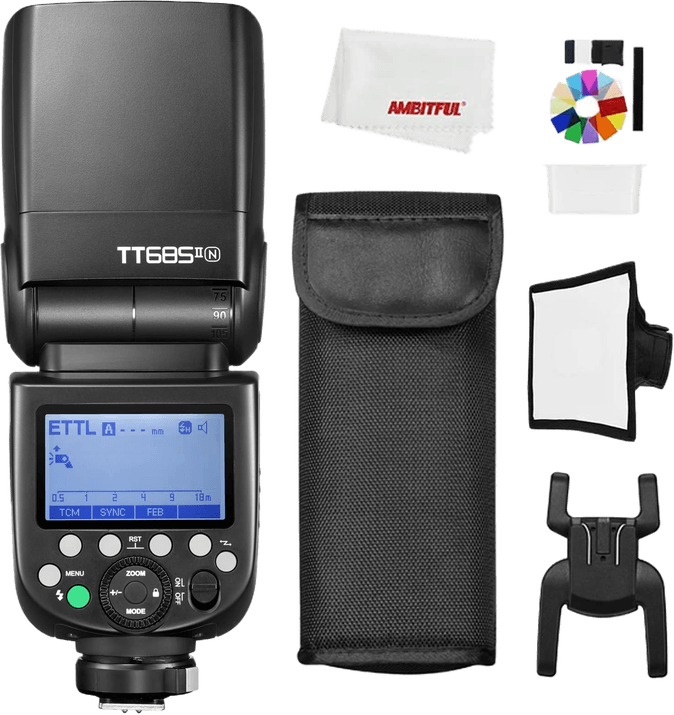
Godox TT685II
The TT685II is the V860III with AA batteries instead of a lithium-ion pack, and it costs a good deal less because of it. For a second or third light on a stand, that is a trade worth making.
The specification is close to identical where it counts. Guide number 60 metres at ISO 100 at 200mm, the same 20 to 200mm zoom head, TTL, high-speed sync to 1/8000 second, and the same Godox 2.4 GHz X radio system, so it sits in a set alongside a V860III or a V1 Pro without any extra hardware.
Manual power runs through 22 steps from 1/1 to 1/128, which is finer control than most flashes at this price give you. There is also a one-button TCM function that takes a TTL reading and converts it to the equivalent manual setting, which is a genuinely useful way to lock an exposure once you like it.
The batteries are the compromise. Four AAs give about 330 full-power flashes with a recycle time of 0.1 to 2.6 seconds, and that recycle time gets worse as the cells drain, which you feel when the action speeds up. If this is going to be your main flash rather than a second one, pay the difference for the V860III.
- Focal length: 20 to 200mm zoom coverage.
- Manual power: 22 steps from 1/1 to 1/128, high-speed sync to 1/8000 second.
- Battery: Four AA cells, around 330 full-power flashes, 0.1 to 2.6 second recycle.
- Wireless: Godox 2.4 GHz X system, master and slave.
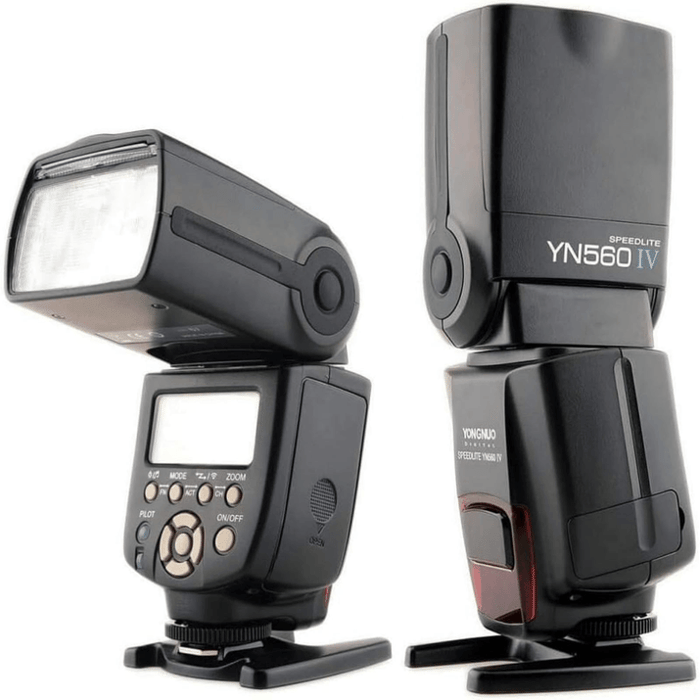
Yongnuo YN560 IV
The YN560 IV is the flash to learn on, and it has survived a decade on this list for a reason. It is manual only, and that turns out to be the point: with no TTL to fall back on you have to understand what power, distance and aperture actually do.
The good is that this is a unit with a wireless trigger that can work both as a master and a slave. You can once again manually change the power of the flash, and the built-in 2.4 GHz transceiver means a set of them talks to each other without buying anything else.
Its guide number is 58 at ISO 100, so power is not the limitation here. The recycle speed between flash bursts is good, and it fits any single-contact hot shoe, which makes it a safe buy if you switch camera brands later. This is a nice flash for those learning to use off-camera lighting for the first time.
What you give up is automation. There is no TTL and no high-speed sync, so every exposure is yours to set and your shutter speed is capped at the camera’s sync speed. For a wedding or a fast event that is a serious handicap, and the TT685II is a better use of the extra money. For a stand in a home studio, it is hard to beat.
- Focal length: 24 to 105mm zoom coverage.
- Manual power: 1/1 down to 1/128th, manual only, no TTL.
- Wireless: Built-in 2.4 GHz transceiver, master and slave.
- Battery: Four AA cells.
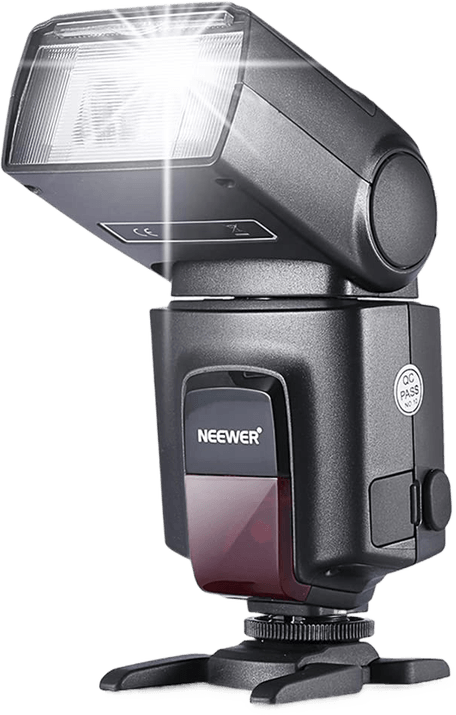
Neewer TT560
This is a very affordable flash unit that’s designed to work on any model. It is the cheapest thing in this article by a distance, and it is the honest answer if you want to try flash before spending real money on one.
You can change the strength of the flash by eight different levels from high to low, running from full power down to 1/128th. That is a lot less control than the other units here offer, but it is enough to learn bounce, fill and off-camera work with.
The single-contact hot shoe fits Canon, Sony, Nikon, Panasonic and Fujifilm bodies, so it will still work if you change systems. The rotating head offers good flexibility through a fairly standard range up and down and left to right, and you will need to work out the control settings yourself, as the English translation on the instructions isn’t very good.
The limitations are exactly what you would expect. There is no TTL, no radio, no high-speed sync and no zoom head, and the recycle time at full power is slow enough that you will miss shots with it. Nobody should use this at a paid job. As a first flash, or as a cheap third light behind a subject, it earns its place.
- Manual power: Eight levels from 1/1 down to 1/128th, manual only.
- Mount: Universal single-contact shoe for Canon, Sony, Nikon, Panasonic and Fujifilm.
- Wireless: Optical slave only, no radio.
- Battery: Four AA cells.
Frequently Asked Questions
Do I need a flash from the same brand as my camera?
No, but you do need the version built for your camera’s system. Own-brand flashes such as the Canon EL-5 and the Nikon SB-5000 use the manufacturer’s own metering and menus, which is the main thing you pay extra for. Third-party makers such as Godox and Yongnuo sell a separate version of the same flash for Canon, Nikon, Sony, Fujifilm and Micro Four Thirds. Buying the wrong version can damage the camera, so check the letter on the end of the model name.
What guide number do I actually need?
For fill light and bounced portraits in a normal room, a guide number around 28 at ISO 100 is enough, which is where the Sony HVL-F28RMA and the Nikon SB-700 sit. For a venue, a large group or anything you have to light from a distance, you want something nearer 60, which is the Canon EL-5, the Nikon SB-5000, the Godox V860III and the Godox TT685II. Doubling the guide number buys you two stops of reach, not twice the light.
Is TTL worth paying for?
It is if your subject distance keeps changing, which is exactly what happens at a wedding, a party or an event. TTL fires a pre-flash, meters it and sets the power before the exposure, so you can keep shooting. If your flash lives on a stand at a fixed distance, manual is more consistent and cheaper, which is why the Yongnuo YN560 IV is still worth buying.
Can I use one flash off-camera without buying triggers?
Sometimes. Any flash with an optical slave mode, including the Neewer TT560, will fire when it sees another flash go off, but it needs line of sight and it is unreliable in daylight. A flash with a radio transceiver built in, such as the Godox units or the Yongnuo YN560 IV, will fire across a room or through a wall with nothing else in the bag. That is the single biggest practical difference between the cheap flashes and the mid-priced ones.
How many flashes do I need to start?
One, on a stand, off the camera, with a modifier on it. A single light you can move is worth more than three you leave on the hot shoe. Add a second when you want to separate your subject from the background, and a third only when you have a reason to name.
Conclusion
A good flashgun is really important for your photography, especially if you’re a portrait or product photographer. The choice is simpler than it looks, because the market has settled into two camps.
If you want your camera maker’s own metering and menus, Canon pairs the EL-5 with the cheaper EL-10, and Nikon pairs the SB-5000 with the SB-700. Sony Alpha owners have the HVL-F28RMA for fill and bounce work.
For everyone else, and for anyone building a set of lights rather than buying one, Godox is the answer. Start with the V860III, add a TT685II as a second light on a stand, and step up to the V1 Pro if you shoot portraits and want the softer round head.
If you are buying your very first flash and would rather not commit, the Yongnuo YN560 IV or the Neewer TT560 will teach you what a flash does for very little. Whatever you choose, get it off the camera and onto a stand as soon as you can. That one change will do more for your pictures than any upgrade on this list.