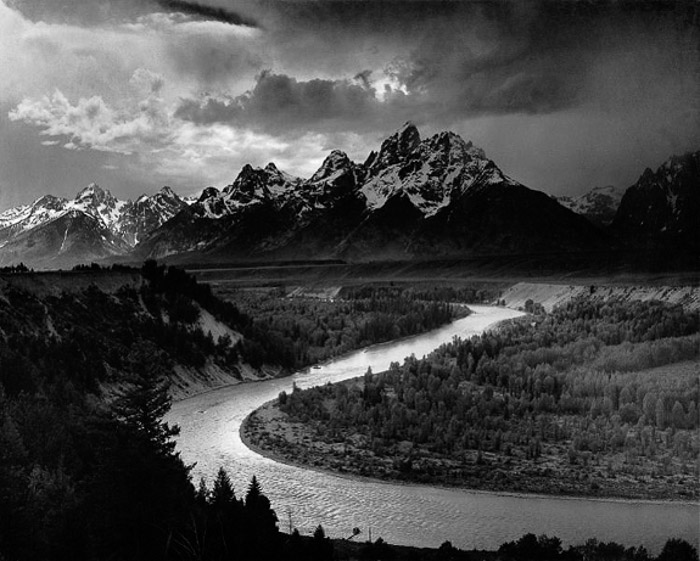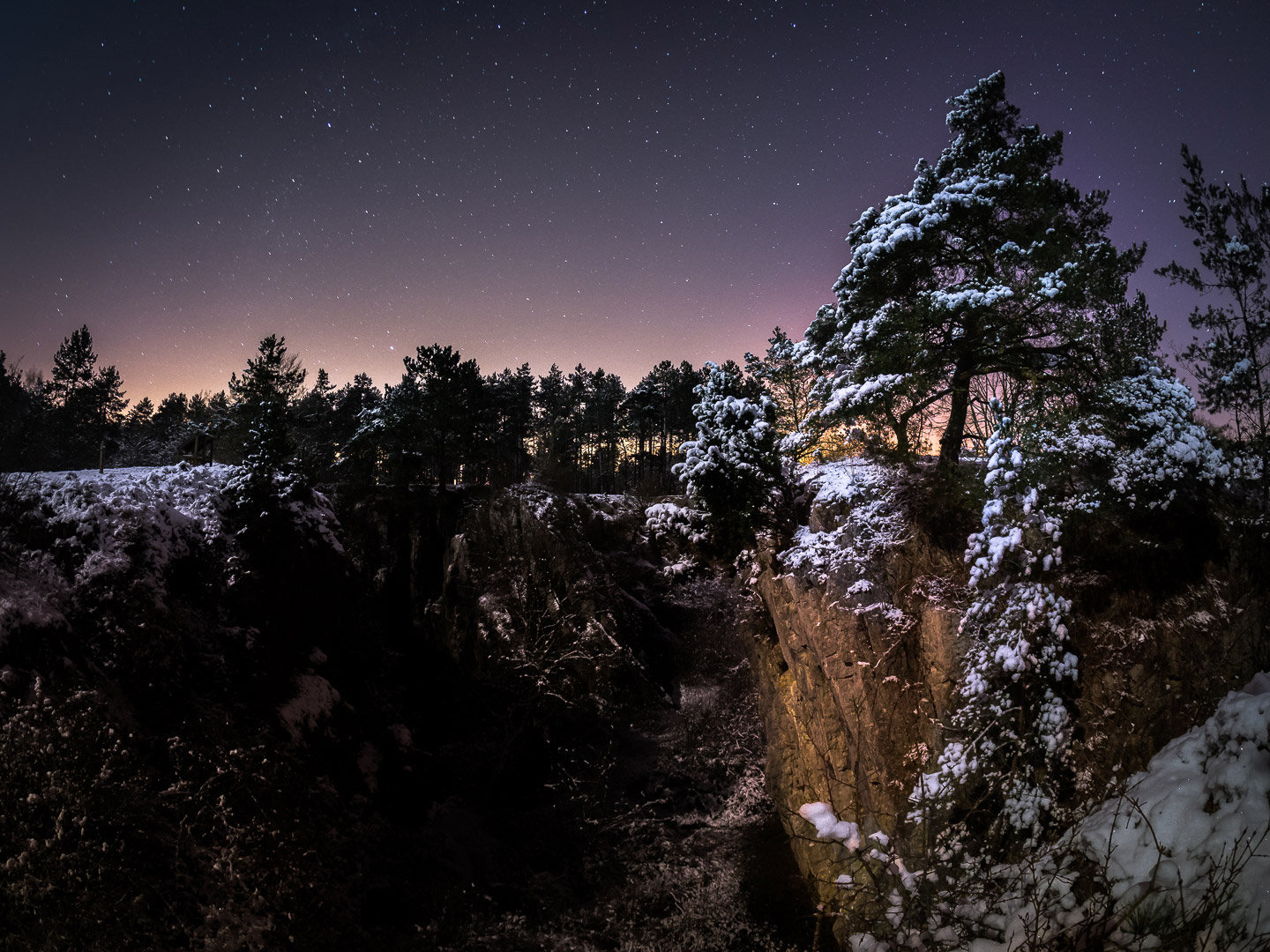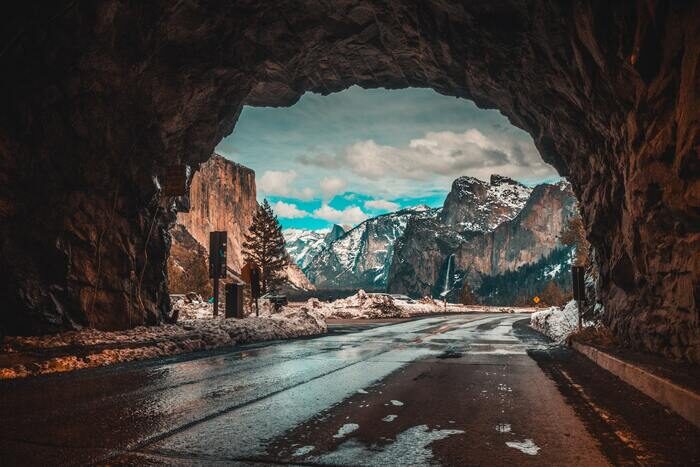
Using the best camera filters is a simple, effective way to enhance your photography. Filters are conveniently sized, easy to use, and reasonably priced compared to other camera accessories. They improve a photo’s quality, color, and effects by manipulating light and reducing unwanted elements in your photos.
Any of the filters could have taken the top spot. But we’ve chosen the Tiffen 77CP Circular Polarizer as our number one camera filter. It’s one of the more versatile camera filters. It has exceptional optical quality. And you can get it at a more-than-reasonable price. It’s the perfect place to start with camera filters.
What Is the Best Camera Filter?
The best camera filter overall is the Tiffen 77CP Circular Polarizer. It cuts glare and reflections, deepens sky and foliage color, and screws onto lenses from 46mm to 82mm. It is the single most useful filter for outdoor photographers.
There are many different types of photography filters. And they all have different effects on your photos. The best camera filter helps you achieve better photography results. But you must find the one that gives you the results you want.
We’ve included all the most popular camera filters in this article. We have polarizing filters for outdoor photographers. We have three different types of neutral density (ND) filters. Creative photographers will love infrared and diffusion filters. And we’ve included different light pollution filters for night sky photographers.
You can go to the FAQ section at the end of our article to learn more. We go into more detail on each type of camera filter and what they are used for.
If you’re ready to dive into the best camera filters, you have the overview table below. This is followed by an in-depth look at all the best filters for photography.
8 Best Camera Filters
This section looks at the best camera filters in more detail. We have the finest examples of polarizing, light pollution, and ND filters. And you’ll also find diffusion and infrared filters. There’s a filter for all photographers.
We’ve only included one filter for each type. If you want to see more of one type of filter, look for the links to our other articles with more info and filter options.
If you only ever buy one, make it the Tiffen 77CP Circular Polarizer. Add the K&F Concept ND1000 when you start shooting long exposures, the NEEWER MRC ND2-ND400 if you shoot video or work in changing light, and the K&F Concept Soft Graduated ND for bright skies over dark ground. The last four are specialist filters. Buy them when you want that specific look or shoot that specific subject, not before.
1. Tiffen 77CP Circular Polarizer
| Brand |
Brand
Tiffen
|
| Filter Type |
Filter Type
Polarizing Filter
|
| Filter Size |
Filter Size
77mm
|
| Other Available Sizes |
Other Available Sizes
46mm, 49mm, 52mm, 55mm, 58mm, 62mm, 67mm, 72mm, 82mm
|
| Other Key Features |
Other Key Features
Rotating aluminum frame
|
| Best For |
Best For
Any photographer shooting outdoors
|
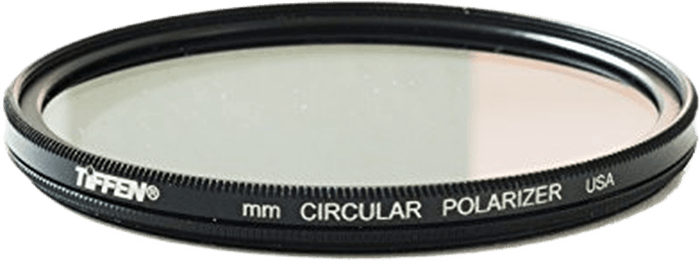
A polarizing filter, or polarizer, blocks polarized light. This deepens and saturates colors and reduces reflections. And the best polarizing filter is the Tiffen 77CP Circular Polarizer.
The glass quality is fantastic, and the outer frame is durable aluminum alloy. As a circular filter, it screws directly onto the end of your camera lens. This option has a 77mm filter thread. But if that’s not right for your lens, they have alternatives ranging from 46mm to 82mm.
You can twist the outer ring of the filter to adjust the intensity. This makes it a versatile piece of equipment you can use in changing conditions. It helps you achieve the desired effect in any light, whether bright sunlight, overcast, or cloudy.
Polarizing filters give you incredible results when shooting outdoors. This is why they are popular to pair with landscape photography lenses. But they can be used for any photography shot outside.
Two things stop it being a filter you leave on. It costs you 1.5 to 2 stops of light, which you will feel at dusk or under trees. And the effect depends entirely on where the sun is. It peaks at 90 degrees to the sun and does almost nothing when you shoot straight into it or straight away from it. On a lens wider than about 24mm the sky also darkens unevenly across the frame, so ultra-wide landscape shooters should take it off rather than fight it.
If you want more options, review our list of the best polarizing camera filters.
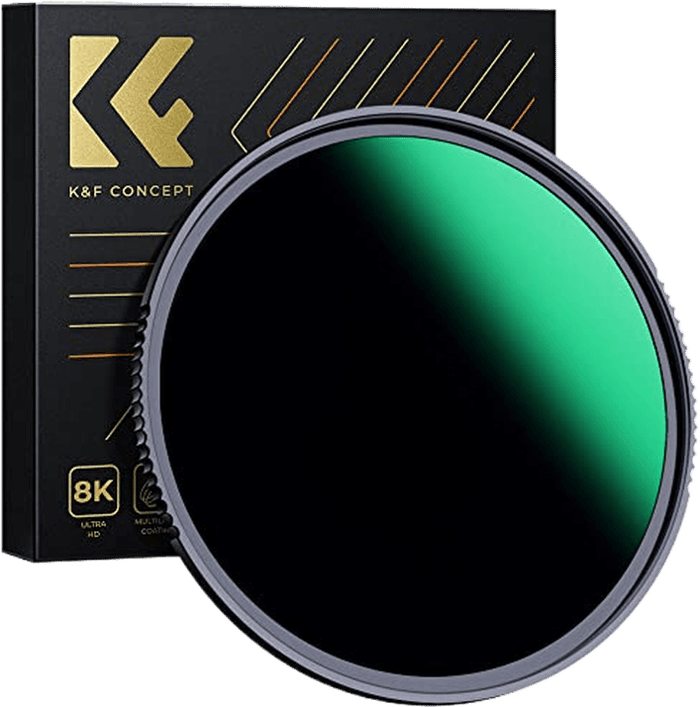
2. K&F Concept ND1000 Neutral Density Filter
| Brand |
Brand
K&F Concept
|
| Filter Type |
Filter Type
Neutral Density Filter
|
| Filter Size |
Filter Size
77mm
|
| Other Available Sizes |
Other Available Sizes
37mm, 40.5mm, 43mm, 46mm, 49mm, 52mm, 55mm, 58mm, 62mm, 67mm, 72mm, 82mm, 86mm, 95mm, 105mm
|
| Other Key Features |
Other Key Features
Aluminum alloy frame, quality AGC glass, multi-layer coatings, scratch-resistant, waterproof
|
| Best For |
Best For
Long-exposure photographers
|
The K&F Concept ND1000 is a superb ND filter. It’s a strong filter with an optical density of 3 (ND factor of 1000). This means it gives you ten exposure stops of compensation. It lets you use bulb mode for long exposures, even in bright conditions.
A neutral density filter reduces the amount of light entering the lens. This lets you shoot with slow shutter speeds without overexposing your image. That’s why this filter is essential for long-exposure photography.
Made with pure Japanese AGC glass, the optical quality is sensational. The outer frame is also made of aviation aluminum alloy, so it’s a premium quality accessory.
The glass has a 28-layer coating for improved quality and protection. The coatings reduce lens flare and ghosting. Plus, the anti-reflection quality improves light transmission, giving you clearer images.
The nanometer coatings also protect the glass against scratches, so they work better for longer. And the outer layer is oil- and water-repellent, making it even more durable. Watermarks and smudges won’t be an issue.
We’ve chosen the 77mm neutral density filter size because that’s a popular option. But you can get this K&F Concept ND1000 filter in any size from 37mm to 105mm.
Ten stops is a lot, and that is the catch. It is a fixed strength, so you cannot dial it back for a two-second exposure. And at ten stops the viewfinder goes black, which means focusing and composing before you screw it on, then switching to manual focus. If you want a filter you can leave on the lens all day, buy a variable ND instead.
You can also get ND filters with lower ND factor ratings. And these can be used for all types of outdoor photography. Read our complete guide to ND filters to work out which strength suits your shooting.
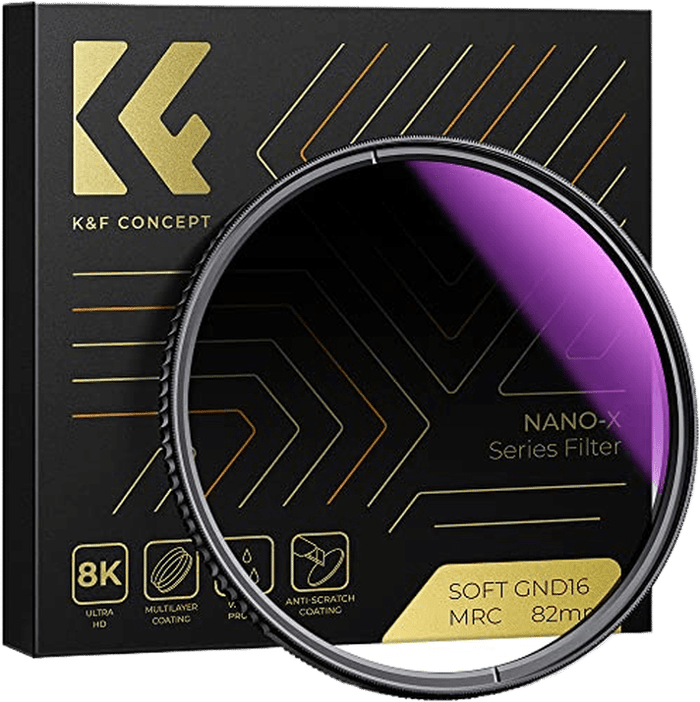
3. K&F Concept Soft Graduated ND Filter
| Brand |
Brand
K&F Concept
|
| Filter Type |
Filter Type
Graduated ND Filter
|
| Filter Size |
Filter Size
77mm
|
| Other Available Sizes |
Other Available Sizes
49mm, 52mm, 55mm, 58mm, 62mm, 67mm, 72mm, 82mm
|
| Other Key Features |
Other Key Features
Aluminum frame, quality AGC glass, multi-layer coating, scratch-resistant, waterproof
|
| Best For |
Best For
Landscape photographers
|
This K&F Concept filter is the best graduated neutral density filter. The optical quality is terrific. And it’s a great tool for all types of landscape photography.
A graduated ND filter only has one section with increased optical density, while the rest is clear glass. This lets you balance your exposures when different parts of your image are under different lighting conditions.
You might have light reflecting off a concrete floor, overexposing that section. Or you might have a bright sky and an under-lit bottom section, giving you an uneven exposure. The filter helps you balance the exposure without having to create composite HDR images with photo editing software.
This K&F Concept ND grad filter has a 0.9 optical density (ND8). This gives a three-exposure stop differential between the filtered and unfiltered sections. It also has a soft transition from unfiltered to filtered, which gives you a subtler finish.
K&F Concept filters use the finest Japanese AGC optical glass. And this glass is protected with multiple layers of coatings. Some of the coatings improve image quality by preventing flare and vignetting. The outer coatings protect against scratches, water, oil, dust, and dirt.
The limitation of any round, screw-in graduated filter is that the transition sits across the middle of the frame and stays there. You cannot slide it up or down to match your horizon, so it works best on a level horizon placed centrally. If your horizon sits high or low in the frame, or you shoot a lot of mountains and coastlines, a square graduated filter in a holder is the more flexible buy.
Our guide to filters for landscape photography covers graduated filters in more depth.
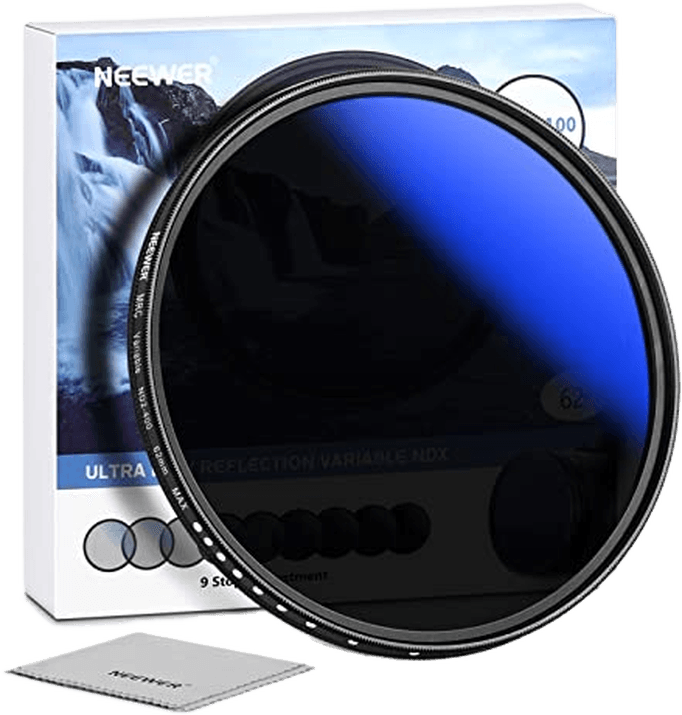
4. NEEWER MRC ND2-ND400 Variable ND Filter
| Brand |
Brand
Neewer
|
| Filter Type |
Filter Type
Variable ND Filter
|
| Filter Size |
Filter Size
62mm
|
| Other Available Sizes |
Other Available Sizes
37mm, 40.5mm, 43mm, 46mm, 49mm, 52mm, 55mm, 58mm, 67mm, 72mm, 77mm, 82mm
|
| Other Key Features |
Other Key Features
42-layer coating, four optical elements, water repellant
|
| Best For |
Best For
Outdoor photographer shooting in changing conditions
|
The NEEWER MRC ND2-ND400 is a beautiful variable neutral density filter for outdoor photography. Turning the outer ring can adjust this variable ND filter’s optical density.
This ND filter ranges from ND2 to ND400, reducing light by about 1 to 8.6 stops. This gives you incredible flexibility when shooting outside. You can shoot with a shallow depth of field in bright sunlight. And you can achieve perfectly exposed long-exposure images.
It’s a beautiful filter made with crystal-clear optical glass and Japanese NITTO polarizing film. The glass has also been treated with a 42-layer nano coating for optimal results. It reduces flare and prevents light reflections. Plus, it protects the lens against moisture, oil, and scratches.
It screws directly onto your camera lens. And if this 62mm option isn’t the right size, you can pick any filter size between 37mm and 82mm. That has most lenses covered.
Every variable ND has the same weakness, and this one is no exception. Because it works by rotating two polarizing layers against each other, pushing it toward the ND400 end can throw a dark X-shaped band across the frame. It shows up first on wide lenses. Stay in the middle of the range and you will not see it, but if you need a clean ten stops, a fixed ND1000 is the safer tool.
We have an article on the best variable neutral density filters. Check it out for more information.
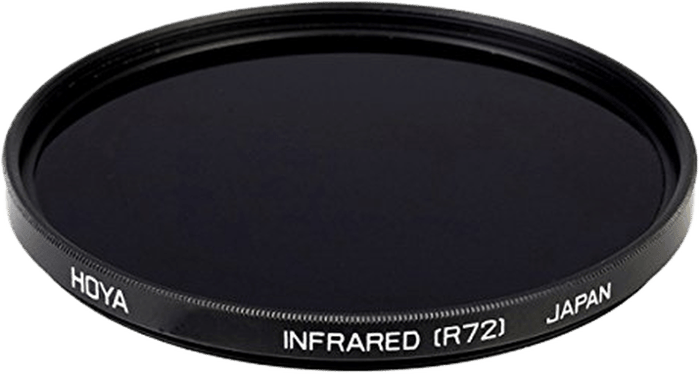
5. Hoya R-72 Infrared Filter
| Brand |
Brand
Hoya
|
| Filter Type |
Filter Type
Infrared Filter
|
| Filter Size |
Filter Size
55mm
|
| Other Available Sizes |
Other Available Sizes
46mm, 49mm, 52mm, 58mm, 62mm, 67mm, 72mm, 77mm
|
| Other Key Features |
Other Key Features
Durable aluminum frame
|
| Best For |
Best For
Infrared photographers
|
Infrared photography is a niche all its own. And you can’t shoot infrared photography without an infrared filter. We recommend the Hoya R-72 Infrared Filter if you want to try it out.
An infrared filter gives you intense dream-like images by allowing infrared light beyond the visible red end of the spectrum. You can use these filters with DSLR or mirrorless cameras, and they work best when there’s no IR-blocking filter in front of the sensor. And you can use them with 35mm film cameras with special infrared B&W film.
It’s a filter of exquisite quality. You’ll experience no visual distortion or imperfections. And this particular IR filter allows light from the infrared spectrum at 760nm to 860nm. This is light not visible to the naked eye. That’s why the results are so other-worldly.
Shooting through it is slower than you might expect. The glass is almost opaque to the eye, so you frame and focus first, then fit it. And because most unmodified cameras have a strong infrared-blocking filter over the sensor, exposures run from several seconds to several minutes even in full sun. A tripod is not optional, and results vary enormously between camera bodies. If you find your camera barely records infrared at all, a converted body is the real answer, not a stronger filter.
Our guide to infrared photography with basic camera gear walks through the workflow.
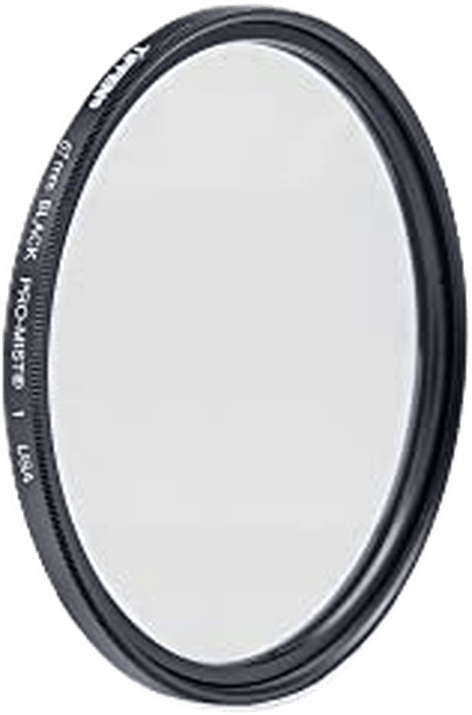
6. Tiffen Black Pro-Mist 1 Diffusion Filter
| Brand |
Brand
Tiffen
|
| Filter Type |
Filter Type
Diffusion Filter
|
| Filter Size |
Filter Size
67mm
|
| Other Available Sizes |
Other Available Sizes
49mm, 52mm, 55mm, 58mm, 62mm, 72mm, 77mm, 82mm
|
| Other Key Features |
Other Key Features
Aluminum frame
|
| Best For |
Best For
Product and portrait photographers and videographers
|
Diffusion filters bloom the highlights and take the hard edge off fine detail, giving you a soft, cinematic image straight out of the camera. They are a popular accessory for product photography lenses and portrait lenses. Videographers and cinematographers also love to use them.
The Tiffen Black Pro-Mist 1 is our diffusion filter recommendation. It gives you a grade-1 mist level and a subtle, dreamy glow around bright areas. The optical quality is excellent, with no imperfections. And its outer aluminum frame is strong and durable.
That word Black is doing real work. Tiffen makes two mist lines, and they are not the same filter. The original Pro-Mist uses white particles, which lifts the whole image and washes contrast out noticeably. The Black Pro-Mist uses black particles instead, so it halos the highlights while keeping your shadows dark. That is why it became the standard on video sets, and it is the one we recommend for stills too.
We’ve opted for the 67mm filter. But it’s available in filter thread sizes from 49mm to 82mm.
The one thing to think about before buying is that the effect is baked into the file. You cannot dial it out later, and you cannot add it in post with the same halation around real highlights. Grade 1 is a confident, visible amount of glow. If you want a hint rather than a look, Tiffen sells the same filter in 1/8, 1/4 and 1/2 grades, and those are the safer first purchase.
7. K&F Concept Clear-Natural Night Filter
| Brand |
Brand
K&F Concept
|
| Filter Type |
Filter Type
Light Pollution Filter
|
| Filter Size |
Filter Size
77mm
|
| Other Available Sizes |
Other Available Sizes
52mm, 58mm, 67mm, 72mm, 82mm
|
| Other Key Features |
Other Key Features
Multi-layer nano coating
|
| Best For |
Best For
Nighttime photographers
|
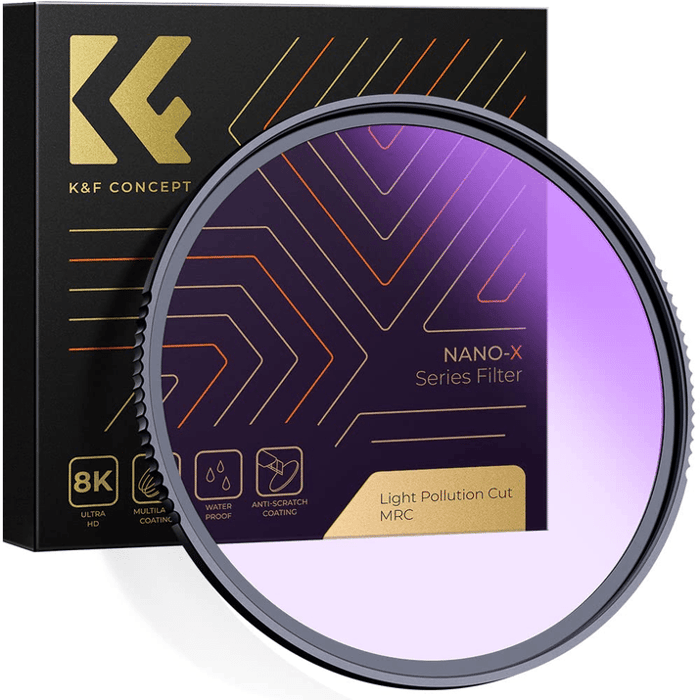
Light pollution is a serious problem when shooting at night, especially in urban areas. That’s why the K&F Concept Clear-Natural Night Filter is essential for anyone shooting after dark.
It’s a broadband light filter, which only blocks a small spectrum of light waves. It blocks artificial lights, like street lamps and house lights. It removes the orange or yellow haze from such lights, so your Milky Way shots come back with clean, neutral color instead of a sodium cast.
The K&F Concept filter is the best of its kind. It’s made with the finest Japanese optical glass. And it has been treated with a 28-layer nano-coating that improves quality and protects against smudges and scratches.
It’s available in many filter thread sizes, from 52mm to 82mm. You can also get the K&F Concept X-Pro square light pollution filter, a 100x100mm sheet. One square filter covers every lens in your bag rather than one thread size, but you do need a filter holder and an adapter ring to mount it.
Know what it can and cannot do before you buy. This kind of filter works by cutting the narrow orange and yellow emission lines that sodium and mercury street lamps produce. That is a lot of the light pollution photographers grew up with, and the filter is very good at removing it. But towns and cities have been converting to white LED street lighting, and LED spills light right across the spectrum. There is no narrow band to cut, so the filter cannot separate it from starlight. If your local glow is white rather than orange, expect a modest improvement, not a transformation, and put the money toward a darker location instead.
You can see how it fits into a full night workflow in our guide to photographing the Milky Way.
8. Optolong L-Enhance Dual Narrowband Filter
| Brand |
Brand
Optolong
|
| Filter Type |
Filter Type
Narrowband Light Filter
|
| Filter Size |
Filter Size
2-inch (M48 thread)
|
| Other Available Sizes |
Other Available Sizes
1.25-inch
|
| Other Key Features |
Other Key Features
Passes the H-Alpha, H-Beta and Oxygen III emission lines, needs a telescope filter drawer or holder
|
| Best For |
Best For
Astrophotographers
|
Narrowband filters are specialist filters for astrophotography. Broadband light pollution filters are great for all types of nighttime shots. But narrowband filters are optimized for emission nebulae, the glowing gas clouds that only shine at a few precise wavelengths.
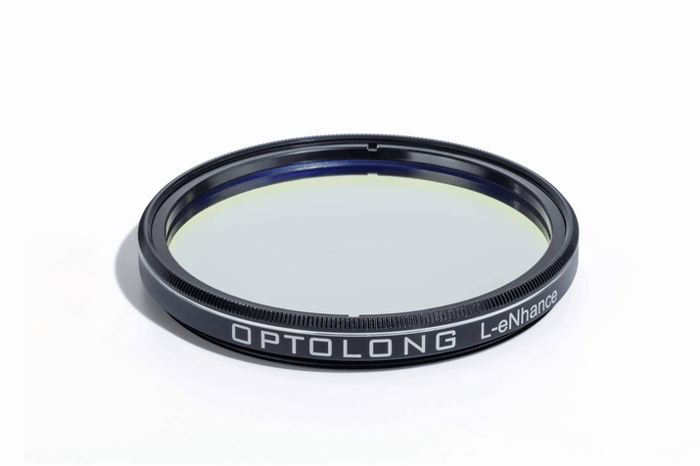
The Optolong L-Enhance Dual Narrowband Filter is a great option for star-gazing. A dual-band filter isolates the H-Alpha, H-Beta, and Oxygen III nebula emission lines.
I’m no Carl Sagan, so I can’t go into too much detail on light emission lines. But this means it allows those light emissions while blocking all others. City glow lands in the gaps and gets thrown away, so your nebula comes through against a far darker background.
It is far more specialised than the other seven filters here, in two ways. First, it only helps subjects that emit at those wavelengths. Galaxies, star clusters and comets shine right across the spectrum, so this filter throws away most of their light and makes them worse. Keep it for the Orion, Lagoon and North America nebulae, and take it off for everything else. Second, this is a 2-inch astronomy filter with an M48 thread. It drops into a telescope filter drawer or screws onto a 2-inch nosepiece. It does not screw onto the front of a camera lens like the other seven filters here, so it is a buy for people already shooting through a telescope, not for someone starting out with star photography and a wide lens.
Filters for astrophotography are a complicated subject. You can read more in our complete guide to astrophotography.
Best Camera Filters FAQs
Camera filters can be a confusing topic if you’re new to them. They all have different uses and help with specific types of photography. And they are often accompanied by lots of technical terms and scientific jargon. We’ve answered some of the most frequently asked questions to help you find the best camera filter.
What Are the Most Popular Camera Filters?
Photographers have many camera filters to choose from. Here’s an explanation of the six most popular types of camera filters so you can find the one that best suits you.
1. Polarizing Filters
Polarizing filters are the most popular in photography. They are commonly used in landscape, cityscape, and architecture photography. But anyone shooting outside will appreciate the effect they have on image quality.
They block unnecessary light waves, which improves color saturation and contrast. They also reduce light reflection, which improves light transmission. Atmospheric haze is also reduced, so you get better clarity and definition.
We recommend the Tiffen 77CP Circular Polarizer.
2. Neutral Density Filters
Neutral Density (ND) filters are another popular choice with many photographers. They reduce the amount of light passing through the lens to the camera. But they do this without any loss of color or definition.
ND filters are great for shooting in bright sunlight. They give you more exposure setting options, letting you use wider apertures in bright conditions. They are also essential for long-exposure photography.
There are three types of ND filters:
- Standard ND Filters: They have a fixed optical density rating consistent across the filter.
- Graduated Filters: They have a fixed optical density on one filter section. The rest is clear, unfiltered glass.
- Variable ND Filters: They have an adjustable optical density but a fixed optical density range. So you can adjust the optical density within that range. They are incredibly versatile and perfect for changeable conditions.
We recommend the K&F Concept ND1000 neutral density filter, the K&F Concept Soft Graduated ND Filter, and the NEEWER MRC ND2-ND400 variable ND filter.
3. Infrared Filters
Infrared filters block most visible light and let through infrared light, which lies just beyond the red end of the visible spectrum. This produces ghostly and dream-like images with altered or drawn-out colors. The images are often surreal, as the filters use light waves not visible to the naked eye.
You can get infrared filters of varying intensity. They range from 590nm to 830nm. Lower-grade filters allow a broader range of light waves to pass through. Filters at the higher end only allow infrared light waves, which gives you a more intense effect.
We recommend the Hoya R-72 Infrared Filter.
4. Diffusion Filters
Diffusion filters diffuse light as it passes through, giving you soft, dreamy images. They soften hard details and create a gentle haze around light sources or brightly lit objects. Diffusion filters also reduce contrasts and produce a more even exposure across your image.
These filters are popular in product and food photography. Fashion and portrait photographers also like to use them. Plus, diffusion filters are popular with videographers and cinematographers.
We recommend the Tiffen Black Pro-Mist 1.
5. Light Pollution Filters
Light pollution filters (natural night filters) are an important accessory in nighttime photography. Whether that’s nocturnal cityscapes or astrophotography, these filters can improve results.
They are also known as broadband light filters because they block a small bandwidth of light, allowing a broad spectrum of light. That’s all a bit scientific. Simply put, they block artificial light while letting natural light pass through.
By removing artificial light pollution, you can see the stars more clearly. And these filters are especially effective in built-up urban areas. That means even city-dwellers can shoot astrophotography from their backyard.
We recommend the K&F Concept Clear-Natural Night Filter or the K&F Concept X-Pro square light pollution filter.
6. Narrowband Light Filters
Narrowband filters are specialist filters for astrophotography. Light pollution filters allow a broad range of light waves, while narrowband filters only let through a select few. That buys you enormous contrast on emission nebulae, and it costs you light on everything else, so they are not a general-purpose filter.
You can get single-line filters that only transmit one slim section of light. But most narrowband filters are dual, tri, or quad-band filters. That means they are sensitive to more than one light-wave section. They are great if you’re shooting Milky Way or nebulae photography.
We recommend the Optolong L-Enhance Dual Narrowband Filter.
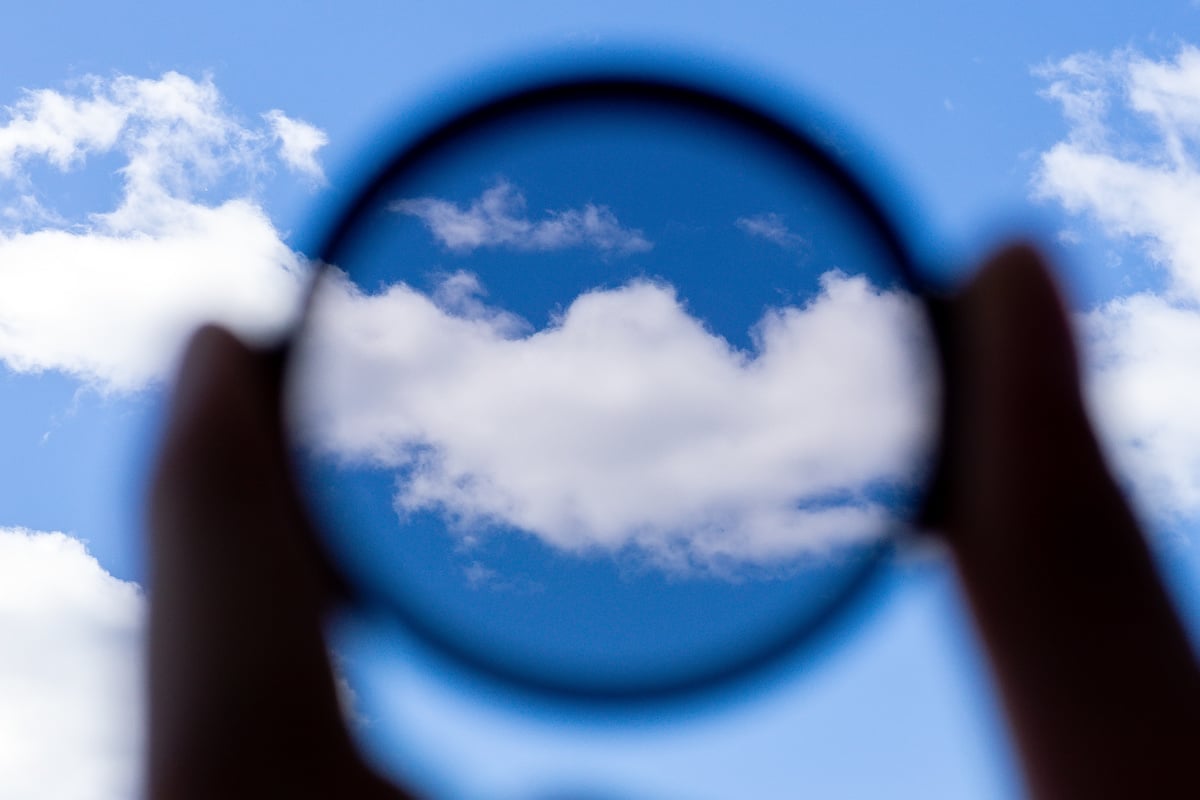
The effect of a circular polarizing filter like the Tiffen 77CP
Which Filters Are Best for Landscape Photography?
Landscape photography is the discipline in which filters are most commonly used. That’s because they affect how natural light gets to the camera sensor. That’s why you get such fantastic results when using filters outdoors.
Polarizing filters are very popular with landscape photographers. They reduce light reflections, allowing cleaner light to pass through to the camera. That gives you more detail. They also reduce glare and haze, giving you more clarity. And polarizers intensify colors and contrasts.
A graduated ND is another filter commonly found in a landscape photographer’s camera bag. They balance your exposures when you’re dealing with uneven light conditions. You can also use them to improve your sunrise and sunset photography.
Standard ND filters are great for long-exposure landscapes. Whether shooting a waterfall or seashore, ND filters help you get perfectly exposed shots in bulb mode.
If you want something striking, you can have heaps of fun shooting landscapes with an infrared filter. It transforms landscapes, turning green foliage a glowing white and skies almost black. It’s well worth a try.
Which Filters Are Best for Portrait Photography?
Camera filters are less common in portrait photography. But you can use a few to transform your portraits or self-portraits.
Neutral density filters are useful when shooting portraits outside. If the sunlight is too bright, an ND filter brings the brightness down so you have more control over your exposure settings.
They let you use a wider aperture, giving you a shallow depth of field. And the blurred background (bokeh) effect works well in portraits. Variable ND filters give you the most versatility, which is helpful when shooting on location.
Diffusion filters also work well with portrait photography. They soften your image and reduce contrast. It also creates a hazy glow. And this dreamy effect helps elevate your subject from their surroundings. It’s a cinematic effect that delivers glorious results for creative portrait photographers.
Conclusion: The Best Camera Filters
Finding the best camera filter depends greatly on what you want to achieve. Polarizing filters are great for landscape photography. ND filters help you achieve perfectly exposed images in bright conditions. And you have several different filters for astrophotography.
The Tiffen 77CP Circular Polarizer is our top camera filter to begin with. We could have chosen any of the filters featured in this article. And curious photographers will want to try them all. But if you want a camera filter for a particular purpose, there’s one listed here for you.
Before you order anything, read the filter thread size off the front of your lens or inside the lens cap. It is the number after the ⌀ symbol. Buy that size for your most-used lens, then use step-up rings to fit the same filter to your smaller lenses. It is far cheaper than buying one filter per lens.