Using a monopod for cameras will revolutionize the way you work. They provide extra stability when shooting. That stability reduces camera shake and gives you more exposure control. But you have more freedom of movement than using a tripod. Whether you’re shooting photos or videos, a camera monopod is exactly what you need.
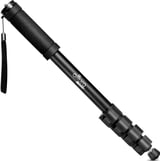
The Altura Photo Camera Monopod tops our list. It folds down to a small and convenient size. It weighs next to nothing. But it’s strong enough for many DSLR and mirrorless cameras. It’s also an absolute bargain.
What Is the Best Monopod for Cameras?
The best monopods for cameras give you extra stability when shooting. But they also allow you to move quickly and freely between shots. A camera monopod can’t stand freely like a tripod. But they are more convenient if you have to move around when shooting.
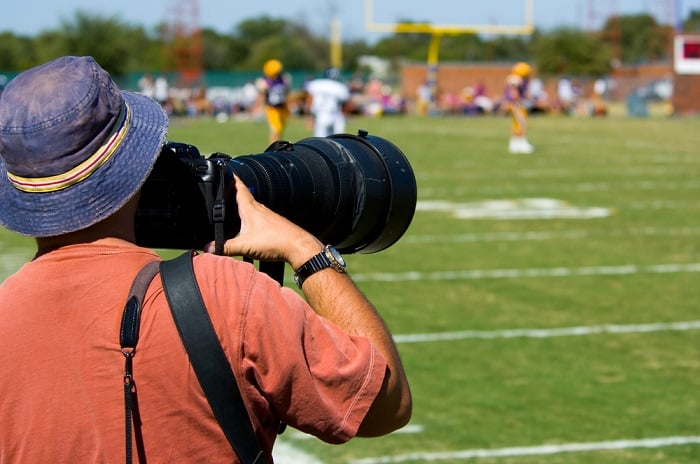
That’s why monopods for cameras are favored by sports photographers. The photographer has more control over exposure settings. They can use slower shutter speeds without worrying about camera shake. But they can still move with the flow of the game.
Monopods are also popular with wildlife photographers. They’re especially useful for capturing animals on the move, like migrating herds. Event and fashion photographers use monopods all the time. And photojournalists are often seen using monopods for their cameras. A camera monopod has become a must-have for any photographer who can’t stay still.
The table below looks at all the monopods for cameras in brief. Then we take a deep dive into each camera monopod in the following section. And we have a buyer’s guide for photography monopods at the end of the article.
- Supports up to 35 lbs (16 kg) of gear
- Fluid base with three fold-out feet for smooth panning
- Four leg sections with sealed twist locks
- Rubber handle and wrist strap for security
- Folds to 19.9 inches (50.5 cm), extends to 50.4 inches (128 cm)
- Lightweight and easy to carry at 1.3 lbs (0.6 kg)
- Adjustable from 20.5 to 66 inches (0.52 to 1.68 m)
- Detachable three-foot stand base with 15 degrees of tilt
- Universal 1/4" screw for most DSLR and mirrorless cameras
- Five aluminum leg sections with twist locks

- Weighs 1.3 lbs (590 g) and rated to 88 lbs (40 kg)
- Six carbon fiber sections fold to 17.9 inches (45.5 cm)
- Extends to 72 inches (183 cm)
- Sealed twist locks plus a machined flip lever on the top section
- Rotating ball-bearing foot, with a spiked foot in the box

9 Best Monopods for Cameras
This is our selection of the best monopods for cameras. We have monopods for photography and video shooting. There are monopods for cameras of different sizes. And we’ve included camera monopods to suit all budgets. You will definitely find the monopod you need for your next shoot.
1. Altura Photo Camera Monopod
| Brand |
Brand
Altura Photo
|
| Build Material |
Build Material
Aluminum
|
| Item Weight |
Item Weight
0.6 lb / 270 g
|
| Retracted Height |
Retracted Height
16.7 inch / 42.5 cm
|
| Max Extended Height |
Max Extended Height
62 inch / 1.57 m
|
| Max Load Capacity |
Max Load Capacity
5 lb / 2.3 kg
|
| Other Key Features |
Other Key Features
4 leg sections, flip locks, spiked foot
|
| Best For |
Best For
Beginner to enthusiast photographers
|
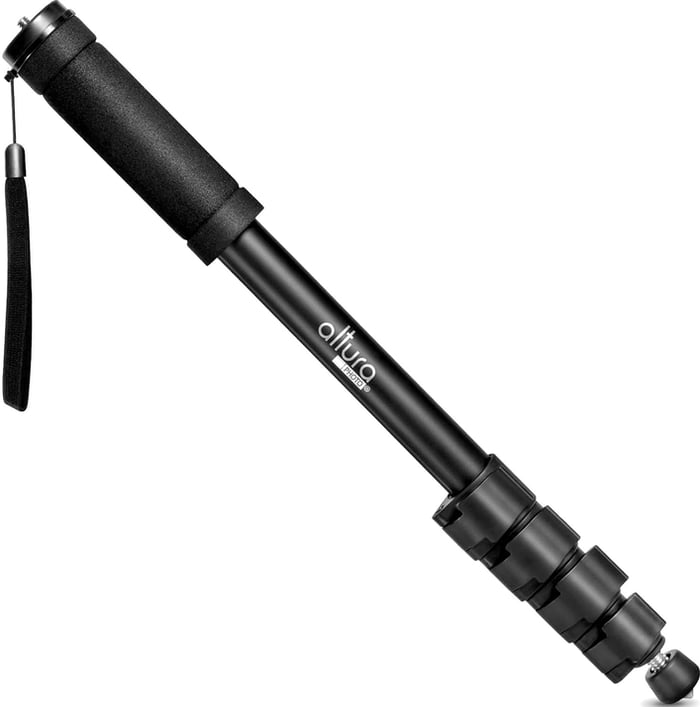
The Altura Photo Camera Monopod is the best place to start with camera monopods. It’s tough and reliable. And it can support a decent amount of camera gear. But it’s compact and lightweight. And the affordable price means it’s an absolute bargain. You can’t miss this camera monopod.
It measures only 16.7 inches (42.5 cm) when it’s folded down. And it weighs nothing more than 0.6 lb (270 g). It easily fits in your camera backpack. And it won’t weigh you down when traveling from shoot to shoot.
The quick-release leg locks make it easy to extend and fix in position. And the four leg sections allow you to find the perfect height for comfortable shooting. You get a max height of 62 inches (1.57 m), which is enough for most photographers. The foot is attached to a ball joint, giving you a good range of movement. And the rubber foot has a retractable spike for extra grip.
The strength might surprise some users. Despite its compact size and light weight, it can carry a load of up to 5 lb (2.3 kg). That’s enough for APS-C DSLR cameras with telephoto lenses. And it’s strong enough for full frame mirrorless cameras with light lenses attached.
The upper section has a foam handle for extra grip and comfort. You also get a wrist strap for extra security. This stops the monopod from toppling over if it slips out of your hand. That’s a lifesaver when you’re using expensive equipment. And it’s vitally important when shooting in wet weather.
The universal thread mount works with a wide range of cameras. You can attach Nikon, Canon, and Sony Models. You can even use it with Fujifilm and Olympus Cameras. The Altura Photo monopod is a practical and versatile camera monopod. And the more-than-reasonable price makes it the best monopod for cameras right now.
The 5 lb (2.3 kg) ceiling is the one number to check before you buy. A full frame body with a 70-200mm f/2.8 on the front is already at that limit, and a 400mm prime is well past it. There’s no head and no fold-out base either, so it will never stand up on its own while you swap a lens. Buy the Altura as a travel stick or a first monopod. Sports shooters with long glass should skip down to the 3 Legged Thing Trent 2.0.
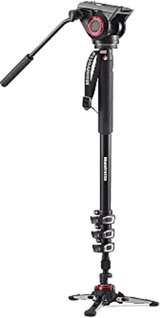
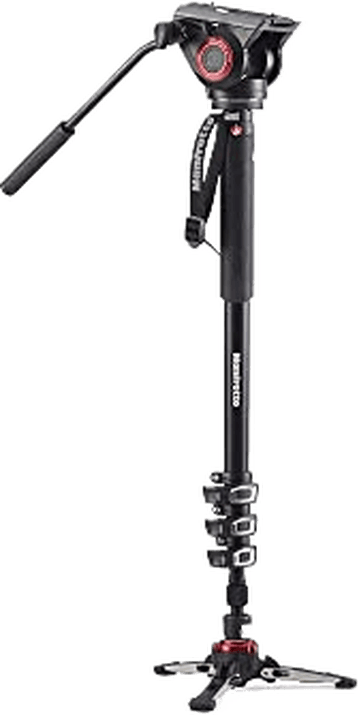
2. Manfrotto XPRO+ Monopod with Fluid Head
| Brand |
Brand
Manfrotto
|
| Build Material |
Build Material
Aluminum
|
| Item Weight |
Item Weight
4.6 lbs / 2.1 kg
|
| Retracted Height |
Retracted Height
30.7 inches / 78 cm
|
| Max Extended Height |
Max Extended Height
79.9 inches / 2.03 m
|
| Max Load Capacity |
Max Load Capacity
11 lbs / 5 kg
|
| Other Key Features |
Other Key Features
Fluid head, quick-release plate, control arm, fluid base with 3 retractable feet
|
| Best For |
Best For
Professional photography and videography
|
The Manfrotto XPRO+ is the best camera monopod on the market right now. It isn’t the cheapest. But it offers the best balance in quality and price. It’s a multipurpose monopod, supporting DSLR, mirrorless, and video cameras. It’s a professional-standard monopod for photography and videography.
Manfrotto has been making a name for itself as one of the best manufacturers of camera accessories. And this XPRO+ monopod is a prime example. The build quality is excellent with a strong aluminum body. There’s a bit of heft to it, which adds stability and security. But it’s not so heavy you’ll feel fatigued when you need to move.
The maximum height is 79.9 inches (2 m), so it’s suitable for photographers of all sizes. And you can even shoot above your head if necessary. And you can keep the camera attached when retracted, using it as a camera stabilizer for shooting video.
The telescopic leg is adjusted using Manfrotto’s Quick Power Lock levers. They provide a secure grip when closed, so the head doesn’t slip down. But they’re quick and easy to release when you need to make a change.
The Manfrotto XPRO+ monopod has three retractable feet at the base for extra stability. It won’t support a full load on its own. But it keeps your shots steady and avoids unwanted camera shake. The fluid base pans and tilts, making it adaptable to uneven surfaces. It also allows you to move and adjust the shooting angle while shooting.
The cost is weight, and payload you don’t get. With the MVH500AH fluid head fitted, this rig weighs 4.6 lbs (2.1 kg), the heaviest thing on this list by a clear margin, and it still only carries 11 lbs (5 kg). You are paying for the head and the fluid base, not for load capacity. Stills shooters with a big telephoto and no interest in video get six times the load capacity at a third of the weight from the Trent 2.0 below.
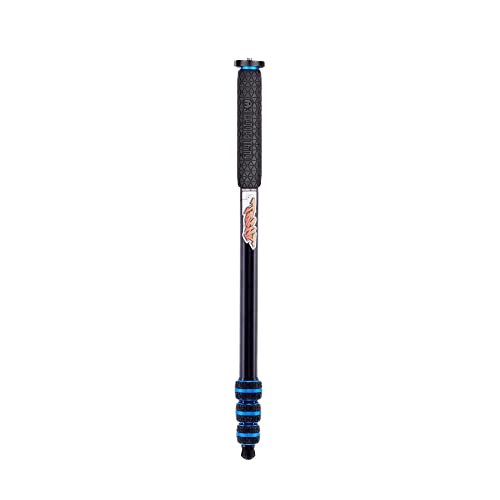
3. 3 Legged Thing Trent 2.0 Monopod
| Brand |
Brand
3 Legged Thing
|
| Build Material |
Build Material
Magnesium Alloy
|
| Item Weight |
Item Weight
1.6 lbs / 728 g
|
| Retracted Height |
Retracted Height
23.8 inches / 60.4 cm
|
| Max Extended Height |
Max Extended Height
79.5 inches / 2.02 m
|
| Max Load Capacity |
Max Load Capacity
66 lbs / 30 kg
|
| Other Key Features |
Other Key Features
Rubber boot, twist leg locks, rubber grip
|
| Best For |
Best For
Full frame cameras and heavy gear
|
The 3 Legged Thing Punks Trent 2.0 gives you one of the longest extended ranges. But it’s also one of the most lightweight monopods for its size. It gives you excellent bang for your buck, with a reasonable price tag and fantastic stability. The Punks Trent 2.0 is worth considering if you’re looking for the best monopod for photography.
This monopod is stripped-down and simple. But I mean that as a positive. You position your camera directly on top and the four-piece monopod allows you to get stable shots. It can support a staggering 66 lbs (30 kgs) of gear. That’s more than enough for heavy camera bodies and big lenses. You can use it with full frame cameras and telephoto lenses for wildlife photography.
The height is easily adjusted using the twist locks found at the bottom of each leg section. It packs down to 23.8″ (60.4 cm) and extends to a massive 79.5″ (202 cm). That gives you incredible scope and flexibility for getting the high-angle shots you want. And despite the height, the magnesium alloy frame weighs just 1.6 lbs (728 g).
The base of the monopod has a detachable rubber foot. It gives you additional grip on slippery surfaces. And it can be swapped for other foot accessories if you need something different. This allows you to adapt to any situation you find yourself in. You could be pitch-side in the rain or in the arctic tundra.
The 3 Legged Thing Trent 2.0 is simple in design but highly effective in application. It gives you tremendous height and can support any camera you need to use. It’s durable, portable, and helps you get sharp shots in trying conditions. It’s a durable monopod for sports and wildlife photographers with heavy gear. And if you love animal photography, our Wonderful Wildlife ebook is a must-read.
What you don’t get is a head or a base. The Trent 2.0 is a bare pole with a 3/8″-16 thread at the top and another at the foot, so your camera either screws straight on or needs a head you buy separately. And it can’t stand by itself for the two seconds it takes to change a lens. If you want something that holds itself up between shots, the two Manfrotto monopods and the Neewer below all have fold-out feet.
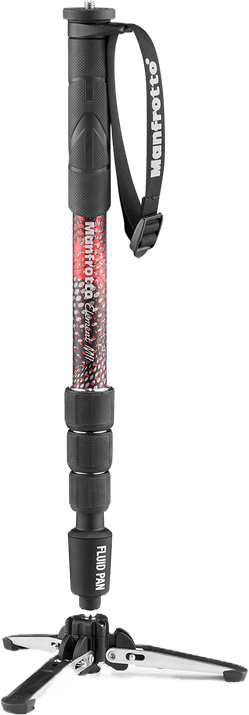
4. Manfrotto Element MII Video Monopod
| Brand |
Brand
Manfrotto
|
| Build Material |
Build Material
Aluminum
|
| Item Weight |
Item Weight
1.5 lbs / 670 g
|
| Retracted Height |
Retracted Height
19.9 inches / 50.5 cm
|
| Max Extended Height |
Max Extended Height
50.4 inches / 1.28 m
|
| Max Load Capacity |
Max Load Capacity
35 lbs / 16 kg
|
| Other Key Features |
Other Key Features
Fluid base with 3 feet, 4 leg sections, twist locks
|
| Best For |
Best For
Video and cinematography
|
There’s no surprise that Manfrotto is again featured so highly on our list. Their equipment is some of the best on the market. And the Manfrotto Element MII is another superb camera monopod. It’s more affordable than the XPRO+ model. But you still get quality and stability.
The aluminum body is lightweight, compact, and easy to transport. It weighs only 1.48 lbs (670 g), making it perfect for travel photography or landscape expeditions. And at 19.9 inches (50.5 cm) closed, it’s small enough to fit in your backpack.
The central column is made of four sections. And you adjust them for height using the twist locks. The twist locks are uncomplicated, making changing the height a straightforward and quick operation. That’s helpful if you need quick mobility to capture the pictures you need.
The base has three foldable feet that give you extra stability for sharp shots. The three feet each have their own rubber foot for grip. And the base is attached to the main pole with a pivoting ball joint. It can cope with any terrain and gives you the flexibility you need as a busy photographer.
The aluminum construction might be lightweight, but it’s also robust and reliable. It has a maximum capacity of 35 lbs (16 kg). That’ll support a full frame DSLR or mirrorless camera. And you can use the best lenses for landscape photography. You can shoot sports, nature, or action photography. But when it comes to shooting video, you can’t go wrong with this Manfrotto Element monopod.
Check the height figure before you commit. The Element MII tops out at 50.4 inches (128 cm), a good foot shorter than most monopods here. That’s deliberate: it’s built to sit low and pan smoothly on its fluid base, not to lift a camera to eye level. Anyone who wants to shoot standing upright should take the XPRO+ or the Trent 2.0 instead. Videographers working from a fixed position should also read our guide to the best video tripods.
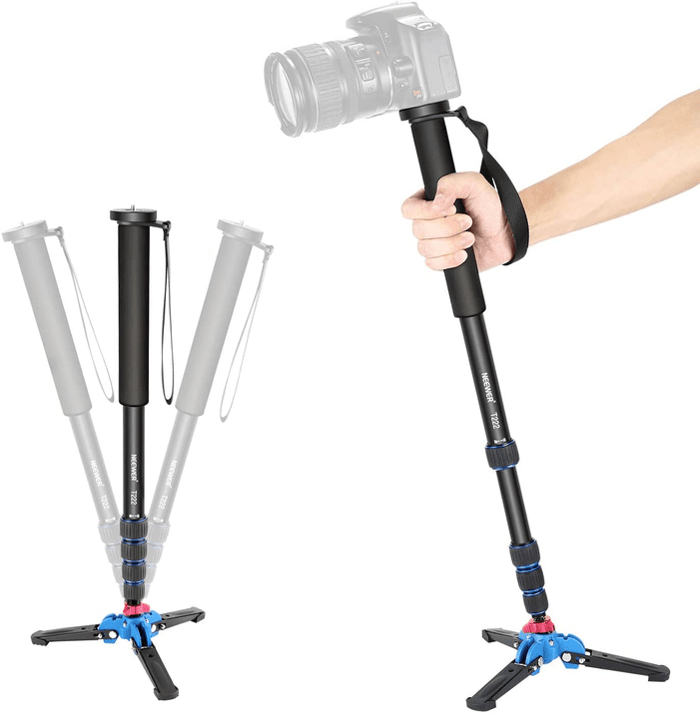
5. Neewer Extendable Camera Monopod
| Brand |
Brand
Neewer
|
| Build Material |
Build Material
Aluminum Alloy
|
| Item Weight |
Item Weight
1.3 lbs / 600 g
|
| Retracted Height |
Retracted Height
20.5 inches / 52 cm
|
| Max Extended Height |
Max Extended Height
66 inches / 1.68 m
|
| Max Load Capacity |
Max Load Capacity
11 lbs / 5 kg
|
| Other Key Features |
Other Key Features
Detachable 3-foot stand base, 5 leg sections, 15-degree tilt in foot joint
|
| Best For |
Best For
Photographers on a budget
|
Neewer is another brand that’s built a solid reputation for photography accessories. And the Neewer T222 extendable monopod is definitely worth your consideration. It’s a well-made piece of equipment with an affordable price tag. It doesn’t break any records for height or capacity. But it’s a versatile and reliable piece of photography gear.
The five leg sections are aluminum alloy, tapering from 25 mm at the top to 13 mm at the foot, and they’re adjusted with twist locks. When fully extended, you get a maximum height of 66 inches (1.68 m), and it packs down to 20.5 inches (52 cm). It’s quick and easy to make adjustments when shooting. You attach your DSLR or mirrorless camera directly to the top. And there’s a foam grip and wrist strap for security.
The 11 lb (5 kg) weight limit is strong enough for most photographers. It’ll hold an APS-C or full frame camera. And you can use large lenses and extra gear.
The base has three foldable feet for extra-stable support on all terrain. They’re strong aluminum stands with rubber feet for grip. And the flexible joint between the base and the pole gives you 15 degrees of tilt. The base unscrews too, so you can leave it behind and carry the bare pole.
The catch is the 11 lb (5 kg) limit. That is the same ceiling as our budget top pick, and half what the carbon fiber monopods further down manage at a lighter weight. There is no head either, so a heavy telephoto will sit nose-down until you add one. Neewer also sells the T222 mainly through its own store rather than the marketplaces now, and that is where our button sends you.
6. Benro MSD46C SupaDupa Monopod
| Build Material |
Build Material
Carbon Fiber
|
| Item Weight |
Item Weight
1.3 lbs / 590 g
|
| Retracted Height |
Retracted Height
17.9 inches / 45.5 cm
|
| Max Extended Height |
Max Extended Height
72 inches / 1.83 m
|
| Max Load Capacity |
Max Load Capacity
88 lbs / 40 kg
|
| Other Key Features |
Other Key Features
6 leg sections, twist and flip locks, rotating ball-bearing foot, spiked foot included
|
| Best For |
Best For
Heavy telephoto lenses on a light monopod
|
The Benro MSD46C SupaDupa is the strength-to-weight champion of this list. It weighs 1.3 lbs (590 g) and Benro rates it to hold 88 lbs (40 kg). That’s a monopod lighter than most kit lenses carrying more than any professional photographer is ever likely to put on top of it.
Six carbon fiber sections give it the other pair of numbers worth having. It folds to 17.9 inches (45.5 cm) and stands 72 inches (183 cm) tall. Very few monopods manage both. It slides into the side pocket of a day pack and still lifts a camera above head height, which is exactly what you want shooting over a crowd at an event or over a barrier at a race.
The leg locks are a hybrid. Five sections use sealed twist locks, and the top section uses a machined flip lever so you can drop or raise the working height in one movement. The foot rotates on a conical ball bearing, so you can pan the whole monopod without the rubber dragging on the floor. A spiked foot is in the box for soft ground, and both ends carry 1/4″ and 3/8″ threads, so it doubles as a boom for a microphone or a light. It’s a natural partner to a long lens for wildlife photographers.
The drawbacks are real. There’s no base and no head, so this is a bare pole and you will be buying a ball head or a tilt head to go with it. It costs more than four of the monopods above it. And the 88 lb figure is Benro’s own safety rating, not an invitation to hang a cinema camera off it. If you want something that stands up by itself, buy the Manfrotto Element MII. And for a cheap stick to steady a kit lens, the Altura at number one does the job for a fraction of the money.
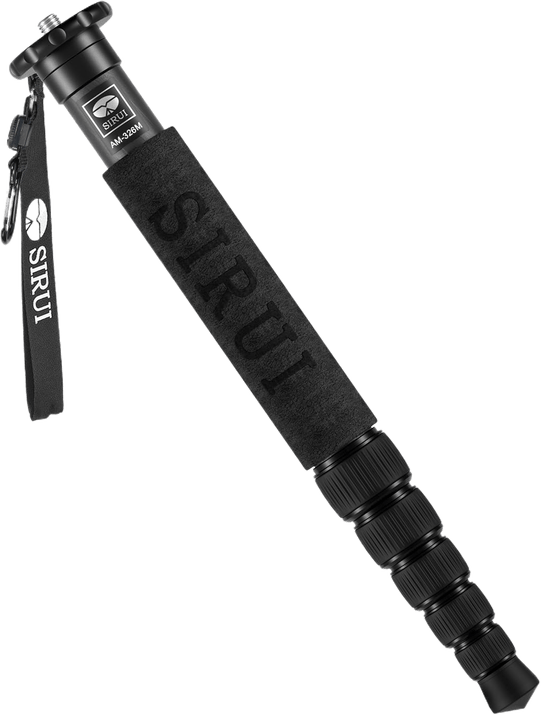
7. SIRUI AM-326M Carbon Fiber Monopod
| Brand |
Brand
Sirui
|
| Build Material |
Build Material
Carbon fiber
|
| Item Weight |
Item Weight
1 lb / 450 g
|
| Retracted Height |
Retracted Height
15.4 inches / 39.2 cm
|
| Max Extended Height |
Max Extended Height
61.4 inches / 1.56 m
|
| Max Load Capacity |
Max Load Capacity
22 lbs / 10 kg
|
| Other Key Features |
Other Key Features
Wrist strap, 6 leg sections, rubber foot with retractable metal spike
|
| Best For |
Best For
Travel photography
|
This compact and portable monopod from Sirui offers excellent value for money. It’s small and light enough for your travel camera bag. But it has a robust construction, so you know it will survive the trip intact. It’s an ideal monopod for travel and adventure photographers.
The total weight is only 1 lb (450 g), so you’ll barely feel it in your backpack. But the carbon fiber frame is strong enough to carry a max load of 22 lbs (10 kg). That’s not the strongest on the list, but definitely enough for your travel cameras.
The six sections have twist-leg locks. And a half-turn twist of the lock gives you a controlled release so you can get the exact length you need. The foam grip on the upper section makes the monopod a pleasure to use. And the rubber foot at the bottom hides a retractable metal spike, so you get a steadier shot indoors and outdoors. The wrist strap is another thoughtful feature.
Six sections is the trade you make for a 15.4 inch (39.2 cm) packed length. That’s five locks to twist open every time you set up, which is slower than the four-section monopods here, and more joints to work loose over time. Full extension is also only 61.4 inches (156 cm). With a head and a camera on top that suits most people standing, but anyone much over six feet will be stooping.
8. Manfrotto 290 Carbon Fiber 4-Section Monopod
| Brand |
Brand
Manfrotto
|
| Build Material |
Build Material
Carbon Fiber
|
| Item Weight |
Item Weight
1.1 lbs / 500 g
|
| Retracted Height |
Retracted Height
19.3 inches / 49 cm
|
| Max Extended Height |
Max Extended Height
59.4 inches / 1.51 m
|
| Max Load Capacity |
Max Load Capacity
22 lbs / 10 kg
|
| Other Key Features |
Other Key Features
Magnesium flip locks, rubber leg warmer, wrist strap
|
| Best For |
Best For
Photographers wanting a carbon fiber monopod
|
The 290 camera monopod is one of the simpler designs from Manfrotto. But this simplicity is precisely what some photographers are looking for. It’s usable and uncomplicated. And the build quality is as good as you’d expect from Manfrotto.
There are aluminum and carbon fiber models of the monopod and both are excellent. But while the aluminum Manfrotto 290 option is cheaper, the overall quality of the carbon fiber model is worth the extra cost.
Manfrotto rates the 290 carbon monopod to a safety payload of 22 lbs (10 kg). That’s not the heaviest load here, but it will hold a professional body with a fast telephoto attached. The height range isn’t record-breaking. But a max extension of 59.4 inches (151 cm) is enough for most photographers.
The individual leg sections are tightened and released with tension-adjustable magnesium flip locks. They’re quick to release and easy to tighten when you need to readjust for your next shot. It also has a rubber leg warmer for grip and a wrist strap for extra security. And the bottom of the pole has a rubber foot.
Two things hold it back. At 59.4 inches (151 cm) it has the shortest reach of any full-size monopod on this list, so with a head and a body on top the viewfinder sits below eye level for a lot of adults. And there’s no fold-out base, so it never stands on its own. Either of those points you elsewhere: the Trent 2.0 is twenty inches taller, and the Element MII stands up by itself. If you like the Manfrotto 290 monopod, you should also see our list of the best tripods.
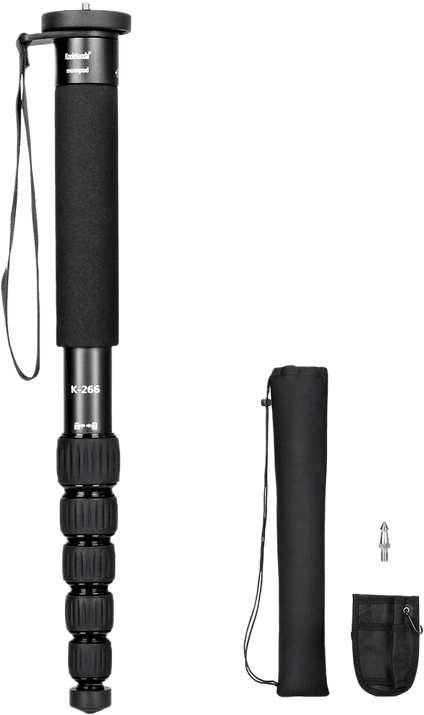
9. Koolehaoda 6-Section Compact Monopod
| Brand |
Brand
koolehaoda
|
| Build Material |
Build Material
Aluminum
|
| Item Weight |
Item Weight
0.94 lbs / 430 g
|
| Retracted Height |
Retracted Height
15 inches / 38 cm
|
| Max Extended Height |
Max Extended Height
61.4 inches / 1.56 m
|
| Max Load Capacity |
Max Load Capacity
22 lbs / 10 kg
|
| Other Key Features |
Other Key Features
Carry case included, removable foot spike, wrist strap
|
| Best For |
Best For
Easy transportation
|
The Koolehaoda Compact Monopod is a great option if your budget is tight. It’s an affordable option for all types of photographers. It’ll hold a surprising amount of gear. You can use pro-grade DSLRs. And it can manage some telephoto lenses.
It’s a lightweight piece of gear, weighing only 0.94 lbs (430 g). And it gives a reasonable max height of 61.4 inches (1.56 m). That’s enough for most photographers to get a comfortable shot. The maximum load weight is 22 lbs (10 kg). That’s plenty of support for adding heavier lenses to your camera.
It folds down to 15 inches (38 cm), which is small enough for your camera bag. The upper section has a foam grip area for comfort. And the base has a rubber foot and metal spike to grip the ground.
The Koolehaoda Compact Monopod is a lowkey but reliable monopod for camera bodies of all kinds. It also comes with a handy carry case for easy transportation.
It’s also the plainest thing on this list. There’s no head, no base, and no spare parts to buy when a lock wears out. The 22 lb (10 kg) figure is the maker’s own rating rather than an independently tested one, and six aluminum sections at this weight will flex more than the carbon fiber monopods above. Buy it as a cheap, genuinely portable stick. If you want a monopod you can still service in five years, spend the extra on the Manfrotto or the 3 Legged Thing.
© Teo Lazarev (Depositphotos.com)
Buyer’s Guide for Best Monopod for Cameras
This section looks at the benefits of using a camera monopod. We’ll look at why you might choose a monopod over a tripod. And we’ll look at the specific features you need to look for in the best monopod for photography and videography.
Monopod For Camera vs. Tripod
Monopods and tripods both serve the same purpose in photography. They give a photographer stability with their camera, giving them more control over their camera settings. Monopods and tripods act as a platform for the camera. This means the photographer doesn’t have to support the camera with their hands while shooting.
The main physical difference is that a tripod has three legs and a monopod has one. The three-leg system allows the tripod to stand independently, holding the camera in place. A monopod has one vertical leg and can’t balance on its own.
While a tripod gives you excellent stability when taking a photo, erecting it and taking it down again can be a nightmare. And this is especially true if you have to move a lot to take pictures. You can move it erected with the camera attached, but this is far from an ideal solution.
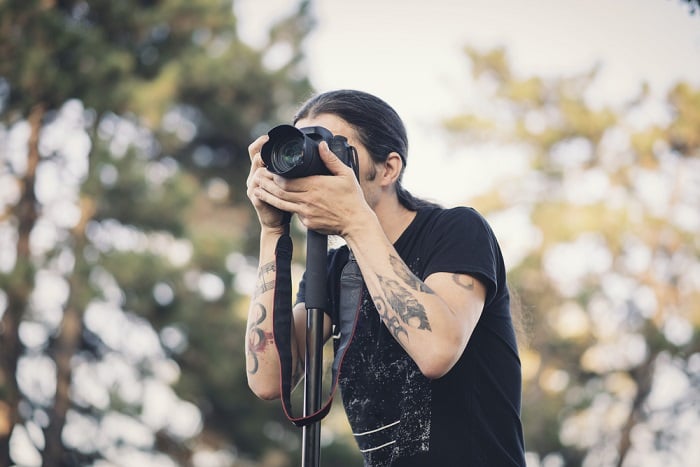
The monopod gives you the stability you need to get the shot. But you don’t lose any mobility. The vertical leg stabilizes the camera while you take a picture. And then you’re free to easily move your position when you need to.
Tripods remain popular with landscape, portrait, and fine art photographers. But sports, action, and wildlife photographers need to be more mobile when shooting. And the monopod has provided them with the perfect solution.
The monopod has become an essential piece of camera gear for photographers in these fields. Sports photographers can shoot night events, with the monopod allowing them to use slower shutter speeds. They can keep their ISO low. And they can move about with the action on the field.
It’s the same with wildlife photographers working at dawn and dusk. They need more freedom with the exposure settings. And it’s also about supporting the weight of the camera. These types of photography also require telephoto lenses. These are bulky pieces of equipment. And the monopod takes the weight so your arms don’t feel fatigued.
© Miflippo (Depositphotos.com)
Which of These Monopods Should You Buy?
Three questions settle it. First, how heavy is the heaviest thing you will put on top? Under 5 lbs (2.3 kg) and the Altura Photo or the Koolehaoda will do. Over that and you want the 3 Legged Thing Trent 2.0 or the Benro MSD46C, both of which carry more than you can comfortably hold.
Second, do you shoot video? Then you need a fluid base, and only two here have one: the Manfrotto XPRO+ if you want the head included and the height to shoot standing, the Manfrotto Element MII if you want the lighter, lower, cheaper version.
Third, how far do you carry it? The Sirui AM-326M and the Benro MSD46C fold to about 16 and 18 inches (39 and 46 cm), so they fit inside a day pack. Everything else here rides on the outside. And if you want the monopod to stand up on its own between shots, you need fold-out feet: the two Manfrotto video monopods and the Neewer T222 have them, the rest do not.
What to Look For in a Monopod
The budget is the first thing you need to think about when buying any camera gear. And the monopod is no different. Thankfully, there are high-quality monopods in every price bracket. There is a difference in quality between the top and bottom of the scale, but there is something for everyone.
Your camera is your most valuable piece of equipment. You need to make sure the monopod you buy can support your camera and the different lenses you use. Look at the maximum weight limits. And go for monopods made from strong and durable materials. Avoid cheap plastic models. Trying to save money here could cost you dearly in camera damage later.
Consider the type of photography you do. Do you need something lightweight and mobile for moving around a sports field? Or do you want something more sturdy for more precise shooting? Knowing this will help you choose the weight and the material of the monopod.
Many monopods have features some photographers will like. There are ball-head joints for changing shooting angles. Some have quick-adjust telescopic legs for changing height and position. And some have padded feet so the monopod doesn’t slip. They’re all features you may want in your monopod.
Frequently Asked Questions
Can a Monopod Replace a Tripod?
No, and it isn’t meant to. A monopod takes the weight of the camera and lets you use a shutter speed two or three stops slower than handheld. It can’t hold a frame still for a 30-second exposure, and it can’t hold itself up while you step away. If you shoot long exposures or careful landscapes, you still need a tripod.
What Load Capacity Do I Actually Need?
Add the weight of your heaviest body and heaviest lens, then double it. A full frame body with a 70-200mm f/2.8 is around 5 lbs (2.3 kg), so a 10 lb (5 kg) rating is the sensible floor. A 400mm or 500mm prime pushes you towards the 30 kg class, which is where the 3 Legged Thing Trent 2.0 and the Benro MSD46C sit. Ratings are the maker’s own safety figures, not test results.
Do I Need a Head on a Monopod?
For horizontal shooting with a lens that has a tripod collar, no. Screw the collar straight onto the monopod and rotate the lens for portrait orientation. For anything else, a tilt head or a small ball head is worth having, because a bare monopod only tilts as far as you dare lean it. Only the two Manfrotto video monopods on this list come with a head.
Are Carbon Fiber Monopods Worth the Extra Money?
For a monopod, the case is weaker than it is for a tripod. Carbon fiber saves weight and damps vibration, but a monopod is already light and your hand is already damping it. The Sirui AM-326M and Benro MSD46C earn it on packed size and carrying weight rather than on stability. If you are choosing between an aluminum and a carbon version of the same model, the aluminum one is rarely the wrong choice.
Conclusion: The Best Monopod For Cameras
The use of monopods is on the rise. They give you extra stability to get perfect shots every time. But they don’t restrict your movement the way a tripod does. You have more camera control and better options with your exposure settings. And you can move freely between shots. They’re beloved by sports and wildlife photographers. Photojournalists love them. And more and more filmmakers are using camera monopods.
The Altura Photo Camera Monopod is the best monopod for cameras right now. It’s compact and lightweight. It can hold most cameras with a light lens. And the price is hard to argue with. It’s the best place to start if you’re looking for a quality all-around monopod.
Before you order anything, weigh your heaviest camera and lens on a kitchen scale and measure the height of your own eye line. Those two numbers rule out most of this list in a minute. Then decide whether you need the monopod to stand up on its own between shots, because that’s the one thing you can’t add later.