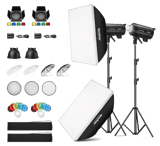
The best photography lighting kit for most people is the Godox DP400III-V kit. It gives you two 400Ws studio strobes with the stands, softboxes and barn doors to use them. You can light a portrait or a product shot the day it arrives. Each head also has a bright LED modeling lamp, so you see where the light falls before you take the picture.
The other kits cover different needs. Two are battery flashes for location work, and one is a premium studio head for photographers who want the Profoto system. Three are continuous LED kits that also suit video, and the cheapest is a simple two-softbox setup for product photos. If you are still choosing between flash and constant light, our guide to studio light types explains the difference.
The Best Photography Lighting Kits for Studio and Location Work
Start with two choices: flash or continuous light, and mains or battery power. A flash (strobe) gives a short, very bright burst. You can work at low ISO and freeze movement, and the modeling lamp gives you a preview. Continuous LED light stays on, so what you see is what the camera records, and it also works for video. But a 50W to 85W LED is much dimmer than a 400Ws flash, so portraits need a higher ISO or a slower shutter. Mains-powered heads give you more light for the money. Battery flashes free you from outlets. The table shows where each kit sits, and the reviews explain what is in each box and what you still need to buy.
7 Best Photography Lighting Kits
If you already own speedlights, our comparison of strobes and speedlights shows what a studio head adds.
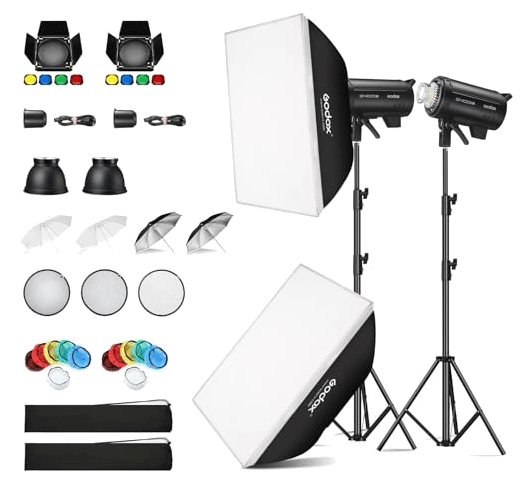
The Godox DP400III-V kit is the most complete setup here for a home or small commercial studio. You get two DP400III-V heads, each rated at 400Ws, plus softboxes, light stands, barn door kits and reflectors. That is a key light and a fill or background light in one purchase.
Each head has a 30W LED modeling lamp with adjustable brightness. It shows shadows and catchlights before you fire, which helps a lot while you learn to place lights. Full-power recycling takes about one second. The heads use the Bowens mount, so softboxes, beauty dishes and grids from many brands fit when you want to expand.
The Godox 2.4G wireless X system is built into both heads. Add a Godox X trigger for your camera brand, and you can fire and adjust both lights from the camera position. The kit does not list a trigger, so plan to buy one.
The limit is where you can use it. The heads run on AC mains only, so this kit stays in the studio. It is also a manual-power studio flash. If you need high-speed sync to shoot at wide apertures in daylight, choose the AD200Pro II or the AD600Pro II kit instead.
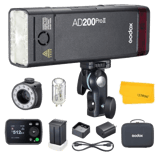
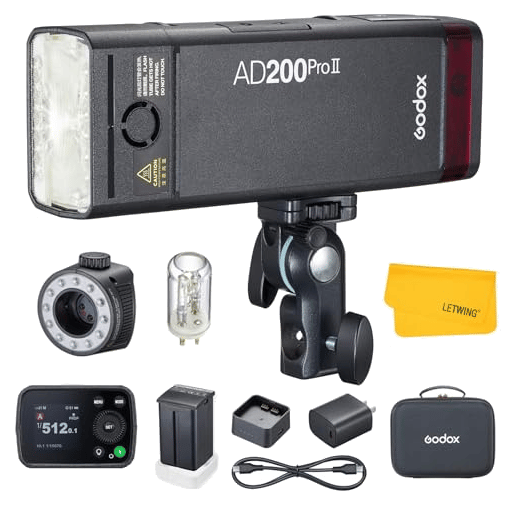
The Godox AD200Pro II is the most flexible single light on this list. It is a 200Ws pocket flash with a lithium battery rated for 500 full-power flashes. It works in a studio, in a client's home or outdoors, with no outlet needed. It supports TTL and manual control, high-speed sync up to 1/8000 s and second-curtain sync. That covers fast event work as well as careful portrait and product photography.
It comes with two interchangeable heads. The H200 II speedlight head gives a focused beam with a guide number of 52 (meters, ISO 100, at 35mm). The H200J II bare-bulb head spreads light into softboxes and umbrellas, and reaches GN 60 with Godox's AD-S2 reflector. Both heads have a modeling lamp with adjustable brightness and color temperature. Godox also improved heat dissipation over the original AD200 Pro, which helps when you fire many frames in a row.
It is the closest rival to the DP400III-V kit. Choose the AD200Pro II if you shoot on location or need high-speed sync. Choose the DP400III-V kit if you work indoors, because it gives you two stronger heads plus stands and softboxes. The AD200Pro II box has no stand or softbox, and one light rarely makes a full setup. Most buyers add a second unit, a trigger and a Bowens bracket.
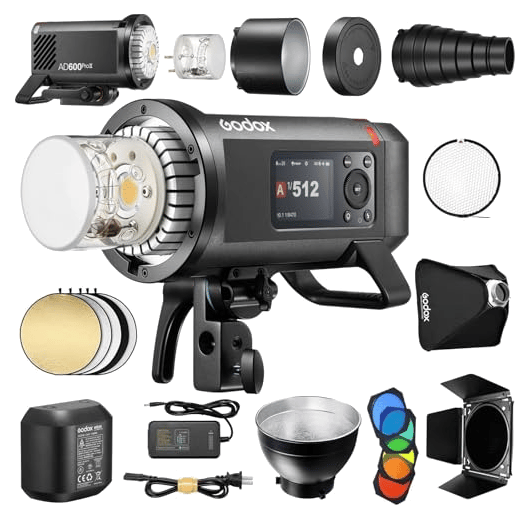
The Godox AD600Pro II kit is the battery flash to choose when 200Ws is not enough. Outdoors at midday, a 600Ws head lets you overpower the sun or light a group from farther away. The kit pairs the flash with a 32 x 32-inch Bowens-mount softbox, a snoot and a barn door set. Add a stand, and you can shoot portraits on location.
The flash has a guide number of 87 (meters, ISO 100, with the standard reflector). Its battery is rated for 360 full-power flashes, and recycling takes 0.9 s at most. It supports TTL, manual and multi mode, plus high-speed sync up to 1/8000 s, through the Godox X system. A 40W bi-color LED modeling lamp doubles as a small continuous light. For studio days, the Godox AC26 adapter runs it from mains power.
This is a full-size monolight, not a pocket flash. It suits photographers who work from a light stand, often with an assistant, rather than from a camera bag. Compared with the DP400III-V kit, you get one light instead of two and no stand. In exchange you gain battery power, TTL and HSS. Choose it for outdoor portraits and weddings, where you need real power away from an outlet.
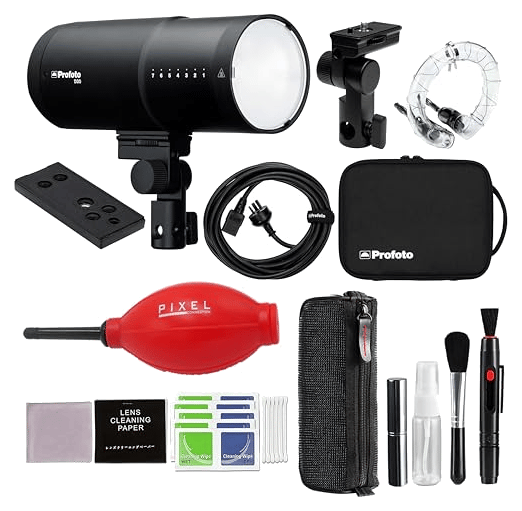
The Profoto D30 is for photographers who want a premium studio head and Profoto's range of light shaping tools. It puts out 500Ws over an 11-stop range. It can go very low for close product work or shallow depth of field, and high enough to fill a large softbox.
Recycling takes from 0.01 s up to 0.9 s, depending on power and voltage. The 35W bi-color LED modeling lamp lets you match the modeling light to the room. Profoto AirX is built in, so the head works with Profoto remotes for TTL and high-speed sync, and with the Profoto app over Bluetooth. It is a strong fit for fashion, product and portrait photography for clients.
The D30 runs on AC mains only. If you need the same system away from outlets, look at Profoto's battery-powered B-series, which our Profoto B10 review covers. The D30 is also by far the most expensive light per head on this page. You can buy it as one head or as a Duo Kit with two. It makes sense if you already own Profoto modifiers or want to buy into the system. For a first studio, the DP400III-V kit gives you two lights, stands and softboxes for far less.
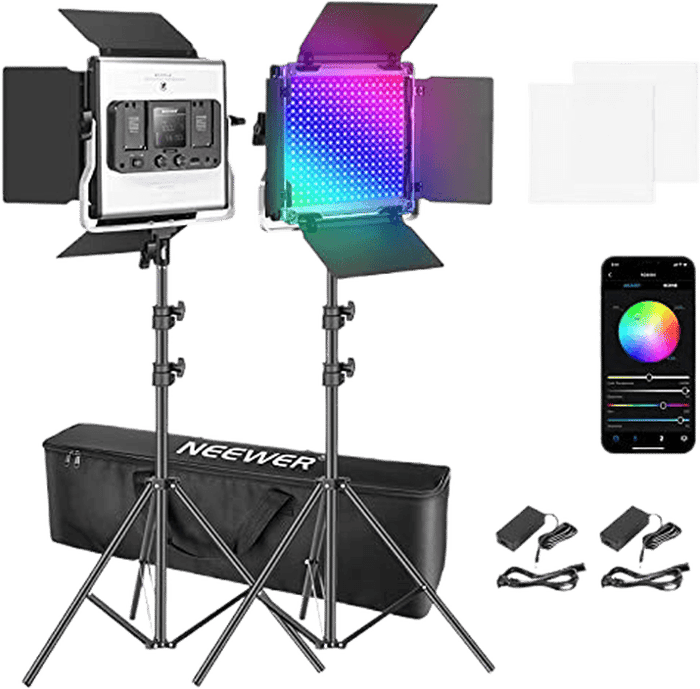
The Neewer 660 PRO II kit is the pick for creators who shoot both photos and video. You get two 50W LED panels with stands and barn doors. Each panel gives white light from 3200K to 5600K and full RGB color. You can add a colored rim light or a background wash without gels. Neewer rates the color accuracy at CRI 97+, which helps skin tones look natural.
Because the light is constant, you see exactly what the camera records. That makes the kit easy to learn on. Each panel runs from its included AC adapter or from optional NP-F batteries, so you can take one on location for an interview. You control both lights from the Neewer app. Our guide to color temperature explains how to match the panels to window light.
The trade-off is output. Two 50W panels are far dimmer than a strobe, so stills of people need a higher ISO or a slower shutter than with the DP400III-V kit. Each panel is about 9 x 8 inches, so the light is harder than a large softbox unless you add diffusion. If your work is mostly stills, a flash kit is the better buy. For more panel options, see our guide to the best LED light panels.
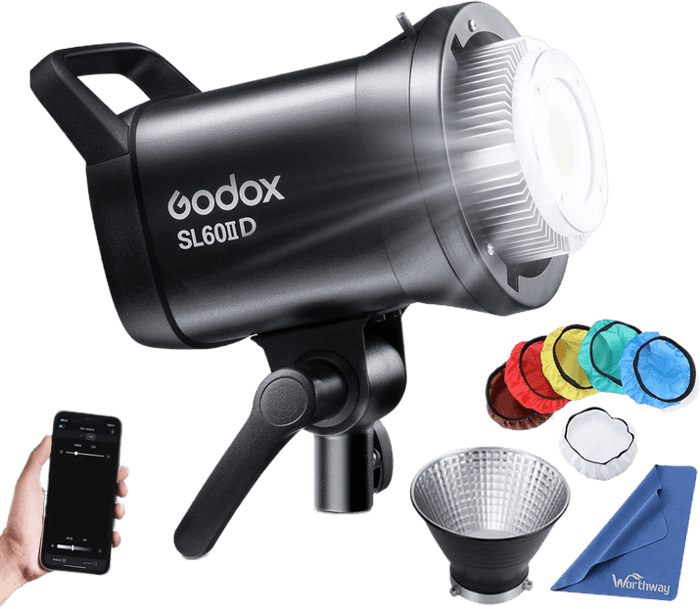
The Godox SL60IID is a continuous LED light built like a studio strobe. It is a 70W daylight (5600K) light with a Bowens mount. It takes the same softboxes, beauty dishes and other lighting modifiers as a flash head. That makes it a good base for a continuous-light kit you build one piece at a time.
Godox rates it at CRI 96+ and TLCI 97+, so colors stay accurate for product photos and video. You can control it from the Godox app, and it has eight built-in lighting effects. It is fan-cooled, which keeps the output steady. Listen for the fan if you record dialogue close to the light.
It runs from an AC adapter only, so it stays near an outlet. It is also daylight-only, with no color control like the Neewer 660 PRO II kit. The light comes on its own, so you need to add a stand and a softbox. Compared with the EMART kit, it is one head instead of two, but it accepts far better modifiers. For a continuous-light studio you plan to grow, the SL60IID is the better long-term buy.
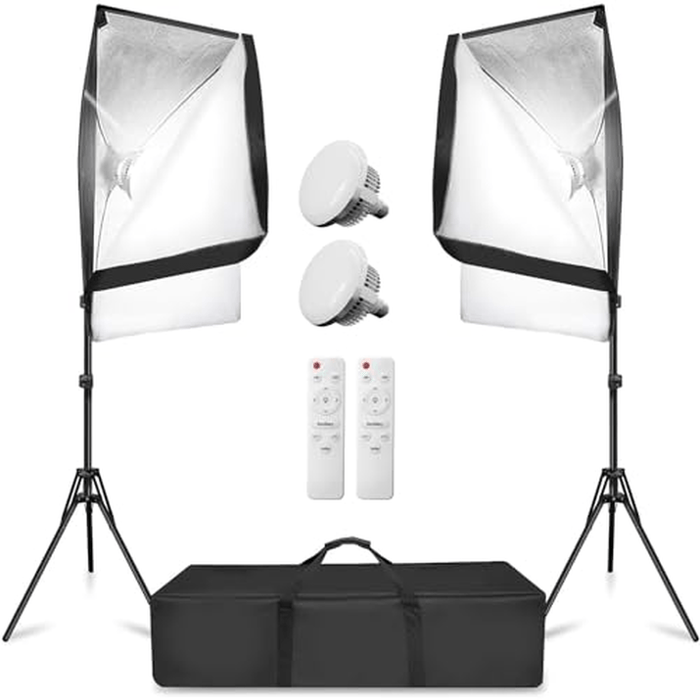
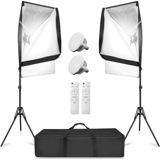
The EMART Softbox Lighting Kit is the low-cost way to start with studio light. It includes two 16 x 16-inch softboxes, two 65-inch stands and two 85W LED bulbs with remote control. The bulbs adjust from 3000K to 6000K, so you can match room light or set a clean daylight balance.
It is best for product photography, flat lays and small tabletop setups. The small softboxes give soft light when you place them close to the subject. With the camera on a tripod, the low output does not matter for still objects, because you can use a longer shutter speed.
The limits show with people. Two LED bulbs give far less light than a strobe kit, so portraits need a higher ISO or a wide aperture, and moving subjects can blur. The 16-inch softboxes are also too small to light a full-length portrait evenly. If you plan to shoot portraits often, the DP400III-V kit or the Neewer 660 PRO II kit will serve you longer.
How to Choose a Photography Lighting Kit
Watt-Seconds and LED Watts Measure Different Things
A flash is rated in watt-seconds (Ws), the energy of one burst. An LED light is rated in watts (W), the power it uses while it is on. A 400Ws strobe and an 85W LED bulb are not on the same scale. In practice, any of the flash kits here gives far more light on the subject than any of the LED kits. Also read kit names carefully. "800Ws" on the DP400III-V kit means two 400Ws heads, not one 800Ws head. LED bulb kits often quote an "equivalent" figure that compares them with old incandescent bulbs. Use the real wattage per light to compare LED kits.
Check What Is Missing From the Box
A kit listing tells you what you still need to buy. Strobes need a way to fire from the camera. For the Godox heads, that is a Godox X trigger made for your camera brand. For the Profoto D30, it is a Profoto remote. Single heads, like the AD200Pro II, the D30 and the SL60IID, also need stands and modifiers. Softboxes give more controlled light than umbrellas, and our softbox vs umbrella guide explains when each one fits. Check the modifier mount too. Bowens-mount heads share a huge range of third-party softboxes. Profoto heads use Profoto's own mount. The AD200Pro II needs a bracket to hold Bowens softboxes.
Decide How Many Lights You Need
One good light with a large softbox can make strong portraits. Our one-light portrait guide shows how, and a single head with a snoot or grid suits dramatic lighting. A second light lets you fill shadows or separate the subject from the background. That is why two-light kits like the DP400III-V and the Neewer 660 PRO II are the easiest start. If you buy a single head now, choose a system you can add to later, such as the Godox X system, so a second light works with the same trigger.
Conclusion: The Best Photography Lighting Kit
The Godox DP400III-V kit is the best photography lighting kit for most people. It gives you two strong studio strobes, stands and softboxes in one box. If you shoot on location or need high-speed sync, choose the Godox AD200Pro II instead. For product photos on a small budget, the EMART Softbox Lighting Kit is the simplest way to start.