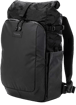
The Tenba Fulton V2 is a camera backpack I would choose for everyday shooting with a compact kit. Its plain exterior, rear camera access and expandable roll-top suit a day in the city. The trade-offs are slower access to your camera, thin divider padding and a basic waist strap.
This review covers the 16L All Weather version in Black/Black Camo, photographed and reviewed here in 2023. The 10L and 14L sizes share the same general layout, but their camera and device capacity differ. The size comparison below uses Tenba’s current specifications; it is not a hands-on test of the smaller bags.
The All Weather model uses water-repellent nylon and a Splashguard front zipper. These are reasons to consider it for changeable weather, but they do not make it a waterproof dry bag. Our sample also came with a separate rain cover.
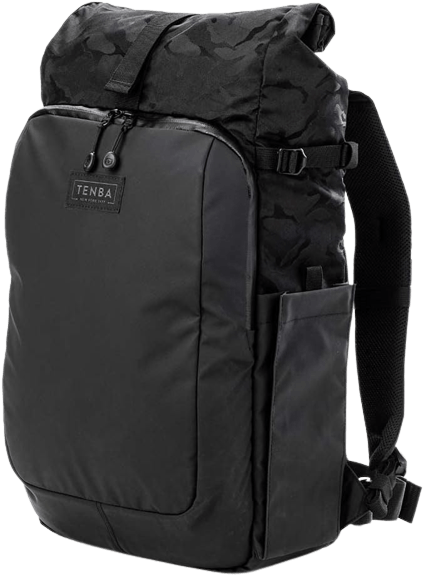
The Tenba Fulton V2 is one of the camera backpacks we selected for review. We also considered bags from Manfrotto, Wandrd, and Lowepro. If you want to see the other bags we have considered, take a look at our top camera backpack article here.
For full transparency about our review process, you can read about how we scored and ranked the bags here.
Strengths and Weaknesses of the Tenba Fulton V2
| Weight |
Weight
1270 g
|
| Capacity |
Capacity
16
|
| Access Points |
Access Points
Back
|
| Airflow Back Support |
Airflow Back Support
No
|
| Laptop Sleeve |
Laptop Sleeve
16-inch
|
| Tripod Holder |
Tripod Holder
Yes
|
| Warranty |
Warranty
5 years
|
| Waterproof Rating |
Waterproof Rating
Water-repellent
|
The Fulton’s main appeal is how much camera gear it holds without looking bulky. The 16L All Weather model weighs 1.27 kg empty, according to Tenba. If you are choosing the lightest bag on our list, compare empty weight as well as the kit you need to carry. The Fulton’s advantage is its slim shape, rather than a claim to be the lightest backpack available.
The water-repellent exterior, rear opening and simple roll-top work well together for everyday use. I also like being able to lay the bag down and see the whole camera compartment at once.
Its weaknesses become clearer as you load it. The smaller dividers are thin, the back panel has little space for airflow, and the waist strap has no padded wings. Rear access also means stopping and taking the bag off to change equipment.
The roll-top can take personal items, but its room depends on how much camera gear you pack below it. Think of the Fulton as a daypack for camera gear, lunch and a light layer, rather than a bag for a long trip’s clothing and equipment.


Design and Color Options
The All Weather version reviewed here comes in Black/Black Camo. It is subtle enough that the pattern does not dominate the bag. I am a sucker for an all-black colorway: it goes with almost any outfit and does not draw much attention.
Tenba also lists the standard Fulton V2 in Black and Tan/Olive. The standard model uses water-repellent 600D canvas, while the All Weather model uses nylon. Do not assume the different finishes have identical weather protection.
The roll-top and small number of visible zippers make the Fulton look more like an everyday backpack than a camera bag. That is part of its appeal on a commute. It does not advertise the photography equipment inside, although an understated design cannot prevent theft.
The slim profile also makes the bag less awkward in a crowded subway car than a deep camera backpack.

Build Quality and Durability
The exterior fabric and reinforced stitching are among the Fulton’s stronger features. The All Weather version combines water-repellent nylon with a YKK Splashguard front zipper. The small plastic buckles and thin internal dividers are less convincing than the main shell.
Exterior Material
Tenba specifies 420D Helix nylon and 600D camouflage nylon for the All Weather Fulton V2. On our sample, the smoother material covers most of the front and the base. The softer camouflage material forms the roll-top.
The front fabric feels tough without being rigid. Having it on the base is also practical when you put the bag down on a damp surface. The flexible upper material rolls down neatly when the top compartment is not full.
These are observations about the construction and feel. They are not proof that the bag is tear-proof or suitable for dragging across sharp surfaces.


Weather Protection
The All Weather model offers several layers of rain protection: water-repellent fabric, a covered front zipper and a roll-top that closes tightly when it is not overfilled. Tenba describes the materials as water-repellent. I would not treat the bag as submersible or leave it exposed to prolonged heavy rain.
Our review sample included a separate WeatherWrap rain cover. Keep it somewhere you can reach before rain gets heavy, rather than at the bottom of a packed camera compartment. Tenba also sells replacement covers; its size C cover lists the Fulton 16L as compatible.
The laptop pocket sits at the front of the bag. Its Splashguard zipper adds protection, but I would still put the cover on when carrying a laptop in rain. The rear camera zipper is not covered in the same way, so the direction in which you set the bag down matters too.


Interior Material
Tenba specifies a 300g brushed tricot interior. It feels soft against camera equipment and lines the camera compartment and the main dividers.
Some of this lining extends into the lower part of the roll-top compartment. The front laptop pocket uses a smoother lining and has padding on both sides. I would have preferred the same soft finish there, but the difference is mainly in feel.

Straps and Back Support
At first, I wasn’t too keen on the straps as a loose, seatbelt-like material holds them up. But then I put the bag on and it made complete sense. The loose fastenings are like that so they can conform to your shoulder shape much easier than the full rigid material most bags use.
The flexible upper attachments also let you move the straps out of the way when opening the back. That small detail makes sorting gear easier.
The shoulder straps have a thin layer of padding with a mesh surface. The back panel is thicker, but it lacks deep channels for airflow. I found the setup comfortable for the bag’s intended use; I would not choose it for a heavy load simply because the empty bag is light.
The chest strap has a wide range of height adjustment. The basic waist strap helps steady the bag, but it does not provide the same support as a padded hiking hip belt.
There is also a luggage pass-through near the top of the back. On our sample it felt loose, so I would check that the bag sits securely on a suitcase handle before walking away with it.


Seams and Stitching
The main seams are tucked away, and I had to pull the fabric apart to inspect some of the stitching. The shoulder strap and handle attachments have extra rows of stitching where the load is carried.
The interior is less tidy, though it still feels well assembled. My main concern is the stitching around the internal padding: the hook-and-loop fasteners grip firmly, so pull the fastener apart carefully when moving dividers.
Concealed seams alone do not make a bag waterproof.


Internal Padding
The larger dividers feel firm and hold their shape. The smaller blue dividers are much thinner. They separate equipment, but I would avoid packing two lenses tightly against one another with only a thin divider between them. If you have spare dividers, doubling one up adds separation.
The rear panel has thicker padding for both the equipment and your back. Do not force gear beyond the depth of the compartment. Anything that pushes the panel outward can make the bag uncomfortable to wear.


Zippers and Fastenings
The front pocket has a YKK Splashguard zipper with a plastic pull that is easier to grip than the small fabric pulls on the rear camera opening. The front zip feels stiff, so it takes a little more effort to open.
The rear zipper has no equivalent protective coating. Your back shelters it while you wear the bag, but that is no reason to leave the open side facing rain when the bag is on the ground.
The chest and waist straps use small plastic clips. They felt less substantial than the rest of the bag, although that is a concern about feel rather than a recorded breakage.
A metal hook holds the roll-top closed. It takes a few seconds to unfasten, but it worked securely on our sample when properly tensioned.


Functionality and Ease of Use
The Fulton favors a closed, uncluttered exterior over fast camera access. That suits a photographer who takes the camera out at the start of a walk and packs it away at the end. It is less convenient if you swap lenses every few minutes.
Size and Weight
The reviewed 16L All Weather bag measures 28 × 51 × 19 cm externally and weighs 1.27 kg empty. It is the largest of the three Fulton V2 sizes. The 10L and 14L are smaller options, but choosing between them is about device fit and camera dimensions as well as volume.
| All Weather model | Empty weight | Outside dimensions (W × H × D) | Tenba’s camera capacity | Device sleeve |
|---|---|---|---|---|
| 10L | 0.79 kg | 25 × 38 × 15 cm | Camera with 2–4 lenses; up to a detached 24–70mm f/2.8 | iPad or iPad Pro up to 11 inches |
| 14L | 0.91 kg | 28 × 44 × 17 cm | Camera with 3–4 lenses; up to a 70–200mm f/2.8 | Laptop up to 14 inches |
| 16L | 1.27 kg | 28 × 51 × 19 cm | Camera with 5–7 lenses; up to an attached 70–200mm f/2.8 | Laptop up to 16 inches |
These are Tenba’s published specifications, checked in October 2026, rather than packing results from three hands-on tests. Lens counts depend on the size of the lenses. The 14L description is not consistent about whether its quoted 70–200mm lens is attached, so check your exact camera-and-lens combination before choosing it.
The 10L is the starting point for a small kit and tablet. The 14L gives a middle option for a laptop and several lenses. The 16L makes more sense if the larger device sleeve or extra camera space is essential. Check the sleeve dimensions too: a screen-size label does not guarantee that every laptop case will fit.

Capacity
The 16L has a lower camera compartment and an upper roll-top compartment for personal items. Packing more equipment upward reduces the space left for lunch or a jacket.
On our sample, the camera section occupied much of the bag when the roll-top was empty. Moving the dividing panel made more vertical room available, but this is a compromise between camera storage and personal storage, rather than extra padded capacity appearing for free.
The roll-top expands when you need more room and rolls down when you do not. Leave enough fabric to close it properly. Filling it to the rim makes the bag harder to carry and weakens the closure’s protection from rain.

Organization and Customization
The rear opening lets you lay the bag down and arrange all your equipment at once. I prefer this for packing, even though side access is quicker while shooting.
All the camera dividers are removable. You can rearrange the lower compartment around your kit, or remove dividers for larger equipment. The separating panel can move upward, but on our sample it did not have a secure attachment point for every possible position.
The front pocket holds the laptop and has smaller spaces for cables and accessories. It lies fairly flat when empty. Avoid filling it so heavily that it presses into the laptop or pulls the front of the bag outward.

Access Points
Camera access is through the back panel. This keeps the main opening against your body while you wear the backpack, rather than exposed on the front or side.
The drawback is speed: you need to take the bag off and set it down to reach the whole camera compartment. The benefit is that you can see the layout clearly. Setting it down on its front also keeps the back padding away from the ground.
The roll-top and front device pocket have their own openings, so you do not need to open the camera compartment for every small item.

Security
I feel more comfortable carrying gear with the main opening against my back in a busy place. Rear access makes casual access to that compartment harder, and the plain exterior is less obvious than a heavily branded camera pack.
That does not make the Fulton theft-proof. The front pocket and roll-top are still accessible, and the fabric is not a security barrier. Keep the bag in sight when you take it off.
The rear zipper pulls on our sample did not provide a practical locking arrangement. The fabric pull cords are not a substitute for a lock.

Additional Features
The side tripod pocket is most convenient with a compact travel tripod. A larger tripod sits high and can pull the bag off balance.
Its securing strap has no quick-release clip. You have to loosen the loop and slide the tripod out, then tighten it again when packing up. It held the tripod, but this was one of the slower parts of using the bag.
The same strap can cinch the upper side of the bag when you are not carrying a tripod. On the opposite side is a deep bottle pocket that keeps water outside the camera compartment.


Compatibility and Versatility
The 16L model holds a camera and several lenses, but its slim depth is the main limit. Plan the divider layout around your camera’s height before relying on a headline lens count.
Compatibility for Cameras and Lenses
Tenba rates the 16L for a mirrorless or DSLR camera with five to seven lenses, including an attached 70–200mm f/2.8. That is a manufacturer capacity claim, not a promise that every combination of large lenses will fit together.
I can store my Canon 5D Mk III comfortably, but I would have to lay the camera flat if I add the battery grip. Allow for that change in layout if you use a tall camera body.
The adjustable dividers give you several ways to divide the space. Leave room between equipment and avoid forcing the rear panel shut over a tall camera body.

Carrying Versatility
The Fulton is primarily a backpack. The chest and waist straps steady it, and the top handle lets you pick it up, but it does not offer a dedicated sling or shoulder-bag mode.
The roll-top supplies most of its flexibility. You can carry a little more personal gear when needed and reduce the unused upper space on a lighter day. I would choose it for that simple adjustment rather than for multiple carrying configurations.

Sustainability
The label in our review sample says it was handcrafted in China. That tells us where the bag was made; it does not establish working conditions, manufacturing cost or environmental impact.
The current Fulton V2 product information does not specify a recycled-material percentage or environmental certification. There is not enough evidence here to judge its sustainability against other bags. Check for documented material and repair information if those are deciding factors for you.

Price and Value
The Fulton’s value is in its simple layout, restrained size and protective exterior. At first glance I wasn’t won over, but the attention to small details made it a bag I would choose for myself.
The All Weather version is worth considering if you want the nylon exterior and protected front zipper. The standard canvas version has a different finish. Compare the exact version being offered rather than buying on the Fulton name alone.
I would spend more on a different design if I needed fast side access, a padded hip belt or more room for personal items. Those are practical reasons to change bags. A more expensive bag is not automatically a better choice for a small daily kit.

Warranty
Tenba lists a five-year limited warranty for the Fulton V2. Its US warranty covers manufacturing and material defects on eligible purchases from Tenba’s distributor or an authorized retailer. Normal wear, misuse and damage from improper handling are excluded.
Keep the dated receipt and register the bag as Tenba requests. Contact the service team before returning it. The policy covers the bag; it does not promise compensation for camera equipment damaged inside it.
For service outside the US, Tenba directs customers to a local authorized distributor. If you live abroad but bought from a US dealer, its US service facility can handle the product, with shipping in both directions paid by the customer. Check the terms that apply to your purchase country.

Alternatives to the Tenba Fulton V2
Wandrd Prvke
The Wandrd Prvke is the alternative to consider if you like a roll-top but want side camera access as well as a full rear opening. It has a more involved storage system than the Fulton.
The current PRVKE range has changed since our original comparison. WANDRD’s product page now describes the V4, so check the version and whether a camera cube is included in the selected bundle. Do not compare a bag-only package with the Fulton’s built-in camera compartment as though they contain the same things.
I would choose the Fulton for a simpler daily bag, and look at the PRVKE when quicker access and more organization matter more.
Use our discount code EXPERTPHOTOGRAPHY at checkout for 15% off your first order!
Lowepro Fastpack Pro BP 250 AW III
The Lowepro Fastpack Pro BP 250 AW III is worth considering if rear-only camera access is your main objection to the Fulton. Its QuickDoor design allows side access or a fuller opening for arranging equipment.
Lowepro specifies a padded waist belt, coated fabric and an All Weather cover. Compare those features with the Fulton’s basic waist strap. They do not support declaring either bag completely waterproof.
The Fulton is the simpler option for a compact daily load. The Fastpack gives you a different access system when you need to reach the camera more often.
Manfrotto Light Multiloader
The Manfrotto Light Multiloader is a larger alternative for photographers who need more ways to reach and carry their equipment. Manfrotto lists four access points and backpack, sling and duffle carrying modes.
The trade-off is size and weight. Manfrotto lists the Multiloader at 26L and 2.16 kg empty, compared with 16L and 1.27 kg for the reviewed Fulton. It makes sense when you need that flexibility; the Fulton is easier to justify when a smaller everyday backpack is the priority.
Final Verdict of the Tenba Fulton V2
| Measurement | Score |
|---|---|
| Design And Aesthetics | 76 |
| Build Quality And Durability | 77 |
| Functionality And Ease Of Use | 73 |
| Weather Resistance | 97 |
| Compatibility And Versatility | 44 |
| Value For Money | 99 |
| Total Score | 76 |
The Tenba Fulton V2 received 76 out of 100 in our original camera-bag review. That is the result of that review and scoring method, rather than a new test of every bag currently on sale.
I would choose the 16L All Weather Fulton V2 for a compact daily camera kit and a laptop, provided rear access suits the way you shoot. The exterior feels tough, the roll-top adjusts to a day’s personal items, and the bag does not look bulky or conspicuously photographic.
I would choose a different bag for frequent lens changes, a heavy load that needs a padded hip belt, or a large tripod. The thin smaller dividers also deserve care when you pack expensive lenses.
For readers choosing between sizes, the 10L starts with a tablet-sized sleeve, the 14L adds laptop space, and the reviewed 16L provides the largest device sleeve and camera capacity in this range. Match the bag to your actual kit. The Fulton works best when you use its small, simple layout as intended rather than try to turn it into a full expedition pack.