Nothing “lifts” your photography like a drone camera. The best drone cameras offer a perspective that’s almost impossible to get any other way. They are used in real estate photography, landscape and nature, and industrial work. Sometimes they are used for inspection work. Others are used to add cinematic “Wow!” to music videos or action photography.
If you’re looking for the best drone camera to use in your photography, we’ve researched the field. Most of the drones in this review will open up the world of commercial drone cameras for you. We’ve included one budget option if you just want to try out the aerial world. Our top pick is the DJI Mini 5 Pro. It carries a 1-inch 50 MP sensor, shoots 4K at up to 120 fps, and still lands at 249.9 g, below the FAA registration threshold for recreational flights.
What Is the Best Drone Camera?
The best drone camera for most photographers is the DJI Mini 5 Pro. It puts a 1-inch, 50 MP sensor into a 249.9 g airframe, so recreational flyers in the US can get the pictures of a bigger drone without registration paperwork. If you want a second focal length as well, the DJI Air 3S adds a 70mm equivalent tele camera beside its 1-inch wide.
You’ll need to balance your requirements for image quality, price, and drone capability. Before we look at the drone cameras in detail, here is a summary of our choices.


Choosing the Best Drone Camera
Now let’s look in more detail at our recommended drones.
1. DJI Mini 5 Pro
| Brand |
Brand
DJI
|
| Max Video Resolution |
Max Video Resolution
4K at up to 120 fps
|
| Max Stills Resolution |
Max Stills Resolution
50 MP
|
| Flying Time |
Flying Time
36 minutes (52 with the Plus battery)
|
| Range |
Range
12.4 miles
|
| Max Speed |
Max Speed
42 mph
|
| Weight |
Weight
0.55 lbs
|
| Other Key Features |
Other Key Features
1-inch CMOS sensor, forward LiDAR, omnidirectional obstacle sensing, 225º gimbal rotation for vertical video
|
| Best For |
Best For
Anyone who wants a 1-inch sensor without crossing the FAA registration weight
|
The DJI Mini 5 Pro is the drone to buy if you want serious image quality and no paperwork. DJI fits it with a 1-inch, 50 MP CMOS sensor, and the whole aircraft still weighs 249.9 g on its standard battery.
That number does more work than it looks like it does. The FAA requires registration for every drone flown under Part 107, and registered drones must comply with Remote ID. For recreational flights, a drone under 250 g is exempt from registration and does not need Remote ID unless registered. The Mini 5 Pro is the one drone here you can drop in a bag before a trip and simply fly.
The camera backs the claim up. Stills come off that 1-inch sensor at 50 MP, up to 8192 x 6144 pixels. Video runs to 4K at 120 fps, or 1080p at 240 fps if you want extreme slow motion. The gimbal rotates 225 degrees, so vertical frames come straight out of the drone instead of a crop. Flight time is 36 minutes on the standard battery, the video link reaches 12.4 miles, and forward LiDAR plus omnidirectional sensors keep it out of branches in poor light.
The catches are worth knowing. DJI’s headline 52-minute flight time needs the Intelligent Flight Battery Plus, and that pack weighs 117 g against the standard 71.2 g, which pushes the aircraft past 250 g. Fit it and you are registering and broadcasting Remote ID after all. There is also only one camera here, so any reach is digital zoom, up to 3x at 4K. And rated wind resistance is 12 m/s, about 27 mph, which is a real ceiling on an exposed coastline. If you shoot mostly in wind, or you want a true telephoto, buy something heavier.
2. DJI Air 3S
| Brand |
Brand
DJI
|
| Max Video Resolution |
Max Video Resolution
4K at up to 120 fps
|
| Max Stills Resolution |
Max Stills Resolution
50 MP
|
| Flying Time |
Flying Time
45 minutes
|
| Range |
Range
12.4 miles
|
| Max Speed |
Max Speed
47 mph
|
| Weight |
Weight
1.6 lbs
|
| Other Key Features |
Other Key Features
1-inch 50 MP wide camera plus a 1/1.3-inch 48 MP 70mm tele camera, 42 GB internal storage, forward LiDAR
|
| Best For |
Best For
Photographers who want two focal lengths without swapping drones
|
The DJI Air 3S is the one to buy when image quality matters more to you than pocketability. It is the only drone here carrying two cameras, and that second lens is what earns it the extra weight.
The wide camera uses a 1-inch, 50 MP sensor at a 24mm equivalent focal length and opens to f/1.8. Beside it sits a 1/1.3-inch, 48 MP medium tele at 70mm equivalent and f/2.8. Having both means you can compress a ridgeline or tighten a rooftop without flying the drone somewhere else, which is exactly the problem a single-camera drone leaves you with on a real estate shoot.
Both cameras shoot 4K at up to 120 fps, and there is 42 GB of storage on board for the day you forget a card. Flight time is 45 minutes, the O4 transmission system holds a link out to 12.4 miles, and top speed is 47 mph. Obstacle sensing is omnidirectional with a forward LiDAR unit reading out to 25 m, which makes dusk flights and drone shots through cluttered scenes far less nerve-racking than they used to be.
The trade is weight and admin. At 724 g the Air 3S is nearly three times the Mini 5 Pro, so you have to register it with the FAA and it has to broadcast Remote ID. It takes up real room in a bag, and 70mm is as far as the tele goes, so anyone who needs longer reach is shopping above this drone. Rated wind resistance is the same 12 m/s as the Mini 5 Pro, so the extra mass buys you steadier footage rather than a higher ceiling.
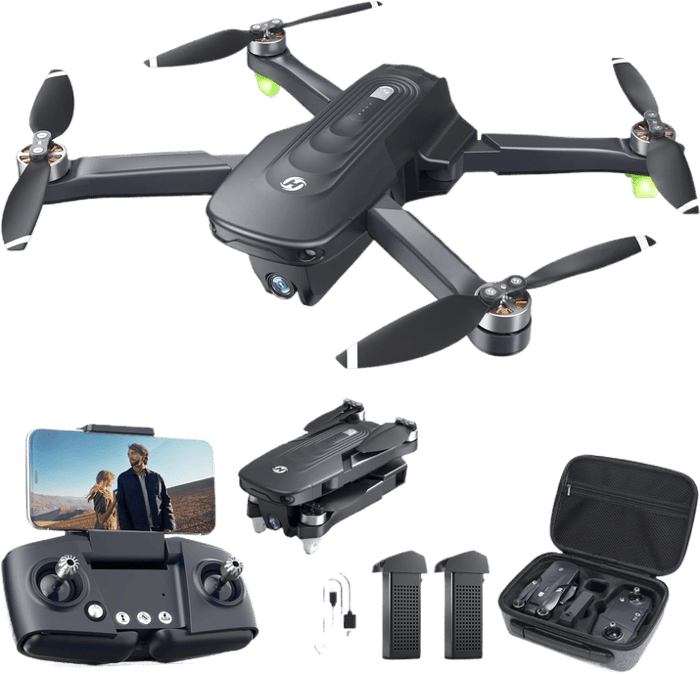
3. Holy Stone HS175D Drone
| Brand |
Brand
Holy Stone
|
| Max Video Resolution |
Max Video Resolution
4K
|
| Max Stills Resolution |
Max Stills Resolution
20 MP
|
| Flying Time |
Flying Time
46 minutes
|
| Range |
Range
1640 ft / 500 m
|
| Max Speed |
Max Speed
30 mph
|
| Weight |
Weight
0.55 lbs
|
| Other Key Features |
Other Key Features
Modular batteries, 100º viewing angle, silent motor, transmitter control with phone mount
|
| Best For |
Best For
People in need of a low-cost drone
|
The Holy Stone HS175D is a drone that’s packed with features but remains affordable. It isn’t the most advanced drone on this list, but it’s the cheapest way to try aerial photography without committing to a flagship price tag.
That 4K video comes from a camera that can be remotely adjusted up or down by up to 90 degrees. The fixed lens has a 100º viewing angle, which gives you a beautifully wide field of view.
An optical flow lens aids altitude stability. This helps the drone know how far away the ground is.
Range is fairly limited at 1640 feet / 500 m, but you can still get some great aerial shots of your surroundings. It also has a silent motor, so you won’t cause a scene when flying it about.
Return-to-home has three modes. The first allows you to summon it back to you. The second initiates a return when battery levels are low. The third is automatic if the drone loses connection with the transmitter. This means that if your drone goes beyond transmission range, it won't just keep going forever. Instead, it will head for home. You can resume your flight as soon as the drone establishes connection again.
The transmitter has all the controls you could need. It also has a smartphone mount so you can see what you’re shooting in real time. You don’t have to wait until the footage has been transferred to another device.
Its limits show up quickly. The 1640 ft range is a rounding error next to the 12.4 miles the two DJI drones manage, the 4K comes off a small fixed lens rather than a 1-inch sensor, and the only sensor on board is the downward optical flow unit, so avoiding trees is entirely your job. Buy it to find out whether you enjoy flying, not to take on paid work.
Buyer’s Guide for the Best Drone Camera
If you've not yet had the pleasure of flying a drone, then hopefully this article will encourage you. Are you looking for a fun toy or looking for the best camera drone you can afford? Here are the things worth paying attention to when you compare camera drones.
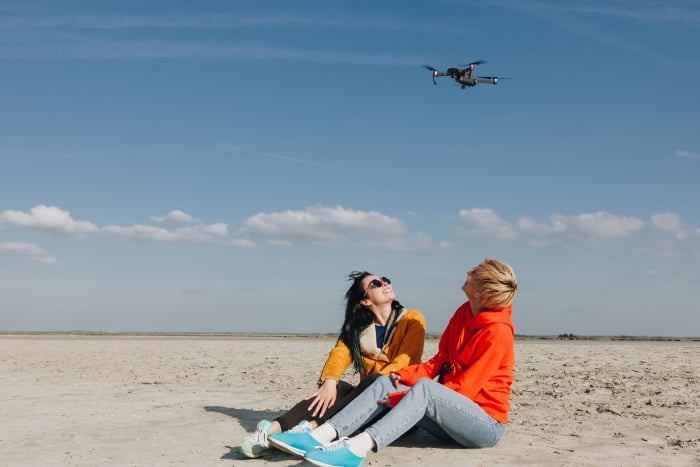
What Are the Legal Requirements for Flying a Drone?
There's no short answer to that. In the US, the Federal Aviation Administration requires registration for all drones flown under Part 107, regardless of weight, and for recreational drones weighing 250 g (0.55 lbs) or more. Registered drones must comply with Remote ID. Weight is not the whole story, though. Every recreational flyer has to pass the free TRUST test and carry proof of it, whatever the drone weighs. And flying for anything other than personal enjoyment puts you under Part 107 rather than the recreational exception. There may be local restrictions too, because of airports or other sensitive areas, so check locally as well.
Privacy laws might have a bearing on drone use too. And there’s no denying that drones can be annoying to others who might object to the noise. Or they might feel they are being watched. These are all things to consider when flying.
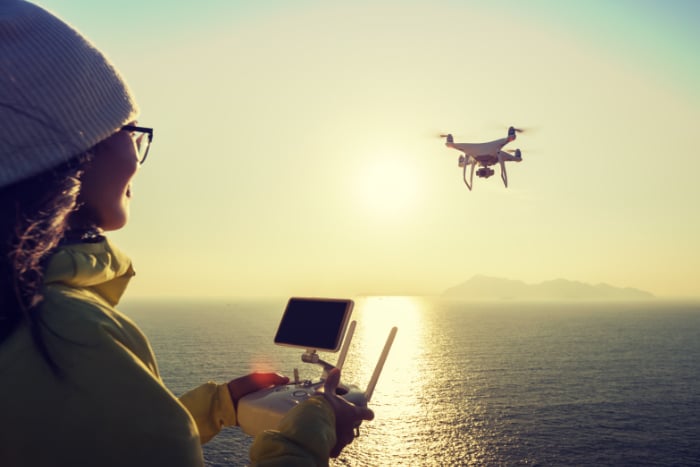
© Li Zhongfei
What Features Should I Look For in a Drone?
This review covers quite a range. At the cheaper end is a simple starter drone. At the more expensive end are capable camera drones built around 1-inch sensors.
Method of Control
Some drones have a designated controller that controls the flight. Others rely on your mobile phone.
First-Person View (FPV)
First-person view is when you can see what the drone is seeing in real time. This is a helpful and fun feature.
Headless Mode
This isn’t as scary as it sounds. If you don't know which way the drone is facing, this allows you to move it forwards or backward in relation to where you are. Let’s say that after rotating the drone left, you want to fly it back to you. With headless mode, towards you is always backward. This is especially helpful on drones without a camera.
One-Button Launch and Recovery
This helpful feature simplifies launching and recovering your drone when you first begin. The push of a button will send your drone into the air. Then you can begin your flight. When you’re done with your flight, just hit the same button. This makes the drone return to the space you launched it from.
Battery Life and Flight Time
Remember, what the manufacturers tell you is the maximum. Longer flight time usually costs money. Some drones come with multiple batteries. This extends the flying time. It might also be worth checking recharge time, and how easy and cheap it is to buy extra batteries.
Communication
Some drones use a 2.4 GHz radio link. Others use Wi-Fi for simplicity. Some also support 5 GHz communication; range depends on transmission power, obstacles, and interference.
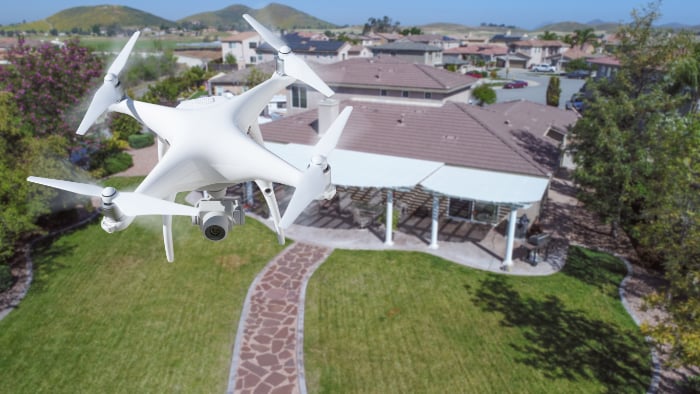
© Andy Dean Photography
Different Flight Modes
You might just want to fly the drone around. But you might want it to do flips, fly around you, or follow a set route. A follow-me mode can be great for social media shots. A GPS drone will offer a range of features, such as waypoint flying and return-to-home. Waypoint flying allows you to mark points on your phone for the drone to follow. In some cases, these points will be on the FPV picture from the drone.
On drones equipped with GPS, this might be on a downloaded map. In theory, you can tell your drone to fly down your street and then turn right. But be sure to check privacy laws in your location.
Return-to-home is useful. If you lose sight of your drone, getting it back to you can be a problem. Return-to-home allows a one-button summons to bring your expensive toy back to you. Many drones will come back automatically if their power is running low. Or if they lose contact with the pilot, they will return to the starting GPS location.
Camera Features to Look For
Camera quality
4K video is common on drones now. But you’ll want to pay attention to where the video is recorded to. Some record to a removable memory card, but some record to your phone.
Some manufacturers claim 4K, but it only applies to still shots. But in this review, all of the drones I’ve listed as having 4K have genuine 4K video.
Stabilization
Some drones have one or multi-axis stabilization. Other drones use a gimbal to stabilize the video.
A stable flight makes the difference between great video and unusable junk. Some of the more expensive drones allow you to change the camera angle while flying. This is a great feature. But it can also lead to annoying video results, so use it wisely.
© Action Sports Photography, Inc. (Depositphotos.com)
Conclusion: The Best Drone Camera
The DJI Mini 5 Pro is our top pick for most photographers. A 1-inch, 50 MP sensor in a 249.9 g body gets you the pictures without registration for recreational flights in the US. If you want a second focal length, buy the DJI Air 3S instead. And if you only want to find out whether flying is for you, the Holy Stone HS175D does that job for a fraction of either price.
For recreational flights, take the free TRUST test. Register the drone if it weighs 250 g or more or you fly under Part 107, and check your local airspace with an FAA-approved airspace app. Then go and fly.