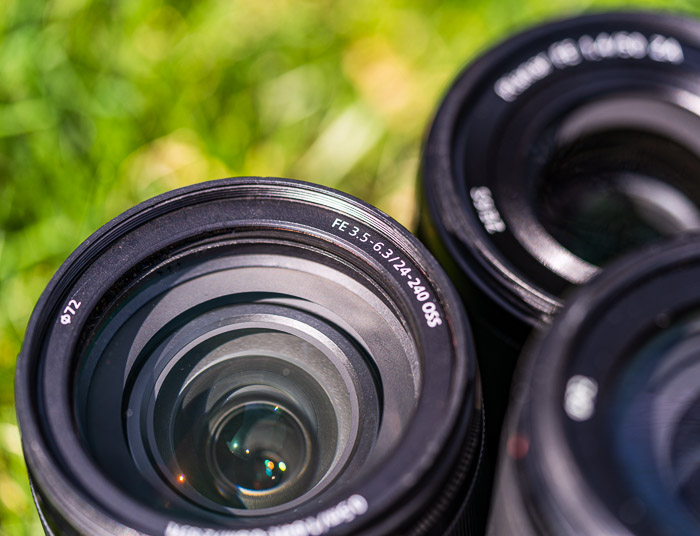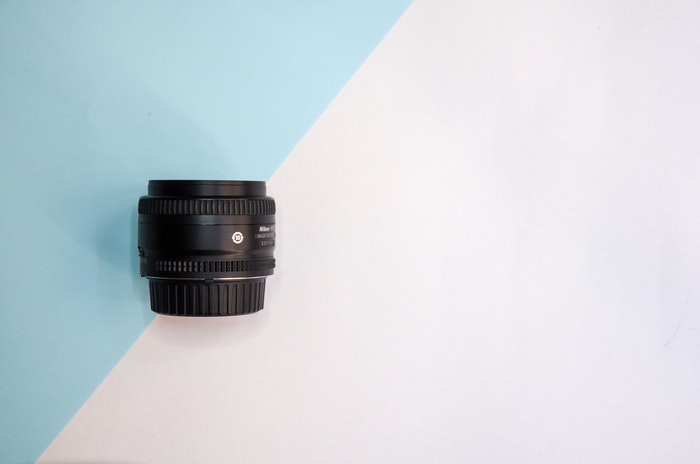
Fisheye lenses are known to have issues with edge-to-edge sharpness. It’s difficult to make a lens element that deals with barrel distortion in an even manner. So today, we look at fisheye lenses that balance optical quality and price in the best way possible.
Out of all the fisheye lenses on the market, the Canon 8-15mm f/4L comes out on top. This may surprise you as it is an old lens. But its optical quality, solid build, and zoom function make this the perfect fisheye lens. If you shoot Nikon Z mirrorless, the Laowa 8-15mm f/2.8 further down this list gives you the same 8mm-to-15mm zoom flexibility.
What Is the Best Fisheye Lens?
Here’s a quick roundup table of the best fisheye lenses. We have included a range of options from high-end to budget options. We have fisheye lenses from many brands and for many cameras and formats, so one of these will be the best fisheye for you.
Not sure where to start? Canon DSLR shooters should go straight to the Canon EF 8-15mm zoom at the top. Nikon DSLR shooters on a crop-sensor body get similar flexibility from the Tokina 10-17mm just below it, or the Nikon DX 10.5mm prime for a lighter, cheaper option. Nikon Z and other full-frame mirrorless shooters get the same 8mm-to-15mm zoom range from the Laowa further down. Need a wide aperture for astrophotography? The Sigma 15mm f/1.4 is built for that. And if you shoot Sony E or Micro Four Thirds, the Samyang, 7artisans, and Panasonic primes further down the list are built specifically for those systems.
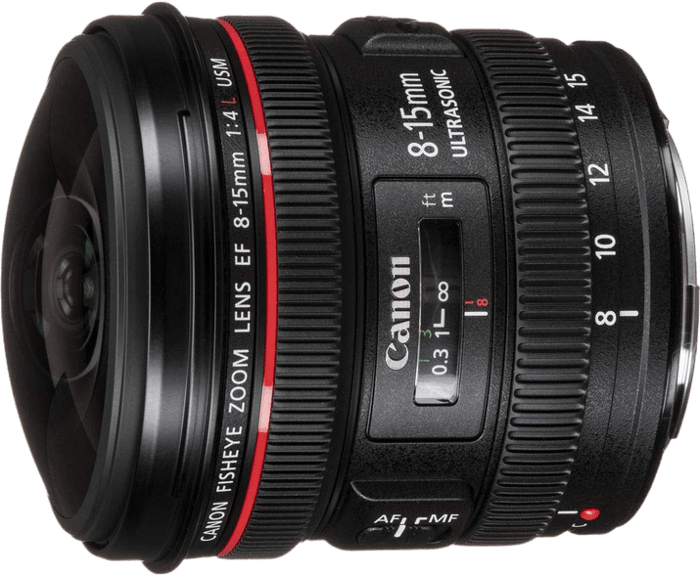
1. Canon EF 8-15mm f/4L USM
| Brand |
Brand
Canon
|
| Maximum Aperture |
Maximum Aperture
f/4
|
| Focal Range |
Focal Range
8-15mm
|
| Image Stabilization |
Image Stabilization
No
|
| Lens Mount |
Lens Mount
Canon EF
|
| Fisheye Type |
Fisheye Type
Circular and Full Frame
|
| Field of View |
Field of View
180 degrees
|
| Minimum Focus Distance |
Minimum Focus Distance
15 cm
|
The Canon EF 8-15mm f/4L is the best fisheye lens available today, even though Canon made it some years ago. Nikon’s own 8-15mm fisheye, the Nikon AF-S FX 8-15mm f/3.5-4.5, has the same focal range. And it came out a few years later. But the Canon fisheye lens still takes the upper edge. This is thanks to its amazing optical sharpness, great build, and durability.
One of this lens’s main features? You can use its zoom to switch between a circular or full-frame fisheye view. You will also notice it is part of Canon’s L-series, which is their flagship professional range.
The Canon 8-15mm fisheye lens offers a very wide view. The lens has an easy-clean fluorine coating and a quiet and fast autofocus motor. Overall, it is the sharpest and most secure fisheye lens you will find on the market for full-frame cameras.
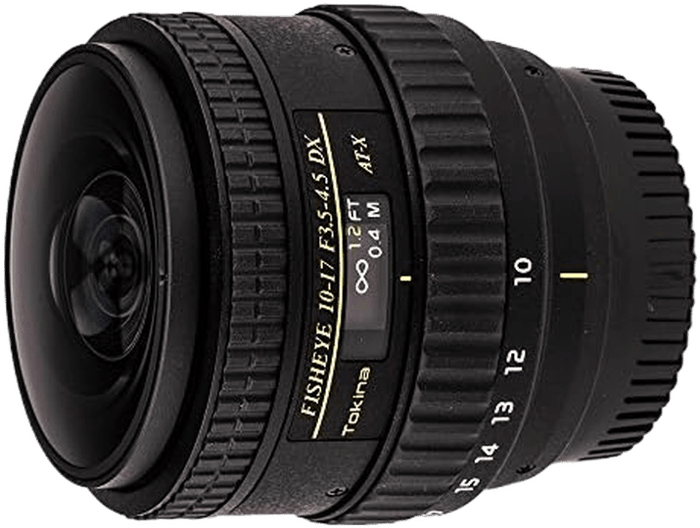
2. Tokina 10-17mm f/3.5-4.5 DX
| Brand |
Brand
Tokina
|
| Maximum Aperture |
Maximum Aperture
f/3.5-4.5
|
| Focal Range |
Focal Range
10-17mm
|
| Image Stabilization |
Image Stabilization
No
|
| Lens Mount |
Lens Mount
Nikon F
|
| Fisheye Type |
Fisheye Type
Full Frame
|
| Field of View |
Field of View
180 degrees
|
| Minimum Focus Distance |
Minimum Focus Distance
13.9 cm
|
Tokina’s 10-17mm f/3.5-4.5 DX is small and light, and you can find a mount for the major camera brands out there. Be aware that it is for crop sensor cameras. The price is why this lens is placed so far up our list. It isn’t too expensive. And it allows you to experiment with the fisheye effect without shedding a lot of money.
The zoom function gives you a full-frame fisheye throughout the various focal ranges. Having a zoom helps you crop your composition to the perfect frame. You can even get close to your subjects as the lens allows you to focus up close.
It is not as durable as the Canon pick above, and you must ensure it doesn’t get knocked about too much. The lens also does not have autofocus for Nikon camera bodies that do not have a focus motor. If you’re looking for the best fisheye lenses for cheap, this is a great option.
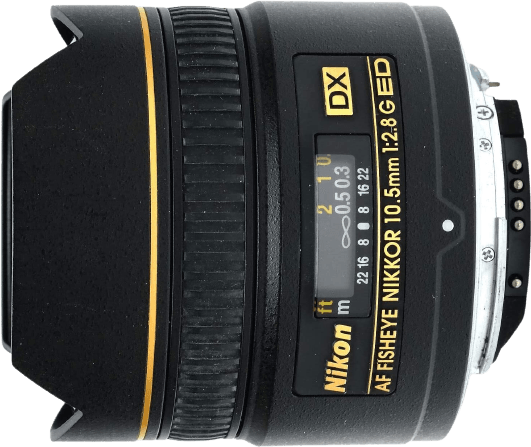
3. Nikon DX 10.5mm f/2.8G ED
| Brand |
Brand
Nikon
|
| Maximum Aperture |
Maximum Aperture
f/2.8
|
| Focal Range |
Focal Range
10.5mm
|
| Image Stabilization |
Image Stabilization
No
|
| Lens Mount |
Lens Mount
Nikon F
|
| Fisheye Type |
Fisheye Type
Full Frame
|
| Field of View |
Field of View
180 degrees
|
| Minimum Focus Distance |
Minimum Focus Distance
14 cm
|
The Nikon DX 10.5mm f/2.8G is another small, light fisheye lens for crop sensor cameras. And it has amazing abilities. The prime lens seems to include the whole world in the shot when you look through the viewfinder, especially as it has the diagonal fisheye effect. Its 180-degree field of view and full-frame cropping make it a spectacular fisheye lens.
The lens allows for a minimum focus distance of 14 cm. This is as close as some specialist macro lenses allow you to get. You can use these extreme close-ups in many effective ways to make exciting photos. The wide f/2.8 aperture makes it ideal for shooting in low-light situations.
The Nikon 10.5mm fisheye lens was the first ever fisheye Nikon made for DX cameras. You can tell the developers spent a lot of consideration over this lens. There hasn’t been another Nikon lens like it to come out since it hit the markets. It’s a DX-only prime, though, so full-frame Nikon shooters should look at the Laowa zoom further down this list instead.
4. Samyang 8mm f/2.8
| Brand |
Brand
Samyang
|
| Maximum Aperture |
Maximum Aperture
f/2.8
|
| Focal Range |
Focal Range
8mm
|
| Image Stabilization |
Image Stabilization
No
|
| Lens Mount |
Lens Mount
Sony E
|
| Fisheye Type |
Fisheye Type
Full Frame
|
| Field of View |
Field of View
180 degrees
|
| Minimum Focus Distance |
Minimum Focus Distance
30 cm
|
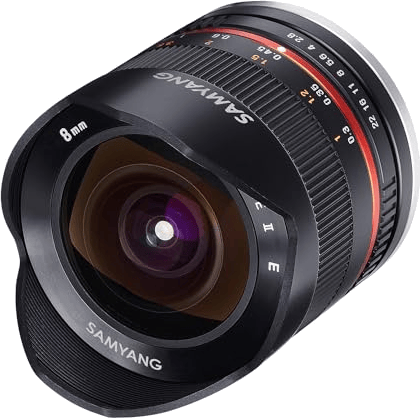
The Samyang 8mm f/2.8 is one of the widest prime lenses on the photographic market. It is extremely small and light. So it won’t tire your arms when stuck on your camera. Samyang is a third-party camera brand, so you have the option to buy a different lens mount for your crop sensor cameras.
The lens is light but includes 11 elements for the best optical performance. And there is a six-diaphragm blade aperture. This ensures smooth bokeh when shooting at wide apertures. Playing with depth of field becomes much more emphasized on a fisheye lens, so this is important.
You can also control the aperture directly from the lens ring. This can be helpful for quick shooting where you don’t want to look away from the viewfinder. The manual focus ring works smoothly and is wide enough to give you added control. This can be helpful when trying to get up close to your subjects. Note this listing is the Sony E-mount version, so check your own mount before buying.
5. Sigma 15mm f/1.4 DG DN Diagonal Fisheye Art
| Brand |
Brand
Sigma
|
| Aperture |
Aperture
F1.4 to F16
|
| Focal Range |
Focal Range
15
|
| Lens Weight |
Lens Weight
1360 g
|
| Fisheye Type |
Fisheye Type
Full Frame
|
| Field of View |
Field of View
180 degrees
|
| Minimum Focus Distance |
Minimum Focus Distance
38.5 cm
|
| Available Mounts |
Available Mounts
Sony E, Leica L (this listing is the Sony E-mount SKU, confirm your mount before ordering)
|
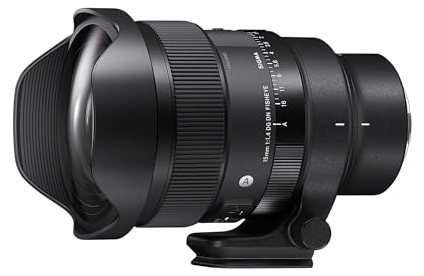
Sigma’s older EX-series 15mm f/2.8 fisheye is officially discontinued, so this list now carries its replacement, the Sigma 15mm f/1.4 DG DN Diagonal Fisheye Art. It is the world’s first full-frame f/1.4 diagonal fisheye, built for astrophotographers and anyone who wants a fisheye that can also work in near-dark conditions.
That f/1.4 aperture is the whole story here. Two stops faster than the old EX-series lens, it gathers enough light for star fields and night landscapes without pushing your ISO into noisy territory, and Sigma’s Art-series glass keeps the corners sharp across the full 180-degree field of view even wide open.
It autofocuses too (the first fisheye to do so on Sony E and Leica L mounts), and it is weather-sealed with a lens heater retainer and rear filter holder built in for long night exposures. It’s available for Sony E and Leica L mounts; the listing above is the Sony E version, so confirm your mount before you buy.
At around $1,999 and 1,360 g, this is a specialist’s lens, not a casual pickup: the old Sigma EX-series lens it replaces sold for around $250. If you only need an occasional fisheye effect, the Tokina or Nikon primes further up this list do the job for a fraction of the price.
6. Laowa 8-15mm f/2.8 FF Zoom Fisheye
| Brand |
Brand
Laowa
|
| Max Aperture Wide |
Max Aperture Wide
2.8
|
| Focal Range |
Focal Range
8-15
|
| Lens Weight |
Lens Weight
650 g
|
| Fisheye Type |
Fisheye Type
Circular at 8mm, Diagonal (Full Frame) at 15mm
|
| Field of View |
Field of View
180 degrees at 8mm, ~175 degrees at 15mm
|
| Minimum Focus Distance |
Minimum Focus Distance
16 cm
|
| Available Mounts |
Available Mounts
Sony E, Nikon Z, Canon RF, L-Mount, Fujifilm GFX, Hasselblad XCD (this listing is the Nikon Z-mount SKU, confirm your mount before ordering)
|
The Laowa 8-15mm f/2.8 FF Zoom Fisheye is the only fisheye zoom ever made for mirrorless cameras, and it is the fastest one too. It is built for photographers who want the flexibility of the Canon and Nikon zooms at the top of this list, on a modern mirrorless body, for roughly half the price.
One lens, two fisheye looks: zoom to 8mm for a full circular fisheye, or to 15mm for a frame-filling diagonal one, without swapping glass. That range makes it a genuinely useful all-rounder rather than a one-trick lens, especially for astro shooters who want the constant f/2.8 aperture at both ends.
It is fully manual (no autofocus, no electronics, no image stabilization), but the all-metal build feels solid, and the 16 cm minimum focus distance lets you get in close for exaggerated foreground distortion. Laowa makes it for Sony E, Nikon Z, Canon RF, L-Mount, Fujifilm GFX, and Hasselblad XCD, so check which mount you are buying before you order; the listing above is the Nikon Z-mount version.
At around $699 it is still a serious purchase, and edge sharpness at 15mm needs stopping down to f/5.6 or narrower to really clean up. If you only ever want one fisheye look rather than two, the primes further up and down this list are simpler and cheaper.
7. Sigma 8mm f/3.5 EX DG
| Brand |
Brand
Sigma
|
| Maximum Aperture |
Maximum Aperture
f/3.5
|
| Focal Range |
Focal Range
8mm
|
| Image Stabilization |
Image Stabilization
No
|
| Lens Mount |
Lens Mount
Nikon F
|
| Fisheye Type |
Fisheye Type
Circular
|
| Field of View |
Field of View
180 degrees
|
| Minimum Focus Distance |
Minimum Focus Distance
13.4 cm
|
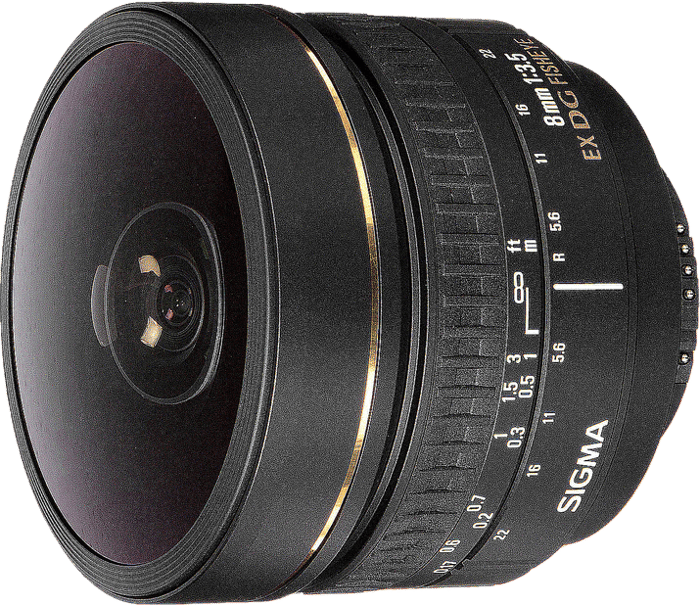
Sigma has added to its ultra-wide angle lenses with this Sigma 8mm f/3.5 EX DG circular fisheye lens. It is also one of the only full circular fisheye lenses on this list. Its f/3.5 aperture is fast for a wide-angle lens but doesn’t compare to the Samyang at position four in this list. Again, the lens features a multi-layer coating to reduce flares and ghosting.
Sigma claims this fisheye lens is great for scientific applications. That’s because the circular fisheye lens can photograph such a wide area. They claim it’s great to make solid angle measurements of cloud distribution over the sky. Or it’s ideal for capturing the vegetation distribution of a rainforest canopy.
It is a great option to pick if you like Sigma lenses. As the Samyang lens above is cheaper, I suggest going for that lens. But the Sigma 8mm still produces amazing fisheye photography images.
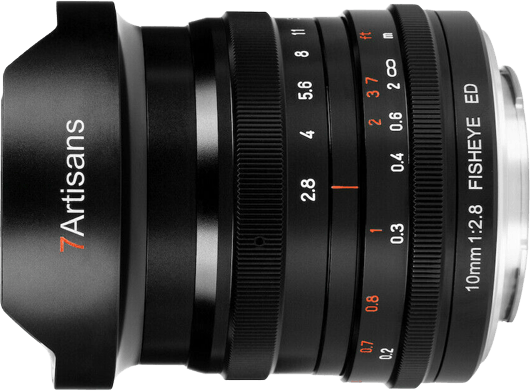
8. 7artisans 10mm f/2.8
| Brand |
Brand
7Artisans
|
| Maximum Aperture |
Maximum Aperture
f/2.8
|
| Focal Range |
Focal Range
10mm
|
| Image Stabilization |
Image Stabilization
No
|
| Lens Mount |
Lens Mount
Sony E
|
| Fisheye Type |
Fisheye Type
Full Frame
|
| Field of View |
Field of View
178 degrees
|
| Minimum Focus Distance |
Minimum Focus Distance
17 cm
|
7artisans lenses are known for being fairly basic. They have no autofocus abilities. But they always produce amazing optics. This is the same for the 7artisans 10mm f/2.8 fisheye lens. This fully manual lens is specifically designed as a third-party lens for mirrorless cameras.
Build quality is another factor people mention when talking about 7artisan lenses. The 10mm is built entirely out of solid metal parts. Surprisingly this doesn’t make the manual focus lens feel too heavy, but it may be one of the heaviest on this list.
The lens elements make for superb image quality for an ultra-wide angle lens. Honestly, the lack of autofocus features isn’t even a dealbreaker. Focusing with a wide-angle lens is easier and more forgiving than with a telephoto lens. You may even find it enjoyable and that it adds to the creativity offered by the best fisheye lenses. Skip it if you need autofocus or shoot handheld video, though: this is a fully manual stills lens for Sony E mirrorless cameras.
9. Panasonic 8mm f/3.5 G
| Brand |
Brand
Panasonic
|
| Maximum Aperture |
Maximum Aperture
f/3.5
|
| Focal Range |
Focal Range
8mm
|
| Image Stabilization |
Image Stabilization
No
|
| Lens Mount |
Lens Mount
Micro Four Thirds
|
| Fisheye Type |
Fisheye Type
Full Frame
|
| Field of View |
Field of View
180 degrees
|
| Minimum Focus Distance |
Minimum Focus Distance
10 cm
|
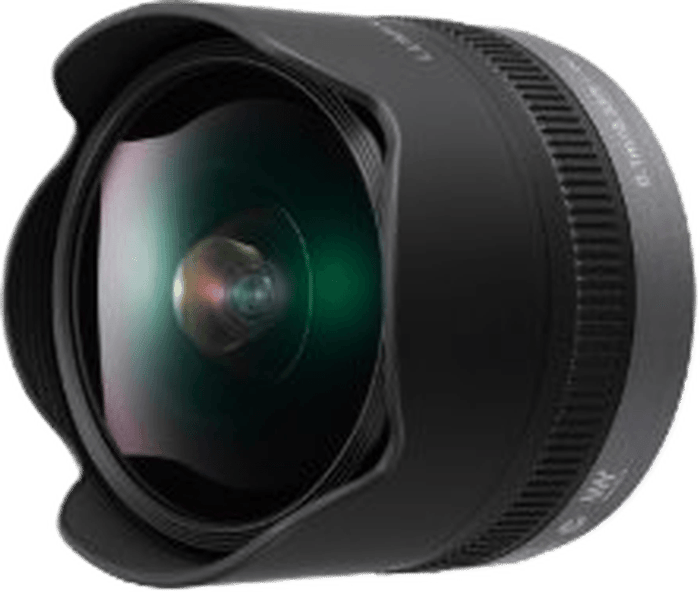
The Panasonic 8mm f/3.5 G is a fisheye lens for those with a Panasonic Micro Four Thirds camera. This lens allows photographers with this camera system to access a fisheye lens. The only downside is that this fisheye lens is quite expensive. But it does have an amazing optical performance.
The Panasonic lens is quite light and well-built. This means it will suit your Micro Four Thirds camera well without being too front-heavy. The lens doesn’t feature a distance scale or focus limiter. But this usually isn’t too much of an issue. One aspect that you may miss is image stabilization.
Overall, it is a great diagonal fisheye lens and fills a gap for any Panasonic Micro Four Thirds photographer. The price dampens things, but it is worth it if you want this particular effect.
What Is a Fisheye Lens?
Fisheye lenses produce a unique effect found in ultra-wide angle lenses. And you can use a fisheye in many genres, from landscapes to fashion and action or sports photography. A fisheye lens is great in the kitbag if you want to add more creativity to your shooting.
A fisheye lens is an ultra wide-angle optic that gives you the largest field of view available. A fisheye lens can give you a 180-degree field of view, but coverage varies with the lens and sensor format. The interesting aspect of a fisheye is that it isn’t a panoramic view you are trying to photograph. Instead, the straight lines converge and warp in a circular pattern.
This phenomenon is usually called “barrel distortion.” You will often read about how lenses do their best to minimize this effect. But a fisheye lens embraces this distortion and pushes it to the max.
This means you should avoid fisheye lenses for official documentation. And don’t use it for photos where you want real aspect ratios to match up. But this makes them perfect for the artists and creatives out there.
Circular or Full Frame Fisheye lenses?
You will notice that fisheye lenses come in two formats: circular and full frame. These formats tell us how our images will look when we shoot fisheye photography.
A circular fisheye lens will have a black border around a circular image in the middle of your frame. Full-frame fisheye lenses cover your entire frame like a normal lens. The full frame effect can be referred to as a diagonal fisheye effect.
These two fisheye formats are circular or full frames, depending on their construction. Any photographic lens provides a field of view for the camera sensor to see.
Although we think of pictures as rectangles, the light comes through a circular lens. So a circular covering power is projected into the camera. But the camera’s sensor is rectangular. So you always see a rectangle. If the lens covering power is smaller than the sensor size, you get a circular fisheye effect.
FAQs About Fisheye Lenses
Is a Fisheye Lens Worth Buying?
Yes, if you shoot genres where extreme distortion is part of the look. Skate and action photographers use fisheyes constantly, and they’re a fun add-on for landscapes, interiors, and astrophotography. They’re a poor choice for anything needing accurate proportions, like real estate or product photography.
Should I Get a Circular or a Full-Frame Fisheye?
A full-frame fisheye fills your entire frame with the distorted image, while a circular fisheye leaves a black border around a round image in the middle. If you want both without buying two lenses, the Canon EF 8-15mm and the Laowa 8-15mm on this list zoom between the two effects. The Sigma 8mm f/3.5 EX DG is circular only.
Can I Use a Fisheye Lens on a Crop-Sensor Camera?
Yes. Several lenses on this list are built specifically for crop sensors, including the Tokina 10-17mm and the Nikon DX 10.5mm f/2.8G. Just check the mount matches your camera brand; a DX Nikon lens will not fit a Canon or Sony body.
What Is the Cheapest Way to Try the Fisheye Effect?
The manual-focus primes further down this list (the Samyang, the 7artisans, and the Sigma 8mm f/3.5 EX DG) cost less than the zooms at the top, and they’re a low-risk way to see if you like shooting fisheye before spending more.
Conclusion: The Best Fisheye Lens
There are a few options available when looking at the best fisheye lenses. Consider your budget and camera format before buying. The Canon EF 8-15mm f/4L is the best all-rounder for full-frame DSLRs, and the Laowa 8-15mm f/2.8 does the same job for full-frame mirrorless. Both let you flip between a circular or full-frame fisheye in one lens.
You can apply the fisheye effect in many situations. But as a commercial photography lens, it also falls short. It can’t achieve an accurate depiction of a situation that commercial jobs often need. So before you buy, be conscious about what kind of photographs you will take. If you are a skate photographer, a fisheye is a must-have, so don’t delay picking one up.
Overall, the Canon EF 8-15mm f/4L fisheye “takes the bait.” It has amazing optical quality and features. Choose this lens if you are a Canon photographer with a big budget. Nikon Z shooters get that same flexibility from the Laowa 8-15mm f/2.8 further up this list.