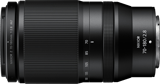
The Nikon NIKKOR Z 70-200mm f/2.8 VR S II is our top pick for most sports photography. Its constant f/2.8 aperture gives you fast shutter speeds in gyms and under floodlights. Nikon rates its autofocus at about 3.5 times faster than the first Z 70-200mm, and it takes both Z teleconverters when a game moves further away.
Sports need different lenses because the action sits at different distances. Courtside basketball suits a 70-200mm zoom. A soccer or football sideline needs 400mm or more. The list below also covers a lower-cost f/2.8 zoom, a long zoom for the stands, a pro prime, a light lens for DX cameras and one all-in-one zoom.
The Best Nikon Lenses for Sports Photography
Start with the light where you shoot. Indoor courts and night games need a bright aperture, which points to the f/2.8 lenses. Daylight field sports reward reach, and the 400mm and 600mm zooms give you far more of it. Every lens here is a NIKKOR Z lens for Nikon Z mirrorless cameras. If you still shoot with an F-mount DSLR or own F-mount lenses, see the FAQ at the end.
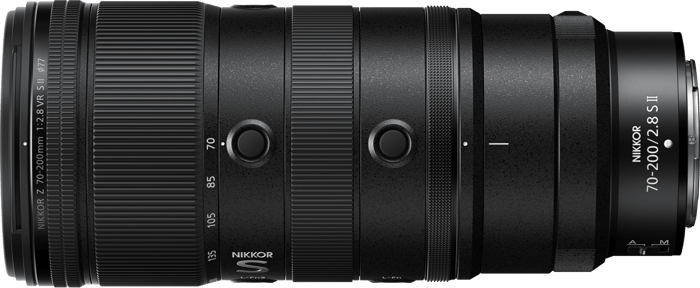
The NIKKOR Z 70-200mm f/2.8 VR S II is the lens to buy if you shoot more than one sport. The f/2.8 aperture stays the same at every focal length. That gives you about two stops more light than an f/5.6 zoom, which is the difference between a clean frame and a noisy one in a school gym.
Autofocus is the main reason it leads this list. Nikon rates the new focus motor at about 3.5 times faster than the original Z 70-200mm, with about 40% better tracking while you zoom. For sports, that means more frames in focus when a player runs at you and you pull back the zoom at the same time.
It is also much lighter than the first version. At 2.2 lb (998 g) without the tripod collar, it is 26% lighter than its predecessor, and you feel that over a full game held by hand. The lens zooms internally, so its length and balance stay the same as you follow play. Vibration reduction is rated at 5.5 stops, or 6 stops with Synchro VR on compatible bodies. The lens is weather sealed, and a fluorine coating helps keep rain off the front element.
With the Z TC-1.4x teleconverter it becomes a 98-280mm f/4 lens. With the TC-2.0x it becomes 140-400mm at f/5.6. One lens can cover an indoor game at night and a daylight game from the far sideline.
This is a full-price pro lens. If you want f/2.8 for less money and weight, the NIKKOR Z 70-180mm f/2.8 is the closest alternative. If you shoot mostly outdoors in daylight, the NIKKOR Z 100-400mm gives you twice the reach.
2. Nikon NIKKOR Z 100-400mm f/4.5-5.6 VR S
| Focal Length |
Focal Length
100-400mm
|
| Maximum Aperture |
Maximum Aperture
f/4.5-5.6
|
| Weight |
Weight
3.0 lb (1,355 g)
|
| Z Teleconverters |
Z Teleconverters
TC-1.4x and TC-2.0x
|
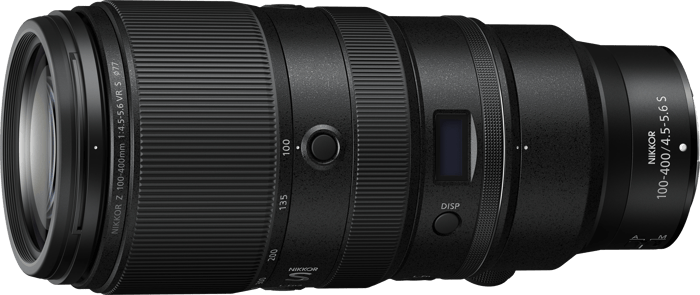
The NIKKOR Z 100-400mm f/4.5-5.6 VR S is the best Nikon lens for outdoor field sports. Soccer, football, baseball and lacrosse happen at distances where 200mm is too short. At 400mm you can fill the frame with one player across the field, and at 100mm you can still show a full goalmouth.
It is an S-line lens with fast autofocus, 5.5 stops of vibration reduction and weather sealing. At 3.0 lb (1,355 g) it weighs about the same as the first Z 70-200mm f/2.8, so most people can hold it through a whole game. A zoom lock stops the barrel from sliding out when the lens hangs from your shoulder.
It also works with both Z teleconverters. With the TC-1.4x it becomes a 140-560mm lens, which helps from the stands or at the far end of a big field.
The limit is light. At 400mm the aperture closes to f/5.6, two stops darker than the 70-200mm f/2.8. Under weak stadium lights you will need much higher ISO settings. The barrel also extends as you zoom, so the balance shifts more than with the internal-zoom 180-600mm.
Choose the NIKKOR Z 70-200mm f/2.8 VR S II instead if you shoot indoors. Choose the NIKKOR Z 180-600mm if you need 600mm and accept more weight.
3. Nikon NIKKOR Z 70-180mm f/2.8
| Focal Length |
Focal Length
70-180mm
|
| Maximum Aperture |
Maximum Aperture
f/2.8 (constant)
|
| Weight |
Weight
1.8 lb (795 g)
|
| Z Teleconverters |
Z Teleconverters
TC-1.4x and TC-2.0x
|
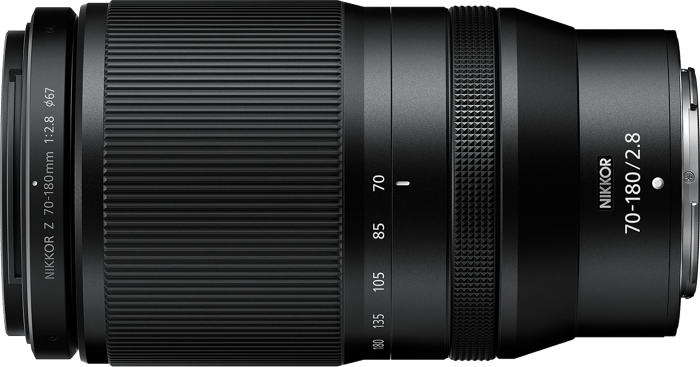
The NIKKOR Z 70-180mm f/2.8 is the best value f/2.8 zoom for indoor sports on a Nikon Z camera. It gives you the same bright aperture as the S-line 70-200mm for gyms, ice rinks and floodlit games, in a lens that weighs only 1.8 lb (795 g).
That low weight makes a real difference across a tournament day. It also uses 67mm filters, which are smaller and cheaper than the 77mm filters on the pro zooms. It is also weather sealed, has a fluorine-coated front element and works with both Z teleconverters.
It gives up some reach and some features. At 180mm it is shorter than a 70-200mm, which matters when the action is at the far end of the court. The lens has no optical vibration reduction, so it relies on the in-body stabilization of full-frame Z cameras. On a Z50 II or Z30, which have no in-body stabilization, you get no stabilization at all. The barrel also extends as you zoom.
If you can stretch your budget, the NIKKOR Z 70-200mm f/2.8 VR S II gives you faster tracking, built-in VR and internal zooming. If you shoot mainly outdoors, the NIKKOR Z 100-400mm is the better buy.
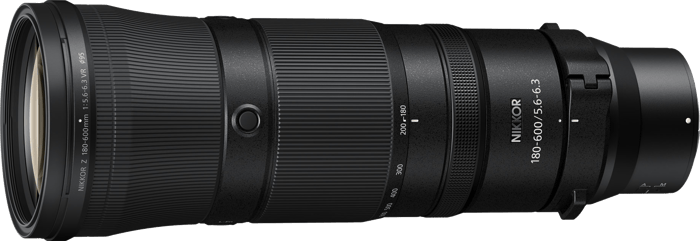
4. Nikon NIKKOR Z 180-600mm f/5.6-6.3 VR
| Focal Length |
Focal Length
180-600mm
|
| Maximum Aperture |
Maximum Aperture
f/5.6-6.3
|
| Weight |
Weight
4.3 lb (1,955 g)
|
| Z Teleconverters |
Z Teleconverters
TC-1.4x and TC-2.0x
|
The NIKKOR Z 180-600mm f/5.6-6.3 VR gives you the most reach for the money in Nikon's Z range. It is the best choice for shooting from the stands, for motorsport from behind the fence and for the far end of a large field. At 600mm one athlete fills the frame from distances where a 400mm zoom shows a group.
The lens zooms internally, so it stays the same length from 180mm to 600mm and its balance does not change as you zoom. Vibration reduction is rated at 5.5 stops, and the lens is weather sealed. It also works with both Z teleconverters. With the TC-1.4x it reaches 840mm, but only bright light makes that useful for action.
Weight is the main cost. At 4.3 lb (1,955 g) it is heavy for a full game held by hand, so a monopod helps. The f/6.3 aperture at the long end needs good light. The 180mm starting point is too long for action that comes close to you.
If you shoot from the sideline rather than the stands, the NIKKOR Z 100-400mm is easier to use. It is lighter, a little brighter at the long end and starts at 100mm.
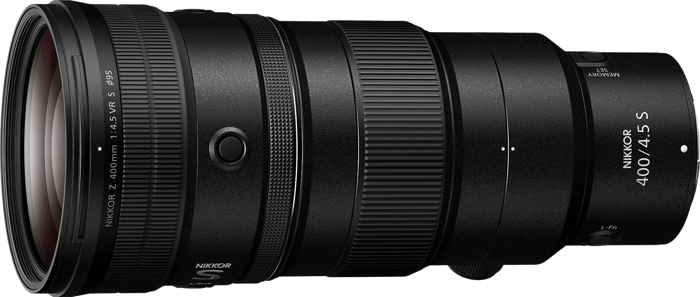
5. Nikon NIKKOR Z 400mm f/4.5 VR S
| Focal Length |
Focal Length
400mm
|
| Maximum Aperture |
Maximum Aperture
f/4.5
|
| Weight |
Weight
2.6 lb (1,160 g)
|
| Z Teleconverters |
Z Teleconverters
TC-1.4x and TC-2.0x
|
The NIKKOR Z 400mm f/4.5 VR S is the lightest way to get 400mm of high-quality reach on a Nikon Z camera. At 2.6 lb (1,160 g) it is lighter than the 100-400mm zoom, which makes a difference when you hand-hold a long lens for a whole game.
A prime suits photographers who shoot from a fixed position, such as the touchline of a soccer field or the end of a track straight. At f/4.5 it is two-thirds of a stop brighter than the 100-400mm at 400mm, which helps late in the day. Vibration reduction is rated at 5.5 stops, and the lens is weather sealed with a fluorine-coated front element.
It also works with both Z teleconverters. With the TC-1.4x it becomes a 560mm f/6.3 lens, which is still light for that focal length.
The limit is the fixed focal length. You cannot zoom out when play comes toward you, so you need to move or accept tighter frames. For most people who shoot several sports, the NIKKOR Z 100-400mm is more flexible. Choose the 400mm f/4.5 if you know your position and want less weight.
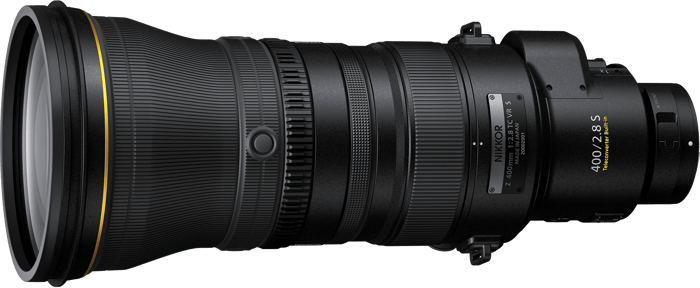
6. Nikon NIKKOR Z 400mm f/2.8 TC VR S
| Focal Length |
Focal Length
400mm (560mm with built-in 1.4x)
|
| Maximum Aperture |
Maximum Aperture
f/2.8 (f/4 at 560mm)
|
| Weight |
Weight
6.5 lb (2,950 g)
|
| Z Teleconverters |
Z Teleconverters
Built-in 1.4x, plus TC-1.4x and TC-2.0x
|
The NIKKOR Z 400mm f/2.8 TC VR S is the lens professional sports photographers use from the sideline of stadium games. It combines a bright f/2.8 aperture at 400mm with a built-in 1.4x teleconverter. A switch on the lens moves the teleconverter into place, and the lens becomes 560mm at f/4 without coming off the camera.
That switch is the reason to choose it. In a night football game you can shoot at 400mm f/2.8 for play near you, then flip to 560mm when the action moves downfield. The lens is weather sealed, has 5.5 stops of vibration reduction and also works with the separate Z teleconverters.
It is built and priced for working photographers. At 6.5 lb (2,950 g) you need a monopod for a full game, and it is a large lens to carry and travel with. It does not suit occasional weekend shooting.
For most readers, the NIKKOR Z 70-200mm f/2.8 VR S II for indoor games and the NIKKOR Z 100-400mm for outdoor games are a more practical pair.
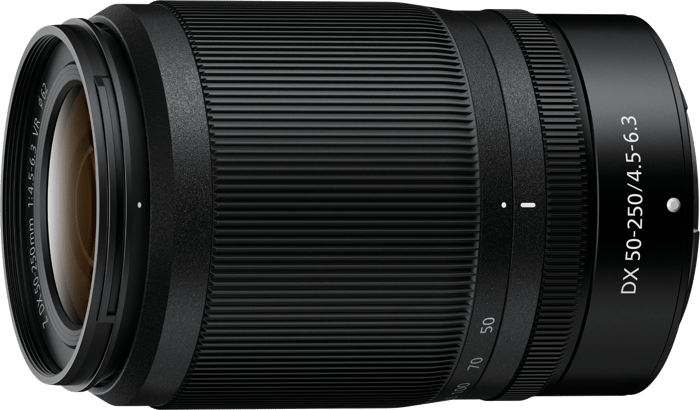
7. Nikon NIKKOR Z DX 50-250mm f/4.5-6.3 VR
| Focal Length |
Focal Length
50-250mm (75-375mm equivalent)
|
| Maximum Aperture |
Maximum Aperture
f/4.5-6.3
|
| Weight |
Weight
14.3 oz (405 g)
|
| Z Teleconverters |
Z Teleconverters
Not supported
|
The NIKKOR Z DX 50-250mm f/4.5-6.3 VR is the best low-cost sports lens for Nikon DX cameras such as the Z50 II, Z fc and Z30. On these bodies its 50-250mm range gives the same view as 75-375mm on a full-frame camera. That is enough reach for youth soccer, baseball and track from the sideline, and it is the lens we recommend for parents with a DX body.
At 14.3 oz (405 g) it is the lightest lens here by far. It suits a parent who wants more reach than the kit lens without carrying a large bag. Its 5 stops of vibration reduction matter more than usual on DX cameras, because the Z50 II, Z fc and Z30 have no in-body stabilization.
The f/4.5-6.3 aperture limits it to daylight, and indoor games will push your ISO high. It has no weather sealing, and it does not work with Z teleconverters. It is a DX lens, so on a full-frame Z body the camera switches to its DX crop mode.
If you own a full-frame Z body, or plan to move to one, the NIKKOR Z 100-400mm is the better long-term choice. On a DX body it gives an even longer 150-600mm equivalent view.
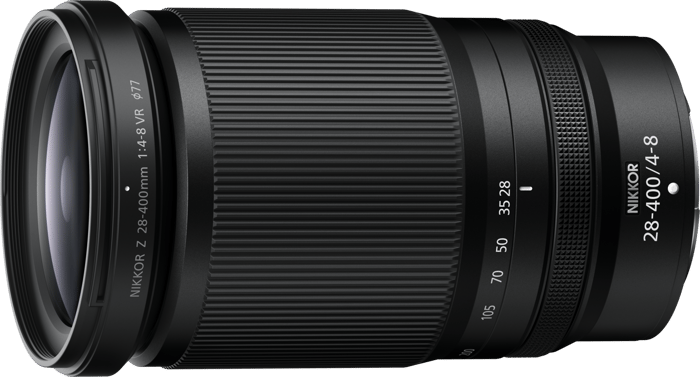
The NIKKOR Z 28-400mm f/4-8 VR is for photographers who want one lens for the whole event. It goes from a wide 28mm view of the team and the venue to 400mm for action across the field. You never need to change lenses on a muddy sideline.
That range makes it a good fit for school events, team days and travel to games. It weighs 1.6 lb (725 g), so it is easy to carry all day, and vibration reduction is rated at 5 stops. It also focuses as close as 7.9 in (20 cm) at the wide end.
It is the weakest choice here for fast action. The aperture closes to f/8 from about 190mm, so the long end needs bright daylight. It uses a stepping motor rather than the faster motors of the S-line telephotos, and it does not work with Z teleconverters.
If action is the main job, the NIKKOR Z 100-400mm is brighter and faster to focus at 400mm. Choose the 28-400mm only when the wide end matters as much as the telephoto end.
How to Choose a Nikon Lens for Sports Photography
Aperture Sets Your Shutter Speed Indoors
Sports usually need a shutter speed of 1/1000 s or faster to freeze a player. Each full stop of aperture halves or doubles the ISO you need for that speed. Going from f/2.8 to f/4 is one stop. Going from f/2.8 to f/5.6 is two stops, so ISO 1600 at f/2.8 becomes ISO 6400 at f/5.6.
That is why the f/2.8 lenses lead this list for gyms, ice rinks and floodlit games. Vibration reduction does not change this. It steadies the lens, but it cannot freeze a moving player. Our sports photography settings guide covers shutter speed and autofocus in more detail.
Match the Focal Length to Your Position
Choose the focal length by how far you are from the action, not by the sport's name. Courtside or at the edge of a small field, 70-200mm is enough. On the sideline of a soccer or football field, 400mm lets you frame play on the far side. From the stands or behind a motorsport fence, 600mm becomes useful.
A Nikon DX body multiplies the view of any lens by 1.5. A 70-200mm lens then gives the view of a 105-300mm lens on full frame. Our guide to full frame vs crop sensors explains the difference.
Teleconverters Add Reach but Cost Light
Nikon's Z TC-1.4x multiplies the focal length by 1.4 and costs one stop of light. The Z TC-2.0x doubles the focal length and costs two stops. On an f/2.8 lens that is a good trade, because you still have f/4 or f/5.6. On a lens that is already at f/6.3, the result is too dark for most action. Our teleconverter guide explains how they work.
Z teleconverters fit only certain lenses. On this list they work with the 70-200mm f/2.8 VR S II, 100-400mm, 70-180mm, 180-600mm, 400mm f/4.5 and 400mm f/2.8 TC. They do not fit the DX 50-250mm or the 28-400mm.
Can I Use Nikon F-Mount Lenses on a Nikon Z Camera?
Yes. Nikon F-mount lenses fit Z cameras through Nikon's FTZ II mount adapter. AF-S and AF-P lenses keep autofocus. Older AF and AF-D lenses that rely on a focus motor in the camera body focus manually only. If you already own a good F-mount telephoto, such as the AF-S 70-200mm f/2.8E FL ED VR or a Sigma 70-200mm f/2.8 Sports, the adapter is the cheapest way to start with a Z body. If you are buying new, choose a Z lens. Nikon's new sports lenses and Z teleconverters are made for the Z mount.
Conclusion
The NIKKOR Z 70-200mm f/2.8 VR S II is the best Nikon lens for sports photography, and it is the one we recommend for most readers. It handles indoor games at f/2.8, its autofocus keeps up with fast play, and with a Z teleconverter it reaches 400mm for outdoor games. If you shoot mostly field sports in daylight, the NIKKOR Z 100-400mm gives you the most useful reach. For f/2.8 at a lower cost and weight, choose the NIKKOR Z 70-180mm.
For more ideas on technique, see our complete sports photography guide, and look at the work of these sports photographers.