Finding the best lens for real estate photography has to be the top priority for any property photographer. Real estate photography poses a unique set of challenges. And finding the best lens goes a long way in overcoming those challenges.
Our top pick is the Canon EF-S 10-18mm STM lens. It’s a fantastic wide-angle zoom lens for Canon cameras. It delivers incredible results for interior and exterior shots for real estate photography.
What Is the Best Lens for Real Estate Photography?
The Canon EF-S 10-18mm STM is the best all-around lens for real estate photography on a crop-sensor camera. Full-frame shooters should pick the Nikon NIKKOR Z 14-30mm f/4 S for its 14mm wide end and constant f/4 aperture.
Find the Perfect Lens For Real Estate Photography
This post has our recommendations for the best lens for real estate photography. We’ve included crop sensor and full frame lens options. And we have lenses for Canon, Nikon, Sony, and Fujifilm users. We’ve also included some tilt-shift lenses for professionals.
Pick the right section below to find the lens you need:
Best Real Estate Lens for Crop Sensor Cameras
This section looks at the best real estate lenses for crop sensor cameras. These are also known as APS-C cameras. The sensors are smaller than those found in full frame cameras.
It’s important to use a lens designed for an APS-C camera. Some lenses are compatible with full frame and crop sensor cameras. But you get a 1.6x crop factor when you use a full frame lens on an APS-C camera. That means you can’t get the wide angle you need for real estate photography.
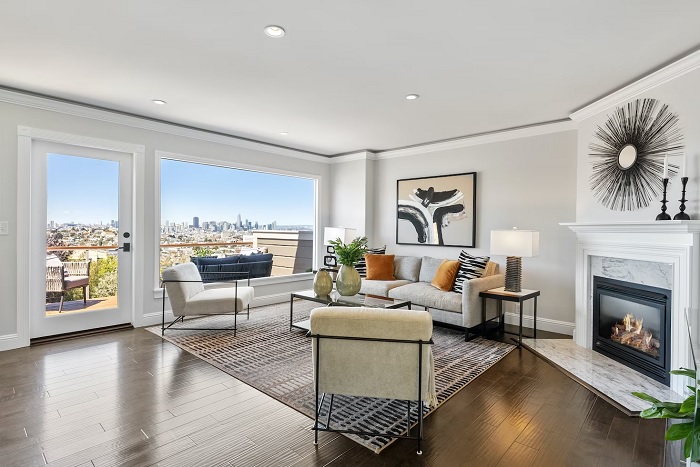
Wide-angle lenses are the best lens for real estate photography. They allow you to capture wide shots in confined spaces. You can shoot entire rooms even when space is tight. A wide-angle zoom also gives you shot variety. You can capture different rooms of the house without having to change your lens every time.

1. Canon EF-S 10-18mm f/4.5-5.6 IS STM
| Brand |
Brand
Canon
|
| Maximum Aperture |
Maximum Aperture
f/4.5-5.6
|
| Focal Range |
Focal Range
10-18mm
|
| Image Stabilization |
Image Stabilization
Yes
|
| Minimum Focus Distance |
Minimum Focus Distance
22 cm
|
| Top Selling Points |
Top Selling Points
The 10mm wide-angle is perfect for tight interiors. The built-in stabilization gives you sharp images and it's an affordable real estate lens.
|
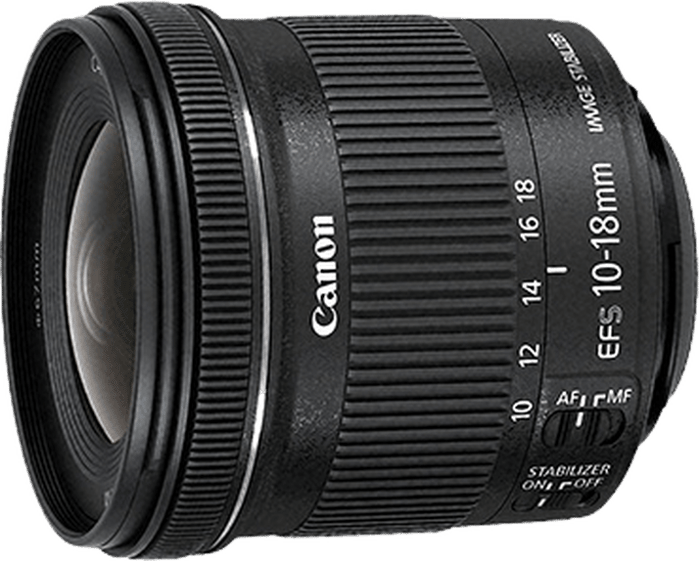
The Canon EF-S 10-18mm is the best lens for real estate photography if you have a crop-frame camera. It is compatible with all of Canon’s APS-C DSLR cameras.
This lens has built-in optical image stabilization. It keeps your images sharp in low-light conditions. And the autofocus motor is fast and reliable for this type of photography.
The wide-angle image quality is superb. And the 22mm minimum focus distance means you can also get in close for detailed shots.
With pleasing results and a modest price tag, the Canon EF-S 10-18mm STM is an affordable way to get started with real estate photography.
2. Tamron 11-20mm f/2.8 Di III-A RXD
| Brand |
Brand
Tamron
|
| Maximum Aperture |
Maximum Aperture
f/2.8
|
| Focal Range |
Focal Range
11-20mm
|
| Image Stabilization |
Image Stabilization
No
|
| Minimum Focus Distance |
Minimum Focus Distance
15 cm
|
| Top Selling Points |
Top Selling Points
A constant f/2.8 across the whole zoom range, 335 g, and an ordinary 67mm filter thread. Sold in Sony E, Fujifilm X and Canon RF mounts.
|
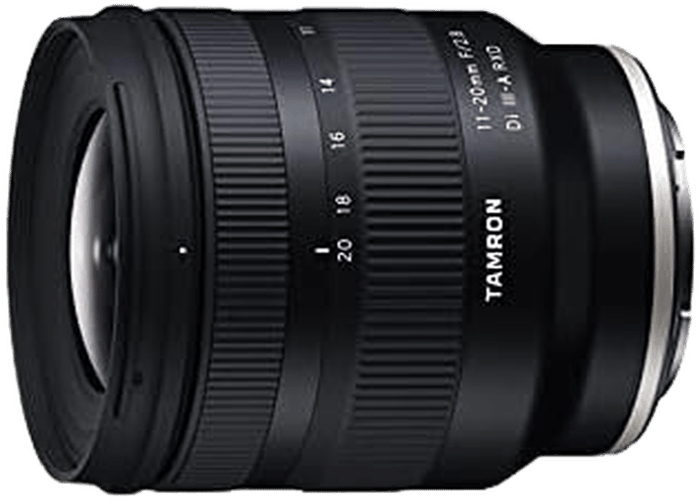
The Tamron 11-20mm f/2.8 Di III-A RXD is the crop-sensor lens to buy if your camera is mirrorless. It holds f/2.8 right through the zoom, which none of the own-brand crop wide-angles on this list manage.
That constant aperture is what earns it the slot. Interiors are lit by whatever comes through the windows, and roughly a stop and a half over an f/4.5-5.6 ultra-wide is the difference between a clean base exposure and a noisy one. The 11mm wide end works out at about 16.5mm in full frame terms on Sony and Fujifilm bodies, so a small bedroom fits in a single frame.
It is built for the work in other ways too. There is a moisture-resistant seal at the mount and a fluorine coating on the front element for exteriors, and the front takes ordinary 67mm filters, so a polarizer to kill window glare costs very little. At 335 g it stays comfortable on a light body all day, and focus goes down to 15 cm at the wide end for close details like taps and door furniture, where a tighter composition does the work. Twelve elements in ten groups, including low-dispersion glass, hold chromatic aberration off the high-contrast window edges that wreck interior shots.
It is not perfect. There is no stabilization in the lens at all, so on a body without in-camera stabilization you are on a tripod for dim rooms, which is where you want to be for property work anyway. And the barrel extends as you zoom, which is a nuisance if you shoot walkthrough video on a gimbal. Tamron makes it in Sony E, Fujifilm X and Canon RF fittings only, so check the listing matches your camera. If you shoot a Nikon DX body, the Nikon lens further down this section is your answer instead.
3. Fujifilm XF 10-24mm f/4 R OIS WR
| Brand |
Brand
Fujifilm
|
| Maximum Aperture |
Maximum Aperture
f/4
|
| Focal Range |
Focal Range
10-24mm
|
| Image Stabilization |
Image Stabilization
Yes
|
| Minimum Focus Distance |
Minimum Focus Distance
28 cm
|
| Top Selling Points |
Top Selling Points
Shoot broad shots in tight spaces with the lovely 10mm wide angle. The image stabilization and constant f/4 max aperture give you good low light performance.
|
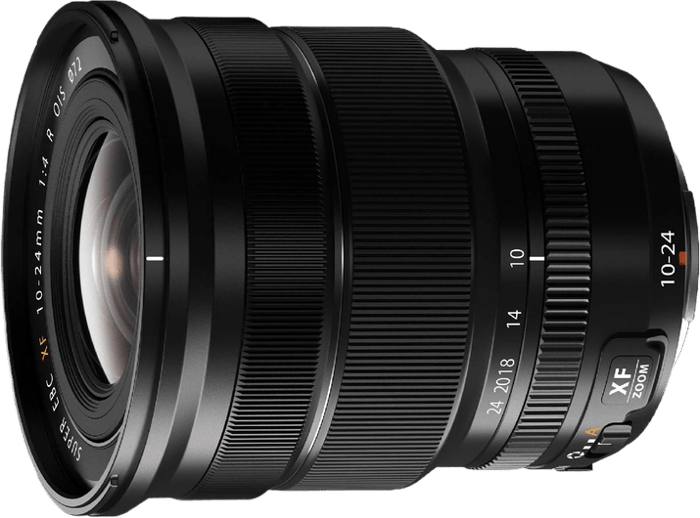
Real estate photographers with a Fujifilm camera need this Fujifilm XF 10-24mm f/4 R OIS WR lens. It has a beautiful construction with excellent optical quality. And it has the perfect focal length range for interior and exterior real estate photography.
The 10mm minimum focal length helps you capture interior shots. You can add space and air to small, poky rooms. And you can adjust it up to 24mm for larger spaces and exterior shots.
Its optical image stabilization is fantastic for real estate photographers. It keeps your image sharp, allowing you more flexibility with settings. This is helped by the constant f/4 max aperture. And it means you can travel from property to property without a tripod.
The WR in the name means weather resistance, which matters when the job list includes exteriors in bad weather. At 385 g it is light enough to hang off a mirrorless body all day, and it takes common 72mm filters. The catch is the price. It costs several times what the Canon and Nikon options in this section do, and what you are buying with that is the constant f/4 and the build, not extra width.
This lens is compatible with all Fujifilm X-mount cameras. These include the Fujifilm X-T30 II and the X-T4. Therefore, this lens is the best lens for real estate photography if you have a Fujifilm camera.
4. Sigma 10-18mm f/2.8 DC DN
| Brand |
Brand
Sigma
|
| Released |
Released
2024
|
| Minimum Focus Distance |
Minimum Focus Distance
11.6 cm
|
| Top Selling Points |
Top Selling Points
The smallest and lightest constant f/2.8 ultra-wide zoom made for APS-C, at 260 g and 62mm long. It starts at 10mm, the widest wide end of any crop lens here.
|
The Sigma 10-18mm f/2.8 DC DN is the widest crop-sensor lens on this list, and it holds a constant f/2.8 while doing it. Sigma builds it as the smallest and lightest ultra-wide zoom of its kind for APS-C, and at 260 g and 62mm long that claim survives contact with a camera bag.
Ten millimetres is the point where a cramped bathroom or a narrow hallway stops needing two frames stitched together. On an APS-C body it gives you roughly a 15mm full frame view, wider than anything else in this section, and the f/2.8 holds all the way to 18mm, so your exposure does not move as you reframe.
The optics are serious for the size. Thirteen elements in ten groups include three FLD and one SLD element to hold down colour fringing, and four aspherical surfaces keep the straight lines of a room straight. Autofocus runs on a stepping motor, so it is quick and near-silent, and focus breathing is suppressed if you shoot walkthrough video as well as stills. Minimum focus is 11.6 cm, close enough for a quarter-life-size frame of a tap or a worktop finish.
What you give up is stabilization. There is none in the lens, so camera shake is down to your body’s system or a tripod once the light drops. Weather protection is a rubber gasket at the mount and nothing further, so this is not the lens for shooting exteriors in the rain. Edges soften a little wide open, which stopping down to f/5.6 clears up, and f/5.6 to f/8 is where you would shoot an interior anyway. It is a mirrorless lens in the Canon RF fitting, so DSLR owners want the Canon and Nikon picks above and below it instead.
5. Nikon AF-P DX 10-20mm f/4.5-5.6G VR
| Brand |
Brand
Nikon
|
| Maximum Aperture |
Maximum Aperture
f/4.5-5.6
|
| Focal Range |
Focal Range
10-20mm
|
| Image Stabilization |
Image Stabilization
Yes
|
| Minimum Focus Distance |
Minimum Focus Distance
22 cm
|
| Top Selling Points |
Top Selling Points
It's an ultra-wide angle option for Nikon DX users. Vibration reduction rated at 3.5 stops covers the slower f/4.5-5.6 aperture in dim interiors.
|
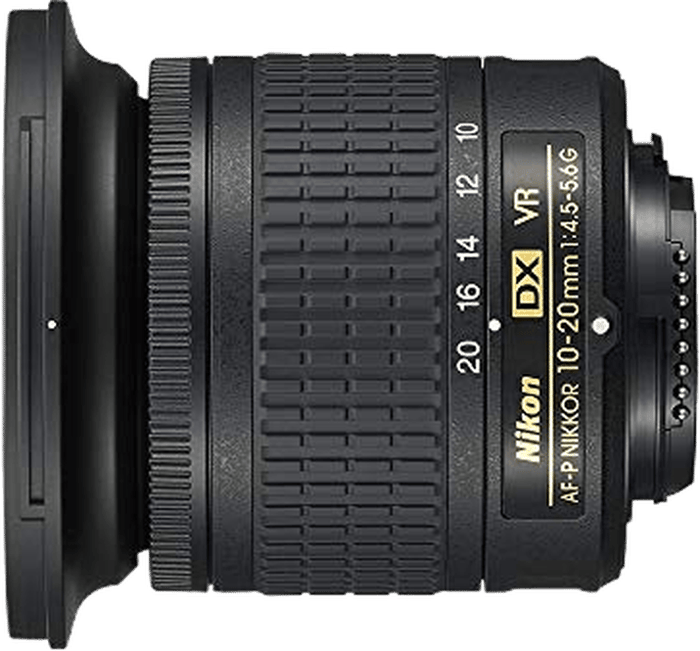
The Nikon AF-P DX 10-20mm f/4.5-5.6G VR is another ultra-wide-angle lens for Nikon APS-C cameras. It’s another fantastic option for real estate photography. And it’s a more affordable option than the previous Nikon lens.
The 10mm wide end is perfect for interior shots, especially if you’re working in tight spaces. It reaches 20mm at the long end, so it is a dedicated wide lens rather than a walkaround, and you will swap lenses for detail shots.
It has built-in vibration reduction, which earns its keep in dim hallways and basements where you cannot always get a tripod down. The stepping-motor autofocus is quick and near-silent, and at 230 g it is one of the lightest ultra-wides you can put on a Nikon crop body. It takes 72mm filters. The trade-off is the f/4.5-5.6 variable aperture, which is a stop slower than the pricier options here, so expect to lean on VR and a higher ISO indoors.
© Collov Home Design (Unsplash.com)

6. Canon RF-S 14-30mm f/4-6.3 IS STM PZ
| Brand |
Brand
Canon
|
| Released |
Released
2025
|
| Minimum Focus Distance |
Minimum Focus Distance
12 cm
|
| Top Selling Points |
Top Selling Points
A 2025 mirrorless ultra-wide at only 181 g. The 22-48mm full-frame equivalent range covers whole rooms, and 5 stops of stabilization keeps handheld interiors sharp.
|
The Canon RF-S 14-30mm f/4-6.3 IS STM PZ is the crop-sensor pick for anyone shooting on Canon's mirrorless bodies. The two third-party picks above it are mirrorless too, but this is the only one Canon makes itself for an R-series crop body.
It is tiny. At 181 g it is lighter than most kit lenses, and the barrel does not extend as you zoom. That matters more than it sounds on a shoot where you are moving between rooms all day with the camera on a tripod.
The 14-30mm range gives you a 22-48mm full-frame equivalent. That is wide enough for tight bathrooms and hallways at one end, and long enough for detail shots at the other, without swapping glass. Optical stabilization is rated to 5 stops, so handheld shots in dim interiors stay usable.
Two honest caveats. The maximum aperture is slow, running from f/4 at the wide end to f/6.3 at 30mm, so this is a lens for a tripod and a considered exposure rather than run-and-gun low light. And it is not weather sealed. Neither matters much for indoor property work, and it is by far the cheapest way onto native RF glass.
Best Real Estate Lenses for Full Frame Cameras
If you have a full frame camera, you’ll need a full frame lens. You can use adaptors if you want to use APS-C lenses with a full frame camera. But these can affect the quality of your images. And you need perfect quality for real estate photography.
Chromatic aberration and distortion can be a problem with wide-angle lenses. But good quality lenses keep these imperfections to a minimum. You can correct aberrations in Photoshop, but it’s a time-consuming process. Buying a good lens for real estate photography is the best solution.
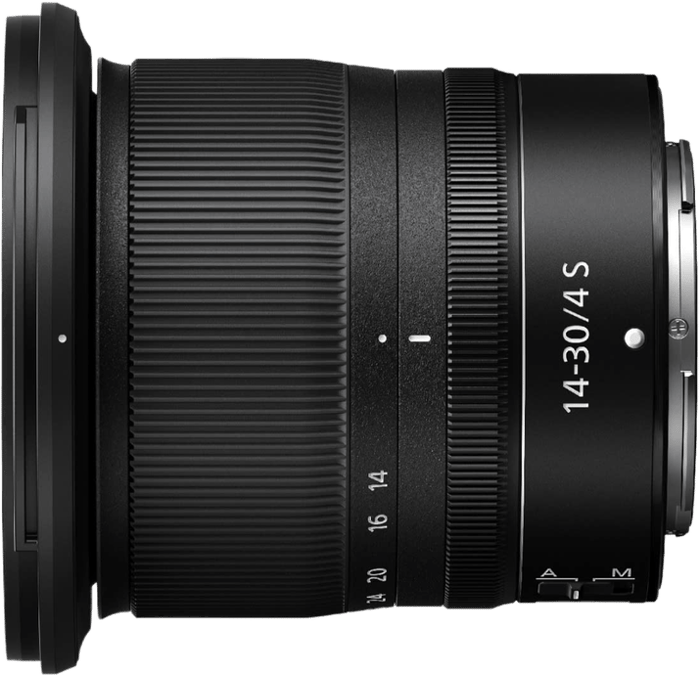
1. Nikon NIKKOR Z 14-30mm f/4 S
| Brand |
Brand
Nikon
|
| Maximum Aperture |
Maximum Aperture
f/4
|
| Focal Range |
Focal Range
14-30mm
|
| Image Stabilization |
Image Stabilization
No
|
| Minimum Focus Distance |
Minimum Focus Distance
28 cm
|
| Top Selling Points |
Top Selling Points
14mm at the wide end with a constant f/4 through the zoom. It takes ordinary 82mm screw-in filters, which is rare on a lens this wide, and it weighs 485 g.
|
The Nikon NIKKOR Z 14-30mm f/4 S is the best lens for real estate photography if you shoot a full frame Nikon. It reaches 14mm, and those extra couple of millimetres past the usual 16mm buy you a lot of room when you are backed into the corner of a bedroom.
The whole zoom holds f/4, so your exposure does not shift as you move from a wide establishing frame to a 30mm detail. Distortion is unusually low for a lens this wide, and that is the specification that matters most for property work, because a bowed door frame or a leaning wall is exactly what a listing photo must never show. At the wide end it covers 114 degrees.
Then there is the front element. It is flat enough to take ordinary 82mm screw-in filters, and almost no ultra-wide zoom lens will let you do that. For real estate that means a polarizer to cut reflections off windows and worktops, and an ND for a long exposure of an exterior, with no bulky square filter holder to carry. It weighs 485 g, well under half a kilo for a full frame S-line zoom, and a zoom lock stops the barrel creeping while it hangs off your shoulder. Minimum focus is 28 cm.
Two caveats. There is no stabilization inside the lens, so you lean on your body’s in-camera system or, better for interiors, a tripod. And the barrel extends as you zoom out to 14mm, so it is not a fixed-length optic on a gimbal. It is also a Z-mount lens. If you are still shooting a Nikon DSLR it will not fit your camera at all, and an F-mount ultra-wide is what you should be looking for instead.
2. Canon EF 16-35mm f/4L IS USM Lens
| Brand |
Brand
Canon
|
| Maximum Aperture |
Maximum Aperture
f/4
|
| Focal Range |
Focal Range
16-35mm
|
| Image Stabilization |
Image Stabilization
Yes
|
| Minimum Focus Distance |
Minimum Focus Distance
28 cm
|
| Top Selling Points |
Top Selling Points
You get three stops of shake compensation from the stabilizer. The 9-blade diaphragm gives you a lovely bokeh effect.
|
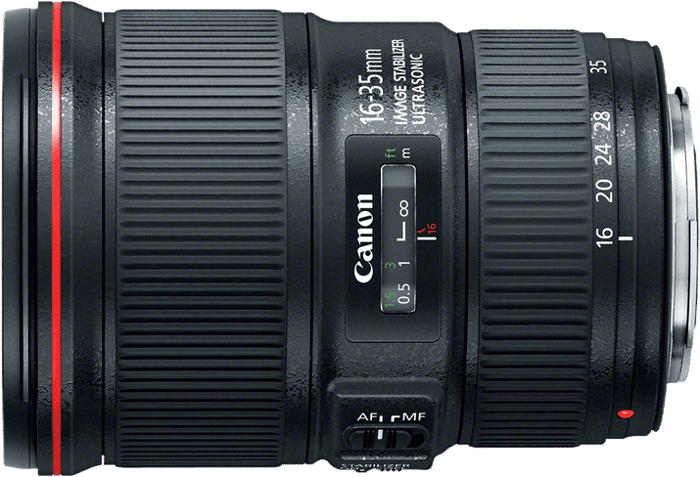
The Canon EF 16-35mm f/4L is the best real estate lens for full frame Canon cameras. It’s from the Canon L series. And that means it’s one of their superior lenses. It also means a higher price. But it’s a price worth paying if you’re serious about real estate photography.
The 16-35mm range is ideal for real estate photography. It’s wide enough to capture even a small space in full. And the 35mm zoom is perfect for larger spaces when you want a tighter composition.
The built-in optical image stabilizer is a fantastic feature for property shooters. It gives you 3 stops of shake compensation. You won’t need a tripod and you’ll have more freedom with settings.
This Canon lens uses a 9-blade diaphragm rather than the usual 7. That helps create a smooth soft focus when using a shallow depth of field.
The EF 16-35mm f/4L is a beautiful lens from Canon. It’s the best option for real estate photographers using full frame Canon cameras.
3. Sony FE 12-24mm f/4 G
| Brand |
Brand
Sony
|
| Maximum Aperture |
Maximum Aperture
f/4
|
| Focal Range |
Focal Range
12-24mm
|
| Image Stabilization |
Image Stabilization
No
|
| Minimum Focus Distance |
Minimum Focus Distance
28 cm
|
| Top Selling Points |
Top Selling Points
Wide minimum focal length for a full frame lens. Superb optical quality and one of the best AF motors for fast focusing.
|
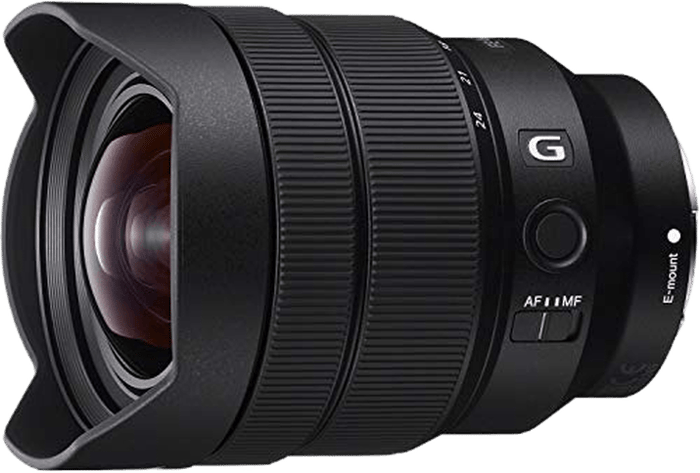
The Sony FE 12-24mm f/4 G is the best lens for real estate photography for Sony users. It’s the perfect partner for your full frame Sony camera. And it’ll be a huge step forward for your real estate photography career.
The 12-24mm focal length range is ideal for real estate. You’ll be able to capture interiors and exteriors without changing lenses. 12mm is the widest angle available in the Sony FE lens series. So it’s your best option for real estate photography.
The build quality is superb. And the 17 glass elements work together to give you an image free of imperfections. There’s no flare or ghosting at any focal length. You also get a constant f/4 aperture throughout the focal length.
There’s no image stabilization in the lens. But the direct drive supersonic motor drives a fast and silent autofocus system.
The Sony FE 12-24mm f/4 G is an example of precision engineering from Sony. With its widest focal length and supreme optical quality, it’s the best real estate lens for Sony photographers.
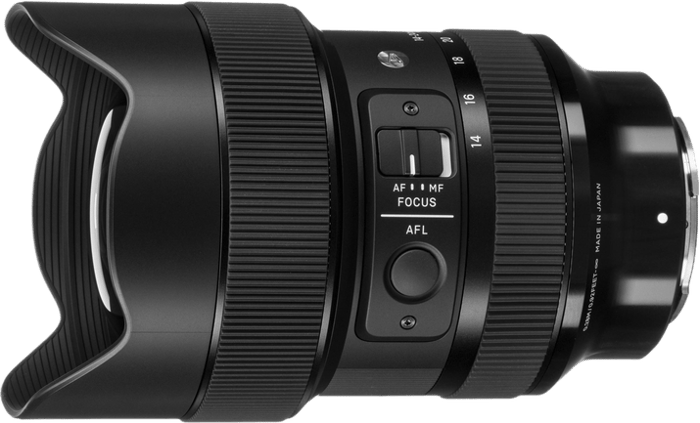
4. Sigma 14-24mm f/2.8 DG DN Art
| Brand |
Brand
Sigma
|
| Maximum Aperture |
Maximum Aperture
f/2.8
|
| Focal Range |
Focal Range
14-24mm
|
| Image Stabilization |
Image Stabilization
No
|
| Minimum Focus Distance |
Minimum Focus Distance
28 cm
|
| Top Selling Points |
Top Selling Points
A constant f/2.8 with an internal zoom that never changes length, plus dust and splash sealing. Made for Sony E and L-mount mirrorless bodies.
|
Third-party glass stopped being the compromise option years ago, and the Sigma 14-24mm f/2.8 DG DN Art is the proof. It is a mirrorless design for Sony E and L-mount bodies, and it is the only full frame lens in this section that opens to f/2.8.
For real estate the f/2.8 buys you two things. Dim hallways and windowless bathrooms come in at a sensible ISO, and if you bracket for an HDR blend you can keep the shutter short enough that curtains and pot plants do not smear between frames. The 14mm end covers 114 degrees, the same view as the Nikon at the top of this section.
It is built like a working lens. The zoom is internal, so the barrel never changes length wherever you set it, which keeps the balance identical on a tripod head and makes the lens easier to seal. Sigma dust- and splash-proofs it, coats the front element with fluorine, and builds the petal hood in rather than bayoneting it on, so there is nothing to lose on a job. Eighteen elements in thirteen groups and an eleven-blade diaphragm keep the rendering clean, and it focuses to 28 cm.
The price of all that is bulk and filters. It weighs 795 g and runs 131mm long, so it is a substantial thing to carry, though the Sigma below it is heavier still. More awkward for property work, the bulbous front element takes no screw-in filters at all. There is a slot at the rear for gel filters, but if a polarizer for window glare is central to how you shoot, note that the Sony FE 12-24mm f/4 G above shares the problem while the Nikon at the top of this section does not. And it is mirrorless-only, so Canon and Nikon DSLR owners should read on to the Sigma below.
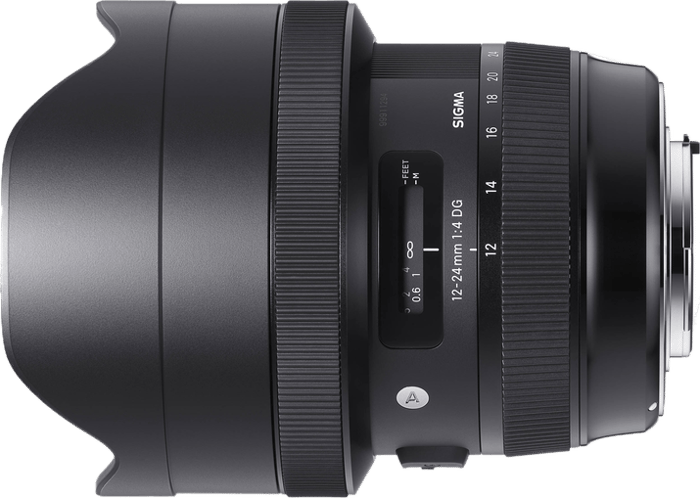
5. Sigma 12-24mm f/4 DG HSM Art Lens
| Brand |
Brand
Sigma
|
| Maximum Aperture |
Maximum Aperture
f/4
|
| Focal Range |
Focal Range
12-24mm
|
| Image Stabilization |
Image Stabilization
No
|
| Minimum Focus Distance |
Minimum Focus Distance
24 cm
|
| Top Selling Points |
Top Selling Points
Excellent zoom range for interiors and lovely optical quality. It's available for Nikon and Canon cameras.
|
The Sigma Art lens series has changed the way people see third-party lenses. They aren’t there to make up the numbers. Now they’re true contenders. And the Sigma 12-24mm f/4 Art lens is a contender for the best lens for real estate photography.
The lens performs beautifully throughout its focal length. The image quality is a delight. And you’ll experience practically zero distortion or aberration.
It has 16 glass elements arranged in 11 groups. That makes it a heavy lens. But it includes low-dispersion glass that reduces imperfections even more.
The Art lens uses Sigma’s Hypersonic Motor (HSM) for it’s autofocus system. It’s one of the best AF systems around. And it gives you smooth, quick, and quiet focus.
The Sigma 12-24mm f/4 Art lens is available for Nikon and Canon full frame DSLR cameras. It’s a beautiful piece of equipment. And exactly what you need if you’re serious about real estate photography.
© Infinite Views (Unsplash.com)

6. Canon RF 10-20mm f/4 L IS STM
| Brand |
Brand
Canon
|
| Released |
Released
2023
|
| Minimum Focus Distance |
Minimum Focus Distance
25 cm
|
| Top Selling Points |
Top Selling Points
The widest full-frame rectilinear autofocus zoom made. 10mm covers rooms nothing else can, with L-series weather sealing and up to 6 stops of stabilization.
|
The Canon RF 10-20mm f/4 L IS STM is the widest full-frame rectilinear zoom with autofocus that anyone makes. For real estate that is not a specification detail, it is the whole argument. At 10mm you can stand in the doorway of a small bathroom and get the entire room in one frame.
Rectilinear matters here. A fisheye at this angle would bow every wall and worktop. This lens keeps straight lines straight, which is exactly what a property listing needs.
It is also far more practical than the lens it replaces. At 570 g it is roughly half the weight of the old EF 11-24mm f/4L, and it takes 5 stops of optical stabilization, rising to 6 stops on an R-series body with IBIS. Sharpness holds up into the corners even at 10mm, which is where cheaper ultra-wides fall apart.
The trade-offs are real and worth stating. It carries no front filter thread, so a polarizer or ND needs the rear gelatine holder. The 10mm end leans on in-camera correction for distortion and vignetting, so leave auto-correction switched on. And it is the most expensive lens here by some distance. If you shoot property on a Canon R body for a living, it earns that. If you do not, the EF-S 10-18mm above does most of the job for a fraction of the price.
Best Tilt-Shift Lenses for Real Estate Photography
Tilt-shift lenses are specialty lenses. They’re made primarily for shooting building exteriors or anything with strong vertical lines.
With a tilt-shift lens, you can keep your camera perfectly level. And then you can adjust the upward and downward composition of your shot by raising or lowering the optics of the lens.
The real benefit is that the tilt-shift lens keeps all the vertical lines vertical. So it solves any aspect, perspective, or distortion problems in-camera. But is a tilt-shift the best lens for real estate photography?
Tilt-shift lenses are a bit on the pricey side. And they weren’t created specifically with real estate photography in mind. But more and more real estate photographers are turning to tilt-shift lenses. And more often than not, they aren’t turning back.
In the long term, a tilt-shift lens can save time and money because so little work is needed in post-production. The lens makes the corrections before the picture is even taken.
A tilt-shift lens is an investment for your real estate photography business. They’re overkill for amateurs. But they’re an incredible tool for professional real estate photographers.
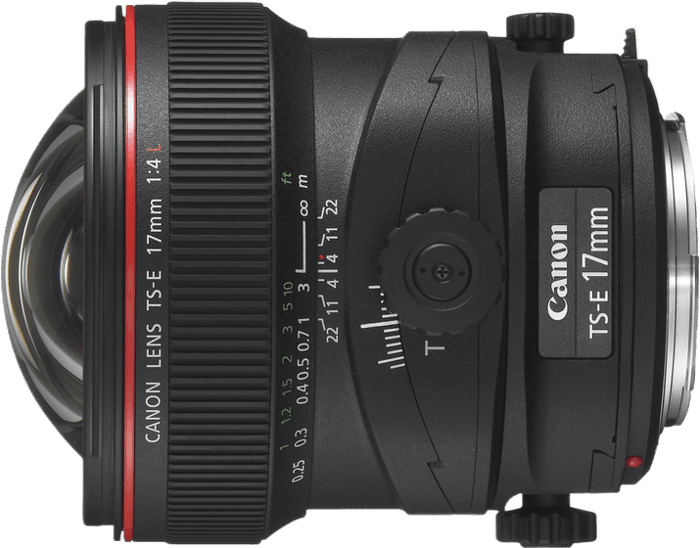
1. Canon TS-E 17mm f/4 L
| Brand |
Brand
Canon
|
| Maximum Aperture |
Maximum Aperture
f/4
|
| Focal Range |
Focal Range
17mm
|
| Image Stabilization |
Image Stabilization
No
|
| Minimum Focus Distance |
Minimum Focus Distance
25 cm
|
| Top Selling Points |
Top Selling Points
Full perspective control with the tilt and shift options. You get a wide 93-degree angle of view.
|
Canon’s 17mm f/4 L lens is the widest tilt-shift lens made for a full frame camera. The build quality is fantastic. And the tilt and shift operations work like magic. It’ll transform the way you shoot real estate photography.
This lens offers an angle of view of 93 degrees, which is ideal for interiors and cramped exteriors. And the specially coated glass minimizes chromatic aberration. The result is crystal clear, glare-free images.
The lens isn’t cheap. But it’s the perfect piece of equipment for architectural photography. The optical results are incredible. And once you start using one, you won’t know how you lived without it.
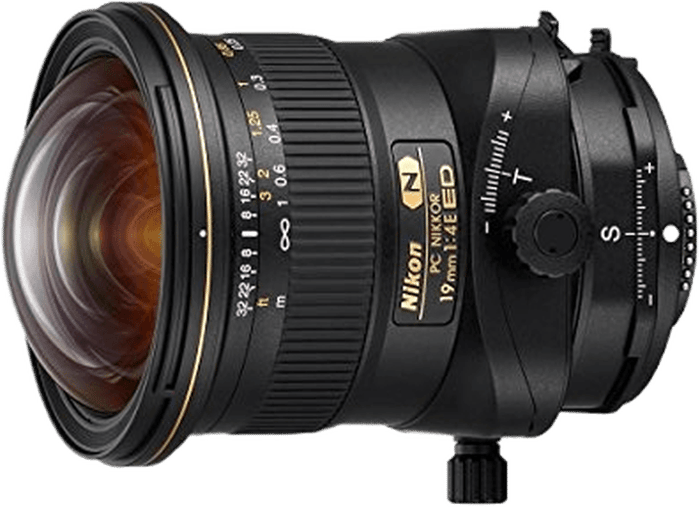
2. Nikon PC 19mm f/4 E ED
| Brand |
Brand
Nikon
|
| Maximum Aperture |
Maximum Aperture
f/4
|
| Focal Range |
Focal Range
19mm
|
| Image Stabilization |
Image Stabilization
No
|
| Minimum Focus Distance |
Minimum Focus Distance
25 cm
|
| Top Selling Points |
Top Selling Points
Full perspective control with the tilt and shift options. Incredible optical quality with no distortion or ghosting.
|
The Nikon PC 19mm f/4 is a masterpiece in precision lens building. It doesn’t come cheap. But for build and image quality, not much comes close.
It uses 17 glass elements. These include three ED and two aspherical glass elements. And each has a Nano Crystal or fluorine coating. You’ll find no signs of distortion or ghosting, even at the very edges of the image.
The 19mm focal length gives you the wide angle that real estate and architectural photographers need. And the tilt and shift capabilities redefine the possibilities. You have maximum perspective control.
The Nikon PC 19mm f/4 is for professional real estate and architectural photographers. The price will be a turnoff for amateurs. Nikon professionals have long treated it as an investment worth making.
Nikon has archived the PC 19mm f/4E ED on its own US store, so treat this as a discontinued lens. Third-party dealers still list new copies, but well above its original launch price, which is what scarcity looks like rather than ordinary retail. Nikon has not announced a native Z-mount perspective-control lens to take its place. If in-camera perspective control matters to you more than the mount does, the Canon TS-E 17mm f/4L above is the tilt-shift lens you can still buy new at a normal price.
© Ronnie George (Unsplash.com)

3. Laowa 12-24mm f/5.6 Zoom-Shift CF
| Brand |
Brand
Laowa
|
| Released |
Released
2024
|
| Minimum Focus Distance |
Minimum Focus Distance
15 cm
|
| Top Selling Points |
Top Selling Points
The first zoom shift lens ever made. Gives you perspective control across a 2x zoom range instead of a single fixed focal length.
|
The Laowa 12-24mm f/5.6 Zoom-Shift CF does something no other lens on this list can. Every other tilt-shift is a prime, so you correct your verticals at one fixed focal length and move your feet for everything else. This one shifts across a 2x zoom range.
For interiors that is genuinely useful. You can frame the room, then shift up to ±7mm to straighten the verticals without tilting the camera, all without changing lenses or repositioning the tripod.
The constant f/5.6 aperture keeps exposure steady through the zoom, and a 15 cm minimum focus distance with 0.4x magnification means it doubles as a close-up lens for fixtures and finishes.
One practical warning before you order. Laowa makes this lens in six different mounts (Canon RF, Canon EF-M, Nikon Z, Sony E, Fujifilm X and Leica L), and they are not interchangeable. A listing does not always make the mount obvious, so check it matches your camera.
Be clear about what you are buying, too. It is manual focus only, which is normal for shift lenses and no hardship on a tripod. It wants stopping down to f/8 or f/11 to reach its best sharpness, and the corners soften as you push the shift towards its limit. Most importantly, this is an APS-C lens. Laowa designs and sells it as a crop-format optic and the plus or minus 7mm shift describes an APS-C image circle, so putting it on a full frame body means shooting in crop mode. On a crop camera it is a remarkable piece of glass. If your camera is full frame, the Canon TS-E 17mm above is the one to buy.
Frequently Asked Questions
What is the best lens for real estate photography?
The Canon EF-S 10-18mm STM is the best all-around choice for crop-sensor cameras, and the Nikon NIKKOR Z 14-30mm f/4 S is the top pick for full-frame cameras.
Do I need a tilt-shift lens for real estate photography?
No. A wide-angle zoom is enough for most real estate work. Tilt-shift lenses only pay off for architectural photographers who need to correct perspective distortion in-camera.
What focal length is best for real estate photography?
Look for a lens that reaches at least as wide as 16mm on a full-frame camera, or 10mm on a crop-sensor camera, so you can shoot tight interiors without a fisheye look.
Our Verdict
The best real estate photographers need the best lens for real estate photography. The Canon EF-S 10-18mm STM is our top pick for the best real estate lens. It’s compatible with APS-C cameras. And it’s an absolute bargain wide-angle zoom lens.
The Nikon NIKKOR Z 14-30mm f/4 S is the best real estate lens if you’re using a full frame Nikon camera. And the Canon EF 16-35mm f/4 L is perfect for full frame Canon users. You can also go for a tilt-shift lens if you’re serious about architectural photography.
Finding the best lens for real estate photography is the first step on the road to professionalism. You’ll see improved results immediately. And you’ll know that the best lens for real estate photography is money well spent.