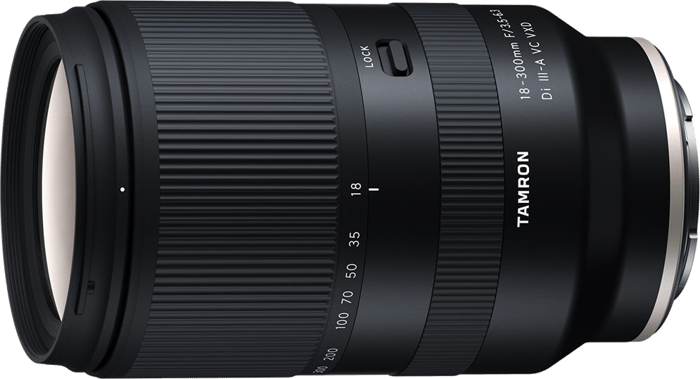
Tamron lens abbreviations describe a lens’s camera format, focusing system, stabilization and optical design. Di identifies a digital lens design, VC means Vibration Compensation, VXD names a linear autofocus motor, and SP identifies Tamron’s high-performance series.
Tamron is a third-party lens manufacturer that provides lenses for Canon, Nikon, Sony and Fujifilm cameras. The letters and numbers help you decode a lens name, but you still need to check its exact mount and camera compatibility.
Here’s how to read those codes, including the older terms you may see when buying a used lens.
How to Read a Tamron Lens Name
Let’s look at an example:
Tamron SP 150-600mm F/5-6.3 Di VC USD
- SP identifies Tamron’s Superior Performance series.
- 150-600mm is the focal-length range.
- F/5-6.3 gives the maximum aperture at the wide and telephoto ends of the zoom.
- Di identifies a digital SLR design that covers full-frame and APS-C sensors, with the correct mount.
- VC means the lens has optical stabilization.
- USD identifies its Ultrasonic Silent Drive autofocus motor.
The letters describe features, rather than a test score. They also don’t identify the mount by themselves. For example, a lens made for Nikon F is not the same mount as Nikon Z. Check the model and mount before you buy, especially if an adapter is involved.

Tamron Lens Abbreviations
The list below covers names and specification terms. Some appear on the lens barrel, while others appear only in a manual or product description.
AD—Anomalous Dispersion. Special glass that helps reduce chromatic aberrations, the color fringes that can appear around high-contrast edges.
ADH—AD hybrid aspherical element. This combines anomalous-dispersion glass with an aspherical lens surface to help control chromatic and spherical aberrations. It is an older optical-design term.
AF—Autofocus. The lens can focus automatically when used with a compatible camera.
A/M—Auto/manual focusing. On some older Tamron lenses, a sliding focus ring changes between autofocus and manual focus. Check the model’s instructions for the control used.
AF/MF—Autofocus/manual focus. These labels identify focus modes or a switch between them. They do not, by themselves, mean that you can turn the focus ring while autofocus is active; that is a separate feature called full-time manual focus.
ASL—Aspherical lens element. Its surface is not a simple spherical curve, which helps correct spherical aberration and distortion.
BBAR / BBAR-G2—Broad-Band Anti-Reflection coating and its second generation. These coatings reduce reflections inside the lens to limit flare and ghosting. BBAR-G2 refers to the coating, while G2 at the end of a lens name refers to the lens generation.

BIM—Built-in motor. The autofocus motor is inside the lens. This does not make the lens compatible with every camera; check the exact lens and mount.
Di—Digitally Integrated Design. These lenses were designed for digital SLR cameras and cover both full-frame and APS-C sensors. The camera mount must still match.
Di II / Di-II—The digital SLR range designed for APS-C sensors, rather than full-frame coverage.
Di III / Di-III—A mirrorless lens design. The label alone does not guarantee full-frame coverage: older Di III designs also include lenses for APS-C and micro-four-thirds cameras.
Di III-A—A mirrorless lens designed for APS-C sensors. The “A” distinguishes it from full-frame designs in this naming system.
eBAND—Extended Bandwidth & Angular-Dependency coating. This anti-reflection coating helps reduce ghosting and flaring.
FEC—Filter Effect Control. A ring lets you rotate an attached filter while the lens hood stays in place. This is especially handy with CPL filters, whose effect changes as you rotate them.
Fluorine Coating—A water- and oil-repellent coating on a lens surface that makes dirt and fingerprints easier to wipe away. It is different from the seals used in moisture-resistant construction.
FTM—Full-Time Manual Focus. On lenses that support it, you can fine-tune focus with the focus ring without switching from AF to MF. Follow the lens and camera instructions for the required focus mode and shutter-button operation.
G2—Generation 2. This marks a second-generation version of a lens. Check the two models’ specifications to see what changed; the code itself does not list the improvements.

HID—A special glass element used to reduce chromatic aberration at the center and corners of the image. It describes an optical component, rather than a general rating of the lens.
HLD—High/Low Torque-Modulated Drive. An autofocus drive designed for stable, precise focusing.
IF—Internal Focusing. The lens focuses by moving elements inside the barrel. Its length stays the same during focusing, and the front filter ring does not rotate. This does not mean the lens also has internal zooming.
LAH—LD hybrid aspherical element. An older term for low-dispersion glass combined with an aspherical surface, used to help control chromatic and spherical aberrations.
LD—Low Dispersion. Special glass that reduces chromatic aberration. It does not guarantee that all color fringing is removed.
Moisture Resistant—Seals help limit moisture entering the lens. This is not a waterproof guarantee: Tamron says its moisture-resistant construction does not completely prevent water droplets from entering.
OSD—Optimized Silent Drive. An autofocus system using a DC motor designed for low operating noise.
PZD—Piezo Drive. An autofocus drive that uses a standing-wave ultrasonic motor.
RD / Rounded Diaphragm—Curved aperture blades help keep the opening rounded as you stop down. This can give out-of-focus highlights in the bokeh smoother edges.
RXD—Rapid eXtra-silent stepping Drive. A stepping-motor autofocus system designed for fast, accurate and quiet focusing in stills and video.
SP—Superior Performance. Tamron’s high-performance lens series. It is a series designation, rather than a promise that every SP lens will outperform every lens without those letters.
USD—Ultrasonic Silent Drive. An ultrasonic autofocus motor designed for fast, quiet focusing.
VC—Vibration Compensation. Tamron’s in-lens stabilization system reduces blur caused by camera shake when shooting handheld. It can help when using slower shutter speeds, but it does not freeze a moving subject.
VXD—Voice-coil eXtreme-torque Drive. A linear autofocus motor designed for fast, precise and quiet focusing. Actual autofocus performance also depends on the lens, camera and shooting conditions.
XLD—eXtra Low Dispersion. Glass with lower dispersion than standard LD glass, giving lens designers more control over chromatic aberration.
XR—Extra Refractive Index glass. Its high refractive index helps Tamron make a lens more compact.
ZL—Zoom Lock. A mechanism that locks the zoom to prevent unwanted barrel extension, often called zoom creep. The positions that can be locked depend on the model.
1:1 Macro / M1:1—Life-size maximum magnification: the image of the subject on the sensor can be the same size as the subject itself. This is a true macro ratio. M1:2 means half life-size. A lens called “Macro” does not necessarily reach 1:1, so check its maximum magnification.
Tamron’s lens technology pages explain its focusing, coatings and optical systems. For operating details, use the manual for your exact model.
Why Some New Tamron Lens Names Look Shorter
In July 2026, Tamron announced a simpler naming system, starting with the 12-20mm F2.8 (Model A084). New names omit Di III, Di III-A and VXD, use F2.8 instead of F/2.8, and use an “A” suffix for future APS-C models.
The older abbreviations still help you understand existing lens names and specifications. For a lens using the new naming system, read the format, mount and focusing specifications rather than assuming a missing code means a missing feature.
Conclusion: Tamron Lens Abbreviations
Start with the camera format and mount, then check the features you need: VC for in-lens stabilization, the autofocus motor type and the maximum magnification. The abbreviations are a quick guide, while the exact model’s specifications settle compatibility and operation.
Keep this glossary handy when you compare Tamron lenses.
Check out our Macro Magic course to get the most out of your Tamron macro lenses!