

The Lightroom radial filter is one of the simplest ways to apply local effects to only a part of the image. And we’ll show you how to use it.
The Lightroom radial filter applies a local adjustment to a circular portion of the image. Lightroom's different controls and sliders affect whether that edit blends seamlessly or creates a striking, obvious look.
With a few modifications, the tool can even go beyond just editing everything outside or inside a basic circle.
What Is the Lightroom Radial Filter and What Can You Use It For?
Simply put, the Lightroom radial filter applies an effect to a circular area of the image. It’s feathered so that the remainder of the image remains untouched.
Using Radial Gradient in the default settings, the different Lightroom controls adjust what's inside that original circle. Use Invert to apply the effect outside that circle.
With extra tools like the brush and range mask, the tool can even work beyond just a simple circle or oval.
The radial filter can be used to create a number of different effects. Lightroom has tools for creating or eliminating a vignette. The radial filter tool allows for a more custom vignette to be added to a photograph.
The tool can also be used to draw more attention to an area of the image by creating a sharper or more vibrant area of the photograph.
The possibilities are nearly endless. These include creating a spotlight-like effect, to brightening the subject but not the background, ‘turning on’ lights that are off in the photograph, and many more effects.
If you want the effect to be applied only to a circular or oval portion of the image (or only outside that portion), then the radial filter should be your go-to tool.
Before using Radial Gradient, you should understand how it works. First, the effects sliders are applied to the area inside the circle.
To affect the area outside the circle, select Invert.
Second, the radial filter uses many of the same sliders found when editing a completed image, only those effects aren't applied to the entire image anymore. Finally, Lightroom has a few tools to adjust exactly where the effect falls in the photo.
To use the Lightroom radial filter, all you need is the Lightroom software, a computer to run it on, and a photo to edit.
How to Use the Lightroom Radial Filter Tool
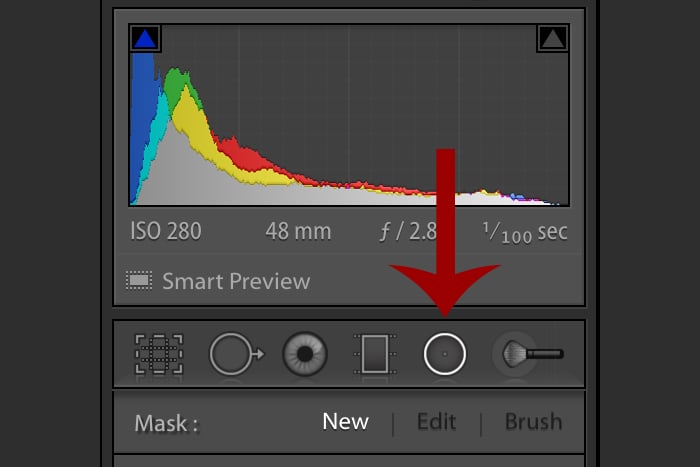
1. Start by Adding the Radial Filter
In Lightroom Classic's Develop module, open Masking below the histogram and select Radial Gradient. Do not confuse it with the Remove tool.
The same tool can also be accessed via the keyboard shortcut. Hit shift and M inside the Develop module.
Once the radial filter is selected, the cursor turns into a plus icon that will draw the circle over the area of the image to adjust.
Click on roughly the center of where you would like that circle to go. Without letting go of the mouse button, slide the cursor back to increase the size of the circle.
If you'd like a perfectly round circle, hold the shift key while drawing the circle.
2. Fine-Tune Where the Adjustment Will Be Applied
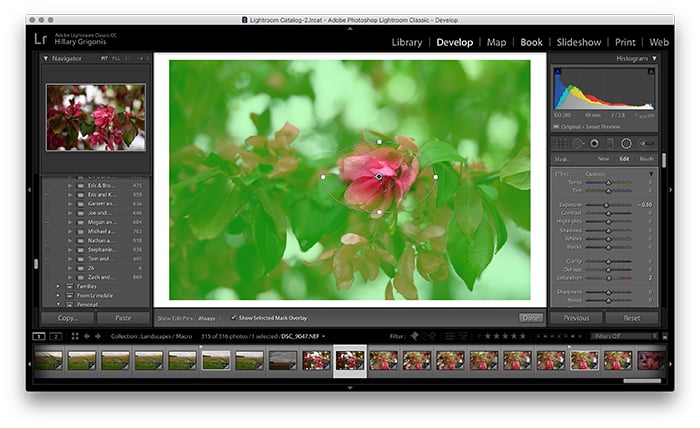
The circle area isn't set in stone once you let that mouse button go. After drawing the circle, click and hold on the middle dot to drag the entire circle to a different part of the image.
To adjust the size and shape, click on one of the four squares on the outside edge of that circle and drag to reshape, or use the shift key to resize without affecting the original shape.
The shift key will create a perfect circle when drawing the radial filter. Once drawn, the shift key will allow the circle to maintain the current shape to resize instead of stretching one side.
To see what areas of the image are affected by the tool, select Show Overlay in the Masks panel or press O.
To change the color of the mask overlay, such as when your image contains a lot of red and the mask is difficult to see, use shift and O at the same time.
By default, the effect will be applied inside the circle.
You can brighten the subject by increasing Exposure. To darken the surrounding area instead, select Invert and lower Exposure.
You can further adjust where the effect is applied by using feathering. Like with other tools, feathering photos adjusts how quickly the adjustment falls off.
No feather would leave a hard line between the edits and not edited. A large feather would subtly blend the effect in.
To adjust the feathering, use the slider towards the end of the radial mask section.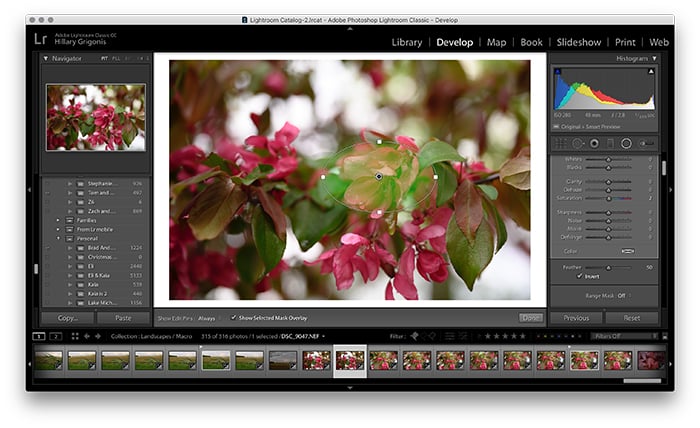
3. Add in the Effects
Time to get creative. The Lightroom radial filter can be used to build a number of different effects all through the various slider options. Use the sliders in the tool section to lighten, darken, add sharpness, adjust saturation and more.
Most of Lightroom's various slider tools are available as part of the radial filter, from white balance to sharpness.
You can also use your brush presets by choosing from the effect drop-down menu. Lightroom includes a dodge and burn preset that can be used for both brushes and the radial filter.
The exact edits will depend on what you'd like to adjust with the tool. For a vignette, select Invert and move the exposure slider to the left.
The tool isn't limited to a single slider at a time. To make an unlit lantern appear to be on, for example, you'd use the white balance and exposure slider to make an orange glow.
Remember, Lightroom is a non-destructive photo editor, so there's nothing to lose except for perhaps a few minutes of your time by experimenting. Double click on a slider to return the value back to zero.
You can also continue to fine-tune the size, placement, and feathering of the radial filter. And if you want to delete the entire radial filter, just hit the delete key with the center of the filter selected.
You can also add more than one radial filter. Select Create New Mask in the Masks panel, then select Radial Gradient.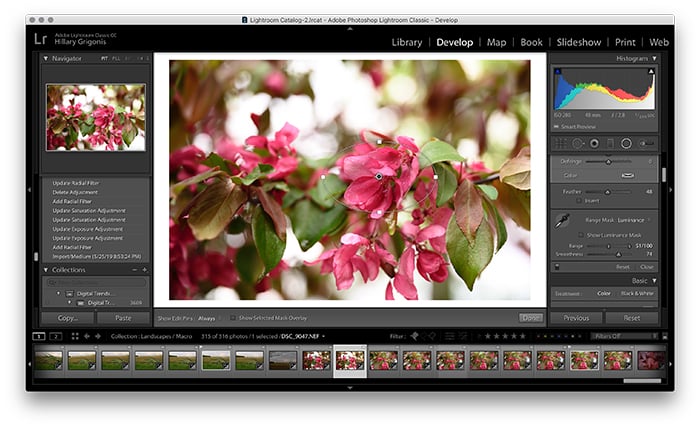
4. Optional: Fine-Tune With the Range Mask
While the radial filter works best for circular (and oval) effects, Lightroom has a few tools for going beyond that circle. The range mask tool allows you to select a color or brightness to apply the effect only to that area.
Lightroom applies the adjustments inside the circle by default. Select Invert to work outside the circle.
To limit the radial mask to selected colors, open its three-dot menu and choose Intersect Mask with > Color Range. Then use the eyedropper to sample a color.
Holding the shift key, click on as many colors in the image that you'd like to include. The adjustments made to the filter will now only apply to those selected colors.
You can also use a Luminance Range mask, which limits the effects based on the light or dark areas of the image instead. Open the radial mask's three-dot menu, choose Intersect Mask with > Luminance Range, and narrow the selection using the Luminance Range slider.
Move the left endpoint towards the center to exclude darker areas. Move the right endpoint towards the center to exclude lighter areas.
Use the smoothness slider to adjust the transition between those lights and darks right for a smoother transition, left for a more abrupt one.
If you decide you don't like the range mask effect, remove the range component from the Masks panel.
5. Optional: Use the Brush Tool for Exact Fine-Tuning
For subjects that are mostly, but not quite round, try using the brush tool to fine-tune the mask. This option is great for adjusting the shape even when the shape doesn't include all the same color or luminance values.
Select Add > Brush in the Masks panel to paint the effect into additional areas.
Adjust the brush Size, Feather, and Flow controls. Now, paint over the areas of the photo where you'd like to add the effect.
You can also erase parts of the mask. Select Subtract > Brush in the Masks panel.
You can erase the mask from any area of the image just by painting over it with the cursor.
Conclusion
The Lightroom radial filter makes it easy to make local adjustments on only circular areas of the image. With the brush and range mask tools, the tool even works for adjustments that aren't perfectly circular.
Using Lightroom's range of different options for the tool, the radial filter simplifies many different types of photo edits, from dodging and burning to adding a vignette.
For more great Lightroom tutorials, why not check out how to use the texture control slider or split toning next!