Macro photography gives small subjects a big presence. These 30 macro photographers show different ways to approach insects, flowers, underwater life, snowflakes and microscopic worlds.
For butterflies and moths, start with Adam Gor. For flower photography, look at Alan Shapiro. Alexey Kljatov explores snow crystals, while James Weiss and Nathan Renfro take us into the world of microscopy.
Use the linked profiles to explore beyond the examples shown here. This is an editorial selection, and the numbers are for browsing rather than a ranking of influence.
30 Macro Photographers to Follow
Start with the subjects you enjoy photographing. As you browse, compare the light, backgrounds and compositions in each photographer’s work.
1. Adam Gor
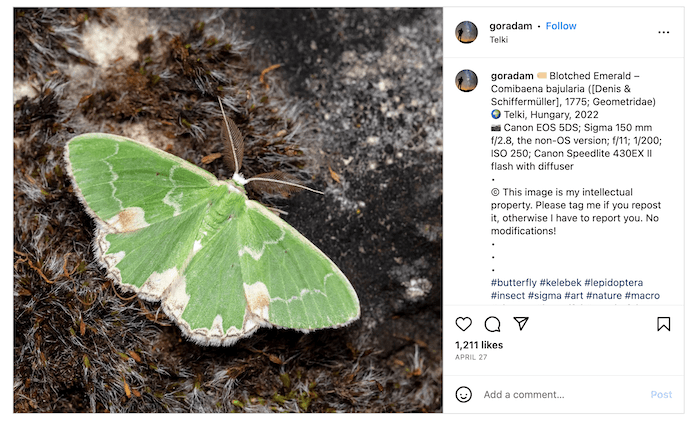
Adam Gor is a Hungarian biologist whose main photographic subjects are butterflies and moths. On his website, he describes himself as an amateur photographer and explains how studying these insects shaped his work.
Look at how the insect sits within the frame. The space around its wings and the background are as much a part of the picture as the subject itself.
© Adam Gor
2. Javier Rupérez
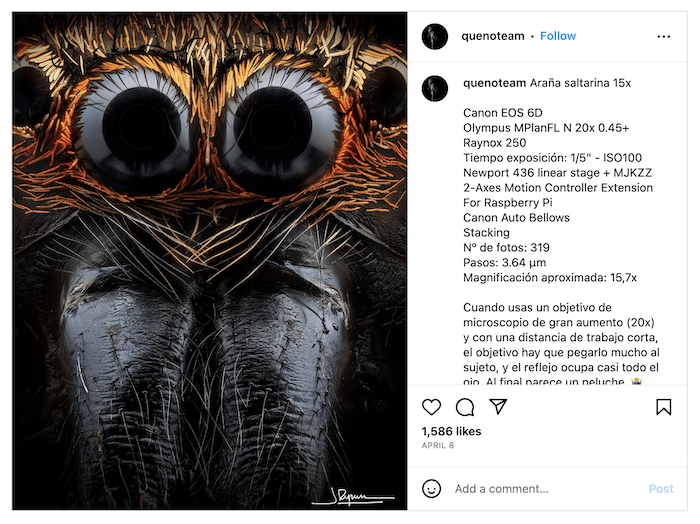
Javier Rupérez specializes in extreme macro photography. His close views of insects reveal structures that are difficult to see with the unaided eye.
Study the shapes and textures in his pictures: an eye, a hair or a section of an insect’s body can become the subject of an entire photograph.
© Javier Rupérez
3. Andrey Savin
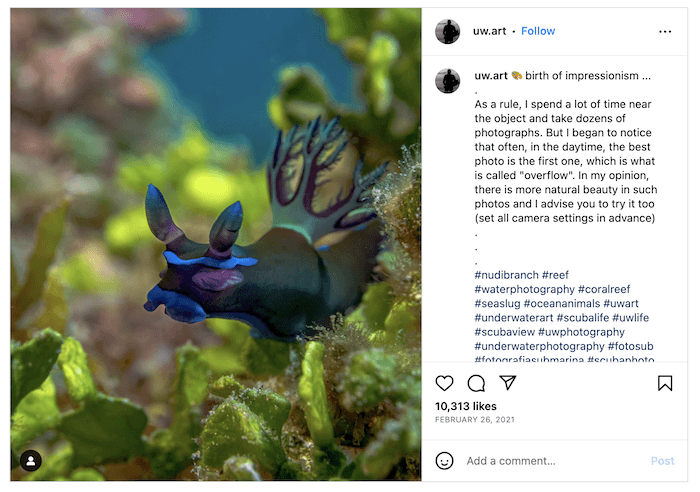
Andrey Savin photographs underwater life. His close-up work takes the list beneath the surface, where small marine creatures offer a different set of shapes, colors and textures.
His underwater subjects broaden the list beyond land-based insects and flowers.
© Andrey Savin
4. Hans Thomassen
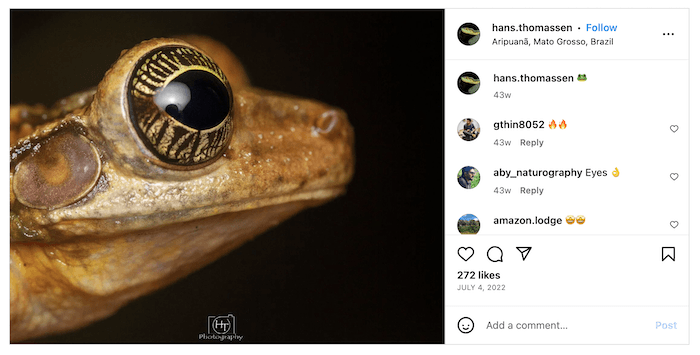
Hans Thomassen is a Brazilian biologist, researcher, photographer, and entrepreneur. He aims to raise awareness about nature and fights for a sustainable world.
You can meet a lot of different creatures in his images. Some of his favorite subjects to photograph are insects, spiders, amphibians, and reptiles.
He also educates his followers by writing informative captions.
© Hans Thomassen
5. Jamie Price
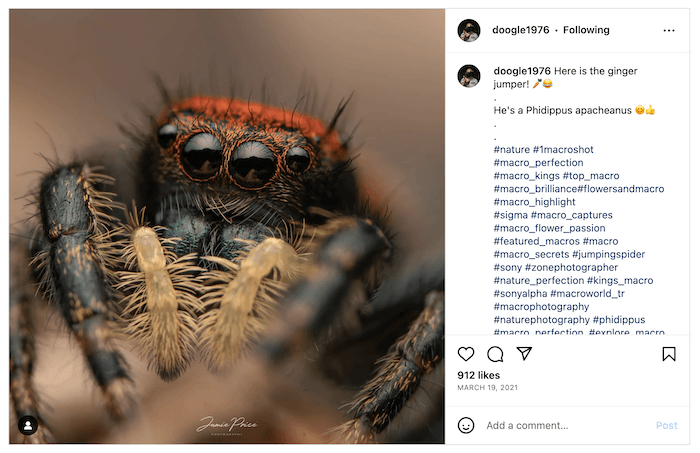
Jamie Price works across macro, portrait, pet portrait and product photography. His macro subjects include insects, spiders and small objects.
Patterns and textures give these small subjects their character, even when they occupy only part of the frame.
© Jamie Price
6. Karla Thompson
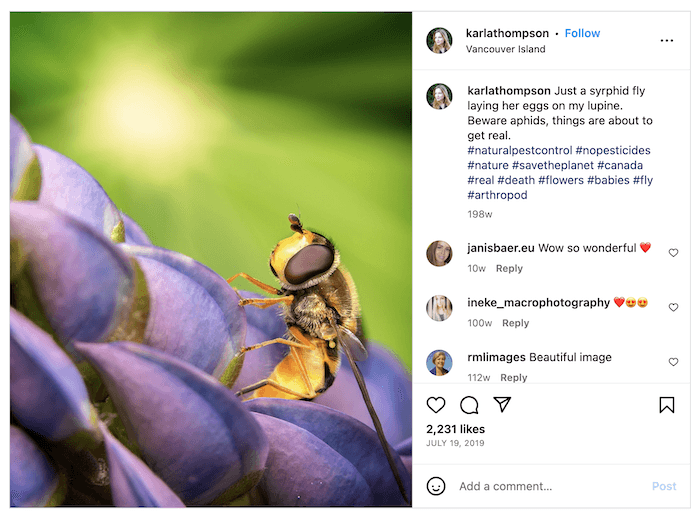
Karla Thompson is an arthropod conservationist photographer with a passion for nature. She stands for ethical photography and hopes to build a bridge between nature and humans.
Her bee and spider images encourage a closer look at animals that are easy to overlook. Read the captions alongside the photographs for context about the subjects.
© Karla Thompson
7. Alan Shapiro
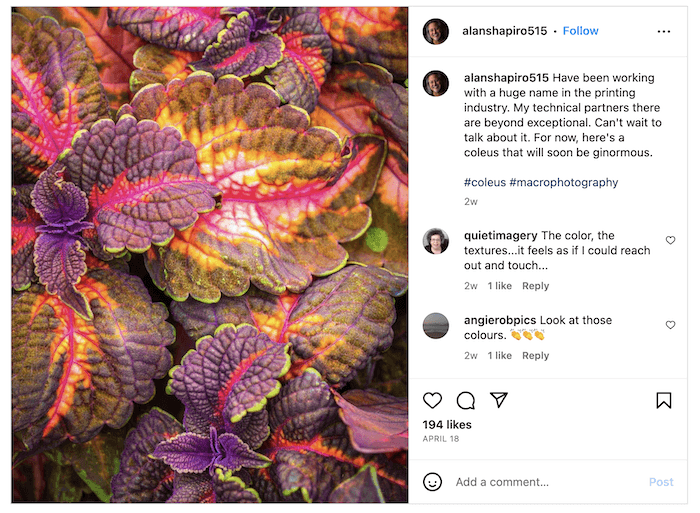
Alan Shapiro works across several photographic genres, including floral photography. His amazing photos of flowers have a painting-like feel.
Look at the shapes of the petals and the way color carries across an image. His flower photographs are a starting point for thinking about a bloom as a portrait subject.
© Alan Shapiro
8. James Weiss
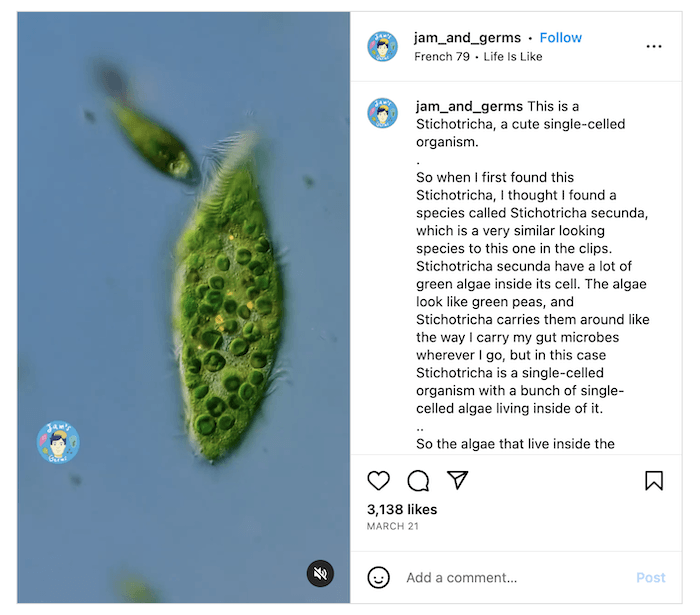
James Weiss shares images and videos of microscopic organisms through Jam & Germs. His subject is life viewed through a microscope, taking us beyond the insects and flowers usually associated with macro photography.
His work is an example of photomicrography: making photographs through a microscope. Watch how movement reveals the behavior of organisms that can be difficult to recognize in a still image.
© James Weiss
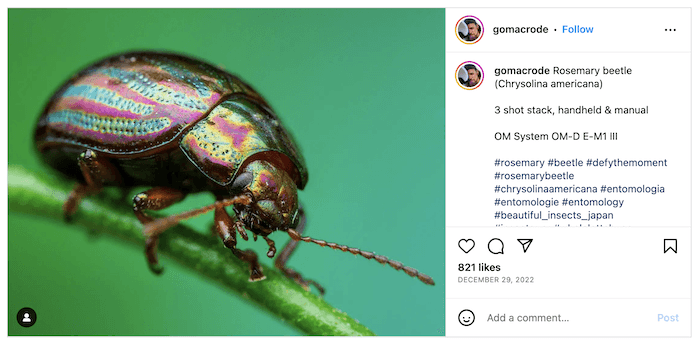
9. Christian Brockes
Christian Brockes, the photographer behind WILD MACRO, photographs spiders and insects. His own introduction connects that work with encouraging understanding and respect for small animals.
Start with his jumping-spider portraits for close views of the animals’ faces and eyes.
© Christian Brockes
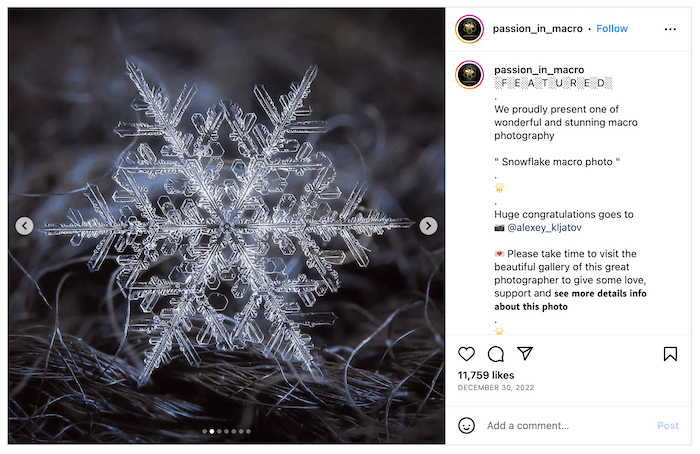
10. Alexey Kljatov
Alexey Kljatov specializes in macro photos of snowflakes. His images show how much variety there is in a subject that can seem almost featureless from a distance.
Crystal outlines and internal patterns give him many variations on one subject.
© Alexey Kljatov
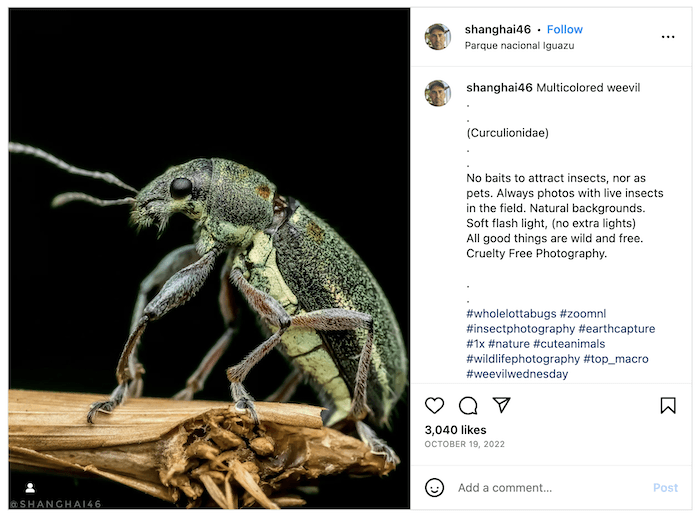
11. Diego Mendez
Diego Mendez’s macro work focuses on insects and spiders. The animals’ positions and surroundings are part of the pictures’ appeal.
© Diego Mendez
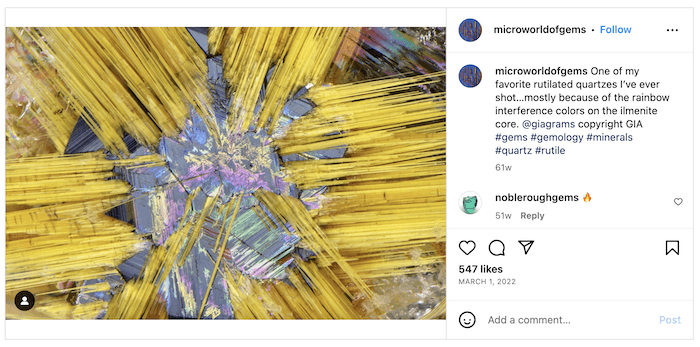
12. Nathan Renfro
Nathan Renfro photographs gems and minerals through a microscope. His Microworld of Gems portfolio includes inclusions inside gemstones as well as mineral surfaces.
Cracks, crystals and patterns within a stone can resemble abstract paintings or miniature landscapes. This is photomicrography applied to the mineral world.
© Nathan Renfro
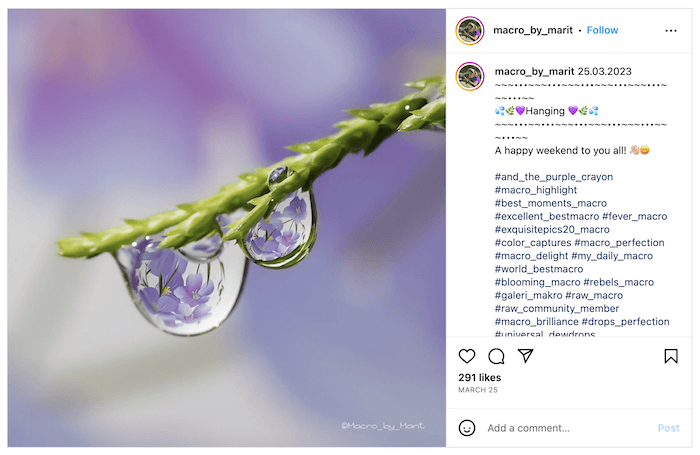
13. Marit Hovden
Marit Hovden’s waterdrops turn a small subject into the center of the frame. Reflections and background color are part of the appeal of these photographs.
The contrast between a reflection inside a drop and the blurred area around it makes these images worth studying.
© Marit Hovden
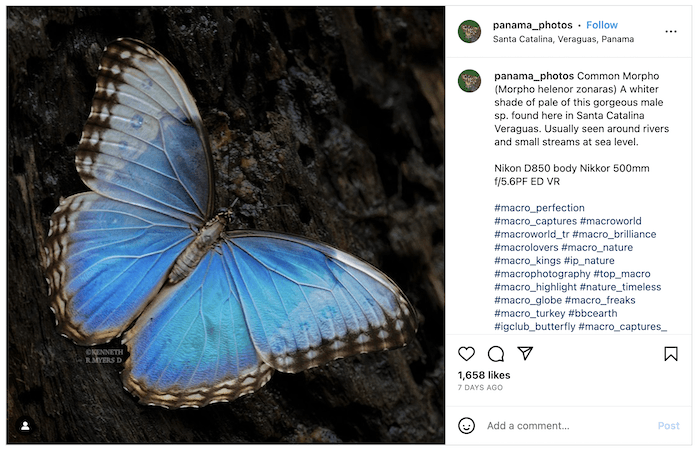
14. Kenneth R Myers
Kenneth R Myers photographs Panama’s wildlife, including jumping spiders and butterflies. His work links nature photography with an interest in conservation.
His broader wildlife portfolio sits alongside those small-scale subjects, showing the range of animals a nature photographer can encounter.
© Kenneth R Myers
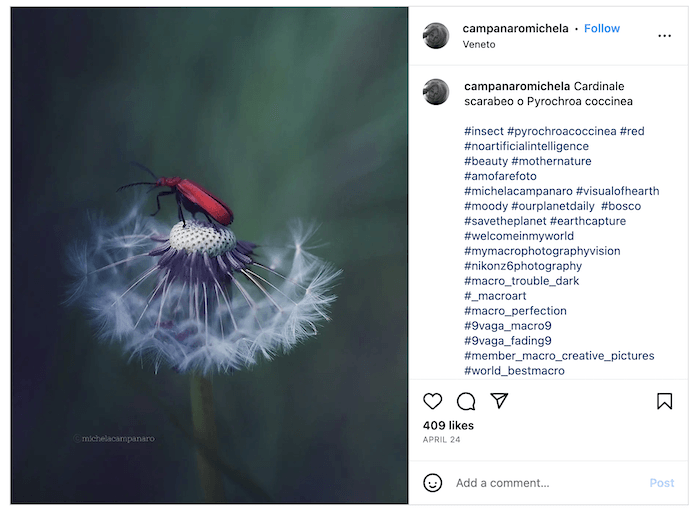
15. Michela Campanaro
Michela Campanaro’s macro photographs have a quiet, dark-toned feel. Small subjects stand out against their surroundings without needing a busy frame.
The darker areas give the insect or flower room within the composition.
© Michela Campanaro
16. Oscar Rojas
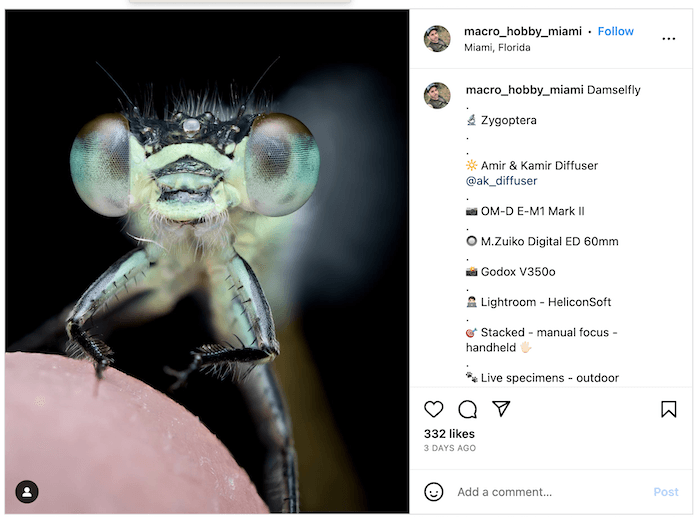
Oscar Rojas photographs insects and spiders at close range. His work includes animal behavior as well as portraits.
Look at where the focus falls and how much of the subject stays sharp. When a caption includes exposure information, compare it with what you can see in the picture instead of treating the settings as a recipe for a different scene.
© Oscar Rojas
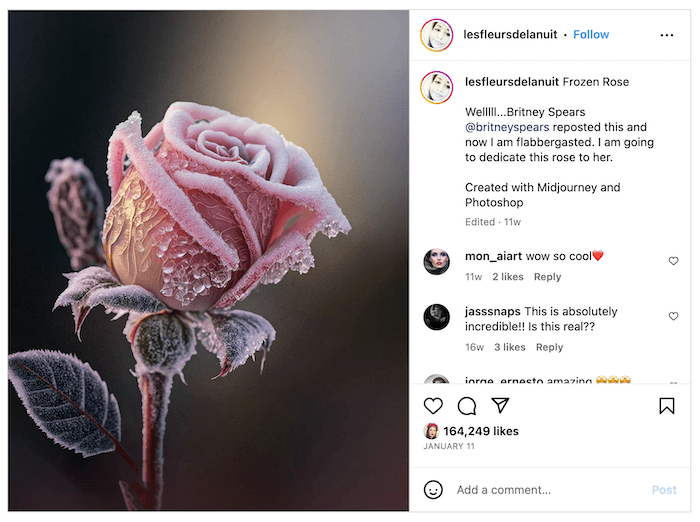
17. Monica
Monica’s flower images use soft color and a painting-like style. The rose artwork in the preserved Instagram screenshot below is labelled “Created with Midjourney and Photoshop.”
Study its color and composition, but do not use it as an example of photographic focus or depth of field.
© Monica
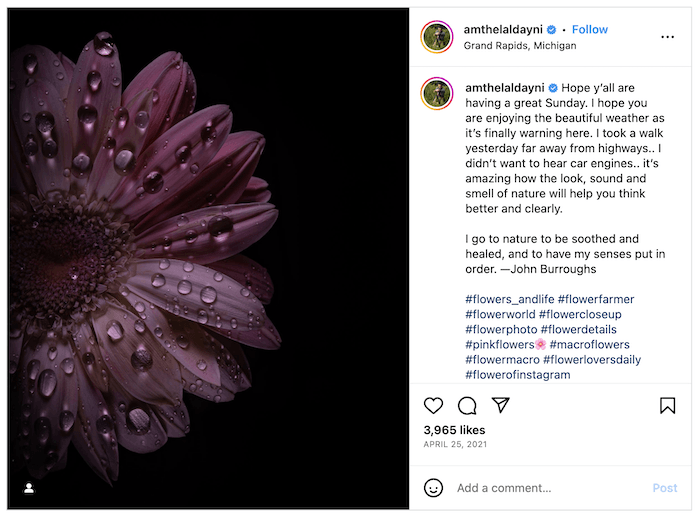
18. Amthel Al-Dayni
Amthel Al-Dayni explores insects, spiders, flowers, fungi, waterdrops and soap bubbles.
Reflections of the background add another layer to his droplet compositions.
© Amthel Al-Dayni
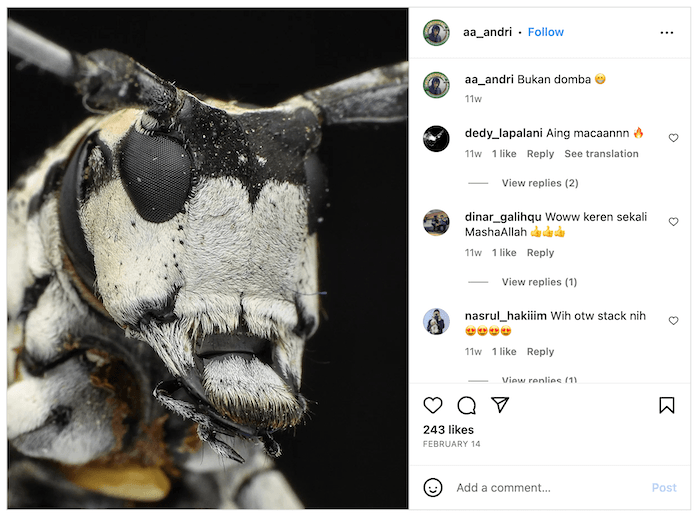
19. Andriansyah Andriansyah
Andriansyah is an Indonesian macro photographer with an interest in tiny animals. He takes stunning and surprising images of insects, flowers, spiders, or snails. And sometimes reptiles or amphibians.
He professionally freezes movement and shows the interactions of the living things around him. Besides animals, you can find objects like jewelry in his portfolio.
© Andriansyah Andriansyah
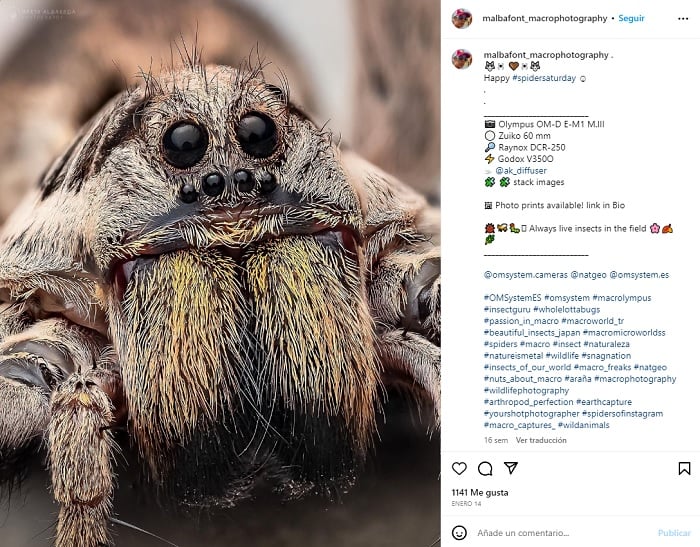
20. Marta Albareda
Marta Albareda photographs insects and spiders in the field. On her own website, she describes working with care and respect for the animals and looking for them around dawn or dusk.
Her close views make the small structures of a bug or spider the center of attention. Study the angle of view and the background, as well as the detail on the animal itself.
© Marta Albareda
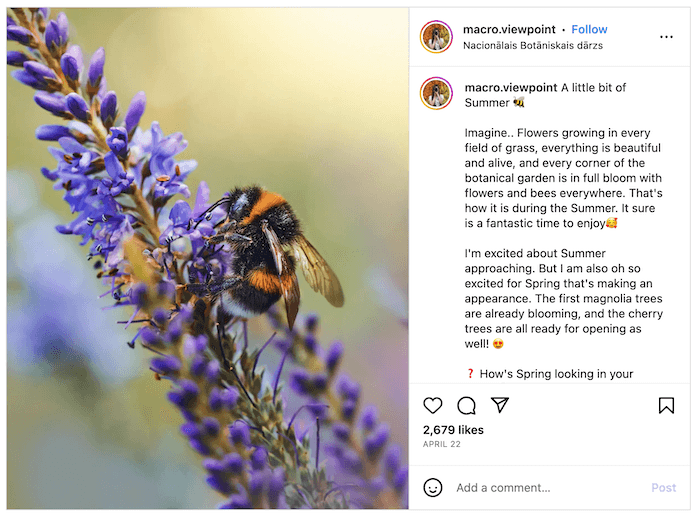
21. Kristine
Kristine, known as Macro Viewpoint, photographs flowers and insects and shares photography and editing tutorials.
Her work combines soft backgrounds with color. Follow the finished pictures alongside her explanations to study how a flower photograph develops from the scene to the final edit.
© Kristine
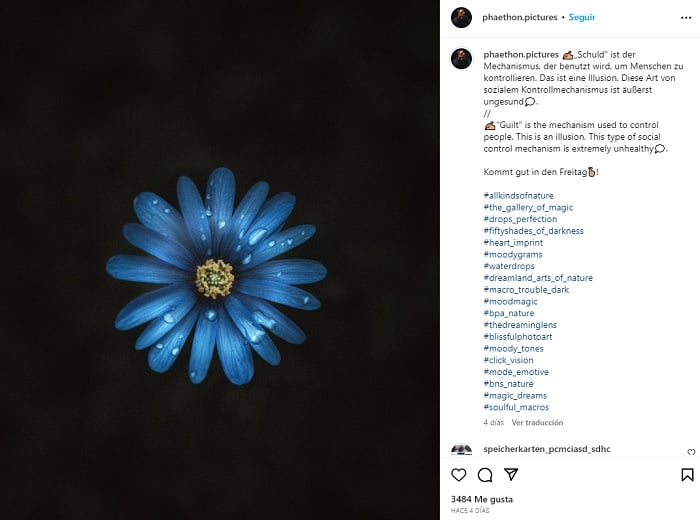
22. Phaethon Pictures
Phaethon Pictures’ floral images pair bright color with dark backgrounds. Flowers and leaves often sit in isolation, giving the pictures a dramatic feel.
The space around the subject is part of that atmosphere.
© Phaethon Pictures
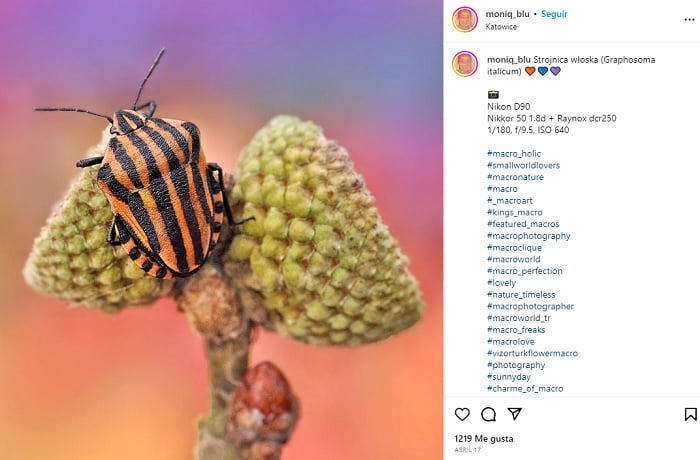
23. Monika Blucha
Monika Blucha’s macro images combine insects and flowers with a bright color palette. Together, the small animals and blooms give the photographs a playful, storybook feel.
As you study her work, think about your exact settings for each shot. Decide how much of the subject you want sharp and how much background blur will support the picture.
© Monika Blucha
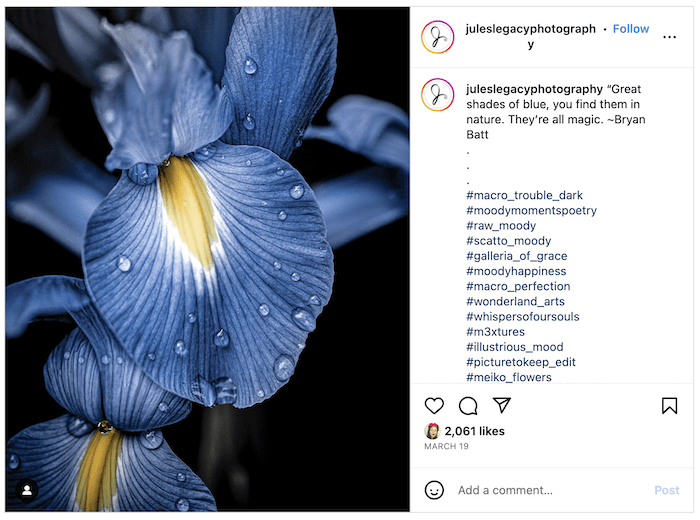
24. Julie
Julie is based in Michigan and Montana. Her stunning macro images are mostly about plants, their leaves, and flowers in all seasons. She captures the frozen winter world by using magical pale colors. And she captures the lively springs with stronger ones.
The background colors help give each season a different mood.
© Julie
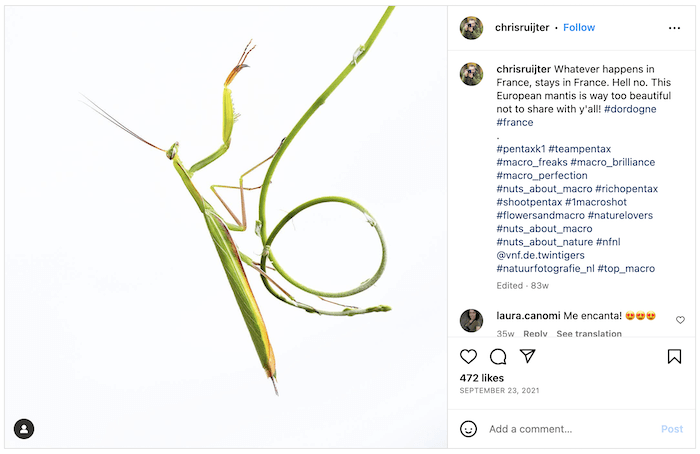
25. Chris Ruijter
Chris is a nature photographer from the Netherlands who is passionate about macro photography. He is a Ricoh-Pentax ambassador. He uses his gear to capture sharp and gorgeous images of dragonflies, fungi, spiders, and other insects and plants.
He documents nature around him with great sensitivity. And he pays attention to the details that so many of us might otherwise never see.
© Chris Ruijter
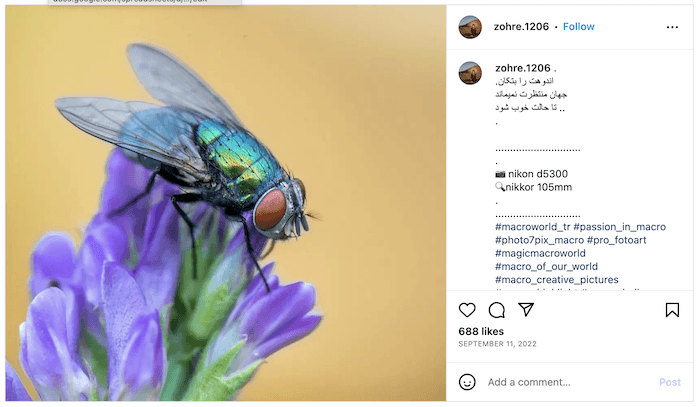
26. Zohre
Zohre is a smartphone camera photographer. She is a great example of what camera phones can do in our daily lives.
Using a Samsung A750 with a macro lens, Zohre takes gorgeous close-ups of insects and flowers. Her images prove you don’t always need a professional camera to take stunning macro pictures.
She now also uses a Nikon D5300 camera with a 105mm lens.
© Zohre
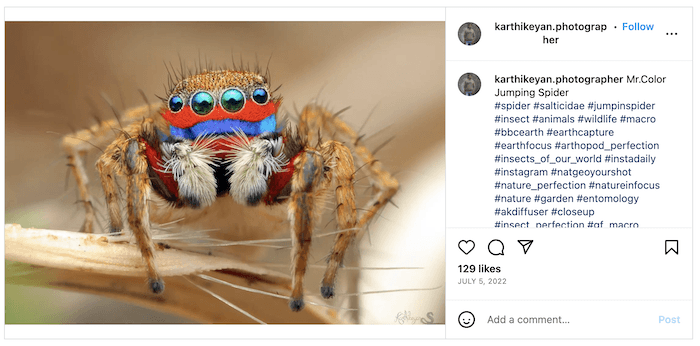
27. Karthikeyan Shanmugasundaram
Karthikeyan Shanmugasundaram’s nature and macro work looks for moments in the lives of small animals.
Study the positions of the animals and their relationship to the frame. Timing can matter as much as magnification when the subject is moving.
© Karthikeyan Shanmugasundaram
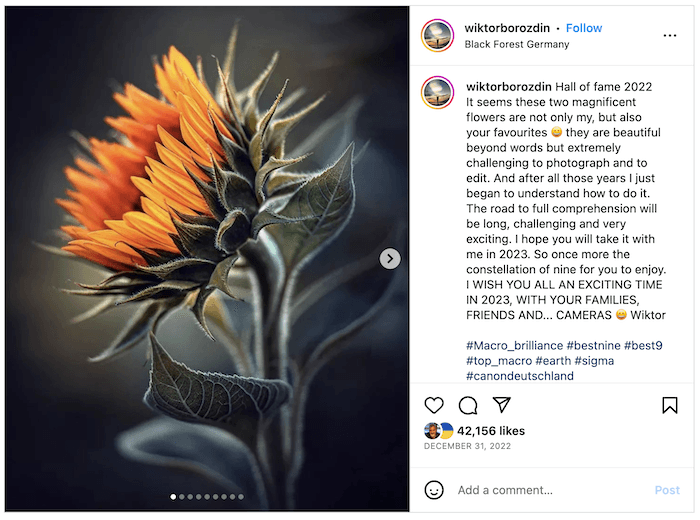
28. Wiktor Borozdin
Wiktor is from Freiburg, Germany. He loves to take pictures in the forest. And he has many beautiful photos of sunflowers and poppy flowers.
He hopes that people will respect nature more if they see the little details of the world. His images look like paintings. And he cleverly uses color to enhance shapes and texture.
© Wiktor Borozdin
29. Андрей Шаповалов
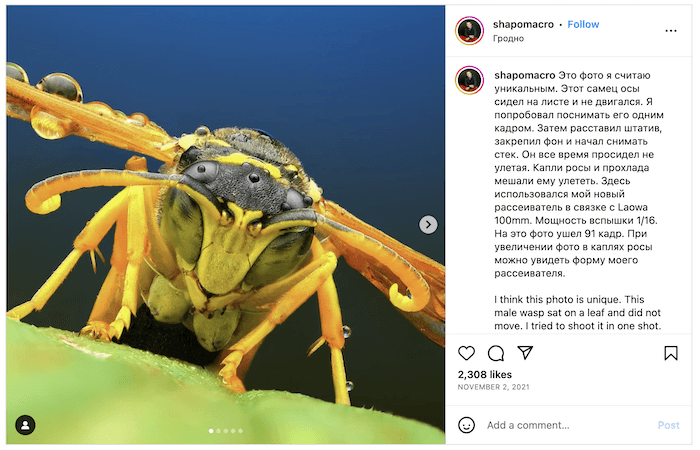
Андрей Шаповалов’s extreme close-ups reveal the forms and textures of insects and spiders.
Look at how much of the subject appears sharp. To understand one technique for extending that sharp area, read our guide to focus stacking, which combines photographs taken at different focus distances.
© Андрей Шаповалов
30. Alperen Yayla
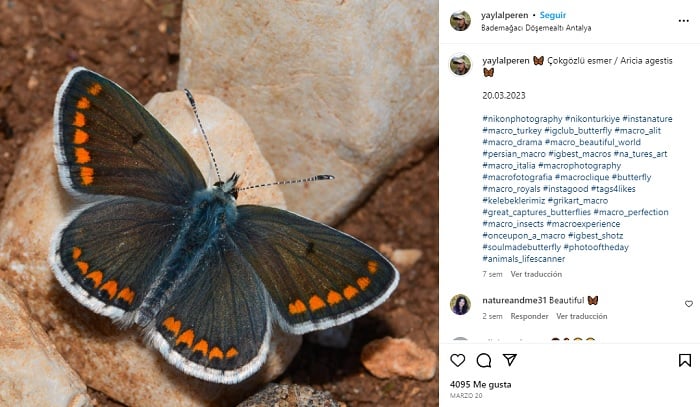
Alperen Yayla combines butterfly photography with research and conservation. His research profile describes his work on butterflies and biodiversity monitoring.
Follow his photographs for a close look at wing shapes and patterns. They also show how photography can help document the animals a photographer studies.
© Alperen Yayla
What Is Macro Photography?
Macro photography captures small subjects at close range. In the strict photographic sense, life-size macro means a reproduction ratio of 1:1: a 10mm subject forms a 10mm image on the camera sensor. That is different from simply enlarging a photo on a screen, as Nikon’s explanation of magnification shows.
The word is also used more loosely for close-ups. This list includes that wider range, plus photomicrography through a microscope in the work of James Weiss and Nathan Renfro.
Macro subjects include flowers, insects, snowflakes, waterdrops and details of objects such as jewelry. You can photograph a whole small subject or isolate one part of a larger one.
Specialist macro lenses let cameras focus closely. You can also explore smartphones for macro photography, using a phone’s close-focus capability or an add-on lens. A microscope is a separate way to photograph subjects too small for ordinary close-ups.
Find Inspiration for Your Macro Photography
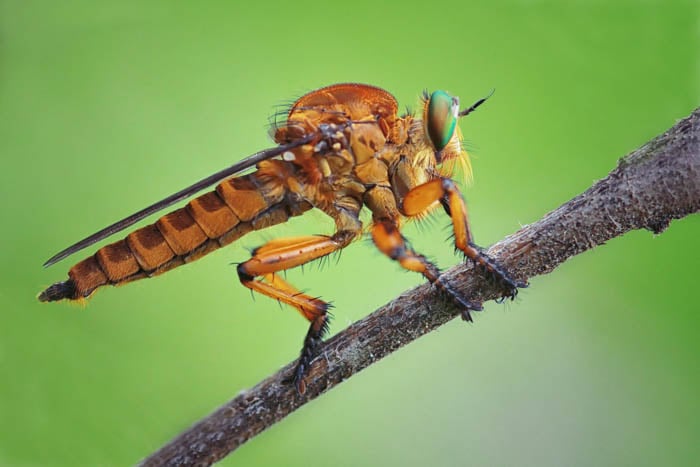
Choose one photograph from the list and identify what holds your attention. Is it the subject’s pose, the background color, the lighting or the point of focus?
Try that one idea with a subject you can photograph yourself. Comparing the results will help you develop your own creative style. When photographing living subjects, leave the animal and its habitat undisturbed.