Acrylic photo prints give a photograph a smooth, glass-like surface without a separate frame. You can choose a photo printed on paper and mounted behind acrylic, or an image printed directly onto the panel. The material has a different look from textured canvas prints, but the print method, reflections and mounting matter as much as the lab's name.
Pictorem is our overall pick for custom dimensions and shapes. CanvasChamp remains our budget pick, while Bumblejax is worth considering for a client print with a choice of photographic papers. The nine services below suit different jobs. Start with your wall size and file, then compare the options you need.

Acrylic Photo Prints: What Are They?
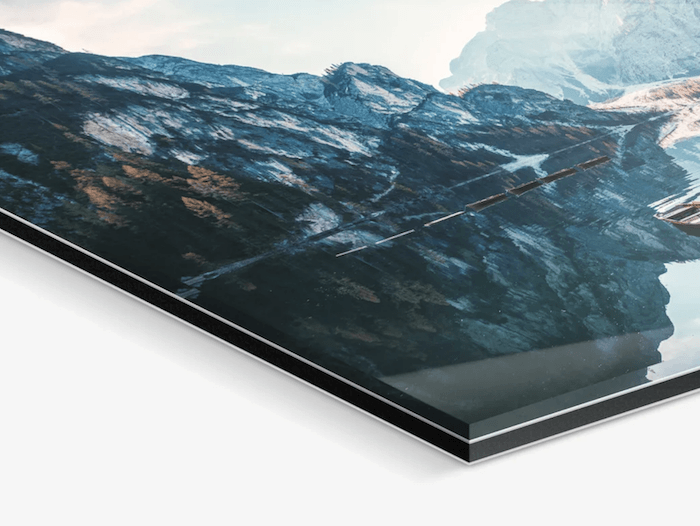
Acrylic is a clear plastic, often called acrylic glass or plexiglass. It is not mineral glass. Labs use two main ways to put your photograph on it:
- Face mounting: The lab prints onto photographic paper and bonds the image side to the back of the acrylic. A backing such as aluminum composite board can add rigidity. The print does not have to sit between two acrylic sheets.
- Direct printing: The lab applies ink to the acrylic itself. Printique, for example, prints onto the back of the panel. This method does not require a separate photographic paper print.
A glossy surface can make colors and depth stand out, but it also reflects windows and lights. Matte, non-glare and anti-reflective options vary by lab. Choose the surface for the room where the photograph will hang.
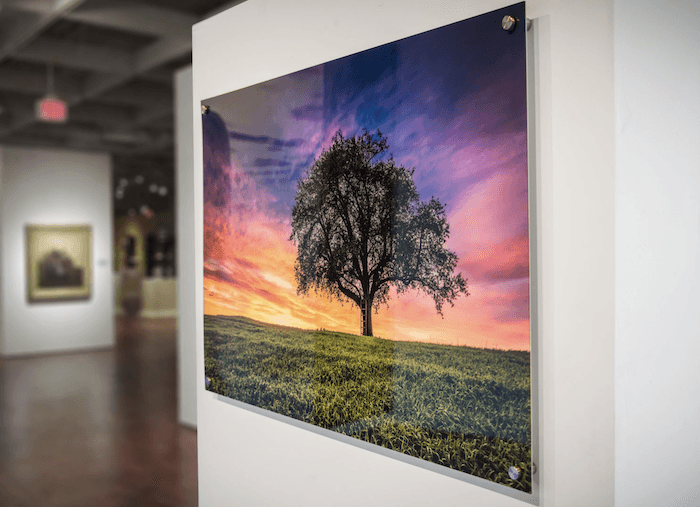
© Pictorem.com
Why Should You Use Acrylic Prints?
Acrylic Prints are Durable
Acrylic is more resistant to impact than ordinary glass, which is one reason to consider it alongside printed glass. It still needs careful handling. A scratch across a glossy face or damage to an exposed edge can spoil a print.
Follow the lab's cleaning instructions. A soft microfiber cloth is a common recommendation. Avoid paper towels and abrasive cleaners, and do not assume a household glass cleaner is safe for acrylic.
Acrylic Prints are Lightweight
Acrylic itself is lighter than glass, but a finished wall print also includes its backing and mount. A large panel with aluminum backing can be heavy. Check the finished weight and the wall fixings before ordering, especially for a large print above furniture.
They Are Thin and Easy to Store
Acrylic wall panels have a slim profile, although the mounting frame can hold them away from the wall. Freestanding desk blocks are a different product and use much thicker acrylic.
Keep the original packaging if you expect to move the print. Protect the face and corners, and follow the lab's storage advice. A thin panel is not a reason to stack photographs against one another without protection.
© Whitewall.com
Tips For Making Your Acrylic Photo Print
Choosing the Right Print Size
Measure the wall before choosing a lab. A paper template at the intended size will show whether the print fits between furniture and how much space remains around it.
Check the shape as well as the dimensions. An uncropped 3:2 photograph fits a 12x18-inch print. It will need cropping or a border to fit 16x20 inches. Look at the order preview for cut-off heads, horizons and details near the edges before you approve it.
Preparing the Image File
Start with the original full-resolution file. If you print it bigger, the same pixels cover a larger area, so there is less detail per inch. Raising a resolution number alone does not recover missing detail.
To check your image size in Adobe Photoshop, open Image > Image Size. Turn Resample off, then enter your intended print dimensions. The resolution now shows how many pixels the existing file supplies per inch at that size.
The familiar 300 dpi print target is more precisely 300 pixels per inch (ppi) when you are preparing an image file. It is a useful starting point for close viewing, but follow the chosen lab's instructions. Some large-format work can use less.
For a 16x20-inch print, 300 ppi needs 4,800 x 6,000 pixels after cropping. At 150 ppi, it needs 2,400 x 3,000 pixels. Those are file-size calculations, not guarantees of sharpness: focus, motion blur and compression still matter.
In photoshop, inspect the image at 100% to look for blur and editing artifacts. That view shows individual pixels; it does not simulate the final print size or viewing distance. For an expensive order, ask the lab to check the file or make a small proof first.
Mounting Your Work
Choose the mount before finalizing the crop. Metal standoffs can pass through the corners and leave visible caps over the image. A rear float mount or French cleat hides the support behind the print. A desk block needs neither.
Check what is included, which options work at your chosen size, and which wall anchors the installation needs. “Ready to hang” describes the supplied print hardware; it does not mean every wall can use the same fixing.
© Monstera (Pexels.com)
The Best Acrylic Print Services
Use these starting points to narrow the list, then read the matching service below:
- Custom dimensions or shapes: Start with Pictorem. Big Acrylic, WhiteWall, Bumblejax and BayPhoto also offer custom dimensions within their product limits.
- Paper and backing choices: Compare Bumblejax and BayPhoto. WhiteWall also offers photographic papers under acrylic.
- A simple gift or family display: Look at Printique's panels and blocks, CanvasChamp's layouts, or Shutterfly's templates.
- A tight budget: Compare CanvasChamp and CanvasDiscount at the same size, including mounting and shipping.
This update compares the services' published options. A sample or small proof is the better way to judge a finish before a large order.
1. Pictorem
- Custom sizes: 8x8 to 96x60 inches
- Mounting options: Floating back frame, metal standoffs or no mount; decorative framing options
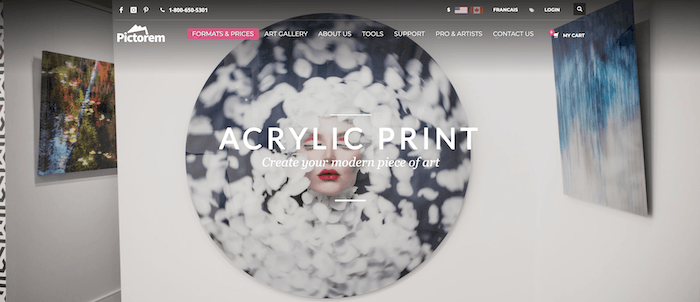
Pictorem stays our overall pick because of its size and shape choices. Alongside rectangles, it offers circles, rounded corners and special outlines. That makes it a practical starting point when the photograph needs to fit a specific space.
The image is UV printed directly onto acrylic. Choose glossy or non-glare, then select the mount to suit the wall. A complimentary professional file review is included with the purchase.
Check the available thickness in the order builder rather than assuming every option works at every size. Its free-shipping offer covers the continental USA and Canada; confirm the dispatch estimate and delivery terms for your order.
2. Big Acrylic
- Custom sizes: Up to 96x60 inches for standard acrylic
- Mounting options: Float off the wall, flush mount, standoffs, traditional frame or no hanging hardware
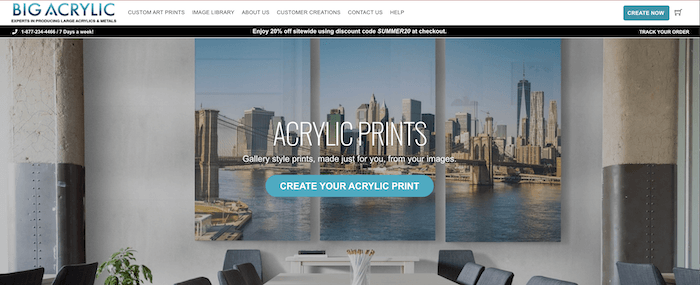
Big Acrylic is a good choice when thickness and presentation drive the order. Its standard acrylic comes in 1/8, 3/16, 1/4 and 3/8-inch panels, with rounded corners available. It prints directly onto acrylic rather than face-mounting a paper photograph.
An anti-glare product is available for rooms where reflections are a problem. Its stated maximum is 96x48 inches, so do not carry the standard panel's larger limit over to that product.
The current standard-product page lists production at 8–10 business days before shipping. Allow for that if you are ordering a gift. If your main requirement is a choice of photographic paper, start with one of the face-mounting labs below.
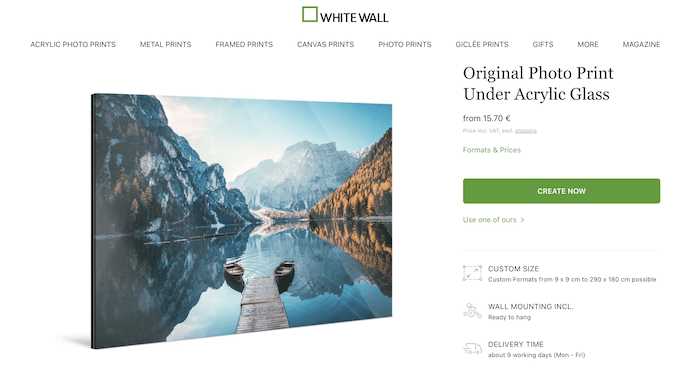
3. WhiteWall
- Custom sizes: Yes; maximum dimensions depend on thickness and product
- Mounting options: Hanging system selected for the print size, or no hardware
WhiteWall suits photographers who want a photographic paper print under acrylic. Its glossy product combines the print with a silicone seal and aluminum Dibond backing. Paper options include Fuji Crystal DP II for color and Ilford for black-and-white work.
Three acrylic thicknesses are listed: 2, 4 and 6 mm. The largest dimensions decrease as the acrylic gets thicker, so a maximum size quoted for one version will not apply to all three. Hanging hardware is included unless you choose to omit it.
For a much larger installation, the separate Masterprint product reaches 196x94 inches. Treat that as a specialist order with its own file check and consultation, rather than the maximum for the ordinary glossy product. Review the image-optimization settings too; WhiteWall lets you adjust or turn them off.
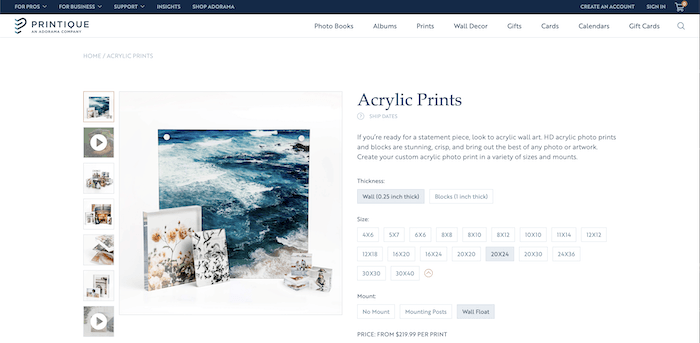
4. Printique
- Size choices: Wall panels and freestanding blocks; check the product builder
- Mounting options: No mount, easel, acrylic pedestal, metal posts or wall float, depending on size
Printique is worth considering for a small display or a gift. The important distinction is between its wall panels and blocks. Wall panels use quarter-inch acrylic with aluminum backing. One-inch blocks have high-gloss cardstock backing and are intended for a freestanding display.
Both are printed directly onto the back of the acrylic. They are not paper prints face-mounted onto Dibond. Choose the display type first, then check the sizes and mounts offered for it. If the chosen dimensions require a crop, review the preview before ordering.
Printique offers pickup in Brooklyn and at its parent company Adorama in Manhattan. Acrylic shipping is limited to the United States and Canada. Check this before spending time preparing an order for another country.
5. Bumblejax
- Custom sizes: Up to 96x48 inches in 1/4-inch increments, with limits by thickness
- Mounting options: Rear hanging hardware or no mount; options depend on thickness and size
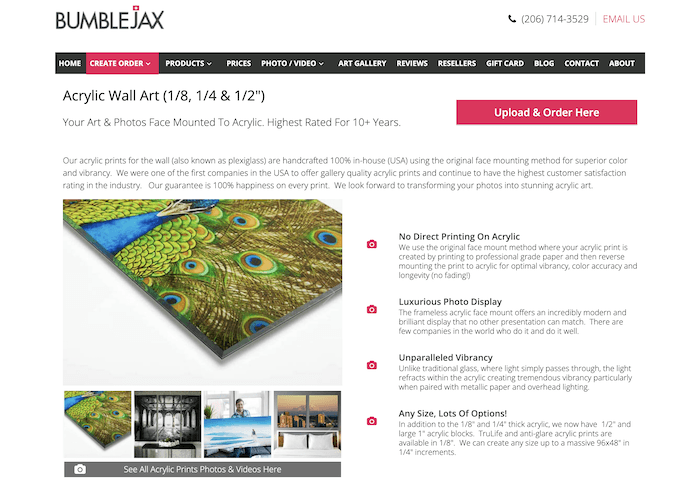
Bumblejax is our pick to consider for a client order where paper and surface choice matter. It face-mounts a photographic print to acrylic and backs it with Dibond. Gloss and metallic paper options let you choose the image's finish before adding the acrylic face.
Standard acrylic is available in 1/8, 1/4 and 1/2-inch thicknesses. The half-inch version stops at 40x30 inches. TruLife and the separate anti-glare option are limited to 1/8 inch, so a thicker panel is not automatically the right upgrade for a bright room.
Compare edge finishes and request a sample if you are unsure about the paper. Large or custom panels may need a separate freight quote. Confirm the complete specification and shipping cost before promising a client a delivery date.
6. BayPhoto
- Custom sizes: 4x4 to 43x96 inches
- Mounting options: French cleat, keyhole hanger, stainless posts or no hardware, depending on size and backing
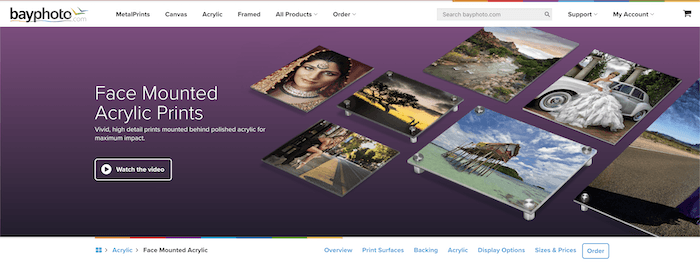
BayPhoto gives you several choices within one face-mounted acrylic product: Vivid or Metallic paper, glossy or non-glare acrylic, and Dibond or white paper backing. Acrylic thickness is 1/8 or 1/4 inch. It is a strong option when you already know the construction you want.
The backing matters. Dibond gives a more substantial panel, while the white paper version is a different build. Choose the backing before comparing the total with another lab.
Hanging options also depend on size: keyhole hangers serve small prints, while cleats are offered for larger ones. Stainless posts are another option. The page currently estimates production at eight or more business days, before delivery. Non-glare costs extra, so include it in the comparison if your room needs it.
7. CanvasChamp
- Custom sizes: Yes, alongside square, rectangular and panoramic presets
- Display options: Front or back mounting, with tabletop products also available
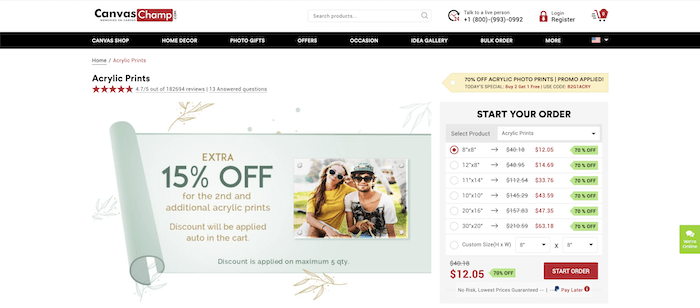
CanvasChamp remains our budget pick to compare for a home display. Its acrylic page offers custom dimensions, collages and split-panel layouts, so you can work with one photograph or a group.
The page advertises “Ships in 24 Hours.” That is a dispatch claim, not an arrival date. Check the delivery estimate for your address before choosing it for a deadline.
Compare the final total for your size, mount and delivery method. A large discount or a price-match headline does not establish which lab is cheapest for that complete order. If you need a particular thickness or non-glare surface, confirm the specification before uploading and paying.
8. CanvasDiscount
- Sizes: Preset formats from 8x8 to 30x40 inches
- Mounting options: Rear hanging system sold as an add-on
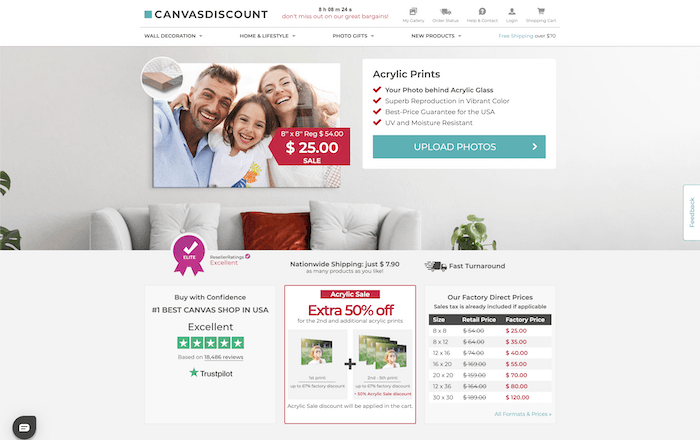
CanvasDiscount is another option to compare when the budget is tight. Its size range covers square, rectangular and panoramic prints, but stops at 30x40 inches. Check that limit before planning a larger installation.
The company describes its acrylic prints as photographs face-mounted behind glossy acrylic, with polished edges. This is a simpler product choice than a lab offering several papers, thicknesses and non-glare surfaces.
Add the rear hanging system if you need one; a frameless panel does not supply its own wall mount. CanvasDiscount describes the product as moisture resistant, but says to avoid constant direct water contact. If it is going in a kitchen or bathroom, keep it away from splashes and check the care instructions.
9. Shutterfly
- Sizes: Preset dimensions; availability depends on the design
- Mounting options: Metal posts on the checked acrylic wall-print product
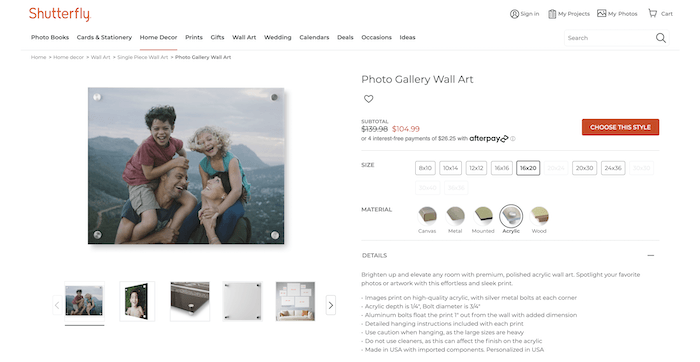
Shutterfly is worth a look when the layout is the main decision. Its acrylic range includes single-photo designs and templates for several photographs, with space for borders or text. You can arrange a family display without starting a design from scratch.
Check the individual product details after choosing the template. The checked wall-print listing specifies quarter-inch acrylic and aluminum bolts that hold it away from the wall. It also warns that large sizes are heavy. A product name alone is not enough to establish its frame or mounting construction.
For an existing Shutterfly user, choosing images may fit an established routine. Keep a full-resolution copy in your own photo storage before building the print, and check the crop for every photograph in a collage.
Acrylic Photo Print FAQs
Which Acrylic Print Service Is Cheapest?
Compare CanvasChamp and CanvasDiscount first, but use the same dimensions and include mounting, shipping and any required upgrades. A smaller starting size or a sale banner can make the wrong product look cheaper. There is no single lowest-cost lab for every configuration.
Do Acrylic Prints Arrive Ready to Hang?
It depends on the selected product and mount. WhiteWall includes a hanging system for its glossy product unless you opt out. CanvasDiscount sells one separately. Other labs offer several mounting choices. Check the order summary for the hardware you need and use fixings suitable for your wall and the finished weight.
What Resolution Do You Need for an Acrylic Print?
Use the lab's file requirements at the finished print size. Around 300 ppi is a good starting point for close viewing, while some larger prints can work at a lower resolution. For example, 16x20 inches at 300 ppi requires 4,800 x 6,000 pixels. Ask the lab to assess a borderline file before ordering a large panel.
Is a Face-Mounted or a Directly Printed Acrylic Better?
Face mounting puts a photographic paper print behind the acrylic. Some labs let you choose the paper. Direct printing applies ink to the panel. Neither description alone proves that a finished print will be better. Compare the complete product, including the surface, backing and a sample if available.
How Do You Clean an Acrylic Print Without Scratching It?
Follow the instructions supplied by your lab. Use a clean, soft microfiber cloth and light pressure. Some labs permit a damp cloth or mild soap; others warn against cleaners. Avoid abrasive materials and ammonia-based household sprays unless the lab specifically approves the product.
Conclusion
Pictorem remains our overall choice for custom dimensions and shapes. Compare CanvasChamp when budget comes first, and Bumblejax when you want paper and acrylic options for a client print. The best choice for your photograph still starts with the size, the room's reflections and the file you can supply.
Measure the space, choose the crop, then check your file at 300 dpi as an initial print-quality target. For the image file, that means 300 pixels per inch at the intended size; follow the lab's recommendation if it differs. Confirm the mount, final total and delivery estimate before placing the order.
For a large or important print, order a sample or a small proof before committing to the finished panel. It is easier to judge paper, glare and color from a physical example than from a product page.
Check out our Effortless Editing with Lightroom course to make sure every photo you print is worth displaying on your wall!