

Do you want to add an extra dimension or a unique style to your photos?
Consider using a texture app to take your images to the next level.
Here’s a list of the best apps available to add textures and transform your photos into something special.
Which one you want comes down to how you like to work. If you want to stack textures by hand and keep control of every layer, look at Mextures, Superimpose, or LD. If you want a finished look in two taps, PICFX, Afterlight, and Distressed FX get you there faster. And if you only ever want one specific effect, Grungetastic and TinType do their single job better than any all-rounder on this list.

1. LD by Lens Distortions
1. LD by Lens Distortions
| Platforms |
Platforms
iPhone, iPad, Android
|
| Price |
Price
Free download with an LD+ annual subscription
|
| Standout Feature |
Standout Feature
Over 400 light, fog and film overlays on stackable layers
|
| Best For |
Best For
Building a cinematic look layer by layer
|
LD is a layer-based editor that is all about stacking effects on top of each other. There are more than 400 overlays available, from light rays and fog to dust and film textures.
LD also includes a lot of tools to edit your photos. You can stack several color layers, each with its own adjustments.
There are also adjustment layers and an erase tool. So you can mask an effect off part of the frame, much like the blending modes you might know from Photoshop.
LD is free to download. The erase tool, most of that 400-overlay library, and TIFF export sit behind an LD+ subscription billed once a year. If you want to drop one texture on one photo, that is a lot of app to sign up for.
2. Distressed FX
Distressed FX is a texture app in the purest sense. Open a photo, pick a textured image to lay over it, and the app blends the two. Every texture in the library is the work of one artist, Cheryl Tarrant, so the looks hang together instead of reading like a grab bag of stock overlays.
It suits still life and landscape work best, where a scratched surface looks deliberate rather than like damage. The results sit closer to a painted image than to a filter. Portraits are harder, but the app has touch masking and portrait depth masking. You can pull the texture back off a face and leave it on the sky behind.
Because it only does one thing, it is fast. There is no layer stack to manage and no tonal range controls to get lost in. Pick a texture, set the strength, save.
The base app is free, and the wider library ships as Distressed FX Plus, a separate one-time purchase. The trade-off is range. If you want light leaks, grain, and film frames as well as painted texture, Mextures or Afterlight will serve you better.
3. Snapseed
Snapseed is not only one of the best editing apps, but it’s also a great texture app. Google rebuilt the app, and its film effects are now the star. The Film tool simulates classic film stocks, complete with authentic texture.
Snapseed offers you a range of film looks, and you can also adjust the strength of each effect.
The Grain and Halation tools make it easy to finish the look. Grain adds analog texture, while Halation gives your highlights the soft glow of old film.
Once you select an effect you like, adjust all the settings until it looks perfect.
Snapseed is free outright. No subscription, no in-app purchases, no ads, and no watermark on the file you export, which is rare for an editor this capable. The limit is breadth. It gives you grain and halation, not a library of painted textures to lay over a photo.
4. Filterloop
If you like full control over the textures you add, then Filterloop is the texture app for you. You’ll be able to build hundreds of personalised looks.
Combine overlays and textures to create your unique filter. Light leaks, film grain, scratches, or glitch textures, it’s all there.
With Filterloop, you can also give your photos a vintage touch. Each effect is adjustable, so you have the freedom to create your personal effects. Some of the light leaks and textures are free forever.
Everything else needs Filterloop Pro, sold as a weekly or a yearly subscription. Watch the free trial, because it turns into the weekly plan on its own unless you cancel first. The app has also been sitting on the same build since January 2025, so treat the free textures as the reason to install it and the Pro tier as optional.
5. Mextures
Mextures has more than 150 textures that can be combined and tweaked. You can use premade textures or create your own and save them in so-called ‘formulas’.
Mextures also has a few standard editing tools and filters. You can adjust exposure, contrast, tint, and color temperature to get the result you want. Don’t worry about your original photos because Mextures uses layers and is non-destructive.
For stacking textures by hand, this is still the best app on the list as far as I’m concerned. Nothing else here gives you 12 blending modes and a layer stack you can go back and re-edit 30 steps later, which is how you settle into your own editing style instead of borrowing somebody else’s preset.
Mextures is a one-time purchase, which is fair for what it does. Be aware that the last update landed in February 2023 and its App Store rating has slipped to 3.4 stars across 263 reviews, mostly from people hitting bugs on newer iPhones. It still works, but it is no longer the safe default it once was.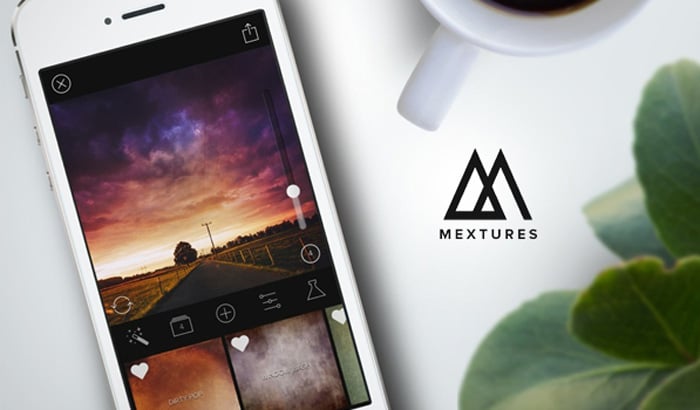
6. PICFX
PICFX has been rebuilt, and what is on the store now is a film-texture app rather than the square-crop filter app it started life as. Its 150-odd filters, frames, and overlays are scanned off real 35mm negatives instead of being simulated digitally.
The texture side is why it earns a place here. You get dust and grain lifted from real film, light leaks, bokeh, VHS static captured from a tape playing on a CRT, and photo-negative frames and borders to lay around the edge of the shot. Stack as many as you like on one image, and use the toy-lens, old-lens, and grunge-adjacent FX to rough the picture up further.
Its free Modern set is tuned for cityscape and street work, while the Vintage set fades tones the way expired film does.
Underneath sit ordinary editing tools for exposure, contrast, saturation, sharpening, highlights, and shadows. A long press compares your edit against the original, the app reuses your last settings so a set of photos gets a matching look quickly, and exports keep full resolution at the aspect ratios posts, stories, and reels actually use.
PICFX is free and ad-free, and four filter sets stay free permanently. The rest is PICFX Pro, offered either as a one-time unlock or as a subscription. One thing to watch: the current build wants a very recent version of iOS, so an older iPhone will be held back on the previous release.
7. Grungetastic
Grungetastic is a bit different from the other texture apps here. It features the ever-popular grunge look, with textures that rip, scratch, and splatter your photo.
The standard presets can be easily adjusted to your style. You can add borders, cuts, and rips by drawing around your subject.
Combine its texture and border libraries for unlimited possibilities. It supports full-size images, so you can save your creations at high resolution and share the result with friends.
Grungetastic comes with seven grunge styles: Classic, Bleached, Pop Grunge, Pop Worn, Worn, Gritty, and Distressed.
There is also a randomize button. It throws a new mix of texture, border, and color at your photo until something sticks.
Grungetastic is a one-time purchase and it commits to a single look. If grunge is the look you want, that is a fair trade and the app is still getting maintenance updates. If you want a general-purpose texture app, buy Mextures instead.
8. TinType
Looking for a texture app specifically for portrait photos? TinType might be the one. Here’s how it works. The app detects eyes in a photo. It then applies a blur and texture to the photo, excluding the eyes.
TinType allows you to simulate beautiful vintage portraits. The result looks like tintypes and daguerreotypes.
It’s easy to use, and you have full control over the amount of blur and colors.
You get four plate finishes, classic black and white, hand-painted color, high-contrast dark black and white, and a sepia-stained ambrotype. Sliders control eye intensity, plate grain, and depth of field, and the edit is non-destructive, so your original file is always there to go back to.
TinType is free to download and does one very good trick. Its developer, Hipstamatic, includes unlimited use in its Hipstamatic Camera Club membership and also sells a one-time Unlimited upgrade.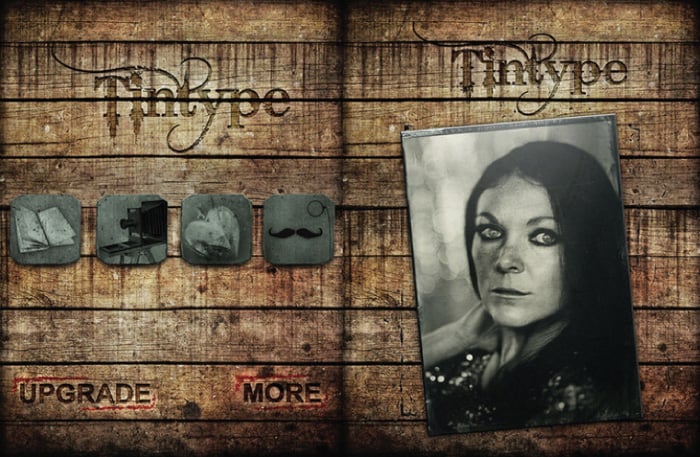
9. Superimpose
If you want to go all the way with textures, Superimpose is the app for you. With Superimpose, you can build your own textures and apply them to images.
Try using your own photos of textures you find in your surroundings: rocky patterns, asphalt, paper, leaves, or wood grains. Even rusty metal or just good old dirt will give your photos an exciting look.
Use Superimpose to stack your own custom textures on top of the image and use a mask to apply the texture only to a specific area of a photo. Brush-based masking, per-layer opacity, and blend modes give you the double-exposure and blending control the one-tap apps on this list cannot.
Superimpose is free now, and recent versions have added AI tools for generating images and swapping backgrounds. That breadth cuts both ways. It is a general compositing app rather than a texture app, so it ships with no texture library at all. You supply the textures, which is why it suits people who already shoot their own and not people who want a library out of the box.
10. Afterlight
Afterlight is an excellent photo editing app. The simple layout has clear icons that make it easy to navigate, and it strikes a good balance between simple and advanced photo editing apps. The app dropped the 2 from its name some years back, so search the store for Afterlight and you will land on the current version.
Not only that, but it’s also a great texture app. There are over 100 overlay textures in it, and they are the genuine article rather than digital fakes: light leaks made with real 35mm film, natural dust, vintage paper, and VHS effects.
Alongside those sit more than 300 film-inspired presets emulating stocks like Kodak Gold and Portra, plus effects that behave like film does. Halation puts a warm glow around your highlights, Chroma adds chromatic aberration, and Color Shift moves the RGB channels apart. Grain, Structure, Glow, and Curves are all there to finish on.
Afterlight is free to download and the developer states plainly that it collects no user data. The catch is that it is a film-look app first and a texture app second, so its overlays are dust, leaks, and paper rather than the painted surfaces Distressed FX or Mextures give you. If you want great editing tools and textures in one app, though, this is the one.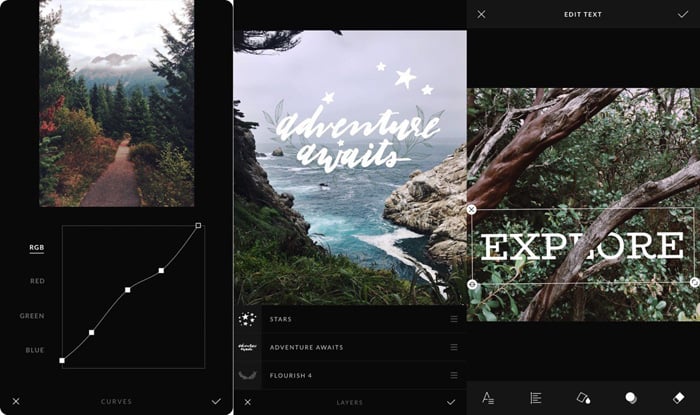
Frequently Asked Questions
What is the best free texture app?
Snapseed. It is free with no subscription, no in-app purchases, no ads, and no watermark, and its Film, Grain, and Halation tools cover the looks most people are after. PICFX and Afterlight are the next best free options, and both keep a set of textures free permanently while charging for the rest.
Which texture apps work on Android?
Five of the ten on this list. LD, Snapseed, PICFX, Superimpose, and Afterlight all ship a current Google Play build. Distressed FX, Filterloop, Mextures, Grungetastic, and TinType are iPhone and iPad only.
What is the difference between a texture app and a filter app?
A filter remaps the colors and tones already in your picture. A texture lays a second image over the top, so scratches, dust, light leaks, torn paper, or grain become part of the frame. Most of the apps here do both, but Distressed FX, Mextures, and Grungetastic are texture-first, while Snapseed and Afterlight lean toward film-look filtering with textures added on.
Do I need to shoot in a particular way for textures to work?
No, but low-contrast frames with some empty space take texture best. A busy photo fights the overlay. It is also worth keeping the effect subtle enough that composition still carries the image, because a heavy texture on a weak frame just looks like a heavy texture.
Conclusion
If you only download one, make it Snapseed. It costs nothing, it has no catch, and its Film, Grain, and Halation tools already cover most of what people mean by texture. Add Distressed FX when you want a painted surface over a still life or a landscape, and buy Mextures when you want to build a look layer by layer and save it as a formula you can reuse.
Past that, choose on the genre of photography you shoot and on how much control you want. Some of these apps offer one-click presets, while others let you customize everything fully.
And as always with filter or texture apps: Don’t overdo it, too many filters will make your photos look fake and ugly.
You can personalize your images to create a unique look but don’t forget about composition and content. That’s what photography is about. Now, start creating images!
